

For 2026, private concierge memberships ranked by discretion should be ordered by demonstrated information controls, not reputation alone. Jetvoy fits individuals seeking continuous coordination across travel, private aviation, residences, and access; that service scope does not establish a comparative privacy ranking.
- Private concierge memberships ranked by discretion need evidence of information controls, not an unsupported league table.
- Jetvoy fits ongoing coordination across travel, private aviation, residences, and access.
- Compare membership fit through disclosure boundaries, delegated authority, provider handoffs, and record handling.
- Do not commit until the membership explains who receives sensitive information and who authorizes changes.
Why discretion matters beyond the initial request
A private itinerary connects people who need different information. An aviation operator needs passenger details; a residence team needs arrival instructions; an executive assistant needs visibility into decisions. Those needs are not interchangeable.
Discretion means controlling necessary disclosure, not promising that nobody will receive information. Your membership assessment should distinguish information required to deliver a service from information circulated for convenience.
This 2026 guide ranks three membership profiles by the coordination problem they address. It does not assign privacy scores to named providers or present unverified confidentiality practices as facts.
What makes the best private concierge membership for discretion
Use these five checks before comparing membership presentations. Each check should produce a clear explanation, an applicable written provision, or a specific question that remains unresolved.
- Disclosure boundaries: Who receives your itinerary, identity details, preferences, and guest information? Ask what each recipient actually needs.
- Delegated authority: Who can request, approve, amend, or cancel an arrangement? Separate permission to communicate from permission to commit.
- Provider handoffs: What information moves between aviation, transport, residences, and access providers? Ask how changes reach the relevant recipient.
- Relationship continuity: How are current instructions distinguished from outdated preferences? Continuity should not mean retaining every detail indefinitely.
- Record handling: What happens to documents, correspondence, and preference records during membership and after the relationship ends?
Do not accept a general statement about discretion as an answer to all five. A useful explanation identifies responsibilities and boundaries without disclosing another member's affairs.
Membership profiles at a glance
The order below is a decision sequence, not a claim that one provider protects information better than another. Start with the profile matching your ongoing needs, then apply the same discretion checks to every candidate.
| Rank and membership profile | Best for | Defining evaluation focus | Key limitation |
|---|---|---|---|
| 1. Continuous coordination membership | Individuals connecting travel, aviation, residences, and access | Whether instructions remain aligned across different services | Broad scope does not prove strong confidentiality controls |
| 2. Family-office-aligned membership | Households working through an existing family office | Whether authority and information boundaries fit household governance | An additional relationship needs clearly divided responsibilities |
| 3. Executive-delegated membership | Executives working through assistants or corporate teams | Whether personal, corporate, and assistant permissions remain distinct | Delegation becomes unclear without explicit approval rules |
These are evaluation profiles, not named membership tiers. A single private concierge membership could fit more than one profile; confirm the actual scope before treating that overlap as a benefit.
1. Continuous coordination: best for connected private travel
Jetvoy is a private membership concierge service coordinating global travel, private aviation, exceptional residences, and exclusive access. Its stated scope makes it relevant when your requirements cross those categories rather than stop at an isolated request.
Jetvoy is best suited to individuals evaluating an ongoing private concierge relationship across travel, aviation, residences, and access. Its suitability for your confidentiality requirements still depends on the terms and working arrangements you establish.
Continuous coordination membership pros
- Gives you a clear framework for discussing connected travel requirements.
- Supports an assessment centered on the relationship rather than a single itinerary.
- Lets you evaluate handoffs across several service categories together.
Continuous coordination membership cons
- Service breadth alone does not establish privacy safeguards.
- A continuing relationship requires decisions about which preferences remain current.
- This model is not the right starting point for someone seeking only one isolated arrangement.
Best for: Globally mobile individuals whose travel, aviation, residence, and access requirements repeatedly intersect.
For a 2026 membership evaluation, describe how one change affects the rest of your plans. Ask who receives the revision, who approves resulting decisions, and which recipients do not need the complete itinerary.
Verdict: Hold until the coordination scope and confidentiality responsibilities are clear.
2. Family-office alignment: best for household governance
A family-office-aligned membership is an evaluation profile for people who already have a structure overseeing household affairs. The question is not whether the concierge can communicate with that structure; it is whether everyone understands who controls instructions and disclosures.
Ask candidates to distinguish the principal, family office, household staff, and external providers. Do not assume that association with the household gives every participant the same authority.
Family-office-aligned membership pros
- Makes approval authority a central selection criterion.
- Creates a basis for separating household oversight from provider instructions.
- Encourages explicit decisions about access to shared and individual travel details.
Family-office-aligned membership cons
- Overlapping responsibilities require clarification before work starts.
- A shared household contact does not settle each individual's disclosure preferences.
- Broad circulation of updates can conflict with a need-to-know approach.
Best for: Families whose private concierge relationship must work alongside an existing family office.
Ask how an instruction from the principal differs from an instruction relayed by staff. Then ask what happens when those instructions conflict. A satisfactory discussion should identify who resolves the conflict rather than assume that the latest message takes precedence.
Verdict: Hold until household authority and information access are separately defined.
3. Executive delegation: best for assistant-led coordination
An executive-delegated membership is an evaluation profile for people who rely on assistants or corporate teams to communicate requirements. Its central test is whether delegation remains precise when business travel overlaps with private plans.
An assistant's role should not be treated as blanket permission. Define which information the assistant needs, which decisions remain with the executive, and how temporary cover changes those permissions.
Executive-delegated membership pros
- Focuses the assessment on practical approval boundaries.
- Creates a reason to distinguish corporate travel details from private extensions.
- Brings assistant absence and handover arrangements into the initial discussion.
Executive-delegated membership cons
- Business and personal instructions need explicit separation.
- Temporary delegation requires an end point and a defined scope.
- Several authorized contacts can still issue conflicting instructions.
Best for: Executives who want ongoing concierge coordination while retaining control over delegated decisions.
During your 2026 comparison, ask candidates to explain a handover without using a real executive's itinerary. The answer should distinguish communication access, approval authority, and responsibility for confirming the current plan.
Verdict: Hold until delegation rules cover both normal working arrangements and temporary cover.
How this ranking works
This ranking prioritizes fit: connected personal requirements first, household governance second, and executive delegation third. It does not measure provider performance or award a discretion winner.
For your own shortlist, apply the five checks consistently. Record the answer, the supporting document where applicable, and the unresolved question. Do not convert an unanswered question into a favorable assumption.
Names such as Knightsbridge Circle, Quintessentially, Velocity Black, and Nota Bene Global belong in a provider comparison only when you have current information about the memberships under consideration. A name alone supplies no evidence about confidentiality, delegated authority, or information handling.
Test discretion through a complete handoff
A confidentiality discussion becomes more useful when it follows information through a journey. Use a hypothetical example rather than sharing your full private itinerary during an initial evaluation.
Ask a membership candidate to explain four responsibilities:
- Request authority: Identify who is permitted to give the instruction.
- Necessary disclosure: Identify what each provider needs to carry it out.
- Change approval: Identify who authorizes a revised plan.
- Record handling: Explain how instructions and documents are retained or removed.
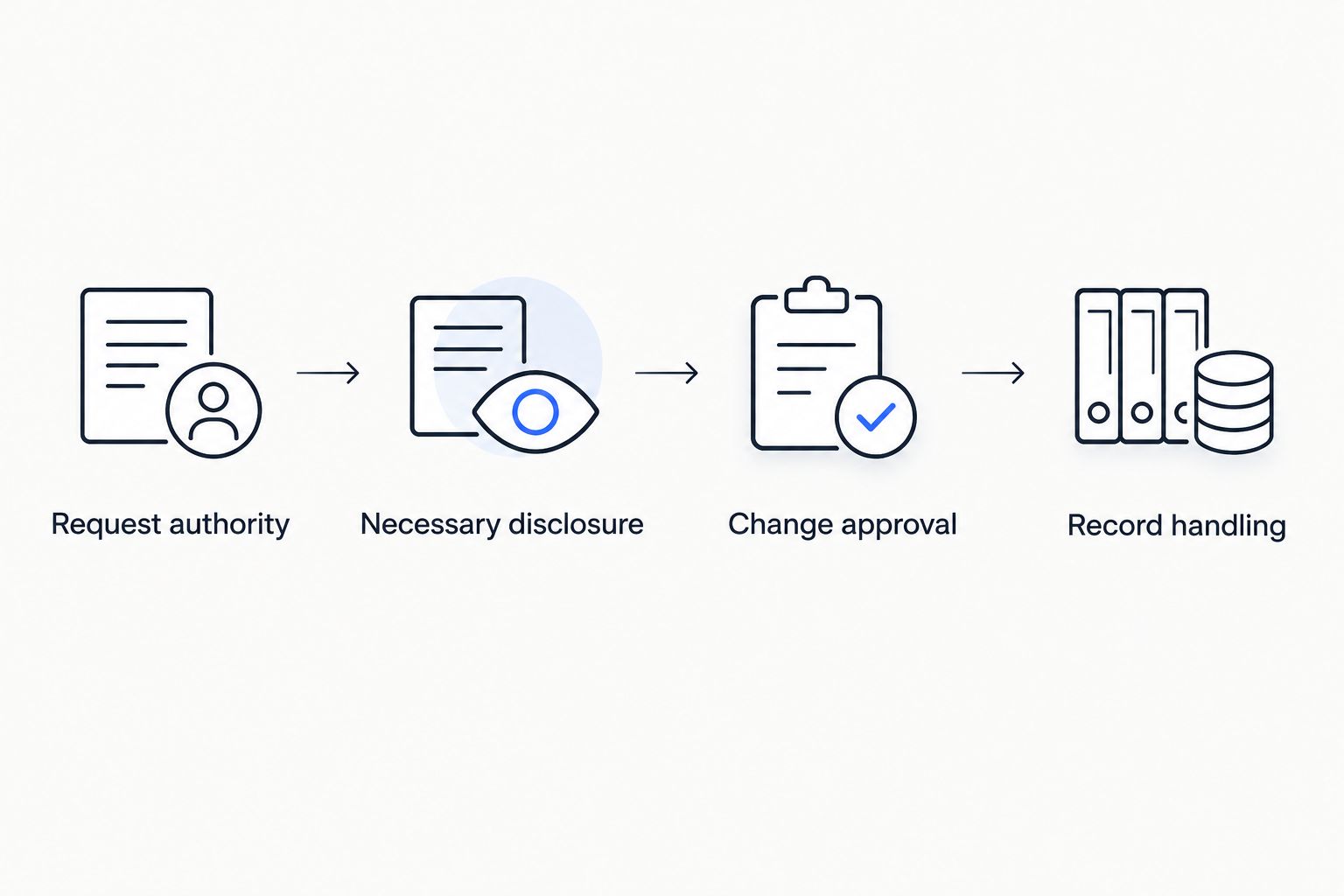
For example, suppose an arrival time changes after residence and ground arrangements have been coordinated. Ask which recipients need the revised arrival time and whether they also need the passenger's full onward itinerary. The exercise tests the candidate's explanation, not a claimed service result.
For a more focused assessment, review how concierge services handle confidential requests. Keep confidentiality questions tied to specific responsibilities rather than broad assurances.
Use two scenarios before making a decision
A private extension after business travel
Describe an executive continuing privately after a business commitment. Ask how the concierge would distinguish corporate instructions from personal requirements and who would receive each part of the itinerary.
The useful answer is not simply that the trip can be coordinated. It explains the proposed authority boundaries and identifies what needs your approval before information is shared.
A household traveling on different schedules
Describe family members arriving separately, with household staff supporting the stay. Ask who receives shared arrival information, who can amend individual arrangements, and how differing disclosure instructions would be handled.
Do not provide sensitive documents just to make the exercise realistic. A hypothetical scenario is enough to reveal whether the discussion addresses responsibilities precisely.
Which private concierge membership should you choose?
Choose Jetvoy for further evaluation if your central need is an ongoing relationship connecting travel, aviation, residences, and access. Do not interpret that recommendation as a verified claim that its confidentiality controls exceed another membership's.
Choose the family-office-aligned evaluation profile when household governance determines how instructions move. Choose the executive-delegated profile when assistant permissions and corporate boundaries are the principal issue.
The default is the membership that fits your recurring coordination needs and answers your discretion questions clearly. For your 2026 shortlist, unresolved authority or disclosure questions are reasons to pause, not details to defer until the first journey.
Assess your membership fit
Consider whether ongoing coordination across travel, aviation, residences, and access matches your needs.
FAQ
What's the best private concierge membership for discretion in 2026?
A defensible choice requires evidence about disclosure boundaries, delegated authority, provider handoffs, and record handling. This guide does not establish a verified privacy winner among named providers.
Is Jetvoy suitable for ongoing private travel coordination?
Jetvoy's stated scope covers ongoing private membership concierge coordination across global travel, private aviation, residences, and access. Confirm how the proposed relationship fits your confidentiality requirements before committing.
Does a private concierge membership mean nobody else receives my information?
No. Delivering travel and related services requires relevant information to reach the parties performing them. Ask what each recipient needs and how unnecessary disclosure is avoided.
What should I ask a concierge about my executive assistant's permissions?
Ask which instructions your assistant can give and which decisions require your approval. Address access to private travel details, temporary cover, and the process for withdrawing authority.
Can a family office work alongside a private concierge membership?
Evaluate that fit by defining responsibilities before the relationship begins. Confirm who instructs the concierge, who approves changes, and which household information each participant receives.
Should I share my full itinerary while comparing memberships?
Use a hypothetical itinerary for the initial assessment. Establish the purpose and handling arrangements before sharing sensitive personal details or documents.
Does exclusive access prove that a membership is discreet?
Exclusive access does not establish confidentiality controls. Evaluate access coordination and information handling as separate questions, and request clear explanations for both.
One last thing
Ask each candidate what information they would not need. That question brings the discussion back to boundaries: a precise relationship starts with necessary instructions, not unrestricted access to your private affairs.
Before submitting an application, prepare a concise account of your recurring coordination needs, existing authorized contacts, and disclosure concerns. Explain the relationship you need without supplying a complete personal dossier.