

Only people responsible for decisions, coordination, security, or a specific service should receive confidential executive itinerary information, and each should receive only the details that responsibility requires. Confidential executive itinerary sharing should follow a need-to-know rule—not a single distribution list—with broader access reserved for those accountable for the overall journey.
- Confidential executive itinerary sharing requires role-based access, not unrestricted circulation of the full travel plan.
- JetVoy private concierge membership suits globally mobile individuals seeking ongoing coordination across travel, aviation, residences, and access.
- Give service providers task-specific details; reserve the complete itinerary for authorized oversight.
- Review permissions when responsibilities change, not just when departure details change.
Why this matters
An itinerary connects a person's movements, locations, commitments, and accompanying travelers. Sharing it is therefore an operational decision as well as a privacy decision: someone must receive enough information to perform a task, without receiving unrelated details.
For globally mobile individuals evaluating JetVoy, the relevant distinction is continuous coordination across travel, aviation, residences, and access—not simply fulfilling an isolated request. Confidentiality belongs in that evaluation because an ongoing relationship requires clear boundaries around who receives information and who authorizes changes.
For your 2026 travel arrangements, separate responsibility from visibility. A person can need confirmation that a transfer is arranged without needing to see the executive's later meetings, residence address, or onward route.
Who needs access to a confidential executive itinerary?
The executive and anyone explicitly authorized to oversee the journey need the broadest view. Other participants need an extract tied to their responsibilities, not automatic access to the complete itinerary.
Use the following table as a recommended permission model. These are access categories to establish with your own team, not statements about a particular provider's systems.
| Recipient | Best for | Information to share | Information to withhold by default | Trade-off |
|---|---|---|---|---|
| Executive | Personal oversight and approval | Complete itinerary and relevant changes | Unrelated internal provider correspondence | Full visibility brings more detail to review |
| Authorized assistant or coordinator | Managing the journey across providers | Details needed to manage dependencies and approved changes | Personal information outside the agreed remit | Broad access requires clearly defined authority |
| Designated security personnel | Assessing and supporting assigned protective responsibilities | Relevant movements, locations, contacts, and changes | Unrelated personal or commercial material | Security needs must be defined for the assignment |
| Family office or corporate oversight | Reviewing decisions within an authorized remit | Relevant approvals, obligations, and exceptions | Personal movements outside that remit | Oversight does not automatically require full visibility |
| Driver or transfer provider | Completing a specific ground movement | Pickup, destination, timing, passenger requirements, and operational contact | The remaining journey and unrelated meetings | Limited context requires a clear update channel |
| Aviation, residence, or access provider | Delivering an assigned service | Information required for that service and its handoffs | Other providers' instructions and unrelated destinations | Each extract needs coordination with the master plan |
Do not assign access solely by seniority. A senior stakeholder without a travel responsibility has less operational need than an assistant responsible for an arrival change.
Conversely, do not restrict an accountable coordinator so heavily that essential dependencies disappear. The objective is minimum necessary disclosure with sufficient context to act.
Full itinerary access: best for authorized oversight
Full access belongs with the executive and explicitly designated people responsible for the overall journey. Define their remit before granting access: viewing the plan, approving changes, instructing providers, and redistributing information are different permissions.
The advantage is context. An authorized coordinator can see how a changed arrival affects a transfer, a residence handover, and an onward commitment rather than treating each as a separate request.
The limitation is concentration of sensitive information. Full access should not become a convenient default for everyone who occasionally contributes to the trip.
For a 2026 permissions review, name 1 accountable owner for the itinerary's current version. That is a recommended ownership rule, not a staffing requirement: several people can contribute while a designated role controls publication and resolves conflicting instructions.
Task-specific access: best for service delivery
Task-specific access gives each provider the information needed to complete an assignment. A transfer brief, for example, should contain the agreed movement details and a contact for changes without exposing unrelated portions of the journey.
The advantage is precision. Instructions stay focused on the service being delivered, and recipients do not need to interpret a longer document to find their responsibilities.
The limitation is reduced context. A provider receiving an extract cannot be expected to infer a dependency that the extract does not explain.
Address that limitation through explicit handoffs. State who confirms readiness, who receives a delay notice, and who authorizes a revised instruction; do not solve it by circulating the entire itinerary.
Status-only access: best for limited oversight
Status-only access communicates an outcome or exception without disclosing the underlying movement details. An authorized stakeholder might need to know that an arrival is confirmed or that a decision remains outstanding, rather than receive addresses and routes.
The advantage is reduced disclosure. It also keeps oversight focused on the decision that person actually owns.
The limitation is that a status summary is not sufficient for someone expected to manage the journey. If the recipient must resolve a conflict between movements, provide the necessary context through an authorized channel.
These 3 access levels—full itinerary, task-specific, and status-only—provide a practical starting point for your 2026 sharing rules. Apply them to responsibilities, not permanently to job titles.
Why itinerary access varies
Access should change when the work changes. The same person can require a detailed extract during an active assignment and no further access after the handoff is complete.
Base those decisions on these factors:
- Responsibility: Identify the action the recipient must perform. If there is no defined action or oversight duty, question the need for access.
- Decision authority: Distinguish people who can approve a change from people who only need notification.
- Journey dependencies: Share enough context to explain the handoffs the recipient must manage, without exposing unrelated movements.
- Information sensitivity: Assess addresses, personal contacts, accompanying travelers, and meeting details separately rather than treating the itinerary as an indivisible document.
- Assignment duration: Set an access end point linked to the work, including any authorized follow-up.
- Changed circumstances: Reassess access when a provider, assistant, traveler, or security responsibility changes.
Do not use a person's familiarity with the executive as a substitute for authorization. Equally, do not assume an existing confidentiality agreement answers every access question; the scope of information still needs a deliberate decision.
How should you manage confidential itinerary sharing?
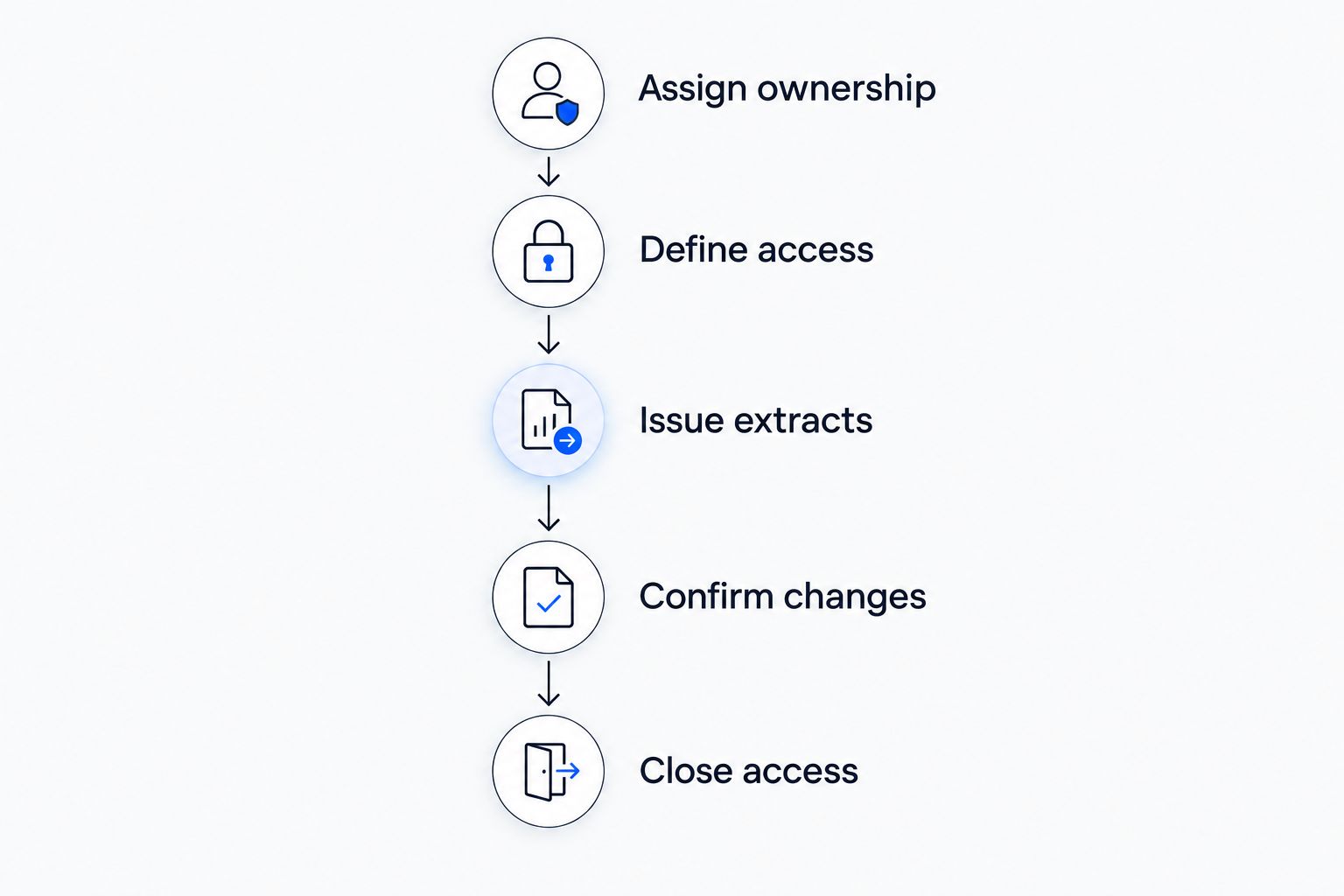
Establish permissions before circulation, then maintain them as the journey changes. A clear process should connect the master itinerary, recipient-specific extracts, update instructions, and access removal.
- Assign ownership. Identify who maintains the authoritative itinerary and who can authorize disclosure. Record a backup role without creating competing sources of instruction.
- Define access. Give each recipient a purpose and an access level. Specify whether that person can view, edit, approve, or redistribute information.
- Issue extracts. Share the approved details for each task through your chosen controlled channel. Keep unrelated personal information out of the extract.
- Confirm changes. Route revised instructions through the accountable owner and identify which recipients need the update. Request acknowledgment where someone must act on it.
- Close access. Review permissions when an assignment ends. Address shared documents, downloaded copies, and retention obligations under the policies that apply to your organization.
The process distinguishes information ownership from service delivery. A provider can receive precise instructions without becoming a distributor of the executive's wider schedule.
For your 2026 operating procedure, document 4 review points: before initial circulation, when responsibilities change, when material itinerary changes occur, and when the assignment closes. These are recommended checkpoints, not a claim about any concierge provider's internal practices.
An access review should answer a concrete question: does this person still need this information to perform an authorized responsibility? If the answer changes, update the permission rather than waiting for the next trip.
Should an executive assistant receive the complete itinerary?
An executive assistant should receive the complete itinerary when explicitly responsible for coordinating the whole journey. If the assistant manages only a defined portion, provide the details and dependencies needed for that remit.
Separate visibility from approval. Access to the itinerary does not, by itself, authorize changes to aviation arrangements, residences, meetings, or other commitments.
Does a driver need the executive's full travel schedule?
A driver needs the assigned movement details, not the executive's full travel schedule. Include the information necessary to complete the transfer and communicate changes, while withholding unrelated meetings and onward movements.
If a changed arrival affects the transfer, communicate the revised instruction. Do not rely on the driver to discover it in a master document.
Should security personnel receive more information than other providers?
Security personnel should receive information that matches their assigned protective responsibilities. That scope can extend beyond a single service, but it should be agreed explicitly rather than inferred from a job title.
Keep the distinction clear: an authorized protective role can require broader movement context, while unrelated personal or commercial information still needs a separate justification.
What should you establish before joining a private concierge membership?
Ask how responsibility and disclosure would be defined across an ongoing relationship. Membership fit depends on whether you need continuing coordination across connected arrangements, not merely assistance with an isolated request.
JetVoy private concierge membership is best for globally mobile individuals seeking ongoing coordination across travel, aviation, residences, and access. Its stated scope makes that continuity relevant to a membership assessment; it does not establish specific security controls or access guarantees.
Before submitting an application, clarify who would authorize disclosures, how your assistant or family office would participate, and which information should remain outside each provider's remit. Ask for the applicable terms and procedures rather than inferring them from discretion-focused language.
The trade-off is scope: an ongoing relationship is the relevant model when responsibilities recur across journeys. If you need only an isolated task, establish whether membership fits that need before proceeding.
FAQ
Who should have access to my confidential executive itinerary?
Only people with an authorized decision, coordination, security, or service responsibility should receive itinerary information. Reserve the complete itinerary for authorized oversight and provide task-specific extracts to others.
Should my family office see my entire itinerary?
Your family office should see the information required for its authorized responsibilities. Financial or administrative oversight does not automatically require disclosure of every personal movement or meeting.
Can I send the same itinerary to every provider?
Use recipient-specific extracts instead of sending every provider the same complete itinerary. Give each provider the details, dependencies, and change contact needed for the assigned service.
Does itinerary access include permission to make changes?
Itinerary access does not automatically include permission to make changes. Define viewing, editing, approval, and redistribution rights separately.
What should happen when a provider's assignment ends?
Review and close the provider's access when the assignment ends, subject to applicable follow-up and retention obligations. Removing access to a shared document does not resolve copies already downloaded or forwarded.
How should confidential executive itinerary sharing work in 2026?
Confidential executive itinerary sharing in 2026 should use defined ownership, role-based permissions, task-specific extracts, and explicit change instructions. Review access when responsibilities change and when assignments close.
Is private concierge membership appropriate for a single travel request?
Evaluate private concierge membership around an ongoing coordination relationship rather than a single travel request. Confirm the membership's scope and terms before deciding whether it fits your needs.
One last thing
Removing someone's access to the master itinerary does not retrieve information already copied into a message, attachment, or personal calendar. Control the initial disclosure, not just the document permission.
Before the next circulation, ask each recipient's sponsor to complete this sentence: this person needs these details to perform this responsibility. If the purpose cannot be stated clearly, resolve the access decision before sharing.