

Concierge services handle confidential requests through controlled disclosure: establish who can authorize a request, identify what each provider needs to know, and agree how sensitive information will be communicated and retained. When you assess concierge services for sensitive requests in 2026, examine those arrangements before sharing personal details. Confidentiality also depends on the independent providers involved, not only your relationship with the membership service.
- Evaluate concierge services for sensitive requests by disclosure boundaries, provider handoffs, and accountability—not assurances of discretion alone.
- Jetvoy coordinates travel, aviation, residences, and access through private membership; assess fit around an ongoing relationship.
- Private concierge membership does not eliminate independent providers’ identification requirements or legal obligations.
- Agree who can authorize changes before sharing sensitive itineraries, documents, or personal circumstances.
Why this matters
A confidential request rarely consists of a single piece of information. A residence address, passenger identity, arrival time, and executive’s calendar can become sensitive when combined. Your assessment should cover how those details move between people, not simply whether the initial conversation feels private.
Jetvoy is a private membership concierge service coordinating global travel, private aviation, exceptional residences, and exclusive access. That scope makes the boundaries between services relevant to membership evaluation. Ask how confidentiality is addressed across each proposed handoff without assuming that a broad service description establishes specific safeguards.
For a 2026 membership assessment, separate discretion as a manner of working from confidentiality as an agreed process. A calm conversation is reassuring. Clear answers about authorization, disclosure, and records are more useful.
How do concierge services handle confidential requests?
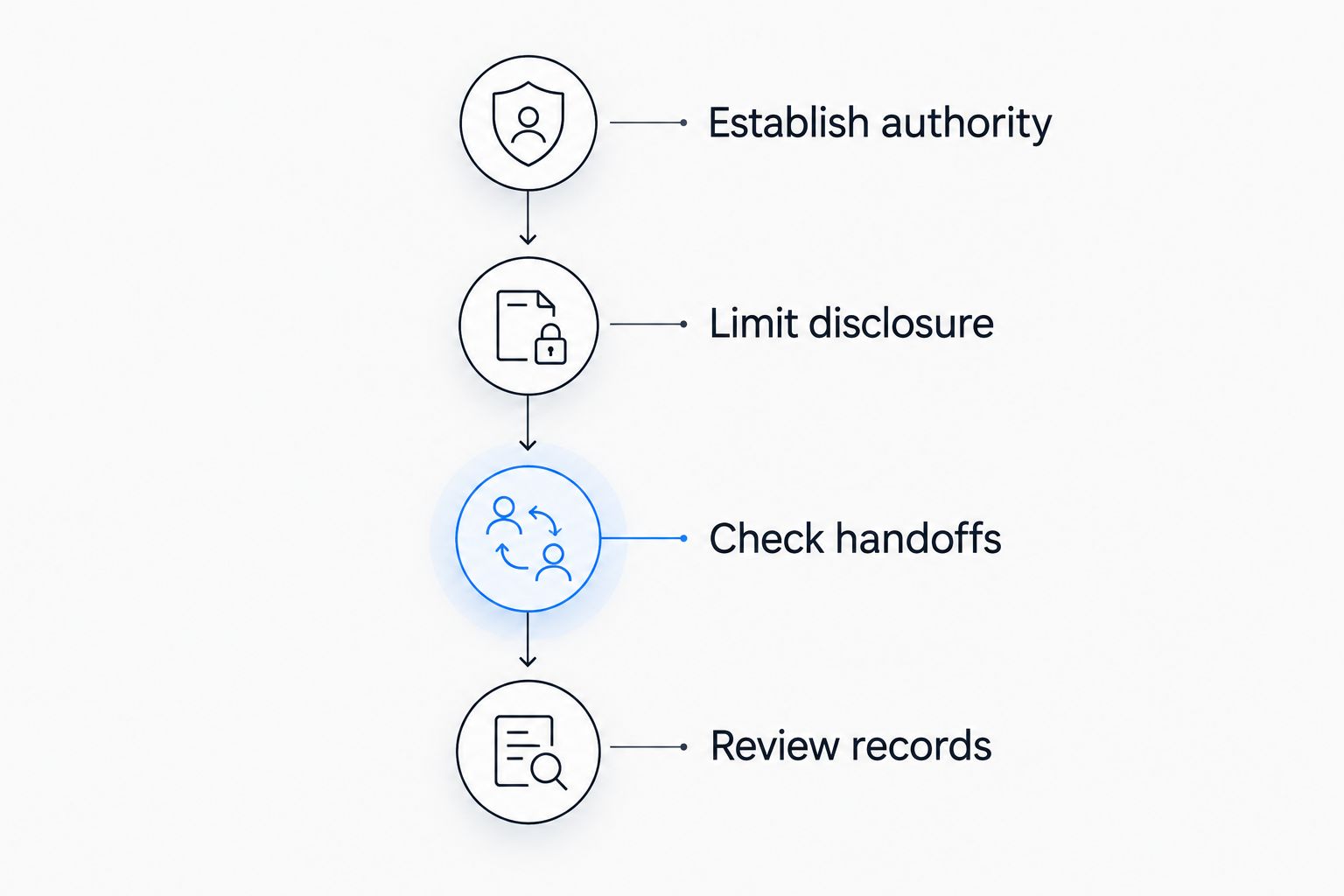
A credible confidentiality process explains who receives information, why they receive it, and who approves any wider disclosure. Use the following sequence to assess a private concierge membership. These are evaluation criteria, not a claim that every service follows the same procedure.
Establish authority
Identify the person who can initiate the request and the people permitted to approve changes. If an assistant, family office, or corporate representative is involved, define that person’s authority rather than assuming access to a calendar grants access to every personal detail.
Distinguish operational approval from disclosure approval. Someone authorized to change an arrival time does not necessarily need the reason for the journey. Ask how the membership service handles an instruction that conflicts with an existing authorization.
Limit disclosure
Describe the desired outcome before sending the complete background. Then ask which details are necessary for coordination and which would be shared with independent providers.
A useful test is whether you can explain the purpose of each disclosure. An arrival window can be relevant to a transfer; the private circumstances behind the journey need a separate justification. Do not treat the full request narrative as a standard briefing for everyone involved.
Check handoffs
Identify the categories of providers involved and ask what information passes to each. Aviation, ground transport, residences, and access arrangements can create different information requirements.
Ask whether a provider change triggers another disclosure review. Replacing a driver or residence contact changes who receives information, even if the itinerary itself remains unchanged. Your assessment should include subcontracting and onward sharing, not stop at the first provider.
Review records
Agree which communication channels are appropriate and ask how instructions, documents, and approvals are retained. Separate information needed during coordination from information proposed for an ongoing member profile.
Ask what happens when the request ends, your representative changes, or membership terminates. Retention, deletion, and access questions deserve clear answers before sensitive material is supplied, not only after a concern arises.
Which private concierge membership scope fits your needs?
Compare private concierge memberships by the coordination you need and the information you are comfortable placing within that relationship. The table below compares scope choices, not verified features of particular providers. Neither scope establishes confidentiality on its own.
| Membership scope to evaluate | Best for | Potential benefit | Limitation to examine |
|---|---|---|---|
| Membership focused on a defined service area | Individuals seeking continuity within a narrow remit | Keeps the relationship centered on a specific coordination need | Responsibilities outside that remit still need an owner |
| Membership spanning travel, aviation, residences, and access | Globally mobile individuals with connected arrangements | Supports evaluating those arrangements as an ongoing relationship | Requires careful boundaries around information shared across service areas |
Jetvoy is best suited to globally mobile individuals seeking ongoing private concierge coordination across travel, aviation, residences, and access. That positioning does not establish a particular confidentiality policy, response commitment, or access entitlement.
The limitation is equally important: an ongoing membership is the wrong starting point if your only need is an isolated request. Choose the relationship model first. Then assess whether its confidentiality arrangements meet your requirements.
Why confidentiality requirements vary
The appropriate disclosure boundaries depend on the request. Use these factors to decide what to examine rather than applying the same briefing to every situation:
- People with authority. A request involving a principal, assistant, and family office needs explicit distinctions between who instructs, who approves, and who receives updates.
- Provider involvement. Each independent provider creates another disclosure decision. Ask what that provider needs and whether further sharing is anticipated.
- Information sensitivity. Identity documents, private addresses, health-related requirements, and personal circumstances deserve separate consideration rather than a single undifferentiated record.
- Destination requirements. Cross-border arrangements require attention to applicable identification, entry, and local requirements. Confidentiality instructions do not remove those obligations.
- Changing arrangements. A revised itinerary, replacement representative, or additional guest changes the information boundary. Revisit permissions when the participants or purpose change.
Avoid collecting sensitive details merely because they might become useful. Start with the intended outcome and request-specific requirements. Where a provider needs further information, establish that need before expanding the disclosure.
What should you ask before sharing sensitive information?
Ask questions that require an explanation of the process, not a promise of discretion. A useful answer identifies responsibilities and boundaries. General reassurance leaves the central questions unresolved.
Who receives the original request?
Ask which roles can access your initial message and whether the complete narrative is passed to providers. Distinguish the people coordinating the outcome from those performing a limited part of it.
You do not need an employee directory. You need an understandable account of access and responsibility, including what changes when someone else takes over the request.
How are new instructions verified?
Ask how the service checks a change of contact, a new representative, or an instruction sent through a different channel. An existing conversation should not substitute for confirming authority when the instruction materially changes the request.
Also establish how your own representatives communicate changes. A clear approval chain is less useful if your assistant and family office give contradictory instructions without a defined decision-maker.
What happens if disclosure becomes necessary?
Ask how the service distinguishes information required for execution from information requested for convenience. Establish how you will be consulted when additional details are needed, subject to applicable obligations.
Do not demand an absolute promise that information will never be disclosed. Instead, seek a clear explanation of the circumstances in which disclosure is necessary and the limits of your control.
What does the written agreement actually cover?
Read confidentiality provisions alongside the membership terms and privacy information. Ask how those documents address independent providers, permitted disclosures, record retention, and concerns about information handling.
For your 2026 review, use the current documents supplied for the proposed relationship. Do not rely on remembered terms, an introductory conversation, or wording from an unrelated service.
Does an NDA make a concierge request confidential?
An NDA can define contractual confidentiality obligations, but it does not replace an information-handling process. Its effect depends on its wording, the parties covered, and applicable law. Obtain legal advice when the consequences of disclosure require it.
Ask whether the agreement covers only the membership service or also addresses information shared with independent providers. Do not assume that an agreement between you and the service automatically binds everyone involved in the request.
Use an NDA to clarify obligations, not to justify wider disclosure. Even where an agreement exists, ask why a recipient needs the information and whether a narrower instruction would achieve the same outcome.
Can a concierge coordinate a request without sharing your identity?
Some preliminary discussions can focus on requirements without a full personal narrative. That does not establish that the final arrangement can proceed anonymously. Identity requirements depend on the service, provider, destination, and applicable rules.
For example, passenger identification is part of aviation arrangements. A preference for discretion does not remove that requirement. Ask at what stage identity information is needed, who receives it, and how it should be supplied.
Keep anonymity and confidentiality separate. An identified passenger can still require controlled disclosure; withholding a name at the outset does not answer how the rest of the information will be handled.
How should you assess ongoing membership fit?
Assess your need for continuity before assessing individual requests. An ongoing private concierge relationship is relevant when you want connected coordination over time, rather than assistance with a single isolated task.
Prepare a short account of the coordination you expect: the service areas involved, who acts on your behalf, and which information boundaries matter most. Describe categories and requirements first. Avoid placing passport copies, detailed medical information, or complete private itineraries into an introductory inquiry without establishing the appropriate channel and purpose.
Use your 2026 membership discussion to resolve these questions:
- Do you need coordination across connected arrangements or within a narrow service area?
- Who will hold authority to initiate requests and approve changes?
- Which details should remain restricted even within your own household or organization?
- What information-handling terms must be understood before the relationship begins?
A qualified application explains the relationship you need without disclosing more than the assessment requires. It does not presume acceptance, a spending threshold, or access to a particular outcome.
Assess your membership fit
Consider whether ongoing coordination across travel, aviation, residences, and access matches your needs.
FAQ
What should I look for in concierge services for sensitive requests?
Look for clear explanations of authorization, necessary disclosure, provider handoffs, and record handling. Evaluate the written terms alongside the process described during your membership discussion.
Will a private concierge keep every detail completely secret?
Do not treat complete secrecy as a credible unconditional promise. Providers can need identifying information to perform a service, and applicable legal obligations still apply.
Can my assistant manage confidential requests on my behalf?
Your assistant’s authority should be defined before sensitive requests are coordinated. Specify which instructions the assistant can give, which changes require your approval, and which information the assistant can receive.
Should I send my passport with an initial membership inquiry?
Do not send passport information with an initial inquiry unless its purpose and the appropriate submission channel have been established. Begin with your coordination needs and ask when identity documents become necessary.
Is an NDA enough to protect a confidential concierge request?
An NDA is not a substitute for controlled disclosure and clear provider responsibilities. Review who is bound by the agreement and seek legal advice where the consequences require it.
Is Jetvoy suitable for a single confidential errand?
Jetvoy’s stated model is an ongoing private membership concierge relationship across travel, aviation, residences, and access. Assess fit around continuing coordination rather than assuming that an isolated errand calls for membership.
Does confidential coordination mean I can travel anonymously?
Confidential coordination does not remove passenger identification or other applicable requirements. Ask which information each provider requires and distinguish necessary identification from unnecessary disclosure.
One last thing
The information you leave out of a request deserves as much attention as the information you include. Before forwarding a sensitive message, separate the operational instruction from the personal explanation. A recipient can need to know what must happen without needing to know why.
Make that distinction part of your 2026 membership assessment. Ask for the disclosure boundary before supplying the full story. The quality of the answer gives you a concrete basis for deciding whether to continue the conversation.