

A concierge membership agreement should clarify what the service coordinates, who can authorize decisions, which obligations belong to outside providers, and how the relationship renews or ends. It should also explain payment authority, confidentiality, changes, complaints, and responsibility when arrangements do not proceed as expected. Use this concierge membership contract checklist to distinguish an ongoing coordination relationship from a collection of individual requests.
- A concierge membership contract checklist should separate coordination duties from third-party obligations.
- Jetvoy suits individuals evaluating ongoing private concierge coordination across travel, aviation, residences, and access.
- Define authorization, confidentiality, renewal, and termination before accepting membership terms.
- Treat access requests and confirmed arrangements as distinct; membership alone does not establish a guarantee.
Why this matters
A membership agreement governs a continuing relationship, not just an itinerary. Your review should therefore address what happens between requests: who maintains instructions, who approves changes, and what remains unresolved when membership ends.
Jetvoy is best suited to individuals seeking ongoing private concierge coordination across travel, aviation, residences, and access. Its private concierge membership is relevant when you are assessing that continuing relationship rather than a single travel request. The agreement itself remains the place to establish the actual obligations.
For a 2026 review, keep the signed terms, incorporated policies, and any written amendments together. A service description is not a substitute for knowing which document controls.
What should a concierge membership agreement clarify?
A useful concierge membership contract checklist follows the relationship from initial scope through authorization, delivery, and exit. Work through these steps against the agreement, not just the membership presentation.
- Identify the parties. Confirm the contracting entity, the member, and any covered individuals or organizations.
- Define the scope. Establish which services involve coordination, which require separate arrangements, and which fall outside membership.
- Map decision authority. Specify who can request, approve, change, or cancel arrangements.
- Separate obligations. Identify the concierge’s responsibilities and those retained by each outside provider.
- Check information handling. Review confidentiality, permitted disclosures, retention, and access to sensitive instructions.
- Read the exit terms. Establish renewal, termination, unresolved commitments, and any continuing obligations.
For each step, record the relevant clause and any unresolved question. An explanation becomes useful contract protection only when the controlling documents reflect it. Ask for clarification in writing before accepting terms that depend on an unstated understanding.
Scope: define coordination before discussing access
The scope clause should describe the work you are engaging the membership to perform. For a relationship spanning travel, aviation, residences, and access, check each of those four service areas separately rather than assuming one general sentence covers every arrangement.
Ask whether the agreement distinguishes researching possibilities, coordinating providers, communicating instructions, and confirming arrangements. Those activities are not interchangeable. A duty to coordinate a request does not, by itself, establish a duty to deliver a particular outcome.
Also identify exclusions. If a request requires a separate agreement or falls outside the membership’s stated responsibilities, the contract should explain how that distinction is communicated before you authorize further action.
Best fit means matching your recurring needs to the written scope. A broad description sounds reassuring; a defined boundary tells you when you need additional arrangements or advice.
Authority: establish who can commit you
Your membership agreement should separate permission to discuss an arrangement from permission to commit you to it. This distinction matters when an executive assistant, family office representative, or another authorized person communicates on your behalf.
Use this comparison to review the authority granted. These are permission types to distinguish, not assumed membership features.
| Permission type | Best for | Practical benefit | Boundary to clarify |
|---|---|---|---|
| Request authority | Delegating research and coordination | Lets a representative communicate requirements | Does not automatically establish approval authority |
| Approval authority | Delegating defined decisions | Identifies who can accept specified commitments | Requires clear limits and a way to withdraw permission |
| Change authority | Managing adjustments after confirmation | Establishes who can revise instructions | Changes can create separate provider obligations |
Require clarity on how authorization is recorded and verified. If instructions conflict, the agreement should identify whose direction controls and how the conflict is resolved.
For your 2026 membership review, check that the authorization record reflects your current representatives. An outdated contact list is not a sound basis for ongoing decision-making.
Provider responsibility: follow the handoffs
A concierge can coordinate an arrangement without being the party that operates the flight, provides the residence, or controls admission. The agreement should identify those distinctions without leaving you to infer them from correspondence.
Separate the roles before assessing any limitation of responsibility:
- Member instructions: what you communicate and authorize.
- Concierge coordination: what the membership service undertakes to arrange or manage.
- Provider delivery: what the outside provider agrees to supply.
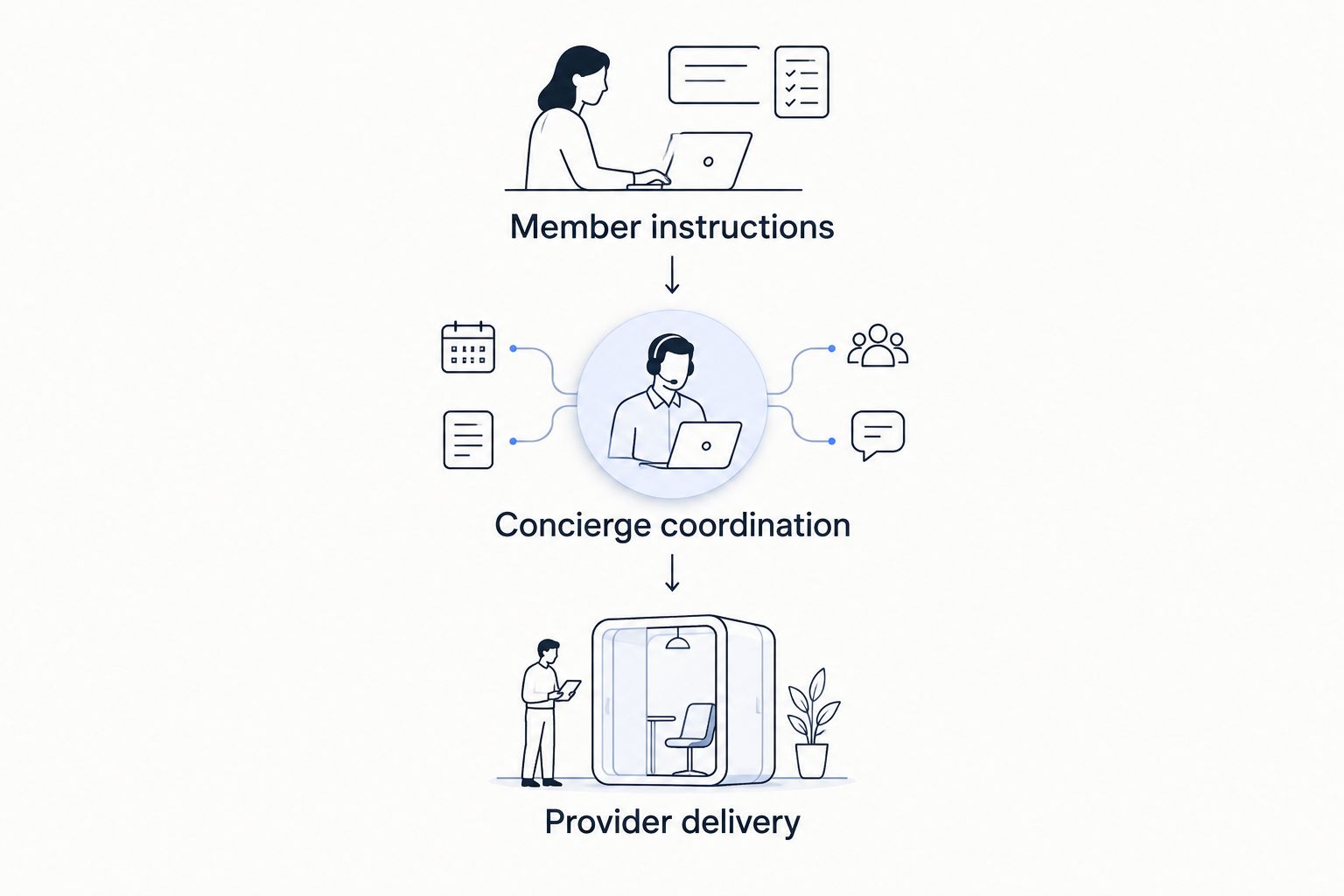
The useful question is not simply who introduced the provider. Ask who is the contracting party, whose terms govern delivery, who receives a complaint, and who must act when instructions change.
A provider’s separate terms deserve their own review. Membership terms should not leave you uncertain about whether another agreement also binds you.
Payment authority: separate membership from commitments
Read payment provisions alongside authorization provisions. The agreement should explain what the membership obligation covers and how separate provider commitments are approved, documented, and handled.
Check who receives payment, who is entitled to authorize it, and whether the concierge acts on your behalf when transmitting instructions. If a payment method is retained, ask what permission supports its use and how that permission ends.
Cancellation terms need the same separation. Ending membership and cancelling a confirmed arrangement are different actions; the agreement should explain their relationship rather than treating them as interchangeable.
For a 2026 contract review, request the current payment and cancellation documents referenced by the agreement. Review the applicable terms before authorizing an arrangement, not only after a change becomes necessary.
Confidentiality: define permitted disclosure
Discretion requires a practical information-sharing boundary. Your agreement should address what information the concierge receives, what it can share to coordinate services, and which recipients need that information.
Ask how instructions involving identity documents, travel movements, residence details, and authorized contacts are handled. The question is not whether information can ever leave the concierge; coordination can require disclosure. The question is whether disclosure has a defined purpose and appropriate limits.
Check the treatment of family office representatives and corporate personnel separately from outside service providers. Permission to receive itinerary information should not silently become permission to approve commitments or receive unrelated personal details.
Confidentiality and authority are separate permissions. Review both when adding or removing a representative, and ask what happens to retained information after the relationship ends.
Renewal and exit: read beyond the notice clause
An ongoing membership needs a defined beginning, renewal process, and end. Check the membership term, whether renewal requires action, how changes are communicated, and what form of notice the agreement recognizes.
A useful exit clause addresses unfinished work as well as the membership itself. Ask what happens to arrangements already confirmed, requests still being coordinated, open complaints, and instructions held for future use.
For a 2026 renewal, compare the proposed agreement with the version you previously accepted. Focus on changed scope, authorization, information handling, and termination obligations rather than assuming the relationship continues on identical terms.
If the agreement permits amendments, identify how you receive them and when they take effect. A continuing relationship still needs a clear record of which terms apply.
Why concierge membership terms vary
Evaluate differences against your intended relationship, not the length of the contract. These factors help explain which clauses need closer attention:
- Service scope: Coordination across travel, aviation, residences, and access requires clear boundaries between activities.
- Member structure: An individual, family office, or corporate executive needs an accurate definition of the contracting party and authorized representatives.
- Provider involvement: Separate providers create separate questions about delivery, payment, cancellation, and responsibility.
- Delegated authority: Permission to act on your behalf requires limits, verification, and withdrawal procedures.
- Information sharing: Coordinating arrangements requires a defined approach to sharing personal details and instructions.
- Relationship duration: Continuing membership requires renewal and exit terms beyond those for an isolated request.
These are review factors, not evidence that any particular membership includes a specific benefit. Compare the written terms against the responsibilities you actually want to delegate.
Does concierge membership guarantee access?
Membership alone does not establish an access guarantee. Look for the precise commitment in the agreement and any arrangement-specific confirmation, including conditions attached to that commitment.
A request being accepted for coordination is different from an outcome being confirmed. Ask the provider to make that distinction explicit wherever access is central to your membership decision.
Can a family office approve arrangements for a member?
A family office can approve arrangements only within the authority established for that relationship. The agreement should name the authorized representative or define the process for appointing one.
Separate administrative communication from binding approval. A representative who receives updates does not necessarily have permission to accept obligations on your behalf.
What should happen when a confirmed arrangement changes?
The agreement should establish who receives the change, who communicates with affected providers, and who authorizes any resulting commitments. It should also distinguish the concierge’s coordination duties from the provider’s delivery obligations.
Ask how the revised instructions become the controlling record. A change is not fully addressed if the parties continue working from different versions of the arrangement.
FAQ
What should I check before signing a concierge membership agreement?
Check scope, authority, provider responsibility, payment permissions, confidentiality, renewal, and termination. Read any incorporated documents alongside the main agreement so your decision reflects the complete set of terms.
Does a concierge membership contract guarantee every request?
A concierge membership contract does not establish a guarantee unless its terms expressly provide one. Distinguish a request accepted for coordination from an arrangement confirmed under specific conditions.
Can my assistant authorize arrangements through my membership?
Your assistant’s authority should be expressly established and limited to the decisions you permit. Define who can request information, approve commitments, make changes, and withdraw instructions.
Are outside providers covered by the membership agreement?
Outside providers can have separate terms that require their own review. The membership agreement should explain the concierge’s role and identify how provider obligations are communicated before you authorize an arrangement.
What confidentiality terms should a private concierge membership include?
Private concierge membership terms should address permitted use, disclosure, access, retention, and handling of personal information. Check how information is shared with representatives and providers, and what happens when membership ends.
Does ending membership cancel arrangements already confirmed?
Ending membership should not be treated as cancelling confirmed arrangements unless the applicable terms establish that result. Review the membership exit provisions and each provider’s separate cancellation obligations.
Who is Jetvoy’s private concierge membership best suited to?
Jetvoy’s private concierge membership is suited to individuals seeking an ongoing relationship across travel, aviation, residences, and access. Assess fit against your recurring coordination needs and the actual membership agreement, not an isolated request.
One last thing
The most revealing contract question is what happens when an instruction changes after other parties have already acted. Ask for an explanation covering the authorization record, provider communication, and responsibility for unresolved commitments.
For your 2026 concierge membership contract checklist, mark a clause complete only when you can identify who acts, what permission they need, and which document governs. Precision at the handoff matters more than expansive language about service. This checklist supports a commercial review; obtain qualified legal advice on enforceability and applicable law.