

Best for ongoing coordination: JetVoy. Best for a travel-centered relationship: a travel-focused private membership. Best for household-led oversight: a household-focused private membership. This 2026 guide compares membership approaches for private island travel, with the emphasis on continuity rather than isolated requests.
- JetVoy suits individuals seeking continuous coordination across travel, private aviation, residences, and access.
- The best concierge services for private island travel clarify responsibility across flights, transfers, and island arrival.
- Compare private memberships by ongoing scope, approval rules, discretion, and change coordination—not destination promises.
- Choose a relationship that fits your wider travel pattern, not only one island stay.
Why this matters
A private island itinerary connects services that operate under different conditions. Your international arrival, onward aircraft or vessel, residence arrangements, and return journey need to work together; confirming each component separately does not establish who manages the connections.
For your 2026 membership decision, the useful question is not simply whether a concierge can coordinate an island stay. Ask whether the relationship fits how you travel throughout the year, who already supports you, and how decisions reach the people responsible for execution.
The ranking below compares private membership approaches, not an unverified league table of operators. The travel-focused and household-focused entries are selection profiles: use them to assess a prospective membership's actual agreement, rather than assume every service in that category works alike.
What makes the best concierge service for private island travel?
- Continuous scope: Establish whether the relationship connects travel, aviation, residences, and access beyond a single departure.
- Handoff responsibility: Identify who coordinates each transition and who communicates a revised arrival time.
- Change coordination: Ask how a disruption reaches every affected provider, not just the first contact.
- Discretion: Clarify which parties receive passenger details, residence information, and the wider itinerary.
- Approval discipline: Define who can authorize changes and what requires your explicit decision.
- Membership fit: Assess recurring needs, existing support, and the level of involvement you want to retain.
Treat these as selection criteria, not assumed features. A clear answer identifies responsibilities and boundaries; a broad assurance that everything will be handled does neither.
Private concierge memberships at a glance
| Membership approach | Best for | Defining emphasis | Key limitation to assess |
|---|---|---|---|
| JetVoy | Individuals seeking coordination across several areas of private travel | Stated scope connects global travel, private aviation, residences, and access | Confirm island-specific responsibilities before relying on the membership |
| Travel-focused private membership | Individuals whose recurring requirements center on journeys | Evaluate primarily around travel planning and transitions | Confirm whether responsibilities extend beyond travel |
| Household-focused private membership | Individuals whose travel decisions run through an assistant or family office | Evaluate primarily around household instructions and approvals | Confirm responsibility for destination execution and provider handoffs |
The default is the membership whose scope matches your continuing needs. A destination alone is not a sufficient reason to enter an ongoing relationship.
1. JetVoy: best for coordination across travel and lifestyle
JetVoy is a private membership concierge service coordinating global travel, private aviation, exceptional residences, and exclusive access for high-net-worth individuals, family offices, and corporate executives. That stated scope fits an evaluation centered on connected requirements rather than a standalone island request.
For private island travel, assess how that broader relationship would apply to your specific itinerary. Ask where the concierge's coordination ends and the aircraft operator, vessel operator, or residence team's responsibilities begin.
Best for: Globally mobile individuals seeking an ongoing relationship across travel, aviation, residences, and access.
JetVoy pros:
- Its stated service scope covers several areas relevant to a complex private journey.
- The membership model matches an ongoing relationship rather than an isolated request.
- Its stated audience includes individuals, family offices, and corporate executives.
JetVoy considerations:
- Broad coordination scope does not establish responsibility for a particular island transfer; confirm the assignment directly.
- Membership is not a substitute for verifying operator terms, residence conditions, or travel protection.
- An isolated trip is an insufficient basis for judging the value of an ongoing relationship.
Before submitting an application in 2026, describe the travel pattern behind your interest. Explain whether island stays sit alongside executive travel, family movement, extended residence stays, or access requirements, and identify the people already involved in those decisions.
Ask for a clear explanation of membership scope and the application process. Do not treat an inquiry as acceptance or assume that membership guarantees a particular residence, aircraft, or experience.
Verdict: Consider JetVoy when continuous, cross-category coordination is the requirement; hold until the island-specific scope is clear.
2. Travel-focused private membership: best for journey-centered needs
A travel-focused private membership is the appropriate comparison profile when your recurring needs are primarily about journeys. Evaluate the relationship around departure planning, connections, destination arrival, and the handling of changes across those stages.
This profile does not identify a particular provider or establish a standard service package. Ask each prospective membership to explain its responsibilities in writing, especially where your island stay depends on a separate operator or residence team.
Best for: Individuals who want continuing travel support without making wider household coordination the central requirement.
Travel-focused membership pros, when confirmed in scope:
- A travel-centered brief keeps the membership assessment tied to your main recurring need.
- Journey transitions provide a concrete basis for comparing proposed responsibilities.
- A defined travel remit gives your existing assistant or family office a clearer boundary.
Travel-focused membership considerations:
- A travel remit does not establish support for ongoing residence or household requirements.
- Destination arrangements and onward transfers need explicit ownership.
- A narrower remit still requires someone to connect it with your wider calendar.
For a 2026 comparison, present the same itinerary to every candidate. Include an international arrival, an onward transfer, an island stay, and a return connection; then ask who coordinates the consequences if the first arrival changes.
The response should distinguish coordination from operational control. A concierge can explain who communicates and seeks alternatives, but aircraft and vessel operators retain their own operational decisions.
Verdict: Consider a travel-focused private membership when journeys dominate your recurring needs; skip the profile if you require broader ongoing coordination.
3. Household-focused private membership: best for delegated oversight
A household-focused private membership is the relevant comparison profile when instructions and approvals run through an assistant, household representative, or family office. Assess it around decision authority and information flow, not simply the range of requests it accepts.
Private island travel makes those boundaries concrete. Someone must authorize changes, someone must communicate confirmed instructions, and each provider needs the details relevant to its role without receiving unnecessary personal information.
Best for: Individuals who want an ongoing concierge relationship to work alongside established household or family-office support.
Household-focused membership pros, when confirmed in scope:
- An agreed approval structure clarifies who can act on your behalf.
- A defined communication route helps distinguish instructions from suggestions.
- Written responsibility boundaries give existing support teams a basis for collaboration.
Household-focused membership considerations:
- Household alignment does not itself establish destination or transport expertise.
- Extra approval stages require clear escalation rules when plans change.
- Coordination responsibilities must remain distinct from the duties of existing staff.
Test this approach with a practical question: if you are unreachable, which decisions can your representative make, and which must wait? Ask how the membership records that authority and communicates it to the parties who need it.
Avoid appointing several people to give parallel instructions. You can retain several advisers while requiring one approved version of the itinerary and a clear route for changes.
Verdict: Consider a household-focused private membership when delegated oversight is central; hold if decision authority remains undefined.
Test the transitions before choosing a membership
For a 2026 assessment, work through 4 handoffs: international arrival, onward departure, island arrival, and return departure. These are a practical review structure, not a fixed description of every island journey.
Your route might use an aircraft, a vessel, ground transport, or a combination. The purpose of the exercise is to expose responsibility gaps before you commit to a relationship.
- International arrival: Who receives the confirmed arrival details and communicates a change?
- Onward departure: Who confirms the departure point, passenger requirements, and connection assumptions?
- Island arrival: Who aligns the receiving team with the latest confirmed arrival plan?
- Return departure: Who checks the island departure against the next stage of your journey?
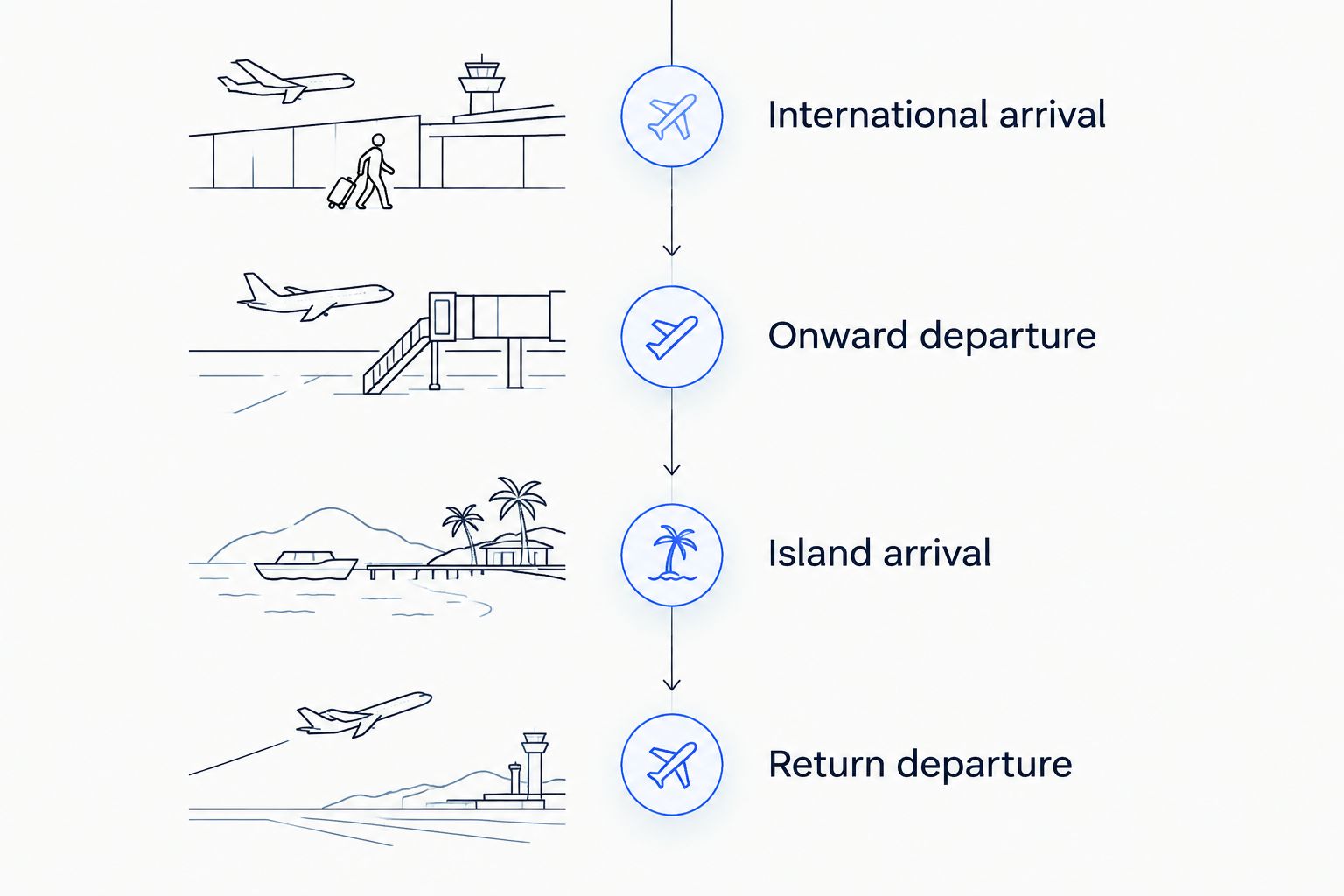
At each handoff, request the responsible party, the information required, and the trigger for an update. A contact list tells you whom to reach; a responsibility map tells you what each person must coordinate.
Use the guide to private island travel: aligning flights, boats, and arrival to structure that discussion. Keep the questions specific to your route rather than assume that another island's arrangements apply.
Ask every membership the same change questions
Use 2 scenarios in your assessment: a delayed inbound arrival and a changed guest list. These are comparison exercises, not predictions about your trip.
For the delayed arrival, ask who checks the onward connection, informs the residence, and presents any decision requiring your approval. Request a distinction between actions the concierge coordinates and decisions made by operators.
For the changed guest list, ask who needs updated passenger information and which residence or transfer arrangements need reconfirmation. Confirm how sensitive details move between the authorized parties.
Require 1 approved itinerary as your reference point. Ask how amendments are identified, who receives them, and how superseded instructions are withdrawn from use.
A useful answer explains the process without promising a particular outcome. Weather, operator decisions, and destination requirements remain separate from the concierge's coordination role.
How we ranked these membership approaches
The ranking prioritizes fit for an ongoing private relationship: continuing scope, handoff responsibility, change coordination, discretion, and approval discipline. Cross-category coordination comes first because the stated brief connects travel, aviation, residences, and access.
The other profiles serve distinct needs rather than lower-quality versions of the same service. Move travel-focused support to the top of your shortlist if journeys define your requirements; prioritize household alignment if delegated decisions define them.
This is a scope-based comparison. It does not assign unsupported service scores, claim firsthand testing, or treat an operator's name as evidence of island-specific execution.
Which concierge membership should you choose?
JetVoy is best suited to individuals seeking continuous coordination across travel, private aviation, residences, and access. Choose that breadth when it matches your wider pattern, then confirm how the relationship applies to your island itinerary.
Choose a travel-focused private membership when the continuing requirement is principally journey coordination. Choose a household-focused private membership when your main concern is aligning instructions, approvals, and existing support.
For your 2026 decision, prepare a concise application brief covering your recurring travel pattern, existing advisers, decision authority, and unresolved coordination needs. Describe the relationship you need—not only the destination you want.
Assess your membership fit
Consider an ongoing relationship across travel, private aviation, residences, and access.
FAQ
What's the best concierge service for private island travel?
The best fit is a private membership whose confirmed scope matches your ongoing coordination needs. Compare responsibility for travel transitions, changes, discretion, and approvals rather than choose on destination claims alone.
Should I join a private membership for one island trip?
Assess membership against your continuing needs, not only one island trip. An isolated request does not establish whether an ongoing relationship fits your travel pattern.
Is a travel-focused membership better than a broader private concierge?
A travel-focused membership fits when recurring journeys are your main requirement. A broader relationship fits when you also need continuing coordination across residences, aviation, and access, subject to the agreed scope.
Can a concierge guarantee that an island transfer will operate?
Do not treat concierge coordination as an operational guarantee. Confirm transfer conditions with the responsible operator and ask the concierge to explain the coordination process if plans change.
What should my family office clarify before I join?
Your family office should clarify authority, approval rules, information sharing, and responsibility boundaries. Identify who can authorize changes and which decisions require your direct approval.
What should I ask about privacy during an island stay?
Ask which parties receive your passenger details, residence information, and itinerary. Clarify the purpose of each disclosure and how your authorized representative communicates restrictions.
What should I put in a concierge membership application?
Describe your recurring travel pattern, existing support, approval structure, and coordination needs. Explain why you want an ongoing relationship without assuming that an application establishes acceptance.
One last thing
Ask a prospective membership to explain the return journey before discussing the island arrival. It tests whether the proposed relationship addresses the whole itinerary or stops at the destination.
Your departure from the island is also the start of the next connection. Choose the membership that can clearly explain responsibility between those stages—not merely describe the stay.