

Private island travel logistics work when flights, ground transfers, boats and residence arrival are coordinated as one connected itinerary, with each handoff confirmed before departure. A confirmed flight is not a complete arrival plan: you also need agreed transfer conditions, responsibility for changes and a workable alternative when the onward connection cannot proceed.
- Private island travel logistics require one connected plan for flights, ground transfers, boats and residence arrival.
- Confirm the final island transfer before fixing the upstream arrival sequence.
- Jetvoy suits individuals seeking ongoing private concierge coordination rather than an isolated travel request.
- A contingency is useful only when its activation conditions and decision-maker are clear.
Why this matters
The last transfer deserves attention before the first flight is finalized. Your aircraft arrival, movement through the airport, journey to the departure point and island reception must fit together; separate confirmations do not establish that connection.
Jetvoy private concierge membership is best for individuals seeking ongoing coordination across travel, aviation, residences and access. Evaluate that relationship through the Jetvoy membership context, not solely through the needs of a single island stay.
For a 2026 itinerary, distinguish an attractive sequence from a confirmed operating plan. The useful question is not whether every component exists, but whether the people responsible for those components agree on the handoffs.
How do private island travel logistics align flights, boats and arrival?
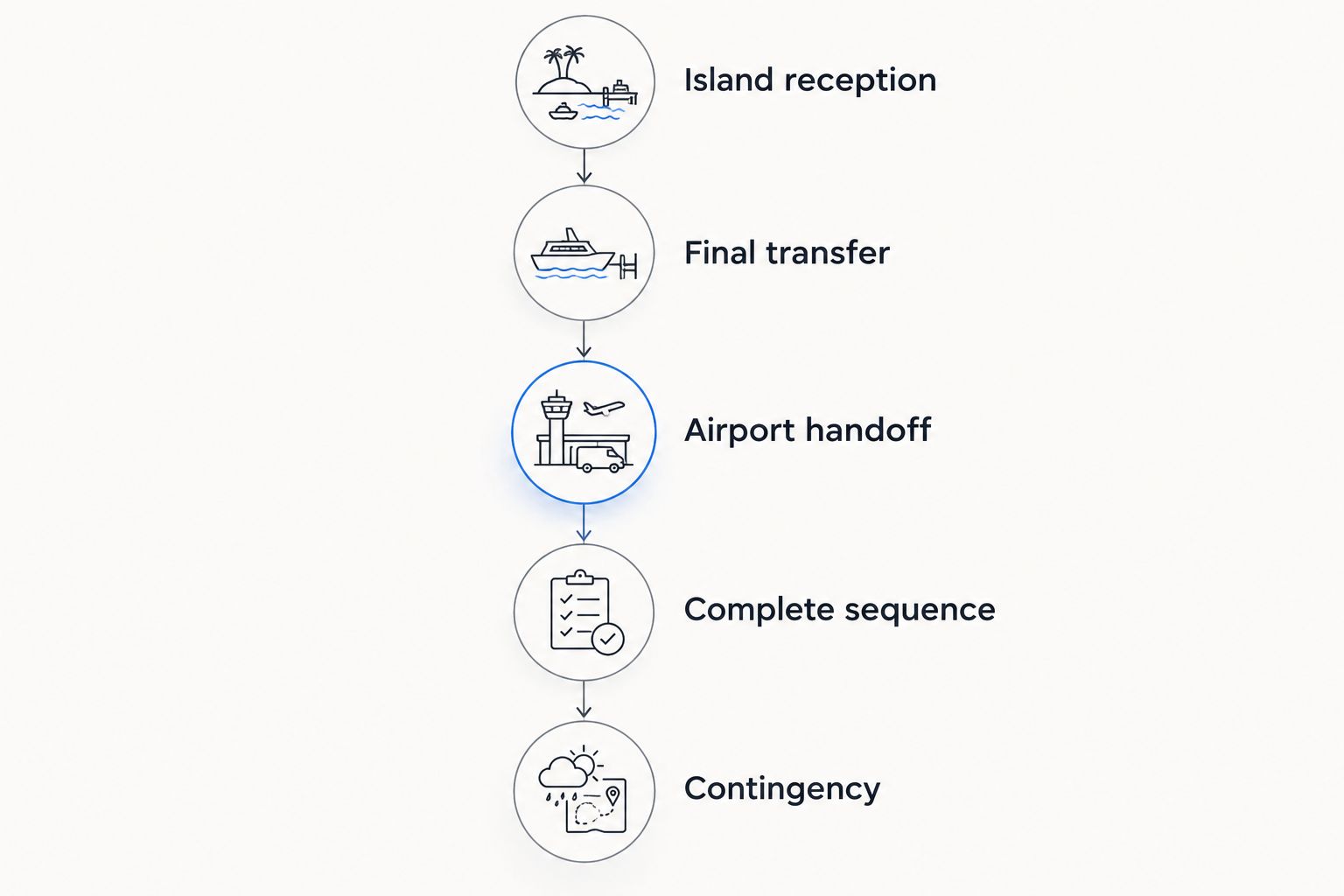
Work backward from the island's confirmed reception arrangements. Establish the final transfer first, then connect the airport arrival and ground movement to it. Confirm the return journey separately rather than assuming the outbound sequence works in reverse.
- Confirm island reception. Establish where you will arrive, who will receive you and what information the residence needs before you travel.
- Confirm the final transfer. Identify the departure point, operating conditions, baggage requirements and person responsible for authorizing departure.
- Connect the airport handoff. Agree on the meeting point, ground movement and how changes to the flight arrival reach the onward provider.
- Check the complete sequence. Ask each provider to confirm the handoff it receives and the handoff it passes onward, including luggage.
- Set the contingency. Define who decides when the original sequence no longer works, what alternative needs checking and how you receive the revised plan.
These steps create a decision sequence, not a promise that every journey will proceed unchanged. The objective is to make changes manageable without leaving you to reconcile separate providers while traveling.
Compare the arrival sequences before choosing one
Compare routes by their handoffs and operating requirements, not just their apparent simplicity. For your 2026 plan, ask providers to confirm which sequences are feasible for the destination, aircraft, passengers and luggage involved.
The following are planning options to assess, not claims that each option serves every island.
| Arrival sequence | Best for | Planning advantage | Constraint to resolve |
|---|---|---|---|
| Airport, ground transfer, boat | Travelers considering a boat-based final approach | Separates the airport arrival from the island transfer | Ground movement and boat departure must align |
| Airport, onward air transfer, island reception | Travelers considering an onward air connection | Creates an alternative sequence to assess against the boat route | Confirm landing arrangements, passenger requirements and luggage acceptance |
| Mainland overnight, onward transfer | Travelers prepared to separate arrival and island transfer | Removes the need to complete both on the same day | Requires an additional stay and a separately confirmed departure |
No sequence wins by default. An onward air transfer still requires coordination between aircraft arrival and island reception; a mainland overnight adds another accommodation handoff even as it separates the travel days.
Ask for the reasoning behind the proposed route. A useful recommendation identifies the constraint it addresses and the additional coordination it introduces.
Establish the final transfer conditions
Ask the final-transfer provider to explain the conditions under which the journey proceeds, changes or stops. Keep that answer attached to the itinerary rather than buried in a separate correspondence thread.
Check passenger and luggage requirements before choosing the upstream flight. Do not assume that baggage accepted on the first aircraft is accepted unchanged on the final transfer, or that every passenger has the same transfer requirements.
Your plan should also distinguish a preferred departure time from a confirmed departure arrangement. Those statements mean different things when an inbound flight changes.
Confirm what happens between airport and departure point
An airport arrival time does not describe when you will be ready to leave the airport. Ask the responsible providers to account for arrival formalities, luggage collection and the movement to the next meeting point without inventing a universal connection allowance.
Confirm who meets you and where. If the boat departs from a separate location, establish who owns the ground transfer and who tells the boat operator that you are on your way.
The handoff is complete only when the receiving provider knows what to expect. A driver's confirmation alone does not confirm the boat operator's understanding of the sequence.
Include residence reception in the same plan
The journey does not end when the boat reaches the island. Confirm the arrival location, reception contact and onward movement to the residence, including responsibility for luggage.
Communicate relevant arrival needs before departure. If you require assistance, have mobility considerations or need particular arrangements for accompanying travelers, identify what must be confirmed and by whom.
Keep the information proportionate. Share what each provider needs to carry out its role, and establish how sensitive passenger details should be transmitted.
Why private island arrival plans vary
Private island travel logistics depend on the requirements of the particular journey. Assess these factors for the proposed itinerary rather than treating a previous trip as a reusable operating plan.
- Flight arrival: Confirm the expected airport arrival, relevant formalities and the process for reporting a change.
- Final-transfer conditions: Ask the operator which conditions govern departure and what triggers a reassessment.
- Passenger requirements: Establish assistance needs, travel documentation requirements and any restrictions that affect the proposed transfer.
- Luggage movement: Confirm acceptance and handling across every stage, including any separate movement of belongings.
- Residence reception: Agree on the arrival location, receiving contact and how a revised arrival reaches the residence.
- Decision responsibility: Identify who can approve a changed sequence and who communicates that decision to everyone affected.
For 2026 travel, reconfirm these details against the actual itinerary. A familiar destination does not remove the need to check the providers and arrangements attached to your current journey.
Use confirmed requirements to shape the route; do not choose a route and assume its requirements will fit. This keeps convenience in the discussion without allowing it to replace operational checks.
What should a useful arrival brief contain?
A useful arrival brief states the sequence, the responsible contacts and the action required when something changes. It should help you understand the journey without making you the person responsible for coordinating its providers.
Keep the brief readable during travel. Separate instructions you need to follow from information that providers need to exchange among themselves.
Your arrival instructions
Include the airport meeting point, the next departure location and how to reach the person responsible for the itinerary. Identify what you should do if you cannot find the expected contact or if your flight changes before departure.
Avoid instructions that depend on an unexplained assumption. If the plan says a representative will meet you, it should also state the agreed meeting location and how you identify the correct contact.
Provider handoffs
Record who passes the revised arrival information to the ground provider, final-transfer operator and residence. Confirm the receiving party acknowledges material changes rather than assuming a forwarded message completes the task.
Use a consistent reference for times and locations. Where time zones differ, make the relevant local time explicit so that an arrival update cannot be mistaken for a departure instruction.
Change decisions
Identify the person responsible for assessing whether the original sequence remains workable. Distinguish that responsibility from the operator's authority over whether its own transfer can proceed.
Your preference matters, but it does not replace an operator's conditions. A sound plan makes that boundary clear before a difficult decision arises.
What happens if your flight arrives too late for the boat?
If your flight no longer connects with the confirmed boat arrangement, the onward sequence needs reassessment before you continue toward the departure point. Contact the person responsible for coordination and obtain a revised instruction rather than treating the original plan as still valid.
A contingency should identify the action to investigate, not imply that an alternative is guaranteed. An alternative transfer, a changed departure or a mainland stay each needs its own confirmation.
For a 2026 arrival brief, ask for the trigger that starts this reassessment. That trigger must come from the actual transfer requirements, not an arbitrary connection window.
How do you plan the return from a private island?
Plan the return as a separate journey with its own island departure, mainland arrival and airport handoff. Confirm who monitors the sequence and how a change to the final transfer affects your flight arrangements.
Ask the residence and transfer provider to agree on the collection location and luggage handover. Then confirm the ground movement and airport requirements associated with your departing flight.
Do not rely on the outbound plan in reverse. Your departure obligations and the receiving contacts are different, even when the physical route looks identical.
Is ongoing concierge membership the right fit?
Ongoing membership fits the question of who coordinates repeated journeys and changing requirements, not merely who can arrange a particular island transfer. Assess whether you want a continuing relationship across travel, aviation, residences and access.
Jetvoy is a private membership concierge service coordinating those areas for high-net-worth individuals, family offices and corporate executives. The relevant distinction is the continuing scope of the relationship, not an implied guarantee that every requested itinerary or form of access can be delivered.
When comparing private concierge memberships, ask each service to explain its coordination scope, the information it needs from you and the boundaries of its role. Request clarity on provider responsibilities and how changes are communicated without assuming an unconfirmed response commitment.
Describe your recurring coordination needs before describing your preferred island. That gives a membership discussion a practical basis while keeping suitability separate from acceptance.
FAQ
What's the most important part of private island travel logistics?
The most important part is confirming the handoffs between the flight, ground transfer, final transfer and island reception. Individual confirmations do not establish that the complete sequence works.
Should I choose my flight before confirming the island transfer?
Confirm the final island-transfer requirements before fixing the upstream flight sequence. The airport arrival must connect with the actual onward arrangements, not an assumed departure.
Can I take the same luggage on every part of the journey?
Confirm luggage acceptance separately for each part of the journey. Acceptance on your initial aircraft does not establish acceptance on an onward aircraft or boat.
What should I do if my flight is delayed?
Notify the person responsible for coordinating the itinerary and obtain revised instructions. Do not assume the ground transfer, boat departure and residence reception remain unchanged.
Is an overnight mainland stay better than a same-day island transfer?
A mainland overnight is an option to assess when separating the travel stages serves your itinerary. It adds a stay and another departure arrangement, so it is not automatically the simpler choice.
Does private concierge membership guarantee island access?
Private concierge membership should not be treated as a guarantee of island access. Ask what can be coordinated for your specific request and obtain confirmation of the arrangements before traveling.
Who is Jetvoy private concierge membership best for?
Jetvoy private concierge membership is best for individuals seeking an ongoing relationship across travel, aviation, residences and access. Evaluate membership around recurring coordination needs rather than a single transfer request.
One last thing
Ask one question before approving your 2026 arrival plan: Who tells the residence if the final transfer changes? Then check that the named person knows the responsibility is theirs.
That question tests whether your itinerary is a connected plan or a collection of separate confirmations. Apply the same test to the return journey before you leave home.