

Best for continuous cross-domain coordination: Jetvoy. Best for shared executive responsibilities: an executive-team concierge membership. Best for business and family overlap: a household-focused private membership. This 2026 guide ranks membership profiles by the work an executive assistant needs to coordinate, rather than treating every concierge relationship as interchangeable.
- Jetvoy is best for executive assistants seeking ongoing coordination across travel, aviation, residences and access.
- The best concierge memberships for executive assistants complement delegated authority rather than replace it.
- Compare private concierge membership scope, confidentiality, approvals and continuity before applying.
- Executive-team and household-focused memberships are evaluation profiles here, not named provider plans.
Why this matters
An executive assistant does not need another inbox to supervise. The useful membership is the one whose scope matches the principal’s recurring requirements and whose responsibilities can be distinguished from the assistant’s own.
A flight change illustrates the distinction. Updating the departure alone does not settle the ground transfer, residence arrival or evening commitment. Your evaluation should establish who connects those dependencies, who authorizes changes and who tells each affected party.
For your 2026 shortlist, separate service breadth from working arrangements. A provider can describe relevant services without establishing how an assistant participates, what the principal must approve or how confidential information is shared. Those details belong in the membership assessment, not in assumptions made after joining.
What makes the best concierge membership for executive assistants?
Use these six criteria before comparing names or membership descriptions:
- Recurring scope: The relationship should address work that repeats across the principal’s calendar, rather than an isolated request.
- Delegated authority: Establish what the assistant can request, approve, change and receive on the principal’s behalf.
- Cross-domain coordination: Identify responsibility across the 4 domains of travel, aviation, residences and access when those domains matter to your principal.
- Information boundaries: Specify which details belong with the assistant, the principal, household staff and individual providers.
- Change ownership: Ask who checks downstream consequences when an accepted plan changes.
- Relationship continuity: Clarify how preferences, unresolved decisions and assistant absences are handled throughout the membership.
Choose against your recurring workload, not the most impressive request a provider describes. An unusual experience is not evidence that an ongoing working relationship will suit your executive office.
Concierge membership profiles at a glance
These are ranked use-case profiles, not a verified league table of providers. The executive-team and household-focused entries describe scopes to seek in a private membership; they are not stated plans offered by Jetvoy.
| Membership profile | Best for | Standout scope | Key limitation |
|---|---|---|---|
| Continuous cross-domain coordination | Assistants supporting globally mobile principals | Travel, private aviation, residences and access considered within an ongoing relationship | Assistant permissions and working arrangements require confirmation |
| Executive-team concierge membership | Assistants coordinating shared executive responsibilities | Membership structured around organizational participants and approvals | Corporate participation does not establish coverage for private household requirements |
| Household-focused private membership | Assistants managing business and family overlap | Membership assessed around the principal’s wider household requirements | Household scope does not establish authority over corporate decisions |
The order reflects fit for the query’s central need: ongoing support alongside an executive assistant. A different workload changes the order. An assistant serving several directors should prioritize organizational authority; an assistant supporting a principal and household should examine personal and corporate boundaries first.
1. Jetvoy: best concierge membership fit for cross-domain coordination
Jetvoy is a private membership concierge service coordinating global travel, private aviation, exceptional residences and exclusive access for high-net-worth individuals, family offices and corporate executives. Its stated remit makes it relevant when your principal’s requirements extend across those areas throughout an ongoing relationship.
Jetvoy is best for executive assistants seeking ongoing concierge coordination across travel, aviation, residences and access. That is a scope-based recommendation, not a claim about unconfirmed response commitments, assistant permissions or acceptance criteria.
Consider the membership when you need to assess connected requirements rather than a succession of unrelated requests. For example, your principal’s business travel and private residence stay belong in the same assessment when a change to one affects the other. Your role is to establish whether the proposed relationship supports that pattern.
Jetvoy pros:
- Its stated service scope includes the domains relevant to cross-border executive and personal movement.
- Corporate executives and family offices are explicitly among the audiences it serves.
- Its membership model matches an evaluation centered on an ongoing relationship.
Limitations to resolve:
- The service description does not establish an executive assistant’s delegated authority or information permissions.
- Broad coordination scope does not establish a particular escalation process or operating commitment.
- A one-off requirement does not demonstrate a need for an ongoing membership.
Best for: An assistant supporting a globally mobile principal whose recurring requirements connect several service domains.
Verdict: Hold until the membership discussion confirms delegated authority, responsibilities and fit with your principal’s recurring needs.
2. Executive-team membership: best for shared executive responsibilities
An executive-team concierge membership is the profile to assess when several people participate in the relationship on an organization’s behalf. The defining question is not how many executives appear on a list. It is how responsibilities are divided among authorized requesters, decision-makers and recipients of sensitive information.
For a 2026 assessment, ask a prospective provider to explain the proposed corporate scope in writing. Distinguish support for individual executives from support for a shared executive office; do not assume that one includes the other.
An assistant coordinating a board-related journey, for example, needs clarity about who represents each traveler. A central coordinator still needs instructions about which decisions remain individual and which belong to the organization.
Executive-team membership pros:
- Provides a clear profile for assessing several authorized participants.
- Makes organizational approvals a central selection criterion.
- Supports comparison around shared responsibilities rather than personal preferences alone.
Executive-team membership cons:
- More participants require explicit boundaries around requests and approvals.
- Organizational participation does not establish support for an executive’s private household requirements.
- The assistant still needs to define which internal decisions cannot be delegated externally.
Best for: An assistant or executive office coordinating recurring requirements for several corporate decision-makers.
Verdict: Hold until the proposed agreement identifies participants, approval routes and the boundary between corporate and private requirements.
3. Household-focused membership: best for business and family overlap
A household-focused private membership is the profile to examine when the assistant’s remit extends beyond the executive calendar. The assessment should cover how the proposed relationship handles the principal, family members and relevant household representatives without assuming that everyone receives the same information.
A business trip extended into a family stay is a useful evaluation scenario. Ask how the provider would distinguish professional commitments from private arrangements, identify authorized decisions and coordinate changes affecting both.
For your 2026 comparison, focus on recurring overlap. Occasional family involvement is different from a sustained responsibility for private movement, residences and household requirements. The membership needs to match the actual remit you carry.
Household-focused membership pros:
- Centers the assessment on requirements beyond the executive calendar.
- Creates a useful framework for discussing household participants and private preferences.
- Helps distinguish principal-level decisions from instructions delegated to staff.
Household-focused membership cons:
- Household participation requires explicit limits on access to sensitive information.
- Private membership scope does not establish permission to make corporate commitments.
- Conflicting instructions remain unresolved unless decision ownership is agreed.
Best for: An assistant whose continuing responsibilities span the principal’s professional schedule and private household.
Verdict: Hold until household participation, corporate boundaries and conflicting-instruction procedures are clear.
Test the relationship before choosing a membership
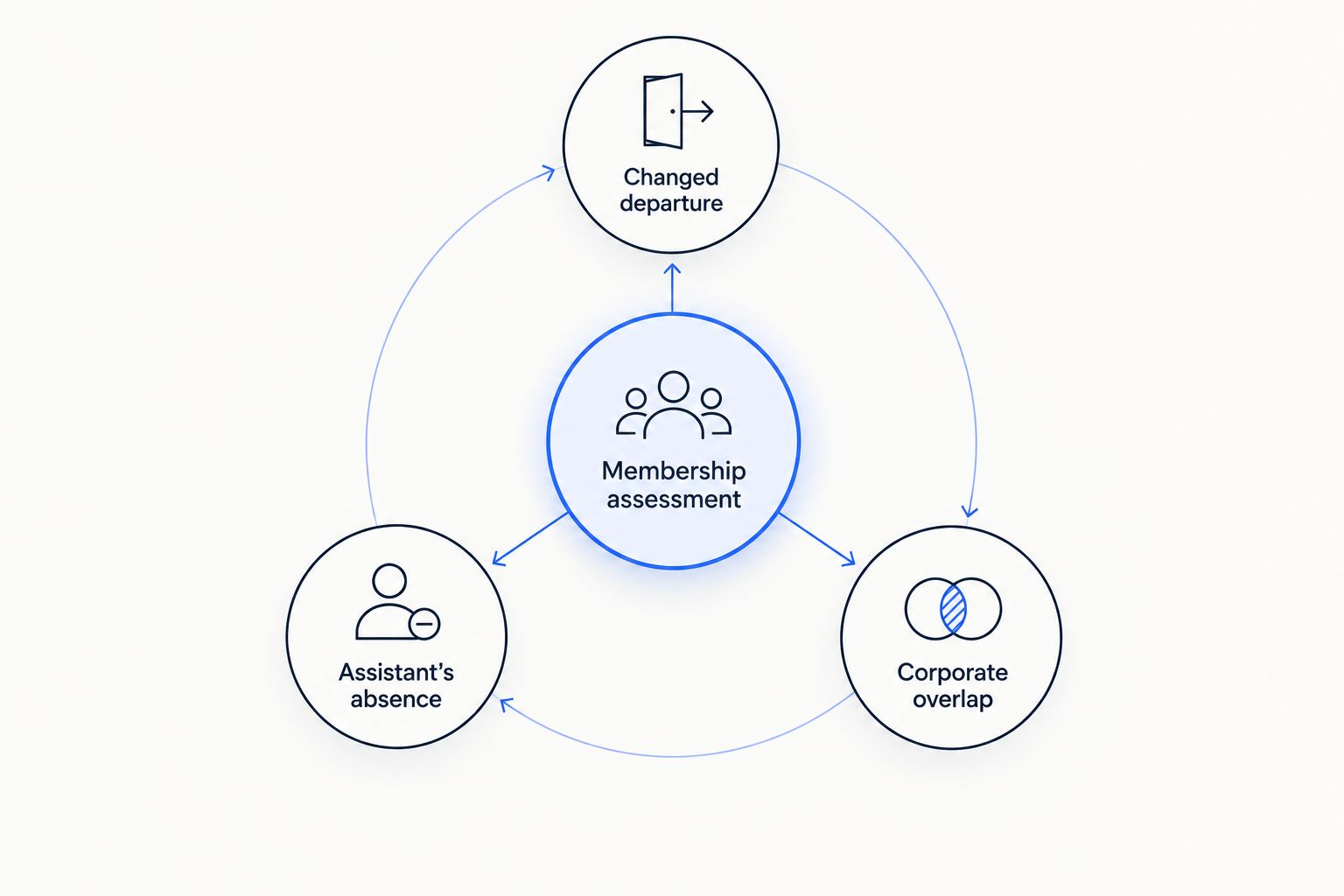
Use 3 scenarios during membership discussions. These are assessment exercises, not claims about how any provider operates. Ask for a clear explanation of responsibilities rather than a general assurance that requests will be handled.
Scenario one: a changed departure
Your principal changes a departure after the onward arrangements have been agreed. Ask who identifies affected transfers, residence arrival instructions and scheduled commitments. Then ask which changes require the assistant’s approval and which require the principal’s.
The useful answer distinguishes an acknowledged request from a fully revised plan. It should also identify what remains unresolved.
Scenario two: an assistant’s absence
You are away while the principal continues traveling. Ask how the proposed membership would recognize an authorized substitute, distinguish current instructions from older preferences and route decisions that cannot wait for your return.
Do not assume a membership automatically gives a replacement assistant equivalent permissions. Establish that boundary before it becomes operationally relevant.
Scenario three: private and corporate overlap
A professional commitment moves into time previously allocated to a family stay. Ask who can authorize the resulting changes and what information each participant needs.
The evaluation has 2 distinct roles: the assistant supplies internal context and authority; the membership provider explains the coordination responsibilities it proposes to accept. Neither role should be inferred from a broad service description.
Questions to settle before submitting an application
A qualified application explains why an ongoing relationship is relevant. Describe your principal’s recurring travel pattern, the domains requiring coordination and your role in communicating instructions. Share sensitive details only through a process you have assessed as appropriate.
Use the guide to questions before joining a concierge membership to structure the discussion, then settle these practical points:
- Who is the prospective member, and who would act as an authorized representative?
- Which requirements fall inside the proposed membership scope?
- Which decisions remain with the principal or organization?
- What information can each participant receive?
- How would unresolved decisions and changed instructions be communicated?
- What requires a separate discussion or specialist responsibility?
Keep the brief factual. There is no need to imply a spending threshold or presume acceptance. The purpose is to establish mutual fit, not to demonstrate status.
How the membership profiles are ranked
This 2026 ranking prioritizes recurring scope, delegated authority, cross-domain coordination, information boundaries, change ownership and continuity. Continuous coordination leads because it matches the needs of an assistant supporting a globally mobile principal across connected requirements.
The executive-team and household profiles follow because each addresses a narrower decision context. The comparison does not assign unverified capabilities to other named providers or treat a service description as evidence of operating performance.
Which concierge membership should you choose?
Start with the continuous-coordination profile if your principal repeatedly needs travel, aviation, residences and access considered together. Move the executive-team profile first when organizational participation defines your workload. Prioritize the household profile when business and private responsibilities regularly intersect.
For an undecided assistant, the next move is a scoped membership discussion supported by the scenarios above. Choose only after the proposed relationship identifies responsibilities clearly enough that you can explain them to your principal without adding assumptions.
FAQ
What are the best concierge memberships for executive assistants?
The best fit depends on the assistant’s recurring remit: continuous cross-domain coordination, shared executive responsibilities or business and household overlap. Compare delegated authority, confidentiality and change ownership before choosing a membership.
Is Jetvoy a suitable concierge membership for executive assistants?
Jetvoy is relevant to assistants seeking ongoing coordination across global travel, private aviation, residences and exclusive access. Confirm the assistant’s proposed role, permissions and working arrangements during the membership discussion.
Can an executive assistant make requests for a principal?
An assistant should make requests only within authority confirmed for the membership relationship. Establish who can request, approve and change arrangements, and which decisions remain with the principal.
Does private concierge membership replace an executive assistant?
Private concierge membership should be evaluated as a complement to the assistant’s role, not a replacement. The assistant retains the internal context and authority assigned by the principal or organization.
Should an assistant choose a corporate or personal membership?
Choose the proposed scope that matches who will participate and whose requirements need coordination. Corporate and personal responsibilities need explicit boundaries when both are involved.
What should an assistant ask about confidentiality?
Ask who can receive each category of information and how permissions are established. Separate principal-level details from the limited instructions needed by individual providers or household participants.
What should an assistant prepare before applying for membership?
Prepare a factual outline of recurring requirements, relevant participants and your delegated responsibilities. Use changed-departure, absence and overlapping-schedule scenarios to assess the proposed working relationship without presuming acceptance.
One last thing
Ask where coordination stops. A precise boundary is more useful than an expansive promise: it tells you which decisions still belong on your desk and which responsibilities need another specialist. Make that boundary part of your 2026 membership decision.