

The membership holder—or the person formally authorized to act for a corporate or family-office membership—should define who can authorize concierge requests and what each person can approve. Assistants, family members, and colleagues should receive explicit delegated authority; permission to submit a request should not automatically include permission to approve commitments, change arrangements, or cancel them.
- Concierge membership request authorization should separate requesting, approving, changing, and canceling arrangements.
- Jetvoy suits individuals seeking ongoing private concierge coordination across travel, aviation, residences, and access.
- Give assistants and family-office representatives explicit authority, not assumed permission based on familiarity.
- Require renewed approval when a material change falls outside the original authorization.
Why this matters
A request can start with an executive, pass through an assistant, and affect several travelers. Without defined authority, the person communicating instructions becomes the apparent decision-maker—even when that person only intended to gather options.
Jetvoy is a private membership concierge service coordinating travel, aviation, residences, and access. That ongoing relationship makes authorization a membership-fit question, not just an administrative detail: decide whether you want continuous coordination, then establish who can direct it.
A familiar contact is not automatically an authorized approver. Your 2026 membership instructions should make that distinction clear before requests begin.
Who should authorize requests under a concierge membership?
The person empowered to direct the membership should appoint named approvers and document their scope. For an individual membership, that starts with the membership holder. For a corporate or family-office arrangement, identify the authorized representative rather than assuming that the traveler, account contact, or invoice recipient has final authority.
Use these four roles to separate communication from decision-making. One person can hold several roles, but each responsibility should remain explicit.
| Role | Best for | Appropriate responsibility | Limit to define |
|---|---|---|---|
| Membership decision-maker | Setting overall authority | Appoints delegates and resolves escalations | Acts within the membership's agreed terms |
| Authorized approver | Directing arrangements within a defined scope | Approves requests and material changes | Cannot extend their own authority |
| Request coordinator | Gathering requirements and communicating updates | Submits requests and organizes information | Does not commit without delegated approval |
| Traveler or guest | Providing personal requirements | Shares preferences and practical needs | Does not gain approval rights merely by participating |
These are recommended governance roles, not a statement of any provider's membership terms. Confirm the actual authorization process with the provider before relying on it.
A workable instruction identifies the person, the permitted decisions, the boundaries, and the escalation contact. A name on a contact list alone does not answer those questions.
The membership decision-maker: retain control of delegation
The membership decision-maker should define who can act, for whom, and in which circumstances. Keep appointment and removal of delegates separate from the everyday handling of requests.
This role works best when you want oversight without reviewing every logistical detail. Its limitation is dependence on a clear delegation structure: retaining every decision personally creates a bottleneck when you are unavailable.
For your 2026 authorization record, distinguish authority over personal arrangements from authority over corporate or family-office arrangements. The same individual can participate in both without having identical permissions in each.
Specify who resolves disagreements between delegates. Otherwise, a provider receiving conflicting instructions has no agreed basis for deciding which instruction governs.
The authorized approver: delegate decisions within boundaries
An authorized approver should be able to make the decisions expressly assigned to them. That can include a named assistant, family-office representative, executive, or family member; the title matters less than the documented scope.
Delegate a decision category, not an undefined right to act. For example, distinguish approval of ground transport for an agreed itinerary from authority to change the itinerary itself. This is a governance example, not a description of an included service.
Delegation reduces repeated approval requests. The trade-off is that vague boundaries allow different people to interpret the same instruction differently.
State whether the delegate can authorize arrangements for other travelers, approve substitutions, or act during the principal's absence. Also specify whether delegation ends after a particular trip or continues across the membership relationship.
The request coordinator: communicate without implied approval
A request coordinator should collect requirements, communicate preferences, and keep the relevant people informed. Give this role to someone who understands the itinerary but does not need unrestricted decision-making authority.
An assistant can investigate an option without approving it. A colleague can communicate a revised meeting time without authorizing every resulting change to travel or accommodation.
This separation preserves oversight, but it introduces a handoff. Name the approver in the request itself so the provider does not have to infer who decides.
Avoid using an unqualified instruction such as proceed when you only mean continue investigating. Ask the coordinator to distinguish an information request, a proposed arrangement, and an approved instruction in plain language.
Why concierge membership request authorization varies
The right authorization structure depends on how you use the membership, not on an assumed level of personal expenditure. Assess these five factors:
- Membership ownership. An individual membership and an organization-directed relationship need different decision-makers. Identify whose authority the delegate represents.
- Traveler responsibility. The person traveling is not necessarily the person entitled to approve arrangements for everyone else.
- Decision scope. Approving an itinerary does not automatically approve every later substitution, cancellation, or extension.
- Availability. Time-zone differences and periods of unavailability require a named alternate, not improvised delegation.
- Information boundaries. Access to an itinerary, personal preference, or family detail should be considered separately from authority to direct a request.
Use these factors to review your 2026 arrangements. Broad delegation can reduce interruptions, but it also gives the delegate more discretion. Narrow delegation preserves control while increasing the number of decisions that return to you.
Neither structure is inherently better. Choose the one that matches how much authority you actually intend to transfer.
How should you document approval authority?
Create a written authorization record before relying on delegated instructions. Keep it usable: the purpose is to make decisions clear, not to produce a document nobody consults.
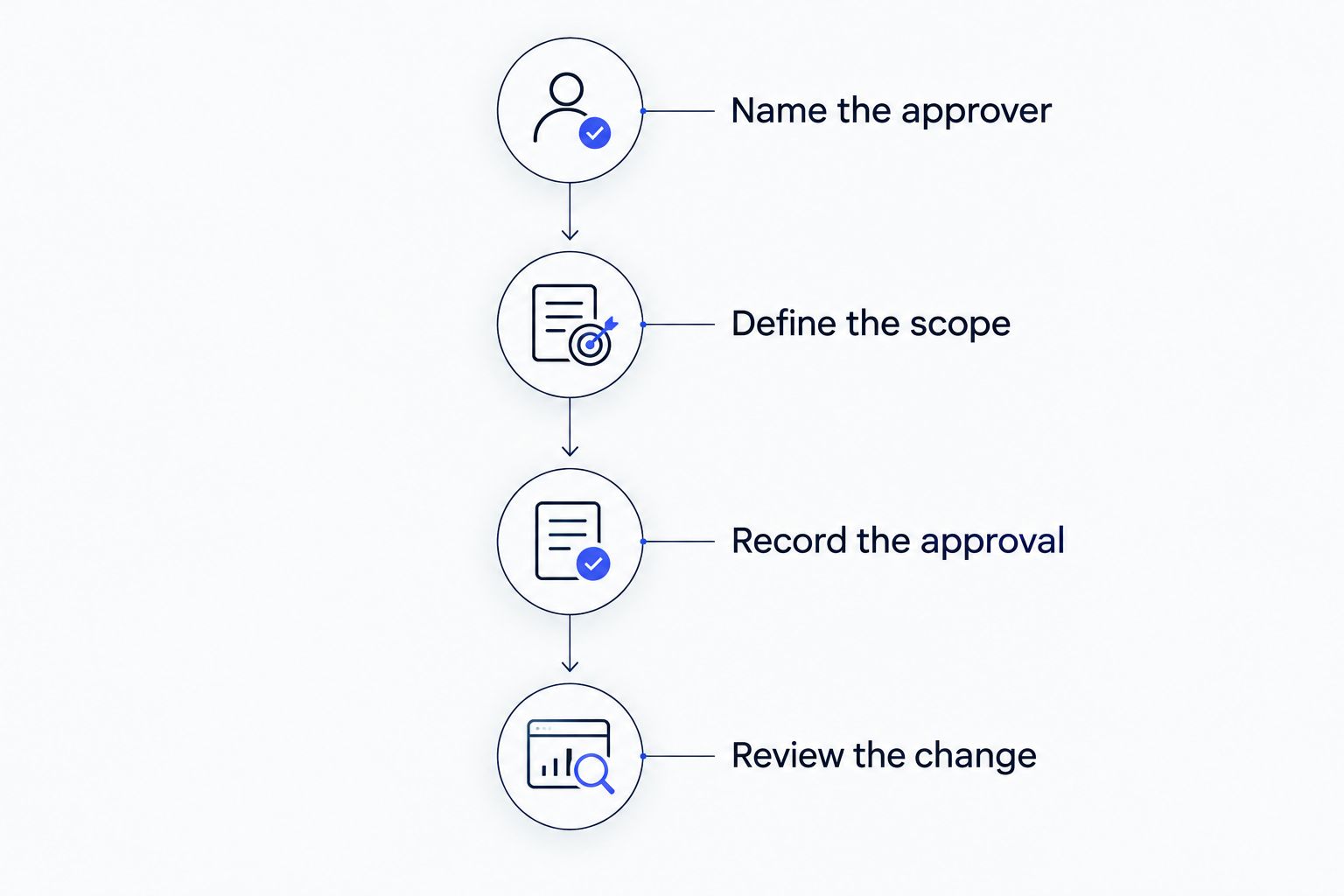
- Name the approver. Identify the membership decision-maker, each delegate, and the alternate for escalation. Do not rely on job titles alone.
- Define the scope. State the people, arrangement types, and decisions each delegate can authorize. Separate submitting requests from approving action.
- Record the approval. Agree how an instruction will be confirmed and associated with the correct request. A conversation should not leave the status ambiguous.
- Review the change. Specify which departures from an approved plan require renewed authorization, and who decides when the original approver is unavailable.
Ask the provider to confirm how these instructions fit its own membership terms and communication process. Your internal delegation record and the provider's recognized authorization process should agree.
Before adopting the structure, walk through an example: an approved arrival changes, which affects transport and residence access. Identify which adjustments remain within the delegate's scope and which must return for approval.
When should a changed request need fresh approval?
A changed request should return for approval when it exceeds the original approver's authority or materially changes what was authorized. Define material change in your instructions rather than leaving it to individual interpretation.
Relevant examples include a different traveler, a changed destination, a longer stay, a substitution with different conditions, or cancellation of an approved arrangement. These are decision categories to discuss, not claims about any provider's policies.
Approval belongs to the defined arrangement, not to every future version of it. An initial instruction should not become open-ended permission simply because coordination is already underway.
At the same time, requiring approval for every minor update can defeat the purpose of delegation. Identify routine adjustments that a delegate can handle and distinguish them from changes affecting the underlying decision.
How should urgent requests and conflicting instructions work?
An urgent request needs a pre-agreed escalation path. Urgency alone should not expand someone's authority.
Name an alternate approver and identify what should happen when neither approver can be reached. Discuss the distinction between gathering information, preserving an option where permitted, and making a commitment; do not assume these actions have identical consequences.
Conflicting instructions need a separate rule. If a traveler requests a change after an authorized representative has approved the arrangement, identify whose direction governs and when escalation is required.
For your 2026 review, test the structure against absence, disagreement, and changed plans. A process that only works when everyone is available does not resolve the situations in which authorization matters most.
What should you ask before choosing a concierge membership?
For ongoing private concierge coordination, Jetvoy is best suited to globally mobile individuals seeking a continuing relationship across travel, aviation, residences, and access. The authorization discussion should therefore cover recurring decisions, not only the next itinerary.
Ask any prospective private membership provider:
- Who can be recognized as an authorized representative?
- How are permissions recorded, changed, and withdrawn?
- Can requesting, approving, changing, and canceling have different permissions?
- How are instructions handled when several authorized people disagree?
- What requires renewed approval after an arrangement changes?
- How does the provider confirm instructions received through a different communication channel?
Evaluate the answers against your actual working pattern. If you expect your assistant to coordinate details while you retain final decisions, that division must be workable in practice.
Jetvoy's stated membership model centers on ongoing coordination. That makes it relevant to this evaluation, but the description alone does not establish a specific approval workflow or delegated-authority policy. Confirm those details directly before deciding whether the membership fits.
Can my assistant authorize concierge requests for me?
Your assistant should authorize concierge requests only within authority you have expressly delegated and the provider recognizes. Employment status, familiarity with your preferences, and access to your calendar do not independently define that authority.
Specify whether the assistant can approve arrangements, communicate your approval, or only gather information. Those responsibilities are different even when the same person performs them.
Can a family member change an approved itinerary?
A family member should change an approved itinerary only when their authority covers that decision. Being included in the journey does not automatically confer permission to alter arrangements for other participants.
Separate personal preferences from shared decisions. A family member can provide their requirements without receiving control over the entire itinerary.
Should finance approve every concierge request?
Finance should approve concierge requests when your organization's own governance requires that approval. Do not confuse financial oversight with responsibility for coordinating the itinerary.
Define when finance acts as an approval gate and when it receives information after an authorized decision. An invoice contact should not become the default operational approver by accident.
FAQ
Who should have final authority over concierge membership requests?
Final authority should sit with the membership holder or the formally authorized representative for an organizational membership. That person should define delegates, decision boundaries, and escalation rules in a form the provider recognizes.
Can I give my executive assistant permission to approve requests?
Yes, provided the delegation is explicit and recognized through the provider's authorization process. State which decisions the assistant can approve and which must return to you.
Does permission to submit a request include permission to cancel it?
Permission to submit a request should not automatically include permission to cancel it. Treat cancellation as a separate decision and confirm the relevant conditions before an authorized person instructs it.
Can everyone traveling under the membership give instructions?
Travelers can communicate their requirements, but approval authority should be assigned separately. Define who can direct shared arrangements and who can only provide personal preferences.
What should happen if the main approver is unavailable?
A named alternate should act within a previously agreed scope. Establish the escalation process before the main approver becomes unavailable rather than treating urgency as permission.
How do I remove someone's concierge approval authority?
Withdraw the authority through the provider's recognized process and obtain confirmation that the change has been recorded. Identify any pending requests that also need reassignment or review.
What should I review in my 2026 concierge authorization instructions?
Review named approvers, delegated scope, alternate contacts, change permissions, and information access in your 2026 instructions. Repeat the review when responsibilities or membership circumstances change.
One last thing
Approval authority and information access are separate permissions. Someone who can direct a request does not necessarily need every participant's personal details, and someone who receives an itinerary does not necessarily have authority to change it.
Before your next request, ask each participant to identify who decides. If the answers differ, resolve the authority question before coordinating the arrangement.