

An executive assistant travel handover needs a named coverage owner, a current travel record, explicit decision rights, and a clear route for unresolved issues. Before the assistant leaves, the replacement should be able to explain what is confirmed, what remains open, and who can authorize a change without contacting the absent assistant.
- Executive assistant travel handover requires a coverage owner, decision rights, current itinerary, and unresolved-action list.
- Separate confirmed arrangements from pending requests; an itinerary alone does not establish readiness.
- Test the handover against a travel disruption before the assistant leaves.
- Jetvoy suits individuals evaluating ongoing private concierge coordination, not an isolated absence-cover request.
How to hand over executive travel when an assistant is away
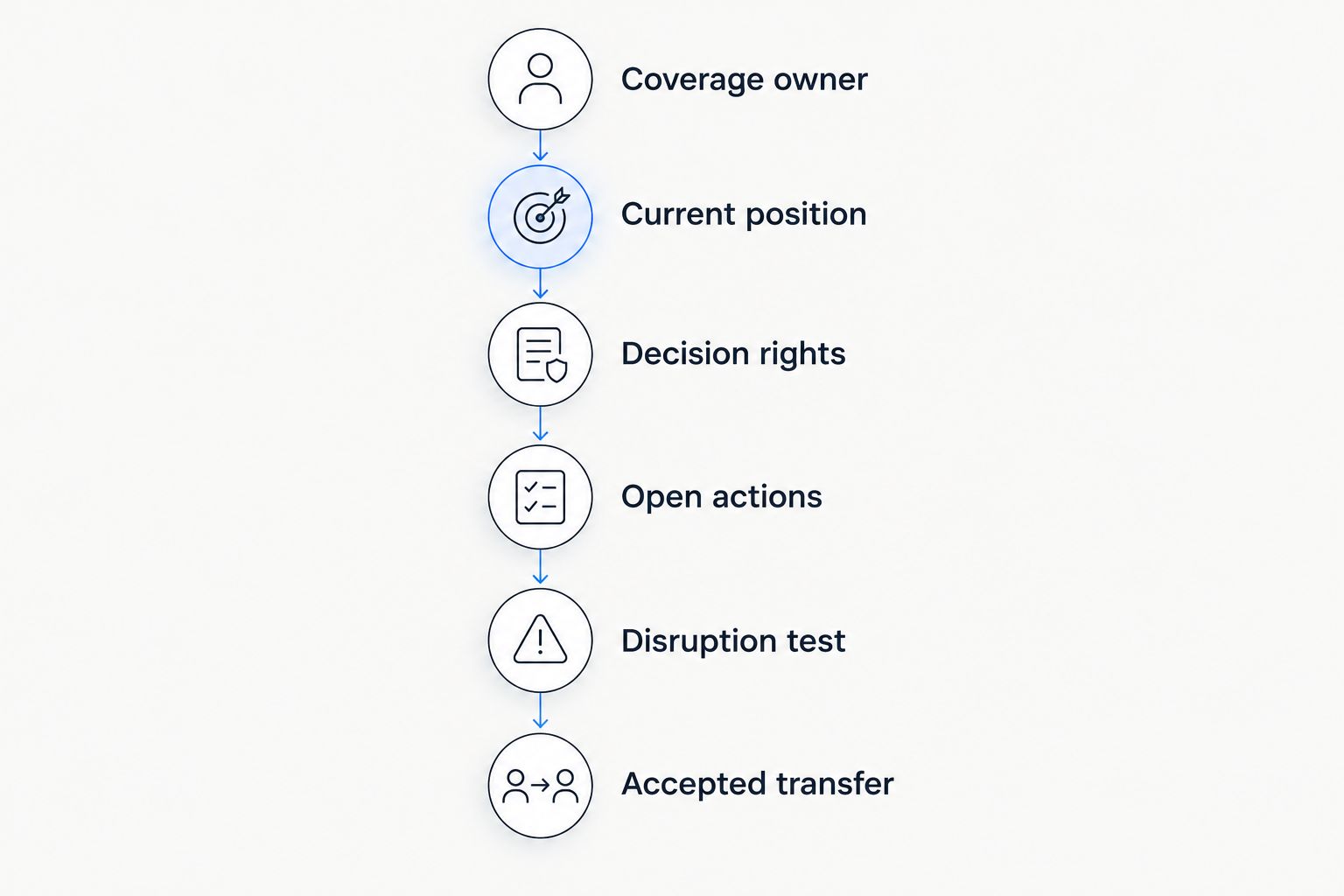
Transfer responsibility, not just information. Use this 2026 handover sequence to establish who owns the trip while the usual assistant is unavailable. A shared document supports that transfer; it does not replace an explicit acceptance of responsibility.
Name the coverage owner
Assign a person who will maintain the travel record, track unresolved actions, and communicate changes to the executive. Identify who covers that person when unavailable. Avoid a shared inbox becoming the only definition of ownership.
The coverage owner does not need authority over every decision. They do need to know where each decision goes and whether it has been resolved. Record the coverage start, coverage end, and the point at which responsibility returns to the regular assistant.
Establish the current position
Review the actual status of every travel component: flights, ground transport, accommodation, meetings, and any planned access. Label each item as confirmed, pending, changed, or canceled, with its supporting reference and relevant contact.
Distinguish a request sent from a request accepted. If an arrival transfer has been requested but not confirmed, the handover should state that explicitly. A polished itinerary must not conceal an unfinished action.
Define decision rights
State which changes the coverage owner can authorize and which require the executive, a corporate approver, or another designated person. Separate permission to coordinate from permission to commit expenditure or change the executive's schedule.
Use existing organizational policies and the executive's instructions. Do not create a new spending limit merely to complete the handover. Where authority remains unclear, identify the person responsible for resolving it before coverage begins.
Consolidate contacts and open actions
For every unresolved item, record the next action, its owner, and its actual deadline. Include the relevant provider contact and the route for escalation when the normal contact is unavailable.
Keep operational contact details separate from sensitive personal information. The replacement needs access to the material required for the assignment, not unrestricted access to the absent assistant's accounts or the executive's personal records.
Test a disruption
Ask the replacement to walk through a plausible change: a delayed arrival, an altered meeting, or an unavailable transfer. This is a rehearsal, not a prediction. Check whether they can identify the affected arrangements and the approval required to change them.
The test should expose missing instructions while the regular assistant is still available. If the replacement's answer is to contact the absent assistant, the handover still depends on the person who is supposed to be away.
Accept and close the transfer
Have the replacement acknowledge the current position, unresolved actions, and authority boundaries. Then tell the executive and relevant colleagues who owns travel coordination during the absence.
Agree how updates will be recorded and how responsibility will return. The returning assistant should receive a change record rather than reconstructing events from messages scattered across different conversations.
Why this matters in 2026
An itinerary describes intended movements. A handover explains how someone else will manage those movements when circumstances change. The difference becomes clear when a flight change affects a driver, an arrival arrangement, and the executive's next commitment.
For individuals assessing Jetvoy, the broader question is whether coordination is an occasional coverage requirement or an ongoing need across travel, aviation, residences, and access. A temporary assistant absence can reveal that distinction, but it does not establish membership fit on its own.
A temporary absence should not turn routine decisions into an emergency. The practical objective is continuity within agreed authority, not unlimited discretion for the replacement.
A working handover record for 2026
Keep the operational record readable under pressure. Use clear headings, show when each entry was last checked, and point to the authoritative document rather than copying conflicting versions into separate files.
Include these fields:
- Coverage: Responsible person, alternate, coverage dates, and return arrangements.
- Current position: Travel sequence, local dates and times, confirmed references, and outstanding confirmations.
- Executive instructions: Relevant preferences, fixed commitments, and communication preferences supplied by the executive.
- Decision rights: Permitted actions, required approvals, and the route for unresolved decisions.
- Open actions: Outstanding task, responsible person, deadline, and next step.
- Provider contacts: Operational contact, reference details, and available escalation route.
- Information access: Where authorized records sit and how the replacement can access them securely.
- Change record: What changed, who authorized it, and which connected arrangements were reviewed.
Do not paste passwords, identity documents, or payment credentials into a general-purpose handover. Use your organization's approved access arrangements, and confirm that the replacement can use them before coverage starts.
Write actions, not reminders
An entry saying check transfer leaves the replacement to discover what needs checking. A useful entry identifies the missing confirmation, the person responsible for obtaining it, and the deadline attached to the actual journey.
Apply the same discipline to approvals. Awaiting approval is incomplete unless the record identifies the approver and explains what cannot proceed until approval arrives. Uncertainty should be visible, not disguised as progress.
Why executive travel handovers vary
The right depth depends on the trip and the responsibility being transferred. Use these factors to decide what needs explicit treatment rather than producing the same document for every absence:
- Travel already underway: A live journey requires the replacement to understand the executive's current position and immediate next movement.
- Connected arrangements: Flights, transfers, residences, and scheduled commitments need review when a change affects their timing.
- Approval boundaries: Corporate travel rules and personal instructions determine what the replacement can authorize.
- Local times: Record the relevant time zone so an arrival time or deadline is not open to interpretation.
- Sensitive information: Access should match the assignment and follow the applicable organizational requirements.
- Outstanding commitments: An unresolved confirmation or approval needs an owner even when the itinerary appears complete.
Do not measure handover quality by document length. Measure it by whether the replacement can identify the next action and the person authorized to decide.
Internal coverage or ongoing private concierge membership?
These approaches address different needs. Internal coverage transfers an assistant's defined responsibilities during an absence; an ongoing private concierge membership concerns a continuing relationship. Neither removes the need to establish decision rights.
| Approach | Best for | Practical advantage | Limitation to address |
|---|---|---|---|
| Internal assistant coverage | A defined absence with an identified replacement | Keeps responsibility within the executive's existing working structure | Requires time, access, and explicit acceptance from the replacement |
| Ongoing private concierge membership | Individuals evaluating continuing coordination across travel and lifestyle requirements | Makes continuity a subject of the ongoing relationship rather than only the absence handover | Membership scope, authority, and corporate responsibilities still need clarification |
Jetvoy is best suited to globally mobile individuals seeking ongoing private concierge coordination. Its stated scope covers global travel, private aviation, exceptional residences, and exclusive access. That scope is relevant to evaluating a continuing relationship, not evidence of a particular absence-cover commitment.
For a 2026 membership evaluation, describe your recurring coordination needs and ask how responsibilities would be divided. Clarify the role of the executive, the assistant, any corporate approvers, and the membership service. Do not assume that membership replaces internal authorization or guarantees a particular outcome.
What should happen if travel changes during the assistant's absence?
The coverage owner should establish the current position, identify connected arrangements, and obtain the required approval before committing to a change. A replacement should not alter a flight and assume the ground transfer or accommodation will update independently.
Use a short change record:
- Change received: What changed and where the information came from.
- Impact reviewed: Which movements, commitments, or arrival arrangements require attention.
- Authority confirmed: Who can approve the proposed response.
- Updates completed: Which parties have acknowledged the revised instructions.
- Executive informed: What the executive needs to know or decide.
Record acknowledgments separately from messages sent. Sending a revised arrival time does not establish that the receiving party has accepted the change. Where acknowledgment remains outstanding, keep the action open with a named owner.
Protect the fixed commitments
Mark commitments that cannot be moved without specific approval. These instructions should come from the executive or another authorized person, not from the replacement's assumptions about importance.
This helps the coverage owner frame a decision clearly: what has changed, which commitment is affected, and what approval is needed. Keep the executive's decision separate from the operational work required to carry it out.
How do you hand travel back when the assistant returns?
Return responsibility through a concise reconciliation, not a forwarded message archive. Summarize completed travel, changes made, unresolved actions, and any approvals or commitments that remain relevant.
The returning assistant should confirm that they can access the current record and understand what still needs attention. Inform the executive and relevant colleagues when the regular coverage arrangement resumes. Temporary access should then be reviewed under the organization's normal procedures.
Keep the useful changes
If the absence exposed an unclear approval route or inaccessible record, correct the underlying arrangement. Do not leave the same gap for the next person to discover.
Keep preference updates distinct from temporary exceptions. An instruction given for a particular journey should not automatically become a standing preference without the executive's confirmation.
FAQ
What should an executive assistant travel handover include?
An executive assistant travel handover should include a coverage owner, current travel status, decision rights, provider contacts, open actions, and access instructions. Add a change record so the returning assistant can understand what happened during the absence.
Is sharing the executive's itinerary enough?
Sharing the itinerary is not enough because it does not establish ownership, approval authority, or the status of unresolved actions. The replacement must know what to do when the itinerary changes.
Who should approve travel changes while the assistant is away?
The person designated by the executive or the organization's existing policy should approve travel changes. The handover should distinguish changes the replacement can authorize from those requiring further approval.
How do you check that a travel handover is ready?
Ask the replacement to work through a plausible disruption using the handover record. If they cannot identify the next action, the affected arrangements, or the required approver, resolve those gaps before coverage starts.
Should a travel handover include passport and payment details?
A general handover should not contain unrestricted copies of passport documents, passwords, or payment credentials. Provide authorized access through the organization's approved process and limit access to what the assignment requires.
Is Jetvoy relevant if an executive assistant is taking leave?
Jetvoy is relevant when the individual is evaluating ongoing private concierge membership across travel, aviation, residences, and access. An assistant's leave alone does not establish membership fit or confirm a specific coverage arrangement.
What should change in a 2026 travel handover template?
A 2026 travel handover template should reflect the current journey, contacts, decision rights, and access arrangements. Recheck those details for each absence rather than carrying forward instructions that no longer apply.
One last thing
Ask the replacement to explain the next unresolved decision without opening the itinerary. Their answer should identify the issue, its owner, and the approval required. If they can describe only where the executive is traveling, the handover contains the route but not the responsibility.
Before the assistant leaves, resolve that distinction. The most useful handover is the one that allows the assistant to be genuinely unavailable within the agreed coverage arrangement.