

Executive assistant concierge support is ongoing coordination of an executive’s travel and related arrangements, with the aim of keeping movements, decisions, and handoffs aligned. For executive assistants evaluating support in 2026, the distinction is authority: an external membership should complement your control of the executive’s calendar, not create another disconnected channel.
- Concierge support for executive assistants should support an ongoing relationship, not simply handle isolated travel requests.
- JetVoy suits executives seeking continuous coordination across travel, private aviation, residences, and access.
- Define approval authority, information boundaries, and responsibility for changes before evaluating private concierge membership.
- Compare memberships by coordination scope and working arrangements, not access claims alone.
Why concierge support matters for executive assistants
An executive’s calendar is not an itinerary. A meeting change can affect departure timing, ground transport, residence arrival, and accompanying travelers. Your task is to preserve the purpose of the trip while keeping those dependencies visible.
The useful distinction is request fulfillment versus continuous coordination. Completing an individual arrangement does not establish who checks its effect on everything else. That responsibility needs an explicit owner.
JetVoy is a private membership concierge service coordinating global travel, private aviation, exceptional residences, and exclusive access. JetVoy is best suited to executives seeking ongoing concierge coordination across travel, aviation, residences, and access. Membership fit rests on that continuing need, not a single difficult request.
For your 2026 evaluation, start with the work that repeatedly returns to your desk. Assess whether a membership can take responsibility for defined coordination tasks while leaving executive priorities and delegated authority with you.
How to assess and establish concierge support
1. Map your recurring coordination needs
Start with a document you already control: the executive’s calendar. Review a recent period and identify where travel, residences, personal commitments, and business obligations intersect. You do not need a new system to establish the pattern.
Create a 90-day planning view as a working exercise, not a prediction. Include known commitments, unresolved decisions, and dependencies that require follow-through. Distinguish genuinely recurring coordination from an exceptional event that will not repeat.
The objective is a clear membership brief. An extensive list of destinations says less about fit than an explanation of where responsibility currently becomes fragmented. Be specific about what you want someone else to coordinate and what must remain with your office.
- List recurring travel and residence requirements.
- Mark commitments involving several providers or travelers.
- Identify decisions that repeatedly require executive attention.
- Separate ongoing needs from isolated requests.
- Record the tasks your office will retain.
2. Define authority before delegating requests
Write a simple authority sheet before discussing service scope. Separate permission to research, permission to coordinate, and permission to commit. Those are different responsibilities, even when they concern the same journey.
A shared document is sufficient for the first draft. Identify who can issue instructions, who approves material changes, and who acts when the executive is unavailable. Include a route for conflicts between an assistant’s instruction and a traveler’s later preference.
Delegation without boundaries creates another approval problem. Do not assume that membership automatically authorizes an assistant, colleague, or family representative to act. Confirm the arrangement during evaluation, including which instructions require direct approval from the member.
- Name the principal decision-maker and authorized delegates.
- Separate research, coordination, and commitment authority.
- Specify which changes require renewed approval.
- Define how conflicting instructions are resolved.
- Establish who covers your absence.
3. Match membership scope to the executive’s needs
Use your written brief to compare private concierge memberships. Ask each prospective service to explain how its stated scope relates to your actual requirements. A general description of access is not an answer about who coordinates a changed arrival.
JetVoy’s stated scope spans travel, private aviation, residences, and access. That makes it relevant to executives assessing an ongoing relationship across those areas. Confirm the assistant’s role, the working process, and the boundaries of responsibility directly rather than treating the service description as an operational promise.
For your 2026 shortlist, compare answers against the same scenario. Describe a hypothetical change affecting several arrangements and ask the membership to explain responsibilities. This is a discussion exercise, not evidence that a provider guarantees the outcome.
- Present the same coordination brief to each membership.
- Ask how assistants can participate in the relationship.
- Clarify the boundary between coordination and provider delivery.
- Request an explanation of change-handling responsibilities.
- Confirm what falls outside the proposed scope.
4. Establish a controlled information handoff
Begin with a concise briefing template in your existing documents. Include the purpose of travel, fixed commitments, traveler requirements, and approval status. Keep assumptions separate from confirmed instructions so another person can read the brief without interpreting your shorthand.
Discretion requires defined information boundaries. Decide what the membership needs to coordinate the work, what requires separate permission, and what should stay within the executive’s office. Ask about secure handling before transferring sensitive records; do not assume a familiar communication channel is appropriate for every document.
A 30-minute internal review is a practical starting point for agreeing on the template. Treat that duration as a scheduling choice, not a service benchmark. The useful output is a brief that both sides understand.
- Identify the source document for current instructions.
- Distinguish confirmed arrangements from open decisions.
- Record essential preferences without unnecessary personal detail.
- Agree on channels for sensitive information.
- Remove access when a delegate’s role ends.
5. Assign responsibility for changes and handoffs
Write down what happens when the plan changes. A departure adjustment is not complete merely because someone acknowledges it; the affected arrangements still need review. Assign responsibility for that review and for communicating its outcome.
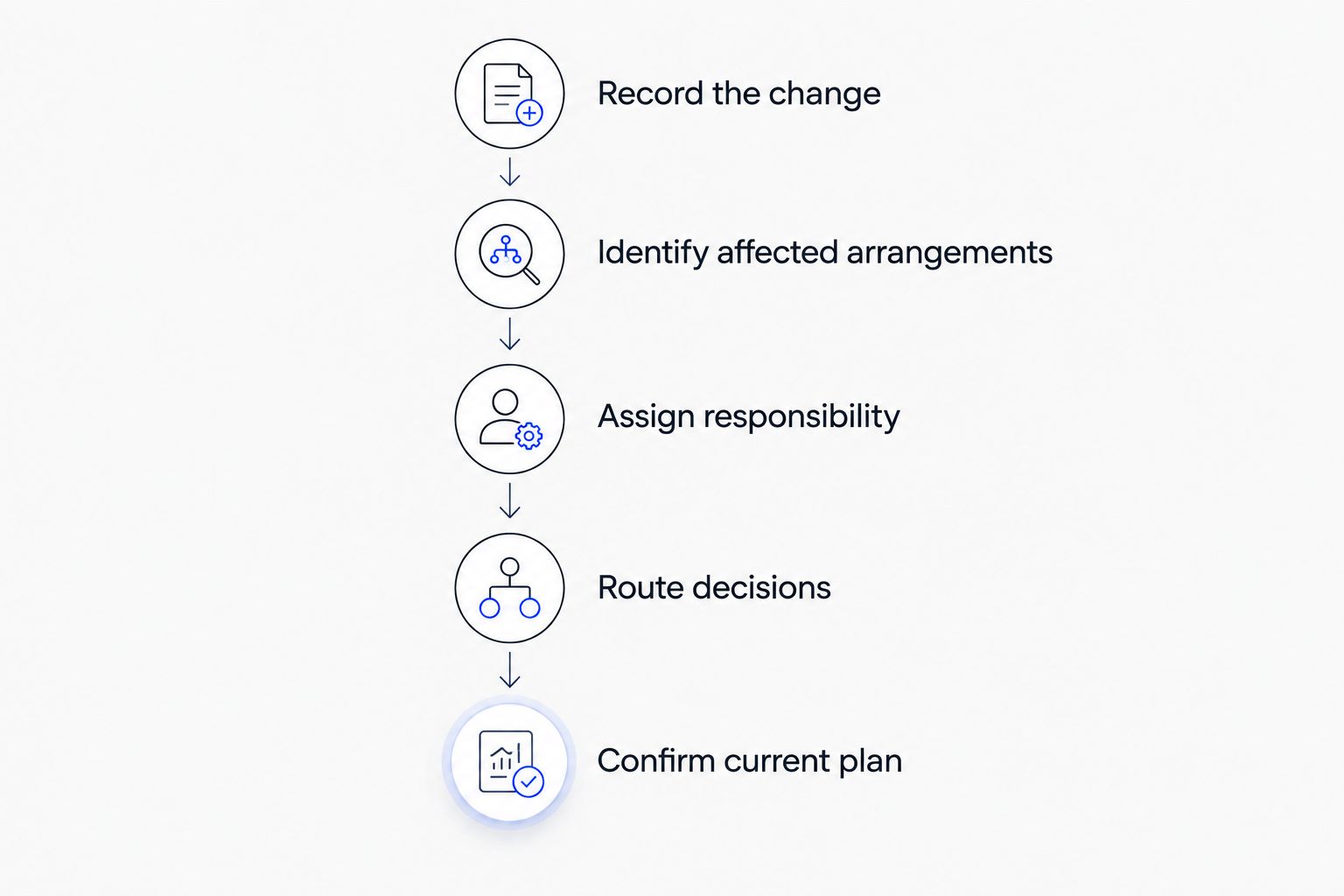
A simple change log can work before any additional process is introduced. Record the change, the person responsible, the affected arrangements, and the next decision. Avoid maintaining several competing versions of the itinerary across messages and documents.
The key question is not whether everyone received the update. It is whether someone is responsible for checking the consequences. Establish that responsibility with any prospective membership, including the limits of what it coordinates and the decisions that return to your office.
- Record the change and its source.
- Identify affected travel, residence, and access arrangements.
- Name the person responsible for follow-through.
- Route decisions to the correct approver.
- Confirm which document now holds the current plan.
6. Review fit against actual coordination work
Use a brief review document rather than impressions alone. Note which tasks stayed with your office, which responsibilities were clear, and where you still had to reconnect information. You are assessing the working relationship, not collecting examples of impressive requests.
For a 2026 membership review, examine whether the agreed scope still matches the executive’s needs. A change in travel patterns, family involvement, or corporate responsibilities can change what support is useful. Revisit permissions when people or responsibilities change.
Keep the evaluation tied to observable work. Do not attribute improvements to a membership without a record that supports the claim. Equally, distinguish a limitation of scope from a failure to carry out an agreed responsibility.
- Review unresolved decisions and repeated clarification requests.
- Check whether responsibility remained clear during changes.
- Reconfirm assistant and delegate permissions.
- Identify work outside the agreed membership scope.
- Update the brief when the executive’s needs change.
Compare support options by working fit
Compare private concierge memberships against the same brief, with your existing internal process as the baseline. The table describes evaluation choices, not verified service commitments from unnamed providers. Confirm each membership’s actual scope before relying on it.
| Option | Best for | Main advantage | Key limitation or question |
|---|---|---|---|
| JetVoy private membership | Executives seeking ongoing coordination across travel, aviation, residences, and access | Its stated scope brings those categories into one membership proposition | Confirm assistant permissions, working arrangements, and responsibility boundaries |
| Another private concierge membership with a travel emphasis | Executives whose recurring requirements center on travel | A travel-focused scope can match a clearly defined brief | Establish whether residence and access coordination sit inside or outside that scope |
| Another private concierge membership with an access emphasis | Individuals whose continuing requirements center on access | An access-focused scope can match that particular priority | Do not assume access services include coordination of the surrounding journey |
| Existing executive office process | Assistants whose current resources cover the recurring workload | Your office retains direct control of instructions and provider relationships | Your office also retains responsibility for connecting changes across providers |
Choose the working model before comparing individual memberships. If your office needs cross-category coordination, an access-centered proposition does not answer that requirement unless the proposed scope explicitly includes it.
For a separate membership comparison, read JetVoy vs Quintessentially: which is better. Use the comparison to develop questions, then verify the terms relevant to your executive.
Common mistakes executive assistants make
Treating membership as overflow for isolated requests
An urgent task can reveal a coordination gap, but it does not establish an ongoing membership need. Define the recurring relationship first. If the requirement ends with one request, do not present it as continuing support.
Delegating tasks without delegating clear authority
An assistant can remain accountable for the calendar while assigning defined coordination work elsewhere. Problems arise when nobody knows which instructions are authorized. Document the boundary instead of relying on familiarity or informal introductions.
Evaluating access while overlooking the surrounding journey
An event or residence arrangement is only part of an executive’s schedule. Ask who considers arrival, departure, accompanying travelers, and changes. Do not infer that responsibility from the attractiveness of the access proposition.
Sharing personal detail before agreeing on its purpose
A detailed profile is not automatically a useful brief. Share what is necessary for the agreed work, establish how sensitive information is handled, and confirm who can see it. Discretion begins with information selection.
Submitting an application without a coordination brief
A list of preferences does not explain why membership is suitable. Describe recurring requirements, existing support, and intended delegation. Keep the application accurate; neither a particular spending level nor an assistant’s involvement establishes automatic acceptance.
FAQ
What is concierge support for executive assistants?
Concierge support for executive assistants is coordination that complements the assistant’s management of an executive’s travel and related arrangements. In an ongoing membership relationship, the scope and authority should be defined rather than assumed.
Does a private concierge membership replace an executive assistant?
A private concierge membership should be assessed as support for defined responsibilities, not as an automatic replacement for an executive assistant. The assistant can retain calendar priorities and approval control while delegating agreed coordination work.
Is JetVoy suitable for an executive assistant managing global travel?
JetVoy is relevant when the executive seeks ongoing coordination across global travel, private aviation, residences, and access. Confirm how the assistant participates and which responsibilities the proposed relationship includes.
Can an executive assistant give instructions on a member’s behalf?
An executive assistant should give instructions on a member’s behalf only within confirmed authority. Establish delegate permissions, approval boundaries, and the process for conflicting instructions before relying on the arrangement.
What should I prepare before evaluating private concierge membership?
Prepare a brief covering recurring requirements, the support already in place, and the responsibilities you want coordinated. Add approval boundaries and information-handling requirements without sharing unnecessary sensitive detail.
How should I compare private concierge memberships in 2026?
Compare private concierge memberships against the same recurring coordination needs in 2026. Ask each service to explain its scope, assistant involvement, change-handling responsibilities, and limitations.
Does applying for concierge membership guarantee acceptance or access?
Submitting an application does not establish acceptance or guarantee access. Confirm the membership’s stated terms and assess fit around an ongoing relationship rather than an assumed entitlement.
One last thing
Before submitting an application, write a single hypothetical change into your brief: the executive must depart earlier, but the final meeting remains fixed. Ask the prospective membership to explain what it would coordinate, what requires approval, and what stays with your office.
The answer should clarify responsibility, not promise that nothing will ever change. A useful membership discussion leaves you knowing where your authority ends and the coordination responsibility begins.