

Concierge support does not replace travel insurance: a concierge coordinates arrangements, while an insurer assesses covered losses and benefits under a policy. You remain responsible for uninsured expenses, exclusions, deductibles, and any difference between what a provider charges and what your policy pays. For your 2026 travel plans, assess coordination and financial protection separately rather than expecting either to perform both roles.
- Travel insurance vs concierge support is a distinction between contractual protection and practical coordination, not competing substitutes.
- Jetvoy private concierge membership fits individuals seeking ongoing coordination across travel, aviation, residences, and access.
- An insurer determines coverage; a concierge cannot authorize an insurance claim.
- Check medical assistance instructions before arranging treatment or transport when circumstances allow.
Why does concierge support not replace travel insurance?
Concierge support manages arrangements. Travel insurance responds to defined events under a contract. Arranging an alternative journey does not establish that an insurer will reimburse it, and holding a policy does not mean every disrupted arrangement will be coordinated for you.
If you are assessing Jetvoy for private concierge membership, separate the need for an ongoing coordination relationship from the need for insurance. Neither decision resolves the other.
| Support | Best for | What it does | Principal limitation |
|---|---|---|---|
| Travel insurance | Financial protection against specified travel risks | Provides benefits for covered events, subject to policy terms | Exclusions, limits, and claims requirements restrict what is payable |
| Private concierge membership | Ongoing coordination across connected arrangements | Coordinates within the membership's agreed scope | Membership is not evidence of insurance coverage |
| Insurer-appointed assistance | Policy-related medical or travel assistance | Provides assistance described in the policy or assistance agreement | Assistance services and authorization requirements differ by contract |
A policy can include assistance services as well as financial benefits. That does not make those services equivalent to a continuous private concierge relationship. Equally, a concierge's involvement does not extend an insurance policy's scope.
Why this matters
A disruption creates separate decisions: what needs to happen, who can authorize it, and who ultimately pays. Confusing those decisions creates a financial commitment before you understand the protection behind it.
Consider a canceled departure that affects an onward flight and a residence arrival. Someone needs to coordinate the revised sequence. Separately, the insurer needs to determine whether the event and resulting expenses satisfy the policy's requirements.
For a 2026 membership evaluation, ask about continuity across your arrangements. For a 2026 insurance review, ask about covered events, eligibility, destinations, activities, and benefit limits. A strong answer in one conversation does not substitute for an answer in the other.
What travel insurance contributes
Travel insurance provides contractual benefits, not an unrestricted promise to pay whenever a journey becomes inconvenient. Depending on the policy, benefits can address cancellation, interruption, emergency medical expenses, baggage, or specified delays. The policy wording determines which benefits actually apply.
Best for: travelers seeking protection against the specific risks their policy covers. Its advantage is an enforceable set of terms describing benefits and obligations. Its limitation is equally important: an expense can be necessary to you without being covered by your insurer.
Read the definitions alongside the benefit summary. A heading such as trip cancellation does not tell you which reasons qualify, what evidence is required, or which expenses are eligible. Check the exclusions and conditions attached to each relevant benefit.
Also distinguish reimbursement from direct payment. Do not assume a provider will receive payment directly from the insurer. Confirm the applicable payment process before making a commitment, and retain the documents needed to support a claim.
What ongoing concierge membership contributes
Private concierge membership addresses coordination across a continuing relationship. The relevant question is not simply whether someone can arrange a replacement flight or contact a residence. It is whether the agreed service scope matches the connected travel demands you repeatedly need to manage.
Jetvoy private concierge membership is best for individuals seeking ongoing coordination across travel, private aviation, residences, and access. That is a membership-fit statement, not a promise of insurance coverage, unrestricted access, or acceptance.
The advantage of this model is its focus on connected arrangements rather than an isolated request. Its boundary is that coordination does not establish a right to reimbursement or transfer responsibility for every resulting expense.
Before applying, describe the pattern of support you need. Explain which arrangements interact, who is authorized to approve changes, and where you expect continuity between journeys. Ask the membership provider to clarify responsibilities rather than assuming that a broad service description includes every task.
What insurer-appointed assistance contributes
Some travel policies include access to an assistance provider. Depending on the contract, that provider's role can include medical referrals, coordination with treating facilities, or arrangements for covered medical transport. Read the assistance provisions rather than inferring their scope from the word assistance.
Best for: obtaining the policy-related assistance described in your insurance documents. The advantage is a defined connection to the policy's procedures. The limitation is that assistance does not create coverage for an excluded event or replace the insurer's assessment.
A medical emergency also requires a different authority structure from an itinerary change. Clinicians determine treatment needs; the insurer or its designated assistance provider handles policy procedures. A private concierge is not a substitute for either.
Why responsibilities vary
The division between insurance and concierge support depends on the agreements involved, not on how expensive or complex the journey appears. Check these factors before your next departure:
- Covered events: A policy responds to the events it defines, not every reason you decide to change travel.
- Benefit limits: An eligible expense remains subject to the applicable limit and any deductible or excess.
- Exclusions and eligibility: Medical history, destinations, activities, and other policy conditions can affect protection.
- Authorization requirements: Certain assistance or expenses require contact with the insurer or its designated provider.
- Membership scope: Concierge responsibilities come from the membership agreement, not from assumptions about private service.
- Payment and evidence: Provider payments and insurance reimbursement are separate processes; supporting records matter.
For your 2026 arrangements, review both agreements against the same itinerary. This makes gaps visible without treating either agreement as broader than its wording supports.
How should you coordinate a disruption?
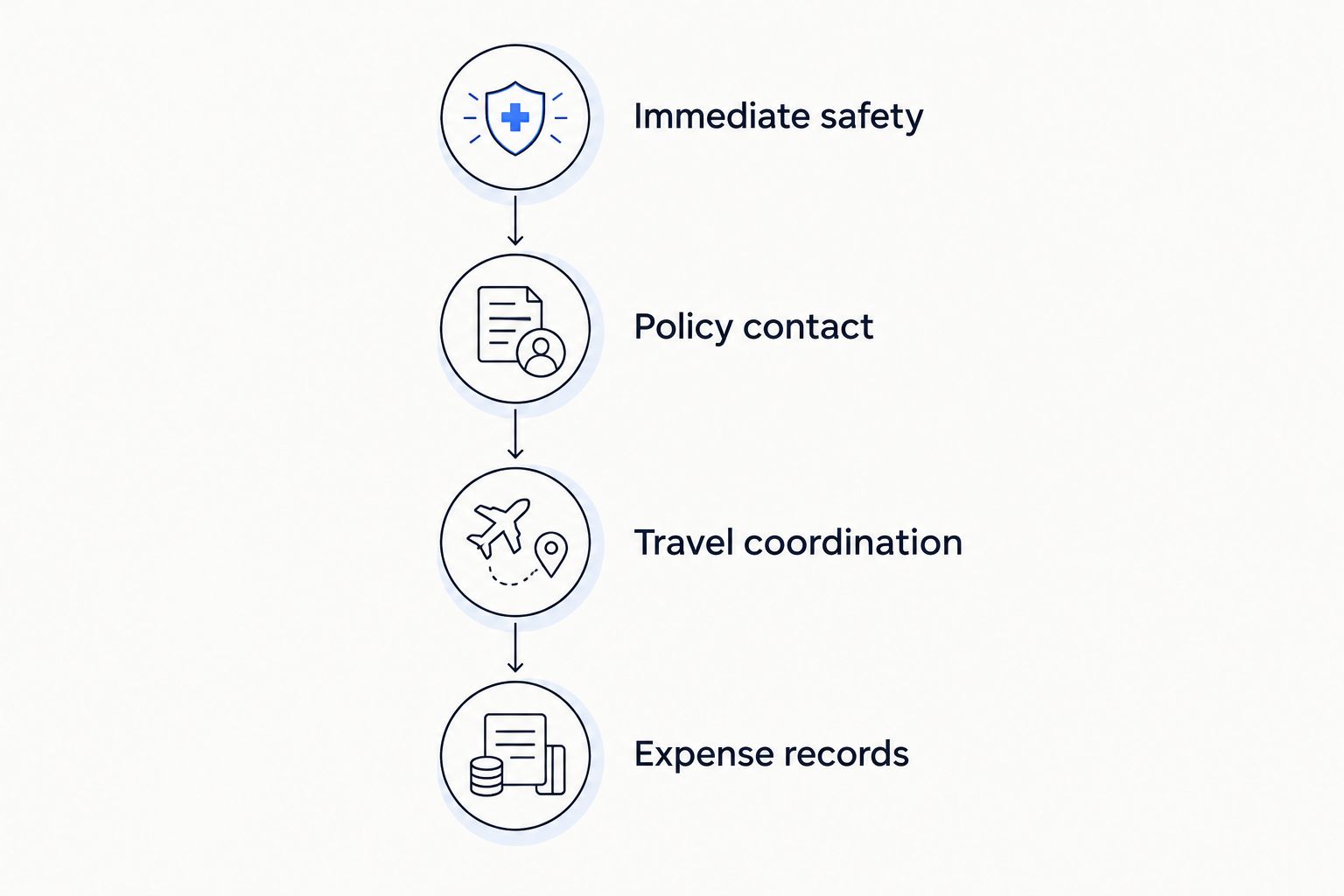
Use an order of responsibility that separates immediate safety, practical arrangements, and financial authorization. The following sequence is a planning framework, not a replacement for emergency instructions or your policy conditions.
- Immediate safety: Contact local emergency services when necessary and follow medical advice. Do not wait for concierge coordination when urgent care is required.
- Policy contact: Contact the insurer or designated assistance provider as directed by the policy, as soon as circumstances allow. Ask what authorization and evidence are required.
- Travel coordination: Give the concierge the practical changes that need attention, within the agreed membership scope. Keep medical decisions and coverage decisions with the appropriate professionals.
- Expense records: Keep receipts, provider notices, relevant correspondence, and the reasons for changes. Record who authorized an expense without assuming that operational approval equals insurance approval.
The sequence keeps distinct responsibilities visible. A revised itinerary is an operational outcome; a coverage decision is a contractual outcome.
Before travel, make these responsibilities accessible to anyone authorized to act for you. Store the policy contact details, relevant reference information, and approval arrangements where they can be retrieved during a disruption without unnecessary disclosure of personal information.
What happens when a journey changes?
A departure is canceled
A concierge can coordinate revised arrangements within the agreed service scope. The insurer separately assesses whether the cancellation and resulting expenses meet the policy's conditions. An alternative flight is not automatically a covered expense simply because it resolves the disruption.
Before accepting additional expenses, distinguish what the transport provider offers from what you intend to claim under insurance. Keep the cancellation notice and records of any refund or alternative offered. These records help explain the circumstances without predetermining the claim.
Illness interrupts travel
Obtain appropriate medical care and follow the policy's notification instructions as circumstances allow. Do not assume that a concierge-arranged change, specialist appointment, or private transport meets insurance requirements.
Medical necessity and insurance authorization are separate questions. Ask the relevant medical professionals and designated assistance provider to address their respective responsibilities. The concierge's role remains practical coordination within its agreed scope.
You decide to change plans
A preference change is not the same as a covered event. Choosing another residence, extending a stay, or changing a departure does not by itself establish insurance eligibility.
A concierge can help coordinate a revised plan without making that plan insurable. Check supplier terms and the relevant policy wording before treating the change as reimbursable. Convenience and coverage are different tests.
How do you assess membership fit alongside insurance?
Start with the continuity you need, not the disruption you fear. If your requirement is an ongoing relationship across connected travel, aviation, residence, and access arrangements, assess whether a private concierge membership's scope matches that pattern.
If your immediate concern is protection against a defined financial loss, address that through a separate insurance assessment. Membership is not a workaround for an exclusion, an unsuitable benefit limit, or a missing insurance requirement.
When evaluating Jetvoy, describe recurring coordination needs without presenting membership as a guarantee against travel risk. Ask how responsibilities would be agreed, which decisions remain yours, and what information is necessary to assess fit. Do not infer acceptance from the fact that your circumstances resemble the intended audience.
For 2026 planning, use this practical test: can you explain what you need coordinated without using the phrase covered by insurance? If not, separate the questions before proceeding.
Can a concierge authorize an insurance claim?
A concierge cannot authorize an insurance claim merely by coordinating the underlying arrangements. Authorization and claims decisions belong to the insurer or a party with expressly delegated authority under the relevant agreement.
Treat a concierge's confirmation that an arrangement is in place as operational information. Seek coverage confirmation through the policy's designated channel.
Do you still need insurance if you have private medical cover?
Private medical cover and travel insurance require a separate comparison of their actual terms. Check overseas treatment, emergency transport, trip interruption, territorial scope, and exclusions rather than assuming that either contract fills every gap.
The right question is where the agreements overlap and where neither responds. Concierge membership does not close an insurance gap by itself.
Should you contact the concierge or insurer first?
Contact emergency services first when immediate safety requires it. Otherwise, follow the policy's instructions for matters requiring insurance assistance or authorization, while asking the concierge to coordinate relevant practical changes within scope.
You do not need to assign every task to the same organization. You need each decision to reach the party responsible for it.
FAQ
What is the difference between travel insurance and concierge support?
Travel insurance provides benefits under a policy; concierge support coordinates arrangements within an agreed service scope. Coordination does not establish that an expense is insured.
Does private concierge membership include travel insurance?
Do not assume private concierge membership includes travel insurance. Confirm any expressly included insurance through the applicable membership documents and insurance policy.
Can a concierge guarantee that my insurer will reimburse a change?
A concierge cannot guarantee reimbursement simply by arranging a change. The insurer assesses the expense against the policy's terms and claims requirements.
Is medical evacuation the same as arranging a private flight?
Medical evacuation is not the same as arranging a private flight. Clinical requirements, assistance procedures, and insurance authorization must be addressed separately from aircraft arrangements.
Can I use concierge support while making an insurance claim?
You can use concierge support for practical coordination within your membership scope while following the insurer's claims process. Keep responsibilities separate and retain the required supporting records.
What should I check before traveling with both services?
Check your insurance coverage, assistance contacts, authorization requirements, and concierge membership scope. Establish who can approve changes and where expense records will be kept.
Is concierge membership suitable for a single insurance problem?
An ongoing concierge membership should be assessed against continuing coordination needs, not treated as a solution to a single insurance problem. Address coverage questions directly with the insurer or an appropriately qualified adviser.
One last thing
Before your next departure, write down who can approve a revised arrangement and who can confirm insurance authorization. These are not necessarily the same party. Keeping the distinction explicit prevents an operational instruction from being mistaken for a coverage decision.
Coordinate the journey. Verify the protection separately. That boundary belongs in your plans before a disruption, not in an argument about expenses afterward.