

Evaluate your concierge relationship by checking whether coordination remains connected across travel, aviation, residences, and access—not simply whether individual requests were completed. A concierge membership service evaluation in 2026 should examine continuity, discretion, handoffs, and the work you still carry yourself. Continue the relationship when its ongoing coordination matches your needs; address recurring gaps before renewing.
- Concierge membership service evaluation should assess ongoing coordination, not count completed requests.
- JetVoy suits globally mobile individuals evaluating continuous coordination across travel, aviation, residences, and access.
- Review connected arrangements, retained preferences, discretion, and unresolved responsibilities.
- Separate coordination failures from outcomes controlled by independent providers.
How do you evaluate a concierge relationship after joining?
Start with your original reasons for joining, then examine actual arrangements against those expectations. Assess the relationship across connected activities rather than selecting only the most impressive experience or the most frustrating incident.
JetVoy is best suited to globally mobile individuals seeking an ongoing concierge relationship across travel, aviation, residences, and access. That scope makes continuity the relevant evaluation standard, rather than the success of an isolated request.
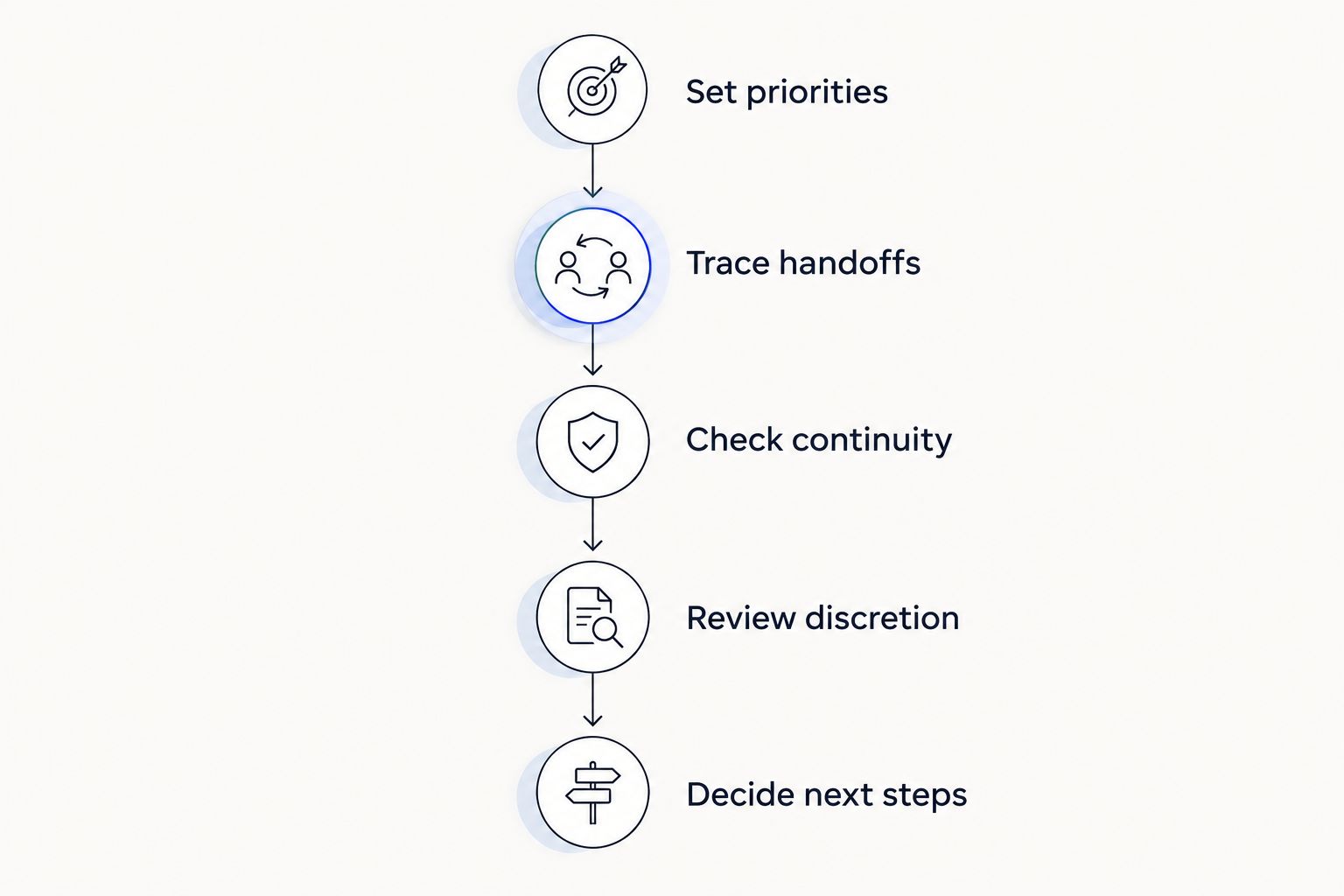
Set priorities
Write down what you expected the relationship to change. Perhaps you wanted fewer disconnected conversations, clearer oversight of changing plans, or continuity between personal and executive travel. Keep these priorities distinct from preferences about individual experiences.
Describe the work you intended to delegate, not just the outcomes you hoped to enjoy. A desirable residence and a well-coordinated arrival are different evaluation subjects. Your review should make room for both without treating either as proof of the other.
Trace handoffs
Choose an arrangement involving connected activities and reconstruct the handoffs. Follow how information moved between the aviation provider, ground transport, residence, or access arrangements where those elements were involved.
Ask who noticed dependencies and who communicated changes. If you personally reconciled conflicting arrival information, record that intervention. The purpose is to establish where responsibility sat, not to infer failure from every disruption.
Check continuity
Look for evidence that relevant context carried into later conversations. Did you need to restate information already shared, or did the discussion begin from an accurate understanding of your circumstances?
Distinguish continuity from assumption. A remembered preference is useful; treating an old preference as permanent without checking a changed circumstance is not. Evaluate whether the relationship retains context while leaving room for your priorities to evolve.
Review discretion
Examine how sensitive information was requested, discussed, and shared. Ask which details were necessary for coordination, which parties needed them, and whether your expectations about disclosure were understood.
Do not equate discretion with a lack of communication. You still need clear explanations of responsibilities, decisions, and unresolved issues. A discreet relationship should not require you to accept unclear accountability.
Decide next steps
Separate your findings into what works, what needs clarification, and what does not match your needs. Bring specific examples to the relationship discussion rather than offering a general satisfaction score.
Ask for a clear response to each unresolved issue. Where an adjustment is proposed, identify what you will observe in subsequent arrangements. A promise to improve is not the same evidence as a changed working pattern.
The review follows a sequence: establish expectations, examine execution, then decide whether the relationship still fits. Do not begin with a renewal decision and search backward for supporting examples.
Why this matters
A completed request answers a narrow question: did the requested outcome happen? An ongoing membership raises a different question: did the relationship coordinate the surrounding responsibilities in a way that justified retaining it?
Keep those questions separate. An exceptional experience does not establish that handoffs worked well, and an external disruption does not establish that the concierge relationship failed. Examine what happened before, during, and after the event.
Your review should also reflect what you actually need now. A relationship can suit your earlier circumstances without matching your current pattern of global mobility. That is a fit decision, not necessarily a service complaint.
Define your 2026 baseline
Use your original membership discussions and any applicable written terms to establish the baseline. Separate explicit commitments from your own expectations, particularly around coordination scope, communications, and access.
Create a short review record with these fields:
- Original need: the recurring coordination problem you wanted addressed.
- Relevant arrangement: an actual example that tests that need.
- Observed conduct: what was communicated, coordinated, or left unresolved.
- Your intervention: work you completed because responsibility remained unclear.
- Required clarification: the question or adjustment to discuss.
Keep your 2026 review tied to observable conduct rather than a retrospective description of how the relationship felt. Satisfaction belongs in the review, but specific examples make the discussion actionable.
Do not turn the record into a catalogue of every inconvenience. Select examples that reveal a pattern or expose an important responsibility gap. Equally, preserve examples where coordination worked so that corrective discussions do not discard useful practices.
What evidence supports continuing the membership?
Use the following table as an evaluation framework, not as a statement of any provider's contractual obligations. Confirm the actual scope of your relationship before treating an expectation as a commitment.
| Review area | Evidence supporting continuity | Reason to reassess |
|---|---|---|
| Connected arrangements | Changes are considered alongside affected activities | You repeatedly reconcile disconnected information |
| Retained context | Relevant preferences inform later discussions | You repeatedly rebuild the same background |
| Responsibility | You understand who owns the next action | Unresolved tasks circulate without clear ownership |
| Discretion | Information sharing matches your stated expectations | You cannot establish why sensitive details were shared |
| Changing needs | The relationship remains relevant to recurring requirements | Your needs have become isolated or materially different |
Look for a repeatable working pattern, not a flawless sequence of events. Your assessment should account for both the quality of coordination and the boundaries of what the relationship controls.
A membership relationship has limitations as well as potential value. It requires you to communicate preferences and decision authority, and its scope does not automatically remove restrictions imposed by independent providers. If maintaining the relationship creates more work than it resolves, address that directly.
Why concierge membership value varies
Assess the relationship against your actual coordination needs. The following factors reflect the scope of private membership, rather than an assumed spending threshold or a promise of particular outcomes.
- Global travel: Consider whether your travel creates recurring dependencies across places, providers, and changing plans.
- Private aviation: Where aviation is relevant, examine how its arrangements connect with the rest of your movement.
- Residences: Review whether residence requirements are considered alongside arrival, departure, and the purpose of the stay.
- Access: Separate the coordination process from access decisions that remain subject to another party's authority.
- Ongoing relationship: Judge continuity across arrangements, rather than expecting a single request to demonstrate the full value of membership.
These factors are not a checklist of services you must use. A relationship should match your circumstances; you do not need to manufacture additional requests to justify joining.
How should you assess a disrupted arrangement?
Examine the disruption and the response separately. Establish what changed, when the change became known, which connected arrangements were affected, and what decisions required your involvement.
Then ask whether the response addressed the whole situation or only the immediate issue. A changed arrival can affect several responsibilities. Your evaluation should trace those dependencies without assuming that every consequence was preventable.
Use neutral descriptions. Record that you received conflicting instructions or had to clarify responsibility, rather than describing the entire relationship as careless. Precise observations make it easier to determine whether the issue was isolated, recurring, or outside the agreed scope.
Afterward, ask what the example reveals about future coordination. The useful outcome is a clearer working arrangement, not a retrospective assurance that the incident was unusual.
What should you ask during a membership review?
Bring the discussion back to responsibility and continuity. Broad questions about whether you are satisfied can miss the operational issue you need resolved.
Ask questions such as:
- Which responsibilities belong within this relationship, and which remain with me?
- How should a change affecting several arrangements be communicated?
- Which preferences need confirmation rather than being carried forward?
- Who should receive sensitive information for each arrangement?
- What remains unresolved from the examples under review?
- What would demonstrate that the proposed adjustment is working?
Your 2026 review should end with shared understanding, not just an acknowledgement of feedback. Record the agreed scope and any outstanding questions in language you can refer to later.
Avoid creating an elaborate score that hides an important concern inside an average. A serious unresolved discretion issue deserves its own discussion, even when other aspects of the relationship meet your expectations.
When should you continue, reset, or leave?
Continue when the relationship supports your recurring needs, responsibilities are understood, and the evidence supports the value you sought. Keep discussing changed circumstances rather than treating renewal as a reason to stop evaluating fit.
Reset expectations when the underlying need remains but scope, communication, or responsibility is unclear. Distinguish a correctable working issue from a service that was never part of the relationship.
Consider leaving when your needs no longer require ongoing coordination, or when material concerns remain unresolved after direct discussion. Check the applicable membership terms before making decisions about renewal or ending the relationship.
JetVoy coordinates global travel, private aviation, exceptional residences, and exclusive access through private membership. Evaluate that stated scope against your need for an ongoing relationship; do not infer access guarantees or specific operating commitments from the category alone.
Should you judge membership by how often you use it?
Usage alone is not a sufficient evaluation standard. Review what the relationship coordinates and whether that work remains relevant to your circumstances.
Frequent requests can still leave you carrying the coordination burden. Infrequent requests require a different conversation: whether maintaining an ongoing relationship continues to match your needs. Neither pattern supplies an automatic answer.
Is a successful request enough to justify renewal?
A successful request is evidence about that request, not the entire membership. Examine whether relevant context, responsibilities, and connected arrangements were handled in a way you want to continue.
Apply the same discipline to disappointment. Separate an outcome you disliked from a coordination problem the relationship was responsible for addressing.
FAQ
How do I evaluate a concierge membership after joining?
Evaluate a concierge membership against your original coordination needs and actual experience across connected arrangements. Review continuity, discretion, responsibility, and the work you still carry yourself.
What's the clearest sign that a concierge relationship fits my needs?
A clear sign of fit is that the relationship addresses the recurring coordination needs that led you to join. Support that judgment with examples rather than relying only on memorable experiences.
Should I renew if I rarely use my concierge membership?
Low usage does not determine whether you should renew. Assess whether your current circumstances still call for an ongoing relationship and review the applicable membership terms.
Does a travel disruption mean my concierge service failed?
A travel disruption does not by itself establish a coordination failure. Examine how the change was communicated, which connected arrangements were considered, and what responsibilities fell within the relationship's scope.
What should I do if I keep repeating my preferences?
Discuss repeated explanations as a continuity issue using specific examples. Clarify which preferences should carry forward and which require confirmation when circumstances change.
How should I evaluate JetVoy membership fit?
Evaluate JetVoy membership fit against your need for ongoing coordination across global travel, private aviation, residences, and access. Confirm the relationship's scope rather than assuming particular access outcomes or operating commitments.
What should I discuss before deciding to leave a concierge membership?
Discuss unresolved concerns, changed needs, and any gap between the agreed scope and your experience. Review the applicable membership terms before deciding how to end the relationship.
One last thing
Before renewing in 2026, ask: What coordination would return to me if this relationship ended? Answer with actual responsibilities, not a list of experiences.
That question separates appreciation from dependence on useful work. If your answer is unclear, clarify the relationship's contribution before making the next commitment.