

The difference between a concierge and a personal assistant is the work each is engaged to coordinate: a private concierge focuses on external services and experiences, while a personal assistant supports your day-to-day priorities, administration, and communications. Their responsibilities overlap, so the agreed scope matters more than the title. In 2026, assess an ongoing concierge membership by how it complements your existing support, not by how many requests it promises to handle.
- The difference between concierge and personal assistant is primarily external service coordination versus day-to-day personal support.
- JetVoy is best suited to globally mobile individuals seeking ongoing private concierge membership across travel, aviation, residences, and access.
- A personal assistant can retain your priorities and approvals while a concierge coordinates agreed external arrangements.
- Define responsibilities, information sharing, and decision authority before choosing either relationship.
What is the difference between a concierge and a personal assistant?
A private concierge coordinates agreed services outside your immediate organization. A personal assistant works closer to your daily agenda. Neither title establishes unlimited responsibility or authority to act without approval.
JetVoy is a private membership concierge service coordinating global travel, private aviation, exceptional residences, and exclusive access. That scope describes an ongoing coordination relationship, not a substitute for every responsibility held by a personal assistant.
| Consideration | Private concierge membership | Personal assistant |
|---|---|---|
| Best for | Ongoing coordination of external services within an agreed membership scope | Continuing support with your personal agenda and administration |
| Primary focus | Aligning providers, arrangements, and related requirements | Organizing priorities, correspondence, schedules, and assigned tasks |
| Context required | Relevant preferences, itinerary details, and service requirements | Detailed knowledge of your working habits and daily commitments |
| Main strength | A defined relationship for coordinating external arrangements | Close alignment with your immediate priorities |
| Main limitation | Membership does not automatically include internal administration or unrestricted access | The role does not automatically include specialist travel or access coordination |
| Decision authority | Must be agreed explicitly | Must be agreed explicitly |
Choose by responsibility, not by title. If your difficulty is managing your daily agenda, the assistant role is the closer match. If your difficulty is aligning external arrangements across recurring travel and lifestyle needs, private concierge membership is the more relevant relationship to evaluate.
Why this matters
The distinction matters when a task crosses boundaries. A residence arrival depends on a flight; the flight affects a transfer; a changed meeting affects all of them. Assigning each task separately does not establish who should reconcile the changes.
Your objective is not simply to have more people available. It is to make responsibility clear enough that an instruction reaches the people who need it, with the right approval attached.
For a 2026 membership assessment, start with the coordination work you currently absorb yourself. Identify where you repeatedly explain preferences, relay updates, or resolve conflicting arrangements. Those recurring responsibilities provide a better basis for assessing membership fit than an isolated request for access.
There is also a limit to delegation. Neither a concierge nor a personal assistant should have to infer your authority rules from past conversations. You need a clear distinction between what someone can organize, what someone can confirm, and what requires your decision.
Private concierge membership: external coordination
Best for: recurring needs that connect travel, aviation, residences, and access. A private concierge relationship is relevant when these requirements form a continuing part of your life rather than an occasional exception.
Consider the coordination involved in a changing international itinerary. The useful question is not whether someone can address each individual request. It is whether the agreed service includes considering the relationship between arrival arrangements, accommodation requirements, and scheduled commitments.
The advantage of membership is the opportunity to establish a continuing service relationship. You can assess how a provider gathers relevant preferences, defines responsibilities, and handles instructions over time. Continuity should be examined during membership discussions, rather than assumed from the word concierge.
The limitation is equally important: a membership description does not establish every service boundary. Private aviation coordination does not, by itself, describe aircraft ownership or operational control. Access coordination does not establish guaranteed admission. Residence coordination does not establish ownership or unrestricted availability.
Ask a prospective membership provider to distinguish its coordination role from the obligations of the underlying service providers. You should also understand what remains your responsibility and where an assistant, family office, or executive office stays involved.
Personal assistant: daily priorities and administration
Best for: maintaining your daily agenda and handling assigned personal administration. A personal assistant is the more relevant role when your main need is someone close to your priorities, communications, and routine decisions.
Depending on the agreed position, those responsibilities can include calendar management, correspondence, document organization, appointments, and liaison with other people supporting you. The title alone does not confirm any of these duties. A written role description does.
The strength of the role is proximity to your day-to-day context. An assistant who is responsible for your calendar can identify a scheduling conflict because managing that calendar is part of the assignment. External coordination still needs a clear owner.
The limitation is scope. Hiring a personal assistant does not automatically establish a specialist function for private aviation, international travel, residences, or access. If those responsibilities belong to the role, confirm the relevant experience, working arrangements, and boundaries explicitly.
A broad job description can conceal competing demands. Someone handling correspondence and immediate calendar changes also needs clear priorities when an external arrangement requires sustained attention. Decide what takes precedence before the conflict occurs.
Why concierge and personal assistant responsibilities vary
The distinction is a useful starting point, not a universal job specification. In 2026, compare the actual membership terms or role description against your needs rather than treating either title as a complete service definition.
Responsibilities vary according to:
- Agreed scope. Establish which tasks belong to the relationship and which sit outside it.
- Relationship structure. Clarify whether you are assessing an ongoing membership or an individual support role.
- Decision authority. Separate permission to research, coordinate, confirm, and change arrangements.
- Existing support. Identify the responsibilities already held by your assistant, family office, or executive office.
- Coordination needs. Explain where travel, aviation, residences, and access intersect in your circumstances.
- Information boundaries. Specify what each participant needs to know and what should remain restricted.
These factors also explain why apparently similar offers are not necessarily interchangeable. A long list of services tells you what a provider discusses; it does not tell you who owns a changing instruction. Ask for that distinction directly.
Can a concierge and a personal assistant work together?
A concierge and a personal assistant can work together when their responsibilities and communication routes are explicit. The assistant can retain responsibility for your priorities and calendar while the concierge coordinates external arrangements within the agreed membership scope.
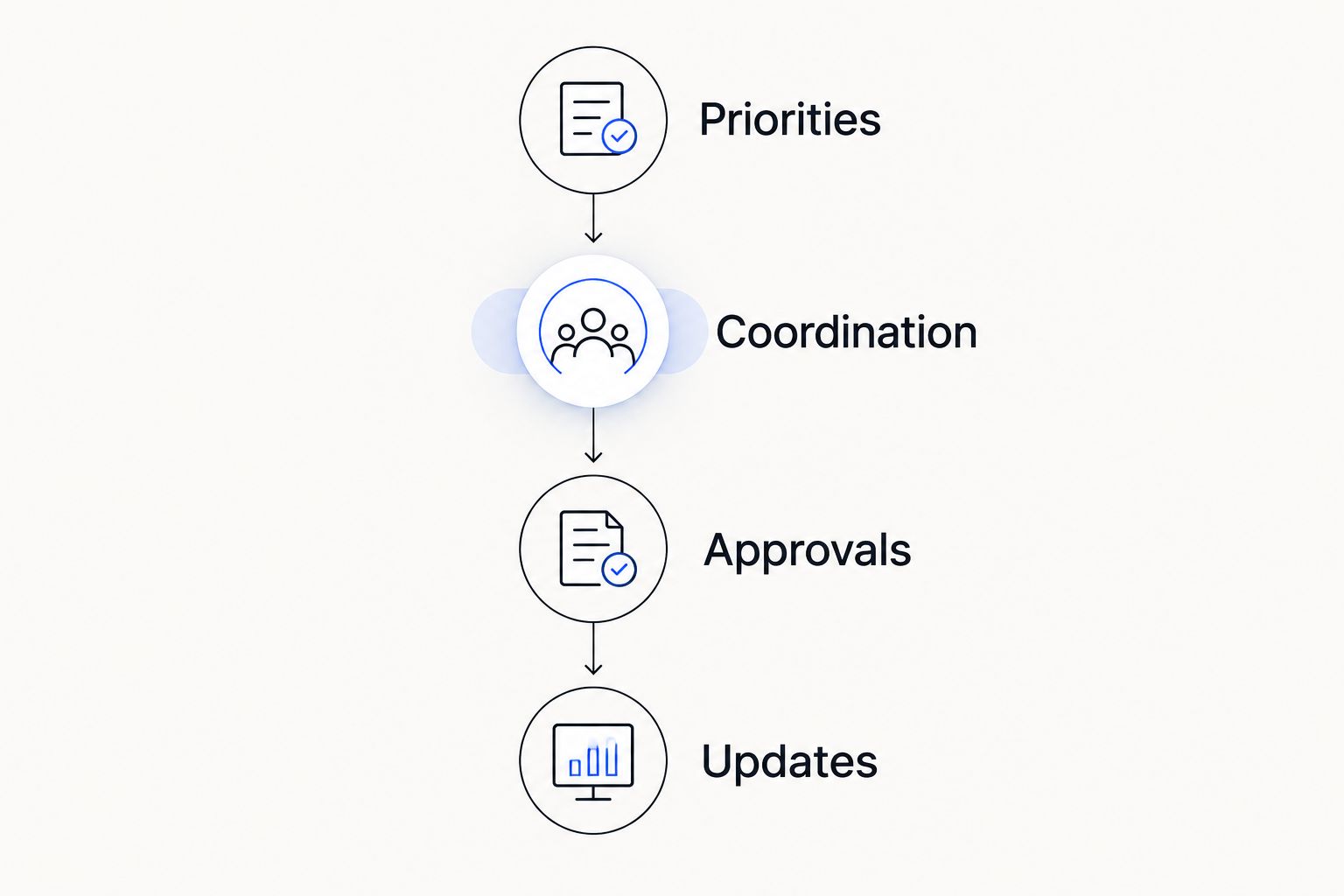
Complementary roles require a defined handoff, not parallel instructions. Use the following sequence to discuss how the relationship should work. It is an assessment framework, not a statement of any provider's operating commitments.
Priorities
Identify who holds the current brief. That person should know which commitments are fixed, which preferences are flexible, and which changes require your attention.
Avoid sending different versions of the same instruction through separate conversations. A concierge cannot reconcile a calendar change that has not been communicated, and an assistant cannot assess an external arrangement without the relevant update.
Coordination
Assign responsibility for the external arrangements in scope. Specify who communicates with the relevant providers and who checks dependencies between those arrangements.
Keep the distinction between organizing an arrangement and authorizing it. A person can coordinate information without holding permission to confirm a commitment on your behalf.
Approvals
State which decisions require your approval and which can be handled under an agreed instruction. Do not rely on a general request to use discretion when the practical boundaries remain undefined.
Include changes as well as initial decisions. Permission to arrange an itinerary does not necessarily include permission to alter every component after confirmation.
Updates
Agree who receives changes and who checks that the affected arrangements have been addressed. The relevant update should reach both the person managing your agenda and the person coordinating the external requirements.
A useful handoff records the current instruction, its approval status, and the next responsible person. That is more precise than simply copying everyone into a conversation.
How do you decide whether private concierge membership fits?
Private concierge membership fits an ongoing coordination need, not merely a preference for having someone available. Before applying, describe the relationship you want and the responsibilities you expect it to cover.
For your 2026 assessment, use recurring situations rather than a wish list of exceptional experiences. Explain what requires attention across your travel and personal commitments, who handles it today, and where the current arrangement leaves you involved.
Choose the relationship around the problem
If the underlying problem is an unmanaged inbox or a calendar that needs daily attention, begin with the personal assistant role. A concierge membership should not be treated as an assumed replacement for internal administration.
If the problem is recurring coordination across external services, examine private concierge memberships. Compare their stated scope, membership relationship, and responsibility boundaries. Do not infer execution standards from broad descriptions of access or global reach.
Describe existing support accurately
Tell a prospective provider whether you already work with a personal assistant, family office, or executive office. Explain which responsibilities those people retain.
This is not an invitation to disclose unnecessary personal information. It is a way to establish the proposed division of work. A useful membership discussion should make that division clearer, not leave everyone expecting someone else to act.
Prepare a qualified application
Describe your ongoing needs, the areas you want coordinated, and the practical role of your existing support. Ask how the provider assesses fit and what information is required for that assessment.
JetVoy membership is relevant to evaluate when your needs span its stated areas of travel, aviation, residences, and access. Its scope is not evidence of guaranteed outcomes or automatic acceptance. Assess the relationship against your circumstances before assuming it is the right fit.
Does a personal assistant replace a concierge membership?
A personal assistant does not automatically replace a concierge membership. The roles overlap only where the assistant's agreed responsibilities and capabilities cover the same coordination work.
Review the work itself. If your assistant already owns the relevant external coordination, adding another relationship requires a clear reason and a clear boundary. If specialist coordination sits outside the role, assess membership as a complement rather than an interchangeable replacement.
Is concierge membership useful for a single request?
A single request does not establish a need for ongoing concierge membership. Membership fit depends on whether you want a continuing coordination relationship across recurring requirements.
Separate the immediate need from the longer-term decision. An exceptional request can start a conversation, but it should not obscure the question of what responsibility the membership would hold afterward.
FAQ
What's the main difference between a concierge and a personal assistant?
The main difference is external service coordination versus day-to-day personal support. A private concierge coordinates agreed external arrangements, while a personal assistant supports your agenda, communications, and assigned administration.
Is a private concierge better than a personal assistant?
Neither role is better independently of your needs. A personal assistant fits daily administrative support; private concierge membership fits ongoing external coordination within an agreed service scope.
Can my personal assistant work with a concierge?
Your personal assistant can work with a concierge when responsibilities, approvals, and updates are clearly assigned. Specify who holds the current brief and who communicates changes to affected providers.
Does a concierge manage my calendar?
Calendar management belongs to a concierge only if it is explicitly included in the agreed scope. Do not assume that travel or access coordination includes responsibility for your complete personal agenda.
Does private concierge membership guarantee exclusive access?
Private concierge membership does not by itself establish guaranteed access. Ask the provider to explain the relevant conditions and the distinction between coordinating a request and confirming its outcome.
Who is JetVoy membership intended for?
JetVoy is a private membership concierge service for high-net-worth individuals, family offices, and corporate executives. Its stated scope covers global travel, private aviation, exceptional residences, and exclusive access.
What should I ask before applying for concierge membership in 2026?
Ask what the membership coordinates, what remains outside its scope, and how it would work with your existing support. Describe recurring needs and clarify decision authority rather than assuming acceptance or unrestricted service.
One last thing
Before adding another support relationship, ask a precise question: Who owns the next action when an instruction changes? Ask your existing support and the prospective membership provider separately, then compare the answers.
An unclear answer exposes a responsibility gap that a broader service list will not resolve. The useful distinction between a concierge and a personal assistant is not prestige. It is knowing which relationship owns which work, and how the handoff operates when your plans change.