

The traveler should verify their personal documents, a designated coordinator should reconcile requirements across the complete itinerary, and the relevant authorities should resolve questions about eligibility or permission to enter. International travel document coordination needs a clear owner, but coordination does not replace official requirements or the traveler’s responsibility to provide accurate information.
- International travel document coordination needs a designated owner, accurate traveler information, and official entry-requirement checks.
- Review transit points and return travel, not just the destination.
- JetVoy private concierge membership fits individuals seeking ongoing coordination across travel, aviation, residences, and access.
- Treat itinerary changes as a reason to reopen the document review.
Why this matters
A complex itinerary is not simply a list of destinations. It connects travelers, transport arrangements, border crossings, transit points, and arrival plans; a document question at one stage can affect the arrangements that follow.
For your 2026 travel planning, assign responsibility before arrangements become difficult to change. The useful question is not just whether someone has checked a passport. It is whether someone owns the complete review and knows which unresolved questions require an official answer.
JetVoy is a private membership concierge service coordinating travel, private aviation, residences, and access. Assess membership against your need for that continuing relationship, rather than assuming a particular document-checking service is included.
Who should check travel documents before a complex itinerary?
Use a designated coordinator for the itinerary-wide review, with the traveler verifying personal information and official authorities resolving entry questions. Transport operators also have their own document procedures, which you should establish directly rather than infer from permission to enter a country.
The responsibility is shared, but the work should not be scattered. Assign each question to a named person and distinguish preparation from an official decision.
| Role | Best for | Contribution | Limit |
|---|---|---|---|
| Traveler | Personal accuracy | Confirms identity details, documents held, and relevant circumstances | Personal familiarity does not establish every route requirement |
| Designated coordinator | Itinerary-wide continuity | Maintains the route, review status, questions, and handoffs | Coordination does not confer entry permission |
| Relevant authorities | Official requirements | Provide the applicable rules and processes within their jurisdiction | One authority’s remit does not cover every country on the itinerary |
| Transport operator | Carriage procedures | Explains its document requirements for the planned service | Operator procedures are not a substitute for official entry requirements |
Follow a defined sequence:
- Traveler confirmation. Establish who is traveling, which documents they intend to use, and whether their circumstances differ.
- Route review. Record every destination, transit point, border crossing, and return segment.
- Requirement checks. Consult the relevant official sources for the traveler and route, then clarify operator procedures.
- Open-question resolution. Assign unresolved issues to someone who can obtain an authoritative answer.
- Change review. Revisit affected requirements whenever the itinerary or traveler information changes.
Keep a dated record of the sources and answers used for your 2026 itinerary. A completed checklist without the route, traveler details, or review date does not show what was actually checked.
What should the traveler check personally?
The traveler should confirm that the information used for the review matches the documents they intend to carry. Delegating coordination does not make an incorrect name, omitted transit point, or misunderstood travel purpose accurate.
Start with the identity document itself. Confirm the document type, issuing country, expiry date, and name, then ensure the itinerary review uses those details rather than information copied from an earlier journey.
Also identify circumstances that need separate attention:
- Which nationality or nationalities are relevant to the journey.
- Which passport or other accepted travel document you intend to present.
- Any residence status relevant to departure, transit, entry, or return.
- The purpose and intended duration of each stay.
- Whether children or accompanying travelers need an individual review.
These are review inputs, not a universal document checklist. The applicable requirements depend on the actual traveler and route.
Do not treat a household, executive group, or traveling party as a single eligibility profile. People sharing an aircraft and residence can still need different checks. Ask the coordinator to record each traveler’s status separately while keeping the overall movement aligned.
What should the designated coordinator own?
The designated coordinator should own the review process: the route being assessed, the questions outstanding, the source of each answer, and the next action. This is an accountability function, not a claim to decide immigration eligibility.
Use a working record with clear distinctions between information received and requirements confirmed. A useful structure is:
- Traveler profile: the information supplied for each person’s review.
- Route record: destinations, transit points, border crossings, and return travel.
- Official checks: the relevant authority, source, scope, and review date.
- Open questions: unresolved issues, their owner, and the action required.
- Change review: what needs reassessment after an alteration.
The record should make uncertainty visible. If an answer depends on a particular airport, transit arrangement, or document, retain that condition alongside the answer.
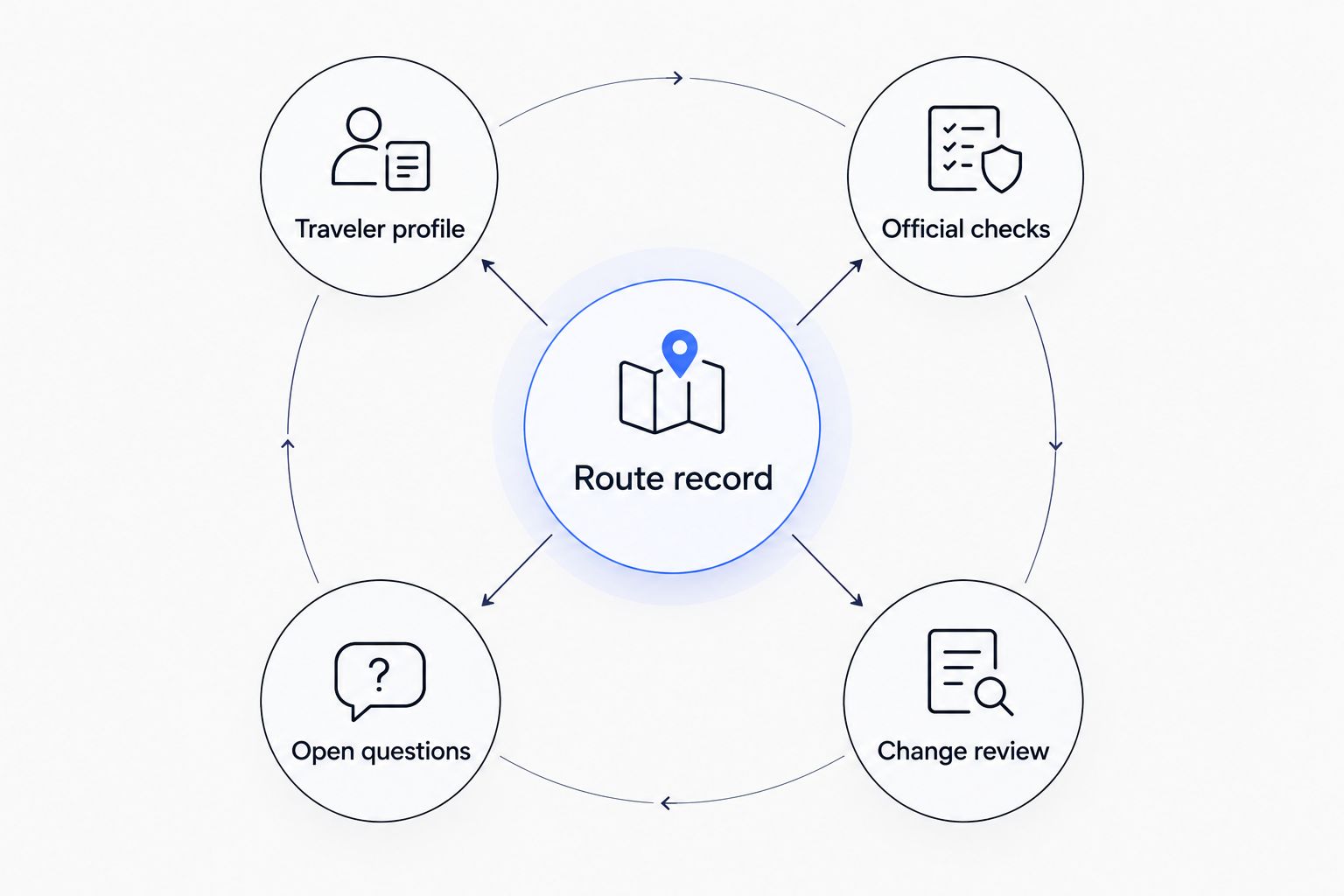
A coordinator’s value is continuity. If a departure changes, someone should know which document questions need to be reopened and which people need the revised answer.
For a 2026 itinerary, make the record specific enough that another authorized person can understand its status without reconstructing the discussion. Avoid an unexplained label such as cleared; state what was reviewed and what remains unresolved.
Who should resolve uncertain entry or transit requirements?
The relevant government authority is the starting point for official entry, visa, and transit requirements. Use the destination’s immigration or consular guidance, and check transit jurisdictions separately where applicable.
Ask a precise question. Include the traveler’s relevant nationality, document type, route, travel purpose, and intended stay rather than asking whether a destination generally requires a visa.
Official guidance and transport procedures answer different questions. Establish both:
- What the relevant authority requires for the planned movement.
- What the transport operator requires for carriage on that service.
- Whether the answer applies to the exact transit arrangement.
- Whether a route change would invalidate the assumptions behind the answer.
For unresolved eligibility or status issues, seek advice from an appropriately qualified immigration professional. A concierge relationship is not a substitute for legal advice, and a coordinator should not present an informal interpretation as an official determination.
Keep the answer’s scope intact. Guidance for one traveler, document, or route should not silently become guidance for the entire party.
Why international travel document coordination varies
The review changes because the traveler and route change. Complexity comes from the conditions that must be checked together, not from how exclusive the journey appears.
- Nationality and document used. Requirements must be checked against the relevant traveler profile, not assumed from another person’s experience.
- Transit arrangements. An intermediate stop deserves its own review; do not assess only the final destination.
- Purpose and duration. The planned activity and length of stay belong in the requirement check.
- Residence and return status. Include the traveler’s intended return, not just outward entry.
- Traveling-party differences. Children, accompanying staff, and other travelers require their own assessment where their circumstances differ.
- Itinerary changes. A revised route can change the questions that need answering, even when the final destination stays the same.
For 2026 planning, use the actual itinerary as the review boundary. A destination summary is background information; it is not a substitute for checking the route you intend to take.
Does private aviation remove the need for document checks?
Private aviation does not remove the need to satisfy applicable border and document requirements. Coordinate with the operator and relevant authorities for the actual route, rather than treating the aircraft arrangement as confirmation of entry eligibility.
Separate the operational plan from the personal document review. Aircraft arrangements, traveler documents, and arrival coordination need to agree, but confirmation of one does not establish the others.
Ask who owns each outstanding question before departure. If the route changes, establish which checks need to be repeated rather than assuming that earlier answers still apply.
Should a family office delegate the entire review?
A family office can designate someone to coordinate the review, but travelers still need to confirm their personal information. The useful delegation is process ownership, not an assumption that another person can supply every relevant fact.
Define who can provide information, who can approve itinerary changes, and who receives unresolved questions. Keep sensitive document handling within agreed channels and establish who needs access for the task.
For corporate travel, apply the same discipline to the executive and accompanying party. A shared schedule does not establish shared document requirements.
When does ongoing private concierge membership fit?
JetVoy private concierge membership fits globally mobile individuals seeking ongoing coordination across travel, aviation, residences, and access. That relationship is different from asking someone to resolve an isolated document question.
Membership fit depends on whether you need continuity across recurring arrangements. The benefit to assess is a continuing coordination relationship; the limitation is that membership itself does not establish immigration eligibility or replace specialist advice.
Before submitting an application, describe your recurring travel pattern and the responsibilities you want clarified. Ask whether document-related coordination falls within the proposed scope, who retains responsibility for personal verification, and how official questions are handled.
Do not infer acceptance criteria or service commitments from the category name. Evaluate the relationship against your needs and the scope actually discussed.
FAQ
Who is responsible for checking my documents before international travel?
You should verify your personal information and documents, while a designated coordinator manages the itinerary-wide review. Relevant authorities determine applicable entry requirements, and transport operators have their own carriage procedures.
Can a private concierge confirm that I will be admitted to a country?
A private concierge cannot replace the relevant authority’s entry decision. Ask the concierge to distinguish coordination, official guidance, and any issue requiring qualified immigration advice.
Do I need to check documents for a transit stop?
Include transit stops in the document review rather than checking only your final destination. Confirm the requirements for your nationality, document, and exact transit arrangement through the relevant official sources.
Should everyone on the same itinerary have a separate document check?
Each traveler needs a review based on their own circumstances. A shared itinerary does not establish identical nationality, residence status, documents, or entry requirements.
What should happen if my international itinerary changes?
Reopen the checks affected by the change. Ask the designated coordinator to identify whether revised destinations, transit points, dates, or travel purposes change the requirements already assessed.
Does flying privately mean I need fewer travel documents?
Do not assume private aviation reduces your document requirements. Check the actual route with the relevant authorities and establish the operator’s procedures separately.
Is ongoing concierge membership suitable for a single document question?
Ongoing concierge membership should be assessed as a continuing coordination relationship, not simply a way to answer one document question. Use official sources or an appropriately qualified professional for the specific issue.
One last thing
For your 2026 itinerary, review the journey backward as well as forward. Start with the intended return, then work through each preceding border crossing and transit point to check that none has been left outside the review.
The final destination is not the full journey. Assign an owner to every unresolved question, not just an owner to the itinerary. That distinction makes the review actionable before a change exposes a gap.