

Your concierge should keep current the preferences that change how you travel: flight arrangements, residence requirements, ground transfers, dining needs, access interests, communication instructions, and approval boundaries. Separate standing preferences from trip-specific exceptions, and identify who can authorize a change. A useful profile records not just what you prefer, but what is essential, what is flexible, and when an instruction stops applying.
- For concierge membership personal preferences, keep standing instructions separate from trip-specific exceptions.
- Jetvoy private concierge membership suits individuals seeking ongoing coordination across travel, aviation, residences, and access.
- Mark each preference Essential, Preferred, or Trip-specific so trade-offs require less interpretation.
- Record approval boundaries and sharing instructions alongside travel preferences, not in a separate conversation.
Which travel preferences should your concierge keep current?
Keep a working profile across 4 coordination domains: travel, aviation, residences, and access. Add communication and authorization instructions across all of them. For your 2026 review, organize the profile around decisions someone will actually need to make on your behalf.
Use this sequence to turn personal preferences into usable instructions:
- State the requirement. Describe the outcome you need, rather than relying on a broad label such as quiet or convenient.
- Assign its status. Mark the instruction Essential, Preferred, or Trip-specific.
- Define the scope. Specify which travelers, journeys, or circumstances it covers.
- Identify the decision owner. Name who can approve an alternative or change the instruction.
- Record the review trigger. State which change in circumstances requires confirmation.
The distinction matters. A preferred departure window allows discussion; an essential arrival deadline defines a constraint. Those instructions should not carry the same weight.
Why this matters
An ongoing concierge relationship needs more than a collection of past requests. Your last itinerary describes what happened then, not necessarily what should happen next. Reusing it without checking exceptions turns familiarity into an assumption.
Jetvoy is a private membership concierge service coordinating travel, private aviation, residences, and access. Jetvoy private concierge membership is best suited to individuals seeking an ongoing coordination relationship across those areas. Membership fit rests on continuity, not the importance of an isolated request.
That breadth also creates a practical responsibility for you: explain which preferences carry across domains. A late arrival affects more than the flight; it can change transfer instructions, residence access, meals, and the following day's commitments.
Travel and aviation preferences
Keep departure windows, arrival deadlines, airport preferences, connection tolerance, seating requirements, and baggage needs current. Distinguish a convenient airport from an essential arrival location. State whether timing, routing, or proximity takes priority when those preferences conflict.
For private aviation coordination, describe the journey requirements rather than assuming a previous arrangement remains suitable. Relevant instructions include who is traveling, luggage or equipment considerations, ground-transfer dependencies, and any mobility assistance that needs discussion with the provider.
Use precise language:
- Essential: Arrive before a fixed commitment, with the required onward transfer accounted for.
- Preferred: Use the airport nearest the final destination when the itinerary permits.
- Trip-specific: Allow additional luggage for this journey only.
Do not treat an aircraft preference as proof of suitability. Ask for journey-specific requirements to be confirmed with the relevant provider. A personal profile supplies context; it does not replace operational confirmation.
For your 2026 profile, remove aviation instructions that belonged to a previous traveling party. A journey with family, colleagues, or guests needs its own scope, even when the destination is familiar.
Residence and arrival preferences
Record the features that affect whether you can use a residence comfortably: bedroom configuration, accessibility needs, work space, kitchen requirements, privacy expectations, and arrival arrangements. Describe observable requirements. Quiet is subjective; a bedroom away from shared living areas is a clearer instruction.
Separate personal taste from suitability. A preferred architectural style is not equivalent to a step-free access requirement. If a feature is essential, request confirmation rather than allowing an attractive description to stand in for evidence.
Arrival instructions deserve their own attention. Specify who should receive access details, whether members of the party arrive separately, and which arrangements need confirmation before departure. Share only the information each recipient needs.
Residence preferences also need an expiry point. A requirement for a particular guest should not silently become your permanent instruction. Keep the reason and scope concise without including unnecessary personal detail.
Ground transfers and transitions
Keep passenger requirements, luggage considerations, mobility needs, preferred meeting instructions, and communication contacts current. Specify whether the transfer serves the whole party or only particular travelers. An accurate passenger list does not automatically explain separate arrival times or onward destinations.
The important distinction is between the vehicle and the transition. A vehicle preference says what you would like to travel in; a transition instruction explains how the handoff should work.
Ask for clarity on:
- Who receives the arrival update.
- Where the traveler should expect to meet the provider.
- Who needs to know if the arrival changes.
- Which onward commitment determines the required timing.
These are coordination questions, not promises about provider performance. Keep the profile focused on your requirements and confirm the actual arrangements for each journey.
Dining, wellbeing, and access preferences
Separate dietary restrictions from preferences. Record ingredients or conditions that require specific discussion, and ask that relevant requirements be confirmed directly with the provider. A note in a profile is not confirmation that a particular meal or setting meets your needs.
For access interests, describe what attracts you: subject matter, atmosphere, preferred companions, participation level, and scheduling constraints. Broad labels such as exclusive or exceptional do little to explain whether an experience fits your interests.
Avoid letting an old request become a permanent identity. An event requested for a guest does not establish your own interest. Note whose preference it was and whether it should remain relevant.
Access interests guide enquiries; they do not establish entitlement. Keep your profile separate from confirmation of any particular arrangement, and ask how changes or alternatives require your approval.
How should you label each preference?
Use 3 status labels: Essential, Preferred, and Trip-specific. These labels describe how an instruction should be interpreted, not different levels of membership.
| Status | Best for | Benefit | Limitation |
|---|---|---|---|
| Essential | Requirements that determine suitability | Makes non-negotiable constraints explicit | Can narrow the acceptable arrangements |
| Preferred | Choices where alternatives are acceptable | Gives room to coordinate around competing needs | Needs a clear priority when preferences conflict |
| Trip-specific | Temporary needs or guest instructions | Prevents exceptions becoming permanent defaults | Needs an end point or confirmation before reuse |
An Essential instruction should explain what makes an arrangement unsuitable. A Preferred instruction should explain the acceptable trade-off. A Trip-specific instruction should identify the journey or circumstance to which it belongs.
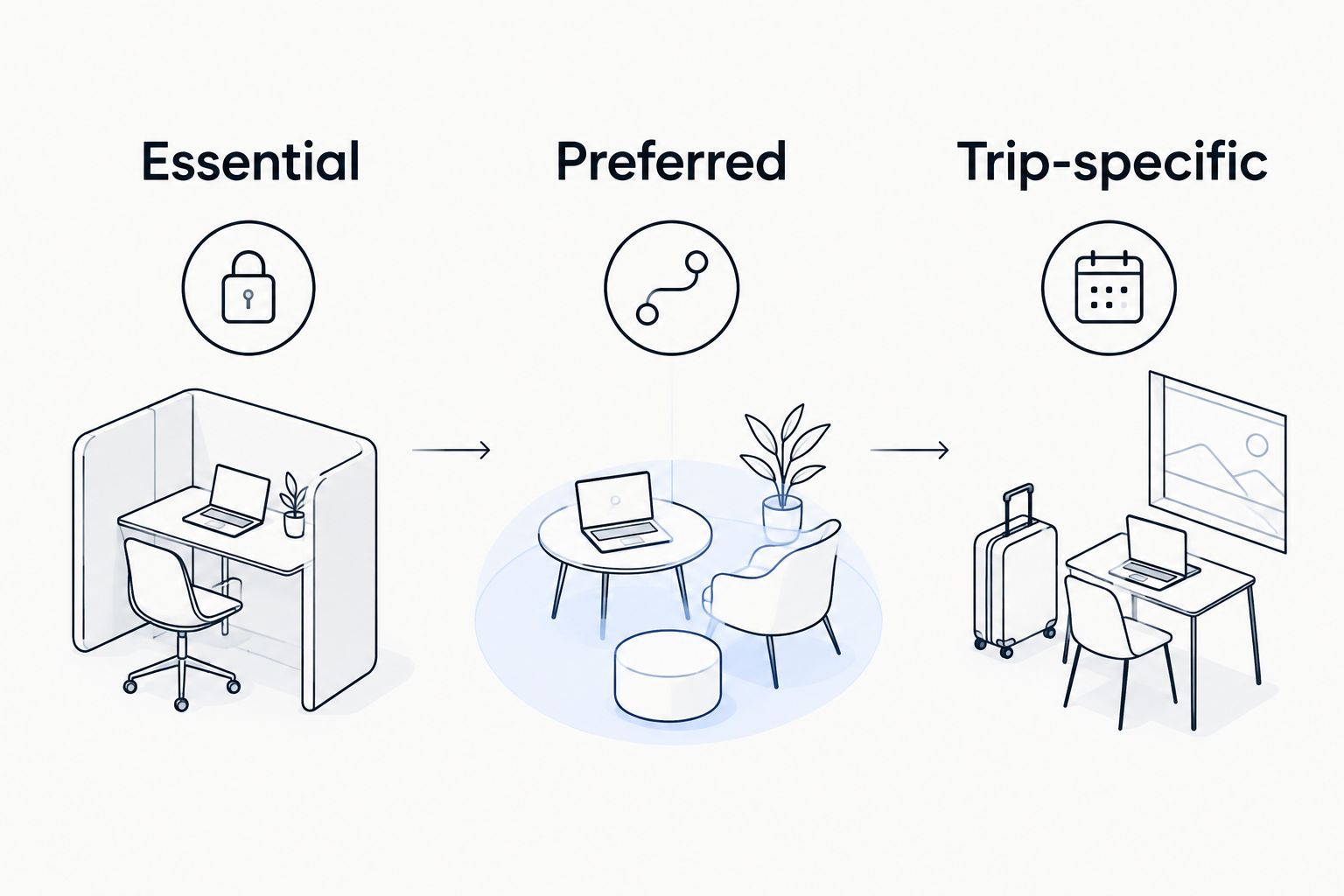
During a 2026 profile review, challenge any instruction marked Essential without a clear reason. Too many absolute requirements can obscure the constraints that genuinely determine whether an arrangement works.
Communication, discretion, and approval boundaries
Record your preferred communication channel, the subjects that need direct confirmation, and who should receive operational updates. Separate permission to receive information from permission to make decisions. An assistant copied on an itinerary is not automatically authorized to approve changes.
For each decision category, identify 1 decision owner and an escalation route. The decision owner can differ by subject: personal travel, corporate commitments, or arrangements involving family members. State those boundaries explicitly rather than expecting a title or relationship to explain them.
Discretion also requires instructions about information sharing. Specify which details can be shared with travelers, assistants, family-office contacts, and providers, then ask how those instructions are handled. Do not assume a preferred communication channel establishes the service's security or retention practices.
Keep sensitive information purposeful. Explain the assistance or arrangement required without circulating a fuller personal history than the task needs. Ask about handling and deletion procedures before providing documents or sensitive details.
Why travel preferences change
Review your profile when the context changes, rather than updating it simply because another trip has ended. These factors directly affect which instructions remain useful:
- Traveling party: Guests, colleagues, and family members bring different requirements and permissions.
- Journey purpose: A fixed professional commitment creates different timing priorities from personal travel.
- Mobility or dietary needs: Changed requirements need explicit confirmation with the relevant providers.
- Residence use: Working, hosting, or traveling with others changes what makes a property suitable.
- Decision authority: A change in assistants or representatives requires updated approval and sharing instructions.
- Personal priorities: A former preference can remain in a profile after it has stopped mattering to you.
For 2026, use these triggers as a review checklist rather than treating the calendar as the only reason to update your instructions. The practical question is whether someone relying on the profile would make the decision you intend today.
How much personal detail should you share?
Share the detail needed to coordinate an arrangement and understand its constraints. A clear requirement is more useful than a long account of why it exists. Where sensitive information is necessary, ask who needs it and how it will be handled before sending it.
For example, a residence requirement can describe the access you need without including unrelated health information. The relevant provider still needs to confirm whether the setting meets that requirement.
Should your concierge reuse preferences from your last trip?
Reuse standing preferences only after separating them from the last trip's exceptions. Keep temporary guest needs, unusual luggage requirements, and destination-specific arrangements attached to that journey unless you explicitly adopt them as ongoing instructions.
Ask which version of an instruction governs if messages conflict. The latest message needs context: a temporary change should not erase a standing preference without your agreement.
How does this help you assess membership fit?
Assess membership fit by asking how an ongoing relationship handles changing instructions, competing priorities, and permission to act. The useful comparison is between private concierge memberships, not between isolated itinerary requests.
Jetvoy's stated scope covers travel, aviation, residences, and access. Evaluate whether you need that continuing coordination, then ask how your preferences and approval boundaries would be managed within the relationship. Detailed preferences support an informed discussion; they do not imply acceptance or a particular outcome.
FAQ
What personal preferences should I give a concierge membership service?
Give your concierge service the preferences that affect travel, aviation, residences, access, communication, and approval decisions. Separate essential requirements from flexible choices and temporary exceptions.
How often should I update my concierge preferences?
Update your preferences when your circumstances, traveling party, requirements, or decision authority change. Confirm trip-specific instructions before reusing them on another journey.
Should I share dietary restrictions with my concierge?
Share dietary restrictions that affect the arrangements, clearly separated from food preferences. Ask for relevant requirements to be confirmed directly with the provider rather than treating a profile note as confirmation.
Can my assistant change my travel preferences?
Your assistant should change standing preferences only within the authority you have explicitly assigned. Permission to receive itinerary updates is separate from permission to approve changes.
Should family members have separate preference records?
Keep each traveler's requirements distinguishable, whether they appear in separate records or a clearly structured shared profile. Identify whose instruction applies and who can authorize changes.
Does a concierge preference profile guarantee special access?
A preference profile does not guarantee access. It explains your interests and constraints; any specific arrangement requires separate confirmation.
Is ongoing concierge membership suitable for a single travel request?
Ongoing concierge membership is designed around a continuing relationship rather than an isolated request. Assess whether you need coordination across repeated journeys and connected arrangements before pursuing membership.
One last thing
For your final 2026 profile check, ask a more revealing question than whether every preference is recorded: which instruction should no longer be followed? Removing an expired exception can improve clarity more than adding another detail. Keep the profile current enough to guide decisions, not merely complete enough to document the past.