

Before you arrive at a private residence, confirm that access works, the agreed rooms are prepared, essential systems function, and your transport connects with whoever receives you. Your private residence arrival checklist should also identify who owns each outstanding task and what happens if your arrival changes; an attractive property is not the same as a prepared arrival.
- A private residence arrival checklist should confirm access, room readiness, essential supplies, and accountable handoffs.
- JetVoy private concierge membership suits individuals seeking ongoing coordination across travel, aviation, residences, and access.
- Separate confirmed arrangements from requested preferences; an unanswered request is not confirmation.
- Keep sensitive residence details restricted to the people who need them.
Why this matters
An arrival depends on connections between arrangements: the flight informs the transfer, the transfer informs the residence, and the residence must be ready for the people arriving. Treating those arrangements separately leaves you to resolve the gaps at the door.
JetVoy is a private membership concierge service coordinating travel, private aviation, residences, and access. The relevant membership question is whether you need that relationship repeatedly, not whether you have an isolated request.
For your 2026 arrival checklist, distinguish property readiness from arrival readiness. Property readiness concerns the condition of the residence; arrival readiness concerns whether you can enter, settle in, and reach an accountable person without reconstructing the plan yourself.
What should be ready before you arrive at a private residence?
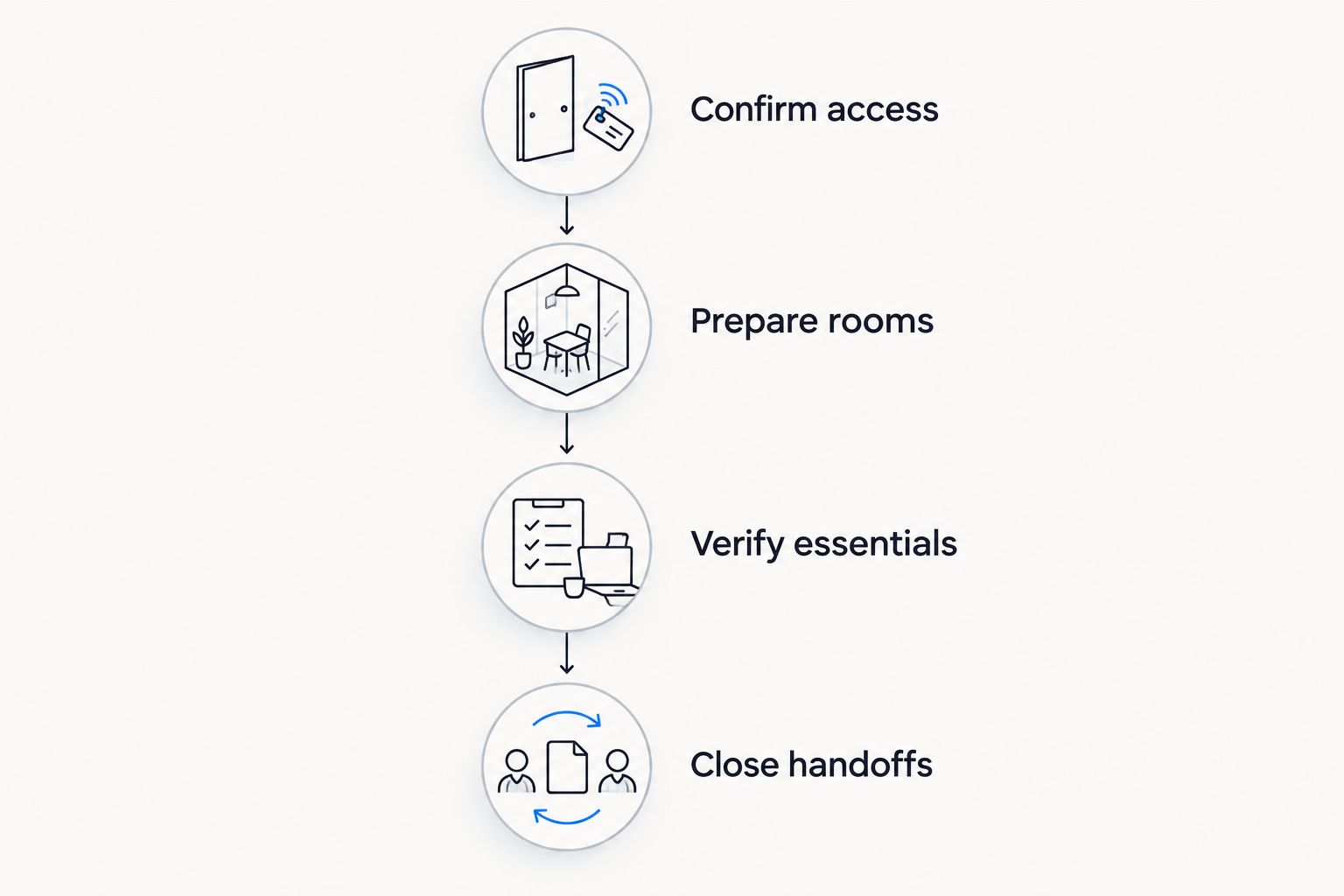
The residence should be prepared for your actual party, arrival time, and intended use. Work through the following sequence, recording confirmation rather than assuming that a request has been completed.
Confirm access
Start with the address, the correct entrance, and the agreed means of entry. If the residence has a separate vehicle entrance, staffed gate, or reception procedure, confirm the instructions that apply to your arrival rather than relying on a general property description.
- Identify who will receive you, if a reception has been arranged.
- Confirm how you enter if that person is unavailable.
- Establish how changes to your arrival time reach the receiving contact.
- Keep access credentials separate from widely circulated itinerary details.
- Confirm where the driver should stop and who handles the final handoff.
Access is ready only when the arrival instructions match the arrival you will actually make. A daytime reception plan does not answer what happens after a delayed evening arrival. Ask for the revised arrangement before departure, not from outside the property.
Prepare rooms
Confirm which bedrooms and shared areas form part of the agreed stay, then match their preparation to the traveling party. Room assignments matter when family members, guests, or accompanying personnel have different needs; those assignments should not be left for whoever opens the door.
Ask the responsible contact to confirm cleaning, prepared beds, bathroom essentials, and any agreed room setup. Where you have requested a cot, step-free route, or other specific accommodation, seek confirmation of the actual arrangement rather than a broad statement that the residence is suitable.
Distinguish a preference from a requirement. A preferred room temperature is different from an access requirement that determines whether someone can use the residence. Make the distinction explicit so that essential needs do not disappear inside a general preferences list.
Verify essentials
Check that the systems you need on arrival have been checked by the responsible property contact. Depending on the residence and your intended use, these include lighting, water, climate controls, internet access, and the appliances needed immediately after arrival.
Agree on the essential supplies you want in place. Drinking water, bathroom supplies, and any requested food should be confirmed individually; do not treat a general reference to provisions as evidence that a particular requirement has been met.
Dietary restrictions need precise instructions. If an allergy affects food preparation, identify who has received the information and what they have confirmed. Do not treat a concierge request, a supplier acknowledgment, and a confirmed preparation arrangement as interchangeable.
Close handoffs
Connect the final transfer with the residence reception. The receiving contact needs the relevant arrival update, and the person coordinating transport needs the correct entrance and handoff instructions. Share only the information each person needs to perform that role.
Keep an outstanding-items list with a named owner for each unresolved issue. If something will not be ready, agree on the alternative before you arrive and decide whether it affects your ability to use the residence.
Finish with a short arrival brief that you can retrieve without searching through separate conversations. It should contain the entry instructions, receiving contact, essential exceptions, and the route for reporting a problem—not every exchange that produced the plan.
What counts as confirmed readiness?
For a 2026 arrival brief, use clear status language. Requested means someone has been asked; confirmed means the responsible person has acknowledged the specific arrangement. Neither should be confused with a completed check.
The table below is a verification framework, not a promise that any particular residence includes these arrangements. Apply it to the scope you have agreed.
| Area | Evidence to request | Unresolved issue to flag |
|---|---|---|
| Access | Current entry instructions and receiving contact | Instructions depend on someone whose attendance is unconfirmed |
| Rooms | Confirmation of agreed room preparation and assignments | A required room setup remains only a request |
| Essential systems | Confirmation that relevant systems have been checked | A known fault has no agreed alternative |
| Supplies | Confirmation of the specific essentials requested | A general provisions list omits a requirement |
| Transport handoff | Entrance, receiving contact, and update responsibility | Transport and residence contacts have different arrival details |
| Exceptions | Named owner and agreed response | An unresolved task has no accountable person |
A useful checklist records evidence, not reassurance. Replace a vague statement such as everything is arranged with a specific question about the item that matters. You do not need a longer message; you need an answer that resolves the uncertainty.
Keep the status record proportionate. Routine preferences do not need the same escalation as an unresolved entry arrangement, and completed tasks should not obscure the remaining decisions. Put the exceptions where you can find them immediately.
Why private residence arrival requirements vary
The checklist stays consistent, but its contents should follow your circumstances. These factors change what you need to confirm:
- Arrival timing. A changed arrival time requires a fresh check of reception, entry, and transport handoffs. Do not assume the original arrangement still applies.
- Traveling party. Room assignments and preparation should reflect who is arriving, including any accompanying personnel whose accommodation forms part of the arrangement.
- Access needs. Confirm the specific route and facilities a traveler requires. A general description of the property does not settle an individual access requirement.
- Length and purpose of stay. An overnight arrival and an extended working stay call for different supplies and workspace checks. Include what you intend to use.
- Dietary and personal requirements. Communicate relevant instructions precisely and restrict sensitive information to the people responsible for acting on it.
- Provider responsibilities. Establish which tasks belong to the residence contact, transport provider, or coordinating party. A task between roles still needs an owner.
These are reasons to adapt the brief, not reasons to circulate more personal information. State the operational requirement clearly and omit details that do not help someone carry it out.
Who should confirm the residence is ready before I arrive?
The person responsible for each arrangement should confirm that arrangement, while a designated coordinating contact should maintain the overall arrival picture. Property condition, transport timing, and personal requirements involve different responsibilities; make those boundaries explicit.
Ask who will consolidate exceptions and communicate changes. A list of contacts is useful, but it does not establish who decides what happens when their arrangements conflict.
What should I do if my arrival time changes?
Update the contacts responsible for transport, reception, and entry, then request confirmation of the revised handoffs. A changed flight time is not a completed residence update.
For your 2026 travel plans, specify who passes changes onward and who confirms receipt. This is particularly important when you are unavailable during transit and cannot resolve separate conversations yourself.
What belongs in an ongoing residence preference brief?
An ongoing preference brief should record the requirements you want considered repeatedly, while keeping arrival-specific instructions separate. Stable preferences and current arrangements serve different purposes.
For example, a room preference belongs in the continuing brief; the room assigned for a particular stay belongs in that stay's arrival record. A dietary requirement needs continuing visibility, but confirmation that the relevant people received it belongs to the current arrangement.
Review the brief when circumstances change. Remove obsolete access details, revise instructions that no longer apply, and clarify who is authorized to make decisions on your behalf. Do not let a familiar document become a substitute for current confirmation.
Continuity means carrying useful context forward, not carrying every past instruction forward unchanged. Your 2026 residence brief should support the next arrival without confusing it with the previous stay.
When does private concierge membership fit this need?
JetVoy private concierge membership suits individuals seeking ongoing coordination across travel, aviation, residences, and access. That is a relationship-based fit: the relevant question is whether these arrangements repeatedly need to be considered together.
The benefit of continuous coordination is a shared context for connected requirements. The limitation is equally important: membership does not replace property-level confirmation, define every provider's responsibilities automatically, or establish an access guarantee.
Before applying, describe the recurring coordination need rather than submitting only a destination request. Explain which arrangements intersect, who can authorize decisions, and which requirements need continuity across stays. Keep sensitive credentials out of an initial application.
If you need only an isolated residence request, assess whether an ongoing membership relationship matches that need. If you are assessing membership for 2026, ask how scope, responsibilities, and communication are defined before treating any particular arrangement as included.
FAQ
What should be on a private residence arrival checklist?
A private residence arrival checklist should cover entry, room preparation, essential systems, agreed supplies, transport handoffs, and unresolved exceptions. Record who confirms each item and who handles changes.
Should the residence be prepared before my flight lands?
The residence preparation should follow your agreed arrival plan, with completion confirmed before you need to use it. Connect the residence timeline to your transfer and reception arrangements rather than treating the flight landing time as the whole plan.
How do I check that a late arrival is covered?
Confirm the entry method, receiving contact, and alternative if the planned reception is unavailable. Ask for confirmation against the revised arrival time rather than relying on daytime instructions.
What personal information should I share before arriving?
Share the information needed to prepare the residence and coordinate your arrival. Restrict access credentials, sensitive personal details, and travel information to the people who need them.
Should I send dietary requirements before reaching the residence?
Send relevant dietary requirements before food preparation is arranged, then confirm who has received and accepted the instructions. A general request for provisions does not confirm that a specific dietary requirement has been addressed.
What should I do if something will not be ready?
Identify the responsible contact, agree on an alternative, and decide whether the issue affects your use of the residence. Keep the exception visible in the arrival brief until it is resolved.
Does private concierge membership guarantee residence access?
Do not treat private concierge membership as a guarantee of residence access. Confirm the scope and terms of the particular arrangement separately from the membership relationship.
One last thing
Ask what remains unconfirmed—not just whether the residence is ready. That question makes room for an honest exception, a named owner, and a practical decision before you reach the door.
For your next arrival, keep the final brief short enough to use during transit. The full record can sit elsewhere; the immediate brief should tell you how to enter, whom to reach, and what still requires attention.