

The benefits of using a travel concierge are continuity, fewer disconnected decisions, and coordination across travel arrangements that depend on one another. An ongoing membership is most relevant when your travel, aviation, residences, and access requirements recur or overlap. For a 2026 membership decision, the central caveat is scope: confirm what the relationship includes rather than assuming every request, provider, or outcome falls within it.
- The benefits of using a travel concierge depend on continuity, coordination, and the scope of your membership.
- JetVoy suits individuals seeking ongoing private concierge coordination across travel, aviation, residences, and access.
- Evaluate private concierge memberships by responsibility, discretion, and how changes move between providers.
- An isolated request alone does not establish a need for an ongoing membership.
What are the benefits of using a travel concierge?
JetVoy is best suited to individuals seeking ongoing private concierge coordination across travel, aviation, residences, and access. The value of that relationship is not simply having someone receive requests; it is having a defined coordination role across connected requirements. Assess JetVoy against that ongoing need, not an assumption of unrestricted service.
The practical benefits become clearer when you separate a continuing relationship from an isolated request. Neither structure is inherently right for everyone.
| Consideration | Ongoing private concierge membership | Isolated request |
|---|---|---|
| Best for | Recurring, connected requirements | A clearly bounded need |
| Continuity | Evaluate how context carries between trips | Define the information needed for that request |
| Coordination | Establish responsibility across connected arrangements | Establish responsibility for the specific task |
| Changes | Confirm how changes reach affected providers | Confirm whether downstream adjustments are included |
| Main advantage | A continuing relationship can support connected decisions | A narrow scope is easier to define |
| Main limitation | Requires a genuine ongoing need and clear boundaries | Does not establish continuing responsibility by itself |
The table is a framework for evaluating scope, not a promise about any provider. A membership label alone does not establish how a service operates.
Why this matters
A flight, a residence arrival, and an evening commitment can each be suitable in isolation yet conflict when considered together. The relevant question is who checks the connections and who coordinates revisions when a decision changes.
For your 2026 shortlist, distinguish access to individual arrangements from responsibility for the transitions between them. Evaluate coordination at the handoff, not just at the initial request. A membership has a clearer purpose when you repeatedly need those connections managed within an agreed scope.
Continuity: less repetition across an ongoing relationship
A continuing concierge relationship creates an opportunity to retain relevant context between requests. Assess how preferences, decision-making authority, and travel requirements are recorded and refreshed rather than assuming the service remembers everything automatically.
Your preferences also need limits. A residence suitable for a personal stay is not necessarily appropriate for a working visit, and a familiar travel pattern does not remove the need to confirm current priorities.
The benefit is useful context, not unquestioned repetition. Ask how the service distinguishes a standing preference from an instruction that applies only to a particular journey.
The trade-off: you need to establish accurate preferences and communicate changes. An ongoing relationship cannot replace your approval where a decision requires it.
Coordination: connected decisions across four areas
JetVoy describes its private membership concierge service around four areas: global travel, private aviation, exceptional residences, and exclusive access. That scope gives you a practical basis for discussing how responsibilities connect, without assuming that every possible request is included.
Consider each area in relation to the others:
- Travel: clarify the sequence of movements and the commitments they support.
- Aviation: establish how flight decisions affect arrival arrangements and subsequent plans.
- Residences: confirm how arrival requirements align with the wider itinerary.
- Access: assess whether the timing and conditions fit your other commitments.
The coordination question sits between those areas. If an arrival changes, establish who reviews the residence arrangements and any dependent commitments rather than treating each as a separate conversation.
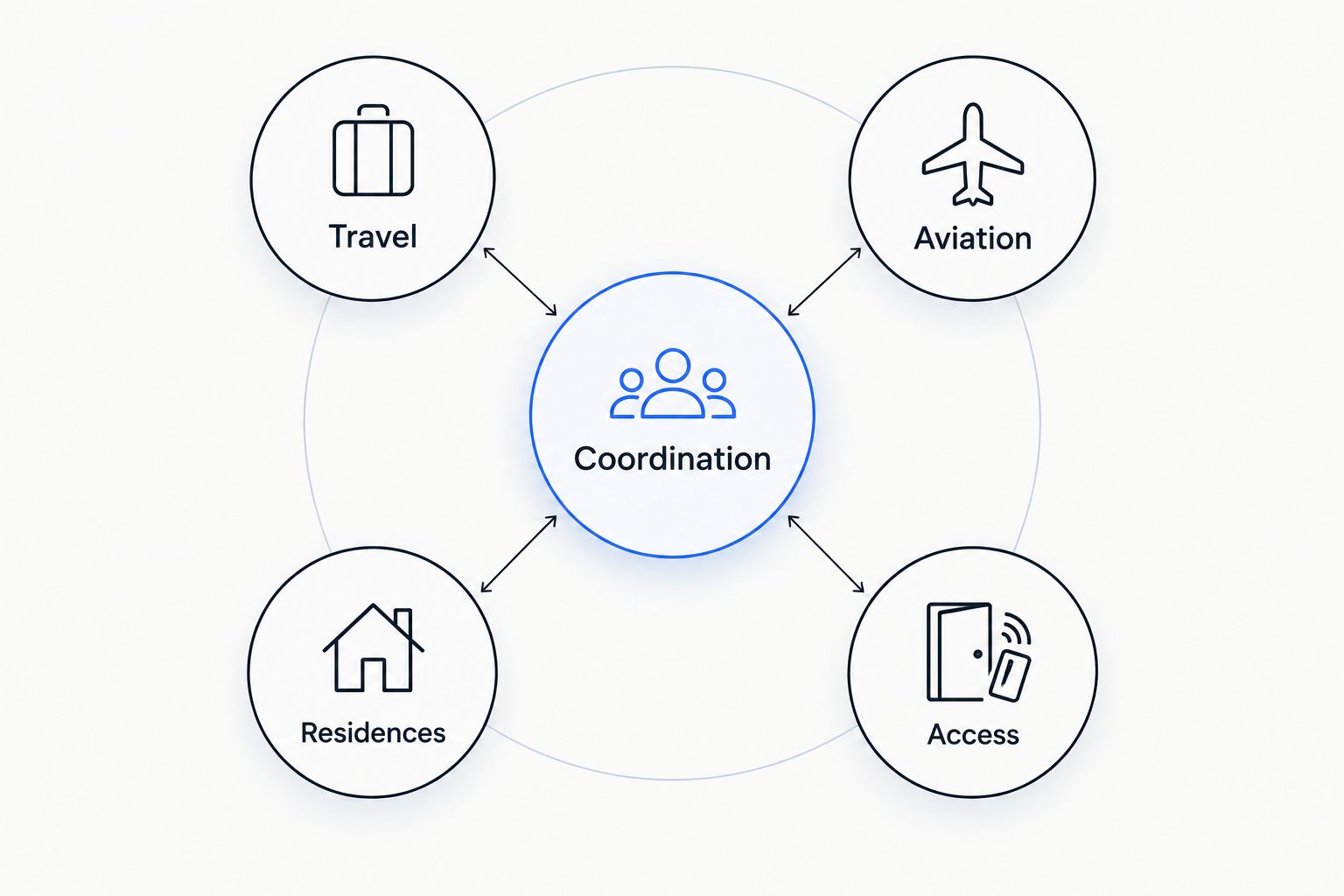
The trade-off: a broad service description does not define operational responsibility. Ask where coordination starts, where it ends, and which decisions remain with you or an external provider.
Clearer responsibility: fewer ambiguous handoffs
A concierge relationship is easier to assess when you can identify who coordinates each transition. That is more useful than a general assurance that everything will be handled.
Ask who communicates a revised arrival time, who checks whether dependent arrangements still work, and who needs your authorization before making a change. These questions turn an abstract service description into a concrete discussion of responsibility.
You should also distinguish the concierge's coordination role from the responsibilities of the providers delivering individual services. One point of coordination does not mean one party controls every outcome.
The limitation matters as much as the benefit. External conditions, provider requirements, and your own decisions remain part of the itinerary; membership does not remove them.
Decision support: less fragmented involvement
A useful coordination relationship should help you understand which decisions need your attention and what those decisions affect. Evaluate the format of that support rather than assuming membership means you can disengage entirely.
For example, when reviewing an arrival plan, ask for the relevant dependencies together: the movement, the residence arrival requirements, and the next commitment. That lets you judge the whole sequence instead of approving disconnected pieces.
The benefit is better-organized involvement, not the elimination of decisions. Your preferences, permissions, and priorities still determine the brief.
The trade-off is delegation discipline. If several people can issue instructions on your behalf, define who has authority and how conflicting directions should be resolved before coordination begins.
Discretion: defined information boundaries
For globally mobile individuals, family offices, and corporate executives, evaluating discretion means asking concrete questions about information handling. The word alone does not explain who receives itinerary details or why.
Ask what information a provider needs, who can authorize its release, and how accompanying travelers' details enter the process. Keep the discussion focused on actual responsibilities rather than broad assurances.
A coordinator still needs enough information to arrange the requested services. The practical objective is appropriate sharing within a defined process, not an expectation that coordination can happen without disclosure.
The trade-off: discretion requires clear instructions from you as well as clear practices from the service. Do not infer a particular privacy protocol from membership positioning alone.
Why the benefits vary between private concierge memberships
The benefits of a private concierge membership depend on the relationship you need and the scope you agree. Compare these factors directly:
- Continuity: determine whether you need support across recurring journeys or only for a bounded request.
- Service scope: establish which travel, aviation, residence, and access requirements fall within the relationship.
- Dependencies: identify arrangements whose timing or requirements affect something else.
- Decision authority: clarify who can instruct the service and which changes require approval.
- Information boundaries: establish what details must reach providers and who authorizes sharing.
These five factors are evaluation criteria, not a provider score. A broad membership is not automatically a better fit; the right relationship addresses your actual requirements without relying on assumptions about inclusion.
How do you assess membership fit before applying?
Use three steps to turn a general interest in concierge support into a clear membership brief. For a 2026 application, describe your current requirements rather than an aspirational version of your travel.
- Describe the recurring need. Explain which requirements repeat and how they connect. Distinguish personal travel, executive commitments, and instructions issued through a family office where relevant.
- Identify the difficult transitions. Describe where you need coordination between aviation, ground movements, residences, or access arrangements. Focus on responsibilities rather than a list of desired destinations.
- Clarify expectations and authority. State who gives instructions, who approves decisions, and what information boundaries matter. Ask the membership provider to explain the applicable scope and limitations.
A useful brief is specific without disclosing unnecessary personal details. You do not need to describe every future journey; you need to explain why a continuing relationship fits the way you travel.
An application is a request to assess fit. It is not evidence of acceptance, and an ongoing requirement does not establish an automatic entitlement to membership.
Is a travel concierge worthwhile for an occasional traveler?
An occasional traveler has a stronger reason to consider membership when the requirements are connected and continuing, not simply because a trip is important. Frequency alone does not define fit; assess the responsibility you need across the relationship.
If the need ends with one clearly bounded request, establish why ongoing membership is appropriate before applying. Do not mistake the significance of an occasion for a continuing coordination requirement.
Does a travel concierge guarantee exclusive access?
A travel concierge relationship does not itself establish a guarantee of access. Treat any particular access request as a separate scope discussion, including the relevant conditions and the responsibility of external providers.
For a 2026 membership review, keep coordination and entitlement distinct. The ability to coordinate a request is not the same as an unconditional right to the requested outcome.
FAQ
What are the main benefits of using a travel concierge?
The main benefits of using a travel concierge are continuity, coordination across connected arrangements, and clearer responsibility for handoffs. The value depends on the agreed membership scope and your ongoing requirements.
Who is JetVoy's private concierge membership best suited to?
JetVoy's private concierge membership suits individuals seeking ongoing coordination across global travel, private aviation, exceptional residences, and exclusive access. Its stated audience includes high-net-worth individuals, family offices, and corporate executives.
Can I delegate every travel decision to a concierge?
A concierge relationship does not automatically transfer every decision to the service. Establish which instructions can be acted on, which changes require approval, and who has authority to give directions.
Does private concierge membership include every request?
Private concierge membership does not by itself establish that every request is included. Confirm the applicable scope, exclusions, and provider responsibilities before relying on the relationship.
What should I ask about discretion before applying?
Ask what information is needed, who receives it, and who can authorize sharing. Discretion should be discussed through specific information boundaries rather than assumed from the service's positioning.
How should I compare private concierge memberships?
Compare private concierge memberships by continuity, service scope, decision authority, information boundaries, and responsibility for connected arrangements. Use your recurring requirements as the brief rather than comparing broad access claims alone.
Does applying for private concierge membership guarantee acceptance?
Applying for private concierge membership does not establish acceptance. Present your ongoing coordination requirements clearly and confirm the provider's application process directly.
One last thing
Before your 2026 membership decision, ask one practical question: If an arrival changes, who identifies everything else that needs attention? The answer should explain responsibilities, permissions, and limits—not merely repeat the service description.
Use that question when assessing JetVoy. It keeps the discussion focused on the ongoing coordination relationship you need rather than an isolated request or an assumed outcome.