

A villa concierge coordinates your stay; a property manager oversees the villa’s condition and property operations within the owner’s agreement. In the villa concierge vs property manager comparison, the decisive distinction is guest coordination versus responsibility for the residence itself. Neither title establishes who authorizes repairs, supervises staff, or handles an overnight problem: those responsibilities need to be explicit.
- Villa concierge vs property manager: separate guest coordination from property operations, then confirm each provider’s actual scope.
- A property manager handles the residence within the owner’s mandate; a villa concierge coordinates the agreed guest experience.
- JetVoy is best suited to individuals evaluating ongoing private concierge membership, rather than isolated villa requests.
- Before arrival, establish who receives changes, who authorizes work, and who confirms completion.
Villa concierge vs property manager: who handles what?
Use the role descriptions as a starting point, not as a substitute for the service agreement. A villa concierge can be attached to a particular residence, supplied by an operator, or engaged separately. A property manager’s authority also depends on the owner’s instructions and the management arrangement.
For a villa stay in 2026, ask for a written division of responsibilities before you rely on either title.
| Responsibility | Villa concierge | Property manager | What you should confirm |
|---|---|---|---|
| Arrival arrangements | Coordinates guest timing and agreed arrival requirements | Confirms property access and readiness within scope | Who reconciles a changed arrival with property access? |
| Dining and activities | Coordinates requests within the agreed service | Handles property-related requirements where assigned | Who approves outside suppliers entering the residence? |
| Property maintenance | Communicates faults affecting the stay | Arranges maintenance within the management mandate | Who authorizes work and communicates its status? |
| Housekeeping | Coordinates guest preferences where included | Oversees staffing or contractors where included | Who sets schedules and approves changes? |
| Departure | Coordinates the guest’s departure requirements | Oversees property handover where assigned | Who receives keys and records property issues? |
| Disruption | Communicates changes affecting the guest’s plans | Addresses property issues within delegated authority | Who owns the next action and confirms completion? |
The comparison is not a ranking. Best for stay-specific coordination: a villa concierge with a clearly defined remit. Best for ongoing property operations: a property manager with the necessary authority. Their responsibilities meet at the residence, but they are not interchangeable.
Why this matters
A villa can be ready while your arrival arrangements remain disconnected. Equally, a well-organized itinerary does not establish who can authorize an urgent repair. Guest coordination and property operations solve different problems.
If your requirements extend beyond the residence, JetVoy provides private membership concierge coordination across travel, aviation, residences, and access. The membership question is whether you need an ongoing relationship across those areas, rather than assistance limited to a particular stay.
For your 2026 plans, assess both the experience you want and the authority needed to deliver each part. A named contact is useful; a named contact with an explicit responsibility is more useful.
Villa concierge: best for coordinating the stay
A villa concierge’s relevant scope centers on what you need during the stay. That can include communicating arrival preferences, coordinating dining requests, arranging activities, and aligning agreed services with your schedule. Confirm what is included rather than assuming that every request falls within the role.
The practical advantage is a contact focused on your requirements as a guest. Instead of communicating the same change separately to each participating provider, you can establish who will distribute that change and collect confirmations.
The limitation is authority. A concierge who receives a maintenance complaint does not necessarily have permission to instruct a contractor, approve work, or change property staffing. Passing a message to the property manager is not the same as owning the repair.
Before relying on a villa concierge, ask:
- Which guest arrangements fall within the service?
- Does the role cover pre-arrival preparation, the stay, and departure?
- Who receives requests outside the agreed contact arrangements?
- Which decisions require the owner’s or property manager’s approval?
Choose a villa concierge for defined guest coordination, not as an assumed replacement for property management.
Property manager: best for overseeing the residence
A property manager’s relevant scope centers on the villa as a property. Depending on the agreement, responsibilities can include maintenance coordination, property inspections, contractor access, staffing oversight, and communication with the owner.
The practical advantage is a role connected to the residence’s operating requirements. When a fault needs attention, you need to know who can assess it, instruct the appropriate provider, and obtain approval where necessary.
The limitation is the boundary of that mandate. Responsibility for the villa does not automatically include your flights, activities, onward travel, or personal preferences. Nor does the title itself establish unrestricted authority to approve work.
If you own the villa, distinguish your responsibilities as owner from those delegated to management. If you are staying as a guest, establish the correct reporting route rather than instructing property contractors independently.
Ask the property manager to explain:
- Which property systems and services fall within the mandate?
- Who authorizes work outside that mandate?
- Who supervises contractors entering occupied areas?
- How are guests informed when work affects their stay?
Choose a property manager for defined responsibility over the residence, not as an assumed personal concierge.
Why the division of responsibility varies
The same title can describe different arrangements. Your 2026 service agreement should resolve these differences before arrival, rather than leaving them to interpretation during a disruption.
- Owner authority. An owner can retain decisions or delegate them. Ask which approvals remain with the owner and who obtains them.
- Service scope. Guest coordination, housekeeping, maintenance, and supplier supervision are separate responsibilities. Inclusion of one does not establish inclusion of another.
- Staffing arrangements. On-site staff, external contractors, and independently engaged providers need a clear reporting relationship.
- Property rules. Access procedures and rules for outside suppliers affect how guest requests can be carried out. Confirm them before arranging services.
- Relationship duration. A stay-specific service has a different boundary from ongoing property management or continuous private concierge membership.
These factors explain why a list of amenities is insufficient. It tells you what the residence contains, not who takes responsibility when your requirements change.
How do you establish who handles a problem?
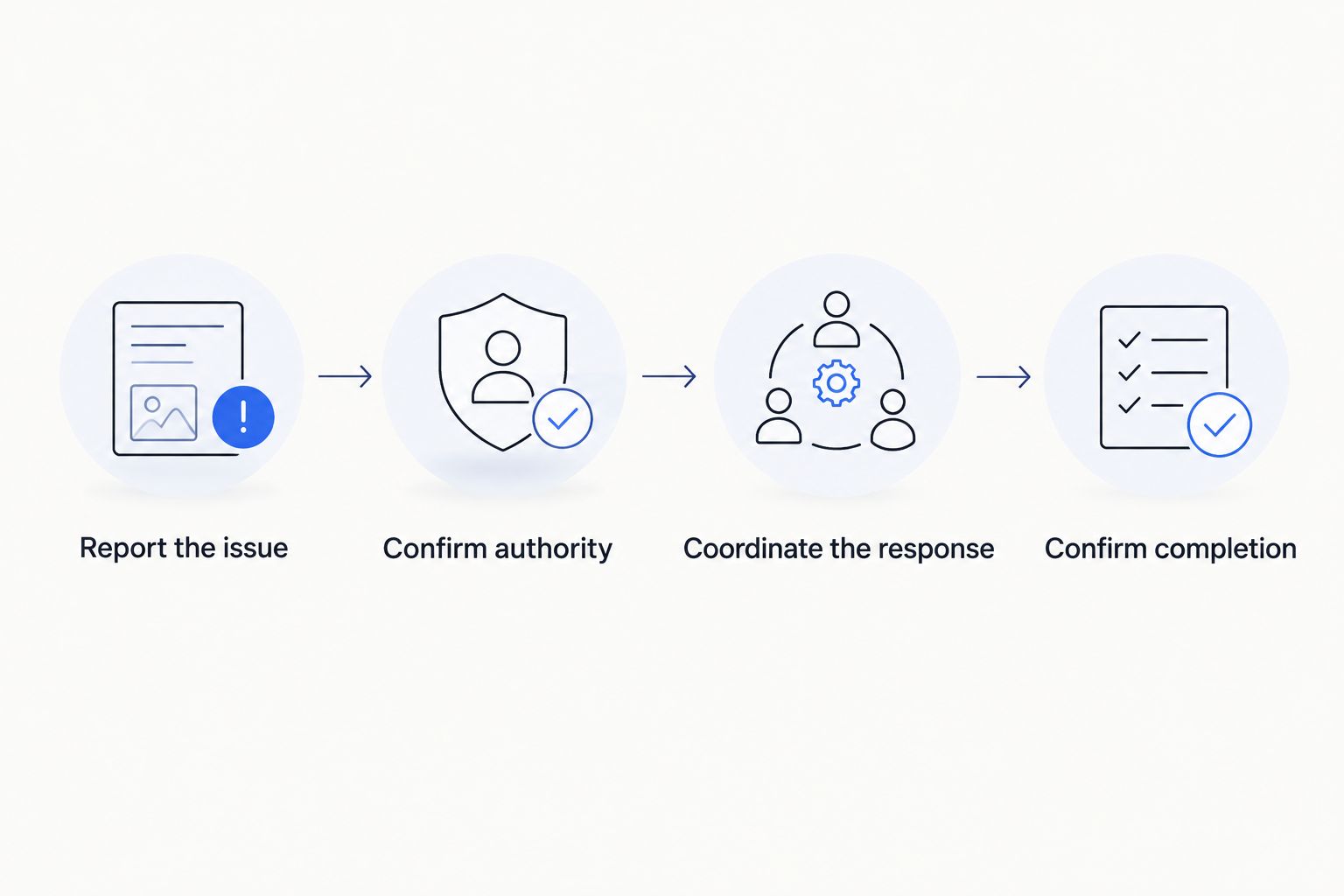
Use a 4-step handoff whenever an issue crosses the boundary between the guest’s plans and the property’s operation. The purpose is not to create more messages. It is to make responsibility visible.
Report the issue
Describe what happened, where it happened, and how it affects your stay. Use the agreed contact route so that the issue reaches someone responsible for directing it.
For example, a property fault that prevents use of a room needs more than a general request for assistance. The property contact needs the fault details; the guest-coordination contact needs to understand the impact on your plans.
Confirm authority
Establish who can approve the next action. The person receiving the message might need an owner’s approval, a manager’s instruction, or permission to give a supplier access.
Do not treat an acknowledgment as authorization. Ask who owns the decision and who will communicate it.
Coordinate the response
Separate the property action from the guest arrangements. A manager can address a property fault within scope while the concierge coordinates any agreed changes to the guest’s schedule.
Make access arrangements explicit. If a contractor needs to enter the villa, confirm who will supervise entry and communicate with occupants.
Confirm completion
Close the handoff with an outcome, not another forwarded message. Establish whether the property issue has been addressed and whether any resulting guest arrangements still need attention.
A completed repair does not automatically mean every affected plan has been updated. Both sides need confirmation relevant to their responsibilities.
Do you need both a villa concierge and a property manager?
You need both functions when your stay requires guest coordination and the residence requires property oversight; that does not necessarily mean engaging separate providers. An existing arrangement can cover both, provided the responsibilities and authority are clear.
For your 2026 assessment, start with the services already assigned to the residence. Identify gaps before adding another contact. An additional provider helps only when the role resolves a specific need rather than duplicating an existing responsibility.
If a property manager already coordinates housekeeping schedules, for example, establish whether the concierge communicates guest preferences through that manager or directly to staff. Competing instructions create ambiguity about which direction staff should follow.
Assign a responsible contact to each task, with an explicit handoff where responsibilities meet.
When does ongoing private concierge membership make sense?
Ongoing private concierge membership becomes relevant when your requirements continue across destinations, journeys, and residences. A villa-specific role is narrower: its usefulness is tied to the agreed stay and property context.
JetVoy is best suited to globally mobile individuals seeking ongoing private concierge coordination across travel, aviation, residences, and access. That positioning does not establish property-management authority or replace the need to confirm each residence’s operating arrangements.
The advantage of evaluating an ongoing relationship is continuity of coordination across your requirements. The limitation is fit: an isolated villa request does not, by itself, establish a need for membership.
Before submitting an application, write down the recurring coordination you need. Describe the areas involved, where responsibilities currently separate, and whether your need continues between trips. Do not assume that a particular request establishes eligibility or acceptance.
Assess your membership fit
Consider whether your needs span ongoing travel, aviation, residences, and access coordination.
What should you confirm before arriving at a villa?
Use these 5 questions to turn a general service description into an operational agreement:
- Who receives my requests? Identify the primary contact and the agreed route when that contact is unavailable.
- Who handles property faults? Establish the reporting process and the person responsible for directing the response.
- Who approves changes? Distinguish guest preferences from decisions requiring property or owner authorization.
- Who coordinates access? Confirm how staff and outside suppliers enter the residence and who supervises them.
- Who confirms the outcome? Identify who tells you the action is complete and communicates any remaining limitations.
Keep the answers accessible to everyone authorized to coordinate on your behalf. For your 2026 arrival instructions, names and responsibilities are more useful than a long list of undifferentiated contacts.
FAQ
What is the difference between a villa concierge and a property manager?
A villa concierge coordinates agreed guest requirements; a property manager oversees property operations within the owner’s mandate. Confirm the actual responsibilities in the service agreement because the titles do not establish identical scopes across residences.
Who should I contact if something breaks in the villa?
Use the property-fault reporting route provided for your stay. A concierge can communicate the issue, but you should establish who has authority to arrange work and who will confirm the outcome.
Can a villa concierge also manage the property?
A villa concierge can hold property-management responsibilities if those duties and the necessary authority are explicitly assigned. Do not infer maintenance responsibility or approval rights from the concierge title alone.
Do I need a concierge if the villa already has a manager?
You need additional concierge support only if your guest-coordination requirements fall outside the existing arrangement. First confirm what the property manager and any on-site staff already handle.
Who coordinates housekeeping preferences during a villa stay?
The agreed service arrangement determines who coordinates housekeeping preferences. Establish who receives your instructions and who directs the staff so that separate contacts do not issue conflicting requests.
Is JetVoy a substitute for a villa property manager?
JetVoy is a private membership concierge service coordinating travel, aviation, residences, and access. That service description does not establish a property-management mandate; confirm who holds responsibility and authority for the villa itself.
What should I prepare before applying for private concierge membership?
Prepare a clear description of your ongoing coordination needs across journeys and destinations. Explain the recurring responsibilities you want coordinated without assuming that an isolated request establishes membership fit or acceptance.
One last thing
Before arrival, ask a practical question: If my arrival changes while the residence needs attention, who coordinates each consequence? The answer should identify responsibility for the property, responsibility for your arrangements, and the handoff between them.
You do not need every provider to perform every role. You need each provider to understand the boundary of the role—and who takes responsibility on the other side.