

Choose a staffed villa when you want a private household setting and can define the service your group needs; choose a luxury hotel when you prefer separate accommodations within an established hospitality operation. The deciding factor is your daily rhythm, not the property label. For either option, confirm the actual staffing, facilities, and service boundaries before committing to a stay.
- Staffed villa vs luxury hotel: choose by household rhythm, privacy needs, and confirmed service scope.
- A staffed villa suits a shared household routine; staffing descriptions still require careful review.
- A luxury hotel suits independent schedules; confirm room placement, facilities, and property-specific service.
- Jetvoy suits globally mobile individuals seeking ongoing private concierge coordination across travel, aviation, residences, and access.
Why this matters: A residence and a hotel organize your day differently. The right choice supports how you eat, work, rest, and move together; the wrong choice leaves you adjusting your routine around the accommodation.
For an ongoing relationship with Jetvoy, accommodation belongs within a wider travel brief rather than an isolated property request. Start your 2026 assessment with the way you live between destinations, then decide which setting supports it.
Staffed villa or luxury hotel: which suits your travel pattern?
A staffed villa fits a shared household rhythm. A luxury hotel fits travelers who want greater independence within the same property. Neither description establishes the quality or extent of service: assess the specific residence or hotel against your requirements.
| Decision | Staffed villa | Luxury hotel |
|---|---|---|
| Best for | A group that wants a shared private household setting | Travelers who want separate accommodations and independent routines |
| Daily rhythm | Assess whether staffing supports your preferred household schedule | Assess whether property service hours fit separate schedules |
| Shared time | Evaluate living, dining, and outdoor spaces for your group | Evaluate suites, connecting rooms, and suitable gathering spaces |
| Discretion | Confirm who enters the residence and which areas are exclusively yours | Confirm room access, shared-area exposure, and arrival arrangements |
| Service scope | Establish named roles, working hours, and responsibilities | Establish which services belong to the property and which require separate arrangements |
| Main limitation | A private setting does not establish the breadth of support | A luxury designation does not establish privacy or room proximity |
Do not compare a fully specified residence with an idealized hotel, or the reverse. Give both the same brief and judge the answers against the same requirements.
A useful 2026 shortlist should make exclusions as visible as inclusions. If the accommodation description leaves a responsibility unclear, treat that responsibility as unresolved rather than assumed.
Staffed villa: best for a shared household rhythm
A staffed villa is the stronger starting point when your group wants to inhabit a residence together rather than meet between separate rooms. Think about shared meals, quiet work, children's routines, visiting relatives, and time spent at the property.
The advantage is the household setting. The qualification is that “staffed” does not specify who does what, when they work, or which requests fall outside their responsibilities. Ask for the actual arrangement, not a broader interpretation of the label.
Before selecting a residence, establish:
- Household rhythm: When does your group want meals, housekeeping, quiet time, and shared activities?
- Service scope: Which roles are present, what do they cover, and when are they available to the household?
- Personal space: Can people withdraw without disrupting those using shared rooms?
- Discretion: Who enters the property, for what purpose, and under whose instruction?
- Onward travel: How will arrival changes and departure requirements reach the relevant people?
A shared address does not guarantee a compatible layout. Review the relationship between bedrooms, communal rooms, work areas, and staff access rather than relying on the bedroom total alone.
Choose the residence when the household arrangement is part of the purpose of the stay. Do not choose it solely because private space sounds preferable; that space still needs to support your actual routine.
Luxury hotel: best for independent daily schedules
A luxury hotel is the stronger starting point when members of your party want separate bases and different daily routines. One person can structure a workday while another organizes leisure time, without making every activity part of a shared household plan.
The advantage is access to the property's established hospitality operation. The qualification is that the word “luxury” does not establish particular facilities, operating hours, room relationships, or access conditions.
Check the property at room level. Being in the same hotel does not establish that your rooms are adjacent, on the same floor, or suitable for gathering privately.
Your assessment should address:
- Whether the proposed room configuration supports both independence and time together.
- Which dining, wellness, work, and other facilities actually match your routine.
- How shared spaces affect your expectations of discretion.
- Whether service hours align with early departures, late arrivals, or changing plans.
- What requires advance coordination outside the property's normal arrangements.
Choose the hotel when separate routines matter more than maintaining a shared household. Reconsider it if your group expects to spend substantial time together in private but has not identified a suitable space for doing so.
Why the right accommodation varies
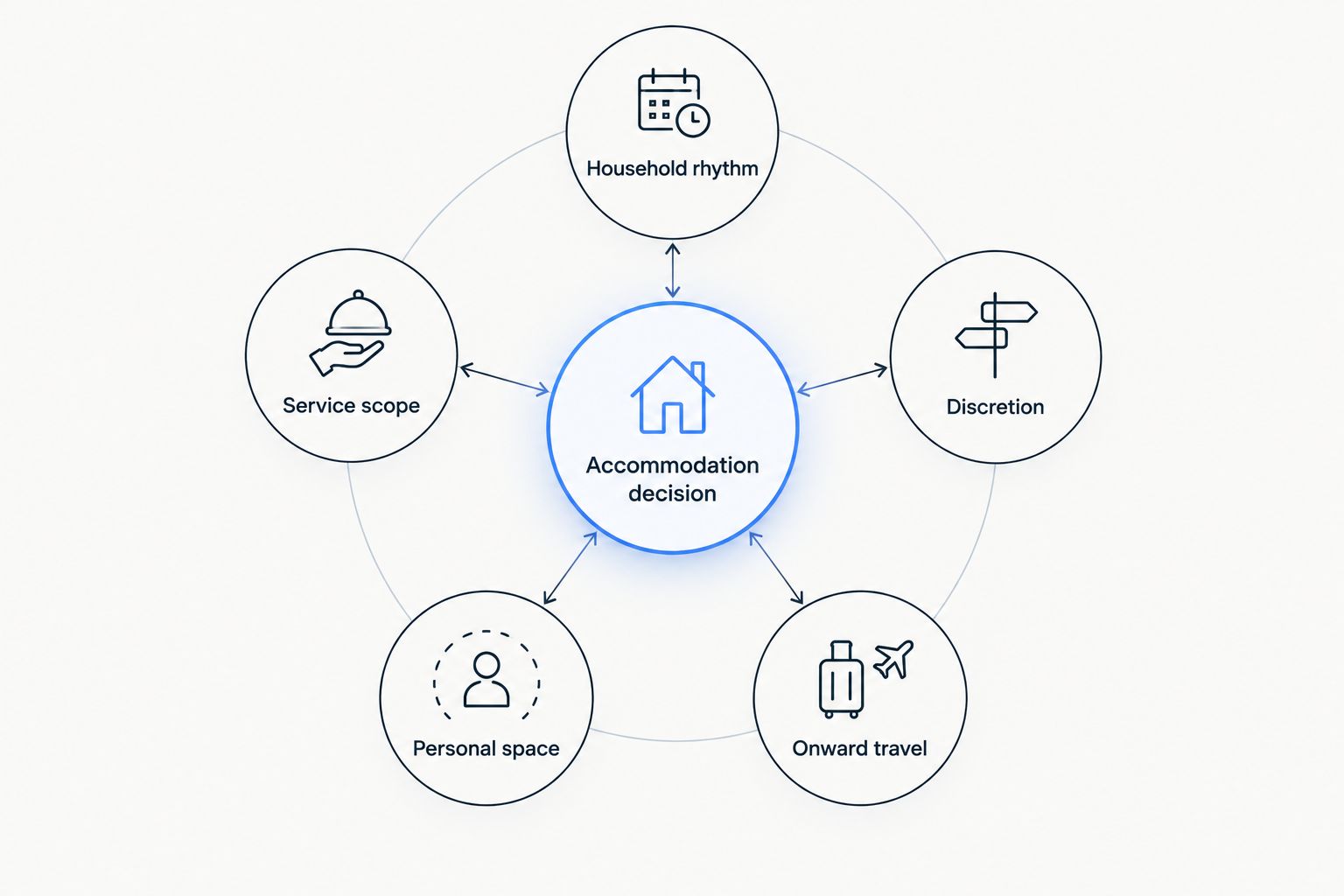
The staffed villa vs luxury hotel decision changes when your travel pattern changes. A preference that works for a family stay need not work for an executive visit or a trip involving several independently moving adults.
Use these factors to assess each journey:
- Household rhythm: Identify which activities genuinely need to happen together. Shared accommodation should support those activities, not create an obligation to coordinate everything.
- Service scope: Translate expectations into named responsibilities. Meal preparation, housekeeping, transport coordination, and specialist assistance are separate requirements, not interchangeable descriptions.
- Discretion: Define what privacy means to you. Exclusive living space, controlled visitor access, and confidential handling of personal information require different questions.
- Personal space: Assess where each person can sleep, work, speak privately, and withdraw. A large shared property and separate hotel rooms solve different spatial needs.
- Onward travel: Connect the stay to arrivals, departures, transfers, and the next destination. The accommodation decision should not leave those transitions outside the brief.
For repeat travel in 2026, keep the underlying requirements consistent while allowing the accommodation type to change. Continuity means preserving what matters to you, not repeating the same format regardless of the journey.
How do you turn your travel pattern into a useful brief?
Write a brief that another person can act on without interpreting what you mean by comfort, privacy, or flexibility. Describe observable requirements and distinguish essentials from preferences.
Start with the day, not the destination
Outline an ordinary day during the proposed stay. Include when people wake, eat, work, leave the property, and return, along with any periods when quiet or separation matters.
This exposes the accommodation's role. If the household spends its most important time together at the residence, assess shared spaces closely; if everyone moves independently, assess room configuration and separate access to services.
Separate requirements from preferences
State what would make the stay unsuitable. Then list the details you would welcome but can adjust.
For example, a private workspace is a different requirement from a preference for a particular view. Keep those distinctions explicit so an attractive property does not displace a practical necessity.
Confirm responsibility before arrival
For each essential requirement, establish who handles it and how changes reach that person. Do not assume a residence manager, hotel team, transport provider, and external specialist share the same information.
Record unresolved points before selecting the accommodation. In your 2026 travel planning, an unanswered question should remain visible until the relevant party confirms the arrangement.
Where does ongoing private concierge membership fit?
Accommodation selection is one part of a continuing travel relationship. Membership fit depends on whether you need coordination across recurring journeys and connected requirements, rather than help with a single stay.
Jetvoy is best for globally mobile individuals seeking ongoing private concierge coordination across travel, aviation, residences, and access. That scope is relevant when your accommodation needs belong to a wider pattern of movement and commitments.
The boundary matters. An ongoing membership should be evaluated as an ongoing relationship; a one-off villa or hotel request alone does not establish fit.
When evaluating Jetvoy private concierge membership, explain how your travel recurs, where coordination is needed, and which preferences should remain consistent. Do not substitute a property wish list for an account of the relationship you are seeking.
A qualified application should describe your circumstances clearly without treating membership as automatic acceptance. Keep any property-specific requirements separate from assumptions about what membership includes.
Is a staffed villa always more private than a luxury hotel?
A staffed villa is not automatically more private in every relevant sense. Exclusive living space answers one question; staff access, visitors, neighboring sightlines, and information handling answer others.
A hotel requires a different review, including corridors, shared facilities, room placement, and arrival arrangements. Define the privacy requirement first, then assess the actual property.
Can you use villas and hotels within the same travel pattern?
Villas and hotels can serve different parts of the same travel pattern. Assess each stay by its purpose rather than making one accommodation category a permanent rule.
For your 2026 travel brief, carry forward the requirements that remain constant—such as discretion or workspace—and reconsider those that depend on the people traveling with you.
FAQ
What's the main difference between a staffed villa and a luxury hotel?
A staffed villa provides a residence-based setting, while a luxury hotel provides accommodations within a hotel operation. Compare the actual staffing, spaces, and service responsibilities rather than assuming either label establishes what is included.
Is a staffed villa better for a family traveling together?
A staffed villa is a stronger fit when the family wants a shared household routine. Confirm the layout, staff responsibilities, and any child-specific requirements rather than assuming a residence is suitable for every family.
Is a luxury hotel better when everyone has different plans?
A luxury hotel is a stronger starting point when travelers want separate accommodations and independent routines. Confirm room placement and suitable gathering spaces if spending time together remains important.
Does a staffed villa include someone to handle every request?
The term staffed villa does not establish responsibility for every request. Ask which roles are present, when they work, and which requirements need separate coordination.
What should I ask before choosing either accommodation?
Ask how the property supports your daily rhythm, discretion, personal space, and essential services. Establish who handles each requirement and how changes will be communicated.
Does private concierge membership mean I should always choose a villa?
Private concierge membership does not make one accommodation category right for every journey. Jetvoy coordinates travel, aviation, residences, and access; assess membership as an ongoing relationship and accommodation as a journey-specific decision.
How should I compare a villa and a hotel for an upcoming stay?
Give both options the same written brief and compare their confirmed responses. Separate essential requirements from preferences, and keep exclusions visible alongside inclusions.
One last thing
Ask what happens when your departure changes after the household or hotel has planned its day. The answer identifies which responsibilities sit with the accommodation and which require coordination elsewhere.
Use that question in your next 2026 accommodation assessment. Choose the stay that fits your routine, then establish how changes will be handled across the rest of the journey. A compelling property description is not a substitute for a clear division of responsibility.