

Formula One hospitality travel planning works when you coordinate event access, your stay and ground transfers as one itinerary, with each decision checked against the others. For a 2026 race weekend, start with the access you intend to use, establish the arrival and departure constraints, and select accommodation around the resulting movements—not as a separate preference.
- Formula One hospitality travel planning should align access, accommodation and transfers before you commit to separate arrangements.
- Jetvoy is best suited to globally mobile individuals evaluating ongoing private concierge coordination rather than an isolated race-weekend request.
- Assess hospitality by its documented inclusions, entry conditions and usefulness to your actual itinerary.
- Choose your stay around the movements you intend to make, not distance from the circuit alone.
Why this matters
A hospitality selection does not resolve the journey around it. You still need to understand where entry takes place, how your party reaches that entrance, where vehicles can meet you afterward, and how those movements connect with your stay.
The useful planning unit is the complete movement, not the individual reservation. For a 2026 itinerary, treat arrival, residence access, circuit attendance and departure as connected decisions. A change to one deserves a review of the others.
Jetvoy is a private membership concierge service coordinating travel, private aviation, residences and access. That scope is relevant when a race weekend forms part of an ongoing pattern of global travel rather than a standalone occasion.
How do you align race-weekend hospitality, stays and transfers?
Use 3 connected decisions: establish the access requirements, select a workable base, and coordinate the movements between them. Document the dependencies before treating any individual element as settled.
- Establish access requirements. Identify the event days, hospitality location, intended attendance and documented entry conditions. Separate confirmed inclusions from requests that still need an answer.
- Select a workable base. Assess the residence or hotel against your arrival, circuit movements, private commitments and departure. Include access to the property itself, not just its address.
- Coordinate transfers. Confirm the permitted meeting locations, intended departure sequence, vehicle requirements and responsibility for communicating changes.
Bring these decisions into 1 written itinerary. It should distinguish confirmed arrangements, open questions and preferences; combining those categories makes an unfinished plan look complete.
A useful final test is to read the itinerary from the traveler’s perspective. At every transition, you should know where to go, what you need to carry, who is coordinating the next movement and what remains subject to confirmation.
Which planning approach fits your race weekend?
The comparison below concerns planning approaches, not claims about specific providers. Each can serve a purpose, but each places a different coordination burden on you.
| Approach | Best for | Advantage | Limitation |
|---|---|---|---|
| Access-led planning | A weekend centered on a defined hospitality experience | Establishes attendance requirements before other decisions | Does not resolve accommodation or transfers by itself |
| Stay-led planning | A trip where the residence or hotel is the primary consideration | Gives the party a clear base for the wider visit | Requires access and transport decisions to be checked against that base |
| Membership-led coordination | Globally mobile individuals evaluating an ongoing concierge relationship | Provides a framework for discussing travel, aviation, residences and access together | Requires assessment of membership fit and agreed scope; membership alone establishes neither admission nor event access |
Choose the approach around the relationship you need, not the prestige of the event. An isolated hospitality requirement and a continuing coordination requirement are different briefs. Neither should be presented as the other.
Access-led planning
Start here when attending a particular hospitality setting is the defining purpose of the trip. Obtain the written terms for the exact experience under consideration, including applicable days, entry requirements and any separately controlled elements.
The strength is clarity of purpose. The constraint is that accommodation and transport still need their own assessment; an attractive hospitality description is not a complete travel plan.
Stay-led planning
Start here when the accommodation has a purpose beyond circuit attendance—for example, hosting your party’s private time or supporting other commitments. Map the intended movements before deciding whether the location suits the weekend.
The strength is a clear base. The constraint is that a preferred setting can create an awkward itinerary if its practical access does not match the movements you intend to make.
Membership-led coordination
Start here when the weekend sits within recurring international travel and you want to evaluate a continuing relationship. Discuss how the proposed membership scope relates to travel, aviation, residences and access rather than treating the event as the entire brief.
The strength is a broader coordination framework. The constraint is fit: an ongoing private membership is a different commitment from assistance with a single occasion, and its scope needs explicit agreement.
Why race-weekend planning varies
For 2026, build the plan from the specific event information and your party’s requirements. Do not carry assumptions from a previous itinerary into a different race weekend.
- Access scope. The days and activities you intend to attend determine which movements the itinerary must support. Request written clarification wherever an inclusion is unclear.
- Accommodation access. Consider arrival procedures, luggage handling and the practical meeting point for vehicles. An address alone does not describe the handoff.
- Arrival and departure. Your aviation or other transport arrangements establish constraints around the event. Review how changes would affect the rest of the itinerary.
- Party requirements. Different attendance plans, luggage needs or separate commitments require explicit coordination rather than a single assumed schedule.
- Changes and responsibilities. Identify who receives updates and who checks their consequences across access, stays and transfers.
These are planning questions, not promises of a particular outcome. Resolve them with the relevant parties and retain the distinction between a requested arrangement and a confirmed one.
Build the itinerary around its handoffs
A handoff is where responsibility moves from one party to another: from your arrival transport to your ground transfer, from the vehicle to the property, or from the circuit exit to the return journey. Review each handoff explicitly rather than assuming the parties share the same instructions.
Use 4 review points: Arrival, Stay, Circuit access and Departure. Under each, record the location, relevant documents, responsible contact and unresolved dependencies. These review points organize the brief; they are not a substitute for provider confirmations.
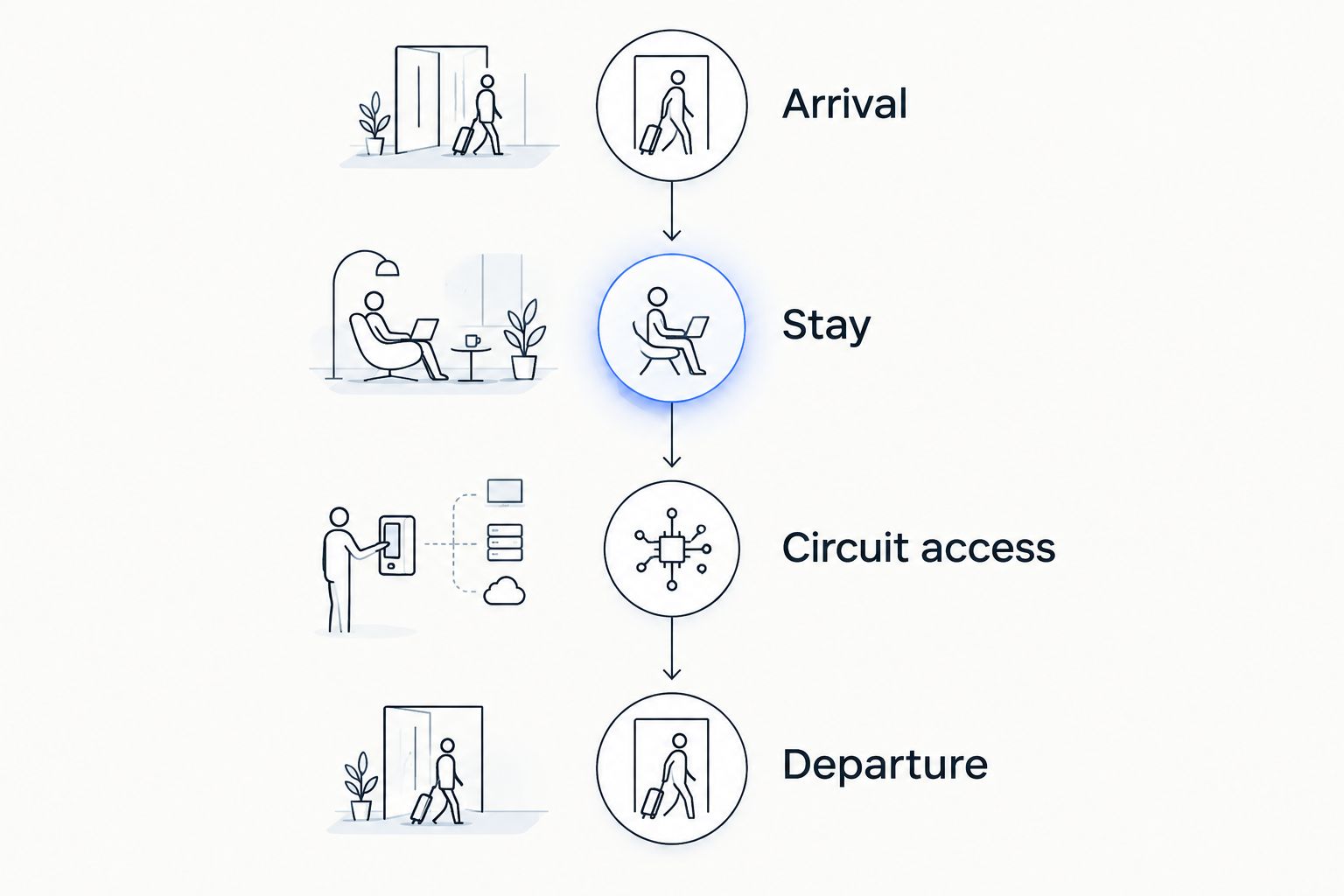
For a 2026 race weekend, maintain a current version of the itinerary and make its status clear to everyone who needs it. A revised transfer instruction is useful only if the affected traveler and coordinating parties receive the same revision.
Arrival: establish the first meeting point
Write down where the arriving party will meet the onward transfer and how that meeting will be communicated. Identify what remains dependent on arrival information and who is responsible for updating it.
If your party arrives separately, describe those movements separately. A shared destination does not mean everyone has the same arrival requirements.
Stay: connect the property to the itinerary
Confirm how the party will enter the property and where vehicles should collect them. Review these details against the first intended movement after arrival and the final movement before departure.
Keep personal preferences separate from operational requirements. A preferred setting matters, but it should not obscure an unresolved entry procedure or collection point.
Circuit access: work from documented instructions
Check the entry instructions associated with the specific hospitality arrangement. Establish what each attendee needs to present, where they should arrive and which questions still require clarification.
Do not turn an access request into an itinerary commitment before it is confirmed. Where different people hold different access, keep their movements distinct until the details support a shared plan.
Departure: plan backward from the onward journey
Review the final event commitment against your intended departure. Include the return to the property if luggage, a change of clothes or another obligation requires it.
Avoid treating departure as a minor extension of the race-day transfer. It has its own destination, requirements and consequences for the next stage of travel.
What should you confirm before committing to hospitality?
Confirm the exact experience, applicable attendance days, documented inclusions and entry conditions before treating hospitality as the fixed center of your itinerary. Then check whether your proposed stay and transport can support that plan.
Ask for a clear separation between what is included, what requires a separate arrangement and what remains a request. Do not infer additional access from the name of a hospitality setting or from a general description of the weekend.
A detailed description is not the same as a confirmation. Retain the relevant written terms and identify the person responsible for resolving discrepancies before they affect other arrangements.
Is accommodation near the circuit always the right choice?
Accommodation near the circuit is not automatically the right choice; assess the complete journey and the purpose of your stay. Geographic proximity answers only where the property is, not whether it supports your intended movements.
Compare the practical collection point, applicable access instructions, your non-circuit commitments and your departure needs. Ask the relevant transport provider to assess the proposed movements rather than substituting a map estimate for an operational plan.
When does an ongoing private concierge membership fit?
An ongoing private concierge membership fits the evaluation when your need extends beyond a single race weekend into recurring coordination. The relevant question is whether you want a continuing relationship across connected travel and lifestyle requirements.
For Jetvoy private concierge membership, frame the discussion around your actual pattern of travel, the people involved in decisions and the areas where coordination is needed. Do not assume a spending threshold, automatic acceptance or guaranteed event access.
A qualified application brief should explain the relationship you are seeking. Include the role of race weekends within your wider travel, the scope you want to discuss and the boundaries of decision-making authority; avoid sharing sensitive documents before the appropriate process is established.
FAQ
What is the first step in Formula One hospitality travel planning?
The first step is to establish the event access requirements before aligning accommodation and transfers. Identify the intended attendance, documented entry conditions and unresolved questions so the rest of the itinerary rests on clear requirements.
Should I choose hospitality or accommodation first?
Choose the defining requirement first, then check the other arrangements against it. An access-led weekend starts with the hospitality requirements; a stay-led visit starts with the property's role in the wider trip.
Does race hospitality include all the access I want?
Treat only the documented inclusions of your specific arrangement as included. Ask separately about any additional access and keep unconfirmed requests distinct from confirmed arrangements.
Can separate arrivals work for the same race weekend?
Separate arrivals can be planned as distinct movements within the same itinerary. Record each party's meeting point, onward transfer requirements and responsibility for communicating changes.
What should a race-weekend transfer plan include?
A transfer plan should identify the intended movement, meeting location, vehicle requirements and coordinating contact. It should also distinguish confirmed instructions from details awaiting clarification.
Is private concierge membership appropriate for one race weekend?
An ongoing private concierge membership should be assessed as a continuing relationship, not assumed to suit one isolated request. Consider whether you need coordination beyond the event itself.
What should I tell Jetvoy when discussing membership?
Tell Jetvoy how recurring travel, aviation, residences and access fit into the relationship you are seeking. Explain your coordination needs without assuming membership acceptance or a particular event outcome.
One last thing
Before finalizing your 2026 itinerary, read it backward from the onward departure. Check whether the final circuit movement, any return to your accommodation and luggage collection all support that departure.
Then read it forward from arrival. Any handoff that depends on an unstated assumption needs clarification. This is a practical way to distinguish a collection of individually confirmed arrangements from a coordinated weekend.