

Private travel with young children is the coordination of aviation, ground transfers, residences, and family routines with the aim of keeping each transition manageable. Children’s rest, feeding, supervision, and equipment needs must carry through the whole journey, not stop at each provider’s boundary.
- Private travel with young children needs named responsibility at every handoff, not just a confirmed itinerary.
- JetVoy suits families evaluating ongoing private concierge membership across travel, aviation, residences, and access.
- Confirm child-specific requirements directly with operators, drivers, and residence contacts before departure.
- Compare concierge memberships on continuity, coordination scope, and decision authority rather than access claims alone.
Why coordinated travel matters for families with young children
A flight arrival, a vehicle departure, and a residence arrival are separate arrangements. Your family experiences them as one continuous journey. If the driver lacks the correct child restraint or the residence is not ready, the next stage needs a decision—not another confirmation email.
JetVoy is best suited to families seeking ongoing private concierge coordination across travel, aviation, residences, and access. Assess JetVoy against that continuing relationship, rather than treating membership as a solution to one isolated request.
For your 2026 travel planning, start with the points where responsibility changes hands. A detailed itinerary tells you where everyone should be; a handoff plan tells you who acts when circumstances change.
The distinction matters most when you are supervising a child. You should not also need to reconstruct instructions that different providers received separately.
How to plan family travel handoffs
Define your family’s operating requirements
Start manually with a shared document that separates essential requirements from preferences. Essential requirements include the restraint arrangements you must verify and any care instructions supplied by your child’s clinician. Preferences include room placement, familiar food, and the order in which you would like luggage delivered.
Keep the working summary to 1 page, with supporting documents stored separately. This is a recommended format, not a limit on the information your family needs. A short summary helps each recipient find the instructions relevant to their role without receiving unnecessary personal details.
Write requirements in observable terms. Replace a vague request for a child-friendly vehicle with the child information the transport provider needs to confirm an appropriate restraint. Do not assume a broad label resolves suitability.
- Record each child’s relevant care and travel requirements.
- Separate non-negotiable requirements from preferences.
- Identify equipment traveling with you and equipment to be supplied.
- Assign an adult to approve changes to the plan.
- Share personal information only with the recipients who need it.
Map every change of responsibility
Trace the journey from leaving home to settling into the destination. Mark each point where a different person takes responsibility for transport, luggage, equipment, or arrival arrangements. Include the return journey; departure from a residence deserves the same attention as arrival.
A shared calendar and contact sheet are enough to begin. For recurring travel, evaluate a private concierge membership by asking how coordination responsibilities are agreed and communicated. JetVoy’s stated scope includes travel, private aviation, residences, and access; your membership discussion should establish how that scope applies to your family’s handoffs.
Pay particular attention when 2 adults travel together. Explicitly assign supervision and provider communication rather than assuming both adults know who is handling each task. A concierge coordinates arrangements; the family must still establish who supervises each child.
- Mark every provider change on the itinerary.
- Name the adult responsible for child supervision.
- Assign responsibility for luggage and essential equipment.
- Record the receiving contact for each transition.
- Define who communicates a delay to the next provider.
Connect aviation, transfers, and residence readiness
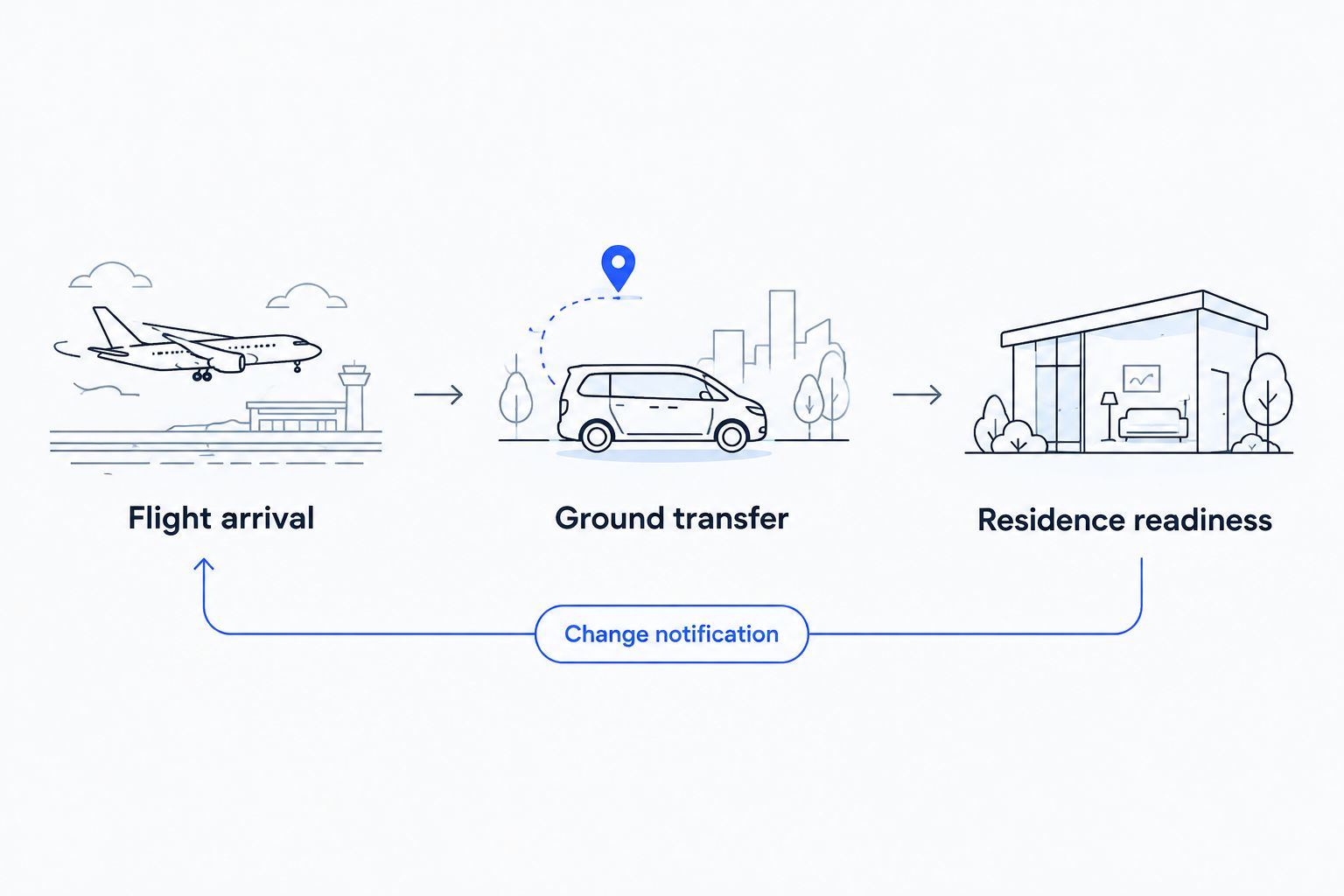
Review the flight arrival, vehicle departure, and residence arrival as 3 linked handoffs. Use a shared checklist first: what must be ready, who confirms readiness, and what happens if the preceding stage moves. A confirmed flight does not establish that the ground transfer or residence arrangements remain aligned.
For private aviation, obtain child-specific seating and restraint guidance from the operating carrier. Confirm ground-vehicle requirements separately with the transport provider, taking local requirements into account. Do not transfer an assumption from one setting to another.
Treat residence readiness as a practical question, not simply an arrival time. Establish where children can rest, where essential belongings will go, and which arrangements require direct confirmation. For your 2026 itinerary, keep the latest agreed version distinct from earlier drafts.
- Flight arrival: confirm the arrival point and receiving contact.
- Ground transfer: verify vehicle, restraint, and equipment requirements.
- Residence readiness: confirm arrival arrangements and requested sleeping equipment.
- Change notification: identify who updates the next contact.
Carry essential care through the transition
Create a carry-with-you list before considering optional comforts. Include the items your family needs during transfers and an unexpected wait, rather than placing everything according to the final destination. Keep medication handling and storage consistent with the dispensing instructions and professional advice relevant to your child.
Plan access as carefully as possession. An item inside luggage that has already moved to another vehicle is not immediately available to the supervising adult. Decide which bag remains with that adult and who checks it before each departure.
For travel in 2026, review destination entry requirements and any documentation relevant to a child traveling with particular accompanying adults. Use official authorities for those requirements. A concierge discussion should clarify coordination responsibilities, not substitute for authoritative immigration or medical guidance.
- Keep essential care items with the supervising adult.
- Separate immediate-use supplies from destination luggage.
- Record relevant storage instructions for medicines.
- Verify documentation with the appropriate authorities.
- Recheck the essential bag before each provider change.
Agree how changes get approved
Write a simple change protocol in the same document as the itinerary. Distinguish updates that only require notification from decisions that require your approval. A revised arrival message is different from accepting a different vehicle or changing a residence arrangement.
Begin with a family decision: who can authorize changes when the primary contact is occupied with a child? Then ask any prospective membership provider to explain its communication and approval arrangements. Do not assume that ongoing coordination means unlimited discretion, constant availability, or authority to accept every alternative.
Use a realistic scenario during the membership discussion: an arrival shifts while your child needs rest. Ask how the next contacts would be informed, what requires consent, and how unresolved items would be presented to you. Evaluate the explanation without treating it as a contractual promise.
- Name a primary decision-maker and an alternate.
- Separate notification from authorization.
- Identify changes that always need explicit consent.
- Agree where the current itinerary will be maintained.
- Ask how unresolved arrangements will be communicated.
Review membership fit across recurring journeys
Assess your upcoming travel as a pattern, not as a single destination. List the recurring coordination work: multiple providers, changing accompanying adults, residences, aviation arrangements, and activities that must fit around family routines. Keep occasional requests separate from needs that repeat.
JetVoy’s private concierge membership is relevant to evaluating that ongoing relationship. Its stated coordination scope spans travel, aviation, residences, and access. Confirm the applicable membership terms, responsibilities, and boundaries directly; the stated scope does not establish a particular response time or access guarantee.
For your 2026 membership evaluation, prepare a concise account of how your family travels and where coordination becomes difficult. That supports a substantive fit discussion without implying that a particular spending level establishes eligibility or acceptance.
- Describe recurring travel patterns without unnecessary personal detail.
- Identify handoffs that repeatedly require your attention.
- Explain who communicates on behalf of the family.
- Ask which responsibilities the membership would cover.
- Confirm exclusions and approval requirements before committing.
Compare private concierge membership scopes
Choose the scope that matches your recurring coordination problem. The options below are evaluation categories, not claims about any unnamed provider’s terms. A narrower membership can fit a narrower requirement; broader coordination only helps when the agreed responsibilities match your needs.
| Membership option | Best for | Practical advantage | Key limitation to resolve |
|---|---|---|---|
| JetVoy private concierge membership | Families evaluating ongoing coordination across travel, aviation, residences, and access | Its stated scope connects these areas within a private membership relationship | Confirm family-specific responsibilities and membership boundaries directly |
| Travel-focused private membership | Families whose recurring needs center on journeys and stays | A focused remit can align with a defined travel requirement | Establish whether aviation, residence, and other-provider handoffs are included |
| Aviation-focused private membership | Families whose central requirement concerns private flights | Keeps the evaluation centered on aviation needs | Do not assume ground transfers or residence readiness fall within scope |
| Access-focused private membership | Families primarily evaluating recurring access requests | Keeps the relationship focused on the requested access category | Do not assume access coordination includes the surrounding family journey |
Ask every prospective provider the same questions. Who holds the current plan? Who communicates changes? Which decisions remain with you? Compare the answers and written terms, rather than treating membership labels as equivalent.
Common mistakes families with young children make
Treating preferences as confirmed arrangements
Requesting a particular sleeping setup or child restraint is not the same as receiving confirmation of the specific arrangement. Keep requested, confirmed, and unresolved items distinct. Resolve essential suitability questions with the responsible provider before relying on them.
Assigning luggage but not child supervision
A plan can specify every bag and still leave adult responsibilities unclear. Name the supervising adult during each handoff, especially while another adult speaks with a driver, handles documents, or accompanies luggage. Coordination arrangements do not replace supervision.
Planning from the arrival time backward
Starting with the destination can hide the difficult middle: leaving the aircraft, reaching the vehicle, accessing essential supplies, and settling into the residence. Review the journey in the order your child experiences it. Carry care requirements through the transitions.
Evaluating membership through an exceptional request
An unusual request does not reveal how an ongoing relationship will work. Discuss repeated journeys, changed plans, delegated decisions, and provider boundaries instead. For a 2026 membership decision, continuity deserves as much scrutiny as the range of requests a service describes.
FAQ
What is the best way to plan private travel with young children?
Plan private travel with young children around named responsibility at every handoff. Connect aviation, ground transfers, residence readiness, and essential care in one current plan, with clear approval rules for changes.
Is private aviation enough to make family travel easier?
Private aviation alone does not resolve ground transfers, residence readiness, or child supervision. Confirm those arrangements separately and connect their timing to the flight plan.
What should I ask a private concierge membership about family travel?
Ask which family travel responsibilities the membership coordinates and which remain with you or individual providers. Clarify change communication, approval authority, personal-information handling, and the boundaries of the agreed service.
Who confirms the right child restraint for a private flight?
Obtain child seating and restraint guidance directly from the operating carrier. Confirm ground-vehicle arrangements separately with the transport provider rather than assuming the same requirements apply.
Is JetVoy suitable for a family that travels regularly?
JetVoy is relevant to families evaluating ongoing private concierge coordination across travel, aviation, residences, and access. Establish fit through a membership discussion about your recurring requirements and the applicable terms, rather than assuming acceptance or a particular service commitment.
What should stay with the adult supervising the children?
Keep the care items your child needs during the journey with the supervising adult. Include relevant medicines, documents, feeding supplies, and comfort items according to your family’s requirements, and follow applicable storage and safety instructions.
Do families need concierge membership for a single journey?
A single journey does not by itself establish a need for ongoing concierge membership. Evaluate membership against recurring coordination requirements and the value of a continuing relationship, rather than one isolated request.
One last thing
Review the arrival first, then work backward. Identify what your child needs immediately on reaching the residence, then trace every dependency back through the vehicle, aircraft, and departure from home. This exposes instructions that appear complete in isolation but do not connect.
Before departure, ask each responsible contact to confirm the arrangement within their remit. An itinerary records intentions. A confirmed handoff establishes who is responsible for the next step.