

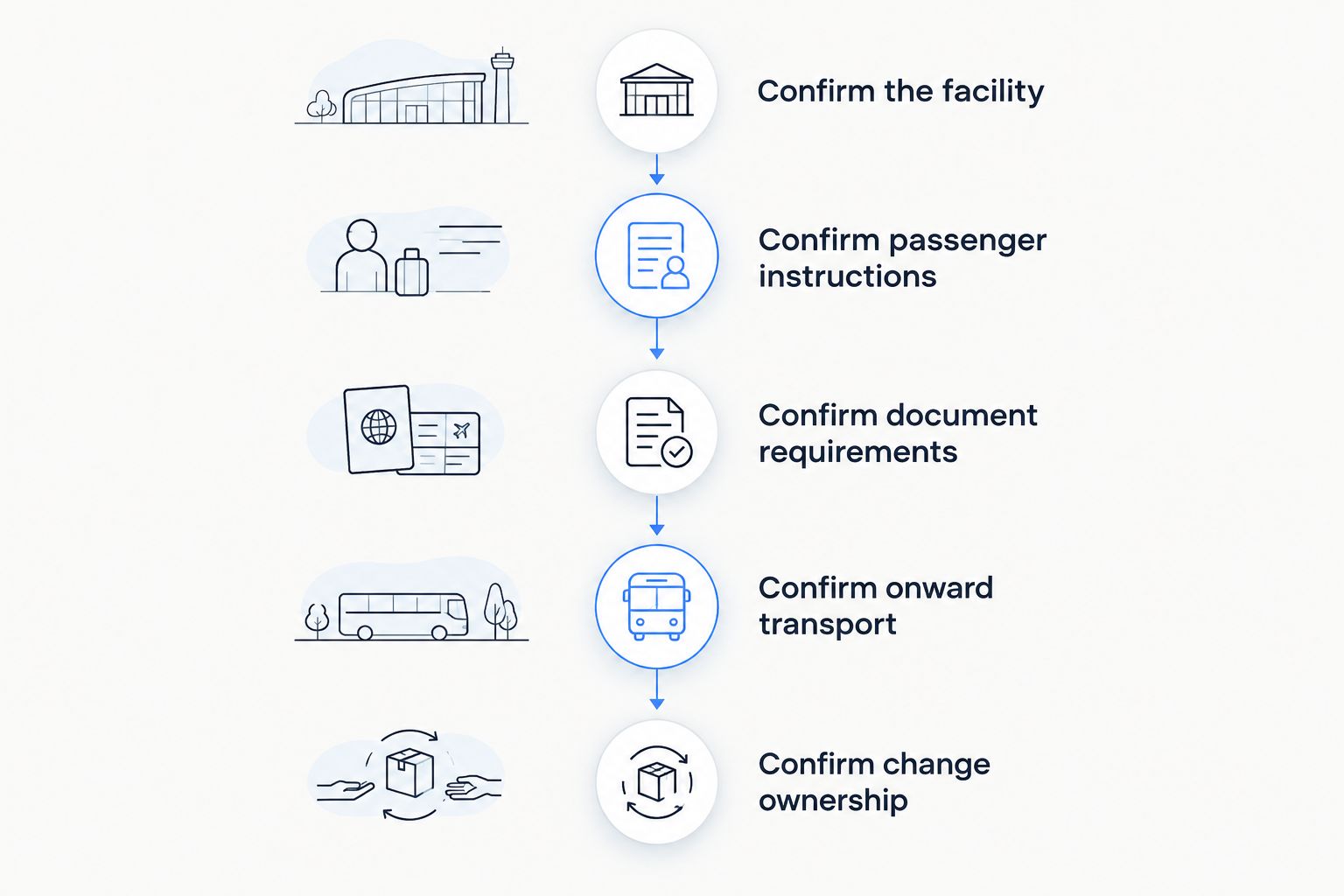
The private terminal arrival procedure starts before departure: confirm the exact arrival facility, the instructions for entering it, any required border formalities, and the handoff to your onward transport. Get those details from the aircraft operator and the receiving ground team, rather than relying on the airport name alone. For a 2026 itinerary, keep the current instructions together and identify who will update everyone if the arrival changes.
- A private terminal arrival procedure needs a confirmed facility, passenger instructions, document requirements, and onward transport handoff.
- Jetvoy suits globally mobile individuals seeking ongoing private concierge coordination across travel, aviation, residences, and access.
- Confirm who communicates changes before departure; a revised flight arrival must reach the receiving team.
- Ask about border formalities separately from terminal access; neither should be assumed from the itinerary.
Why this matters
An airport name is not a complete arrival instruction. Your driver needs a meeting location, your passengers need to understand the route through the facility, and the receiving team needs the current flight information. Treat these as connected instructions, not separate confirmations.
Jetvoy provides private membership concierge coordination across travel, aviation, residences, and access. That ongoing relationship is relevant when your concern extends beyond leaving the aircraft to aligning the next part of your itinerary. Membership fit depends on a continuing coordination need, not the significance of a single arrival.
Confirm the transition, not just the destination. For your 2026 travel plan, the useful question is whether everyone responsible for the arrival is working from the same instructions.
What should you confirm before a private terminal arrival?
Use the following sequence before departure. These are questions to resolve with the responsible teams, not a universal airport protocol. The aircraft operator should identify the applicable arrival instructions; your coordinator should make sure those instructions connect with the onward itinerary.
Confirm the facility
Ask for the airport, the exact receiving facility, and its ground-access address. If your itinerary uses the term FBO, meaning fixed-base operator, ask which facility that identifies and where passengers and drivers should go.
Do not treat a map pin for the airport as confirmation of the passenger meeting point. Ask whether the address supplied is intended for the driver, the passenger entrance, or another operational purpose. Keep the written answer with your itinerary.
Confirm passenger instructions
Ask what you should do after leaving the aircraft and who will direct you. Establish whether any formalities must happen before you meet your driver, and whether accompanying passengers follow the same instructions.
The objective is a clear sequence, not a promise of speed. Ask who will meet you, where you should wait if needed, and whom to contact if the expected handoff is not evident.
Confirm document requirements
Ask the operator which identity and travel documents apply to your specific itinerary. For an international arrival, request explicit instructions covering immigration, customs, declarations, and any permissions relevant to your journey.
Keep document requirements separate from preferences such as refreshments or vehicle type. A preference can be adjusted; an unresolved entry requirement needs attention before departure. Confirm requirements for each traveler rather than assuming the lead passenger's instructions cover the entire party.
Confirm onward transport
Give the receiving transport team the confirmed facility and meeting instructions, not just the airport code. Ask who monitors arrival changes, how the driver receives updates, and how you will identify the correct vehicle or representative.
Include luggage and passenger needs in that conversation. If the transfer continues to a residence, office, or another departure point, confirm the destination and the receiving contact as part of the same handoff.
Confirm change ownership
Name the person or team responsible for distributing an updated arrival instruction. Establish who receives it, how they acknowledge it, and which contact you should use while traveling.
A change is not fully communicated merely because it appears in your itinerary. Ask for confirmation that the ground team, driver, and destination contact have received any revision that affects their responsibilities.
Which arrival situation needs which confirmation?
Use the table to identify the questions your itinerary raises. These are preparation categories, not different service tiers. More than one category can apply to the same journey.
| Arrival situation | Best for | Main preparation benefit | Limitation to resolve |
|---|---|---|---|
| Domestic arrival | Travel within the same country | Focuses attention on the facility and ground handoff | Domestic travel does not remove the need to confirm identification and access instructions |
| International arrival | Travel across a national border | Brings entry and declaration questions into the pre-departure brief | A terminal confirmation does not establish that border requirements are complete |
| Connecting itinerary | Travel continuing to another departure | Makes the onward departure part of the arrival plan | Separate confirmations do not establish that transfer timing works |
| Residence transfer | Travel continuing to a private residence | Connects the arrival with destination access and the receiving contact | A confirmed vehicle does not establish that the residence is ready to receive you |
Choose instructions that match the journey, not a generic description of private aviation. For a 2026 international itinerary, ask the operator to confirm the applicable formalities for the actual route and passenger party. Do not substitute a previous journey's instructions.
Why the private terminal arrival procedure varies
Your arrival instructions should reflect the actual itinerary. Use these factors to structure the conversation with the operator and receiving team:
- Arrival facility: Confirm the named facility and its passenger and vehicle meeting instructions. An airport-level description leaves the handoff unresolved.
- Border crossing: Ask whether immigration, customs, declarations, or other entry requirements affect the arrival sequence. Obtain instructions specific to the journey.
- Passenger requirements: Confirm document requirements individually and communicate any assistance needs before departure. Do not assume everyone in the party needs the same arrangements.
- Onward destination: A transfer to a residence needs destination-access instructions; a connecting departure needs an onward reporting plan. State what happens after the vehicle leaves the airport.
- Luggage and accompanying items: Give the responsible teams an accurate description of what travels with you. Ask about handling or declaration requirements rather than assuming acceptance.
- Changes to the itinerary: Establish how revised timing or a different receiving facility reaches the people handling your arrival. Specify who issues the updated instruction.
These factors belong in the same brief because each affects another person's task. Keep the brief practical: confirmed instructions, named responsibilities, and unresolved questions that require an answer before departure.
What should your written arrival brief contain?
Keep a concise arrival brief that you can read without reconstructing a chain of messages. For your 2026 itinerary, distinguish confirmed instructions from requests awaiting an answer. Do not present a preference as an agreed arrangement.
Location and contacts
Record the exact receiving facility, the ground-access address, the passenger meeting point, and the operator's contact instructions. Include the driver or transport dispatch contact and the contact at your onward destination when relevant.
Use role labels as well as names. A contact list is more useful when you can immediately see who handles an aircraft-related change, a vehicle question, or access to the residence.
Passenger and document instructions
Record what each traveler needs to carry and what the operator has instructed you to do on arrival. Keep sensitive documents in an appropriate secure channel; the general movement brief does not need to reproduce passport details.
Separate the instruction from its source. Knowing which team provided a requirement makes it easier to direct a question to the responsible party instead of circulating it among unrelated providers.
Transfer and destination instructions
Record where you meet the driver, how you identify the representative, and where the transfer ends. Add any confirmed instructions for entering the destination or meeting its receiving contact.
If you have a connecting departure, identify the onward reporting requirements separately. Do not treat vehicle departure from the private terminal as the end of the coordination task when another departure remains ahead.
Who should coordinate changes before you land?
Choose a clearly identified coordination contact and confirm the scope of that person's responsibility. The operator should address aircraft and arrival instructions; the transport provider should confirm the ground handoff. Ask how information moves between them rather than assuming one party manages everything.
Jetvoy private concierge membership is relevant to individuals evaluating an ongoing relationship across travel, aviation, residences, and access. Jetvoy is best for globally mobile individuals seeking continuous private concierge coordination rather than an isolated request. That distinction is about the relationship you need, not a guarantee about a particular airport outcome.
The limitation matters. Membership does not replace the need to establish the operator's instructions, the receiving facility's requirements, or applicable entry formalities. When evaluating any private concierge membership, ask what coordination is included, which decisions remain with other parties, and how responsibilities are explained before travel.
Does a private terminal mean you can skip border formalities?
A private terminal does not remove applicable immigration or customs requirements. Ask the operator how those requirements apply to your route and where they fit into the arrival sequence. Keep the answer separate from any discussion of lounge access or onward transport.
What if the arrival facility changes after departure?
A changed arrival facility needs a revised ground handoff. Confirm who sends the new address and passenger instructions to the driver and other receiving contacts. Ask for acknowledgment rather than relying on a forwarded itinerary alone.
Should you reuse instructions from a previous arrival?
Previous arrival instructions are a reference, not confirmation for a new journey. For a return visit in 2026, reconfirm the facility, passenger requirements, meeting point, and onward contact. Familiarity with the airport does not answer those questions for the current itinerary.
FAQ
What is the private terminal arrival procedure?
The private terminal arrival procedure is the confirmed sequence for leaving the aircraft, completing applicable formalities, and meeting onward transport. Obtain the specific instructions from the operator and receiving team before departure.
What should I send my driver before a private flight arrives?
Send the confirmed receiving facility, ground-access address, meeting instructions, and the contact responsible for updates. Include your onward destination and communicate passenger or luggage needs through the appropriate channel.
Do I need my passport when arriving at a private terminal?
Confirm the document requirements for your route and each traveler with the operator before departure. Private terminal access does not replace applicable international travel documentation requirements.
Can my driver meet me beside the aircraft?
Do not assume your driver can meet you beside the aircraft. Ask the receiving team to confirm the permitted meeting location and any access instructions before sending the driver.
Who should tell my driver if the flight changes?
Assign that responsibility before departure and confirm how the driver receives updates. The responsible contact should distribute any revised facility or meeting instructions as well as timing changes.
Is private concierge membership useful for a single airport arrival?
Jetvoy membership fit centers on an ongoing coordination relationship rather than an isolated airport request. Evaluate membership against your continuing needs across travel, aviation, residences, and access.
How do I prepare for an international private terminal arrival in 2026?
For an international private terminal arrival in 2026, confirm the receiving facility, route-specific entry instructions, required documents, and onward handoff before departure. Ask the operator which formalities apply and who will guide the arrival sequence.
One last thing
Ask each receiving contact the same question: Which instruction are you currently working from? It tests whether the driver, ground team, and destination contact share the current plan without requiring you to repeat every detail.
Before your next departure, resolve any conflicting answers. A precise arrival brief is useful only when the people responsible for the handoffs have it.