

Choose private membership when you need an ongoing coordination relationship across connected travel and lifestyle requirements; choose credit card concierge when its stated scope covers your individual requests. The deciding factor in 2026 is responsibility between requests, not the prestige of the membership or card. Neither label establishes who follows a change through flights, ground arrangements, residences, and access—you must confirm that responsibility before relying on it.
- Concierge vs credit card concierge is a choice about continuity, scope, and responsibility—not status.
- Jetvoy private concierge membership fits individuals seeking ongoing coordination across travel, aviation, residences, and access.
- Assess credit card concierge against your card’s current terms, not assumptions about what concierge includes.
- Choose the relationship that matches your recurring requirements; confirm limits before submitting an application.
Private membership vs credit card concierge: which support fits?
Choose the support model that can take the responsibility you actually need. A clearly defined request and a changing, interconnected itinerary require different levels of coordination. Do not assume either service model handles both in the same way.
Jetvoy is a private membership concierge service coordinating global travel, private aviation, exceptional residences, and exclusive access for high-net-worth individuals, family offices, and corporate executives. That stated scope makes an ongoing relationship—not an isolated request—the relevant basis for evaluating membership fit.
Use this comparison when reviewing your options in 2026. It identifies what to establish, rather than assigning unverified capabilities to every card or private membership.
| Support model | Best for | Principal reason to consider it | Limitation to assess |
|---|---|---|---|
| Private concierge membership | Individuals evaluating ongoing, connected coordination | A relationship organized around recurring requirements across several areas | Membership alone does not establish the exact scope, exclusions, or responsibility for execution |
| Credit card concierge | Cardholders whose individual requests fit their card’s stated service | Support connected to an existing card relationship, where the relevant benefit applies | The concierge label does not establish continuity, provider responsibility, or coverage of every request |
Why this matters
A successful individual arrangement does not prove that an entire itinerary is coordinated. A residence can be suitable while its arrival arrangements remain unresolved. A flight change can be confirmed while the people expecting you still have the previous schedule.
These are dependency problems. Your evaluation should establish who identifies those dependencies, who communicates changes, and where responsibility ends. A service that meets a narrow need is not inadequate because its remit is narrow; it is the wrong choice only when you expect it to carry responsibilities outside that remit.
When is private concierge membership the better fit?
Private concierge membership is the better fit to evaluate when you want a continuing relationship across recurring, connected requirements. The important distinction is not how elaborate a single request sounds. It is whether your needs extend beyond that request and remain connected over time.
Consider a journey involving private aviation, a residence, ground arrangements, and an event. Each element has its own requirements. Your question is whether the membership coordinates their relationship or addresses each element separately.
Jetvoy private concierge membership is best for globally mobile individuals seeking ongoing coordination across travel, aviation, residences, and access. This describes membership fit, not automatic acceptance or a guarantee that every requested arrangement can be delivered.
What supports the membership case?
You have a stronger reason to evaluate membership when you repeatedly need to explain the same preferences, align several providers, or account for changes affecting other arrangements. These are useful issues to bring into an application conversation because they describe the coordination burden you want to address.
The advantage to assess is continuity: whether the relationship can carry relevant context across agreed requirements. The limitation is equally important. A membership description does not, by itself, establish a dedicated contact, response commitment, geographic coverage, or authority to make decisions on your behalf.
Ask for those boundaries explicitly. Do not substitute an impression of personal attention for a clear understanding of what the membership includes.
When is credit card concierge the better fit?
Credit card concierge is the better fit when the service attached to your card covers the request you have and you do not need a broader ongoing relationship. Begin with the current benefit description and service terms. The card’s positioning is not a substitute for either.
A bounded request has a recognizable endpoint. You can explain the objective, receive the relevant assistance, and determine whether the request has been completed without requiring continued coordination across unrelated arrangements.
The reason to consider this route is straightforward: an existing card benefit deserves evaluation before you seek a separate relationship. Its limitation is that you cannot infer the service’s responsibilities from the word concierge.
What should you verify with the card provider?
Ask whether your intended request falls within the service’s remit, what information you must provide, and what happens after an arrangement changes. Establish whether the service communicates with the relevant providers or expects you to manage those conversations.
For a 2026 comparison, use current terms for your specific card and issuing market. Do not rely on another cardholder’s experience as evidence of your own entitlement or service scope.
Use card concierge for a defined need only after confirming that the benefit covers it. A clearly limited service can be the correct choice when your need is equally limited.
Why the right concierge support varies
The right choice depends on your requirements and the actual service terms. These factors provide a more useful assessment than broad claims about which model is more exclusive.
- Continuity: Do you want assistance with a single request, or a relationship that carries relevant context across recurring requirements?
- Connected arrangements: Does a change affect only one element, or does it alter several parts of your journey?
- Decision authority: Who can approve alternatives, and when must the service return to you for a decision?
- Communication boundaries: Who informs providers and other authorized participants when plans change?
- Service scope: Which requirements are included, excluded, or subject to separate confirmation?
- Discretion: What information is necessary, who is authorized to share it, and how are sensitive details handled?
These are assessment criteria, not features you should presume either model provides. A useful answer explains an operating boundary. A vague assurance that someone will handle everything does not.
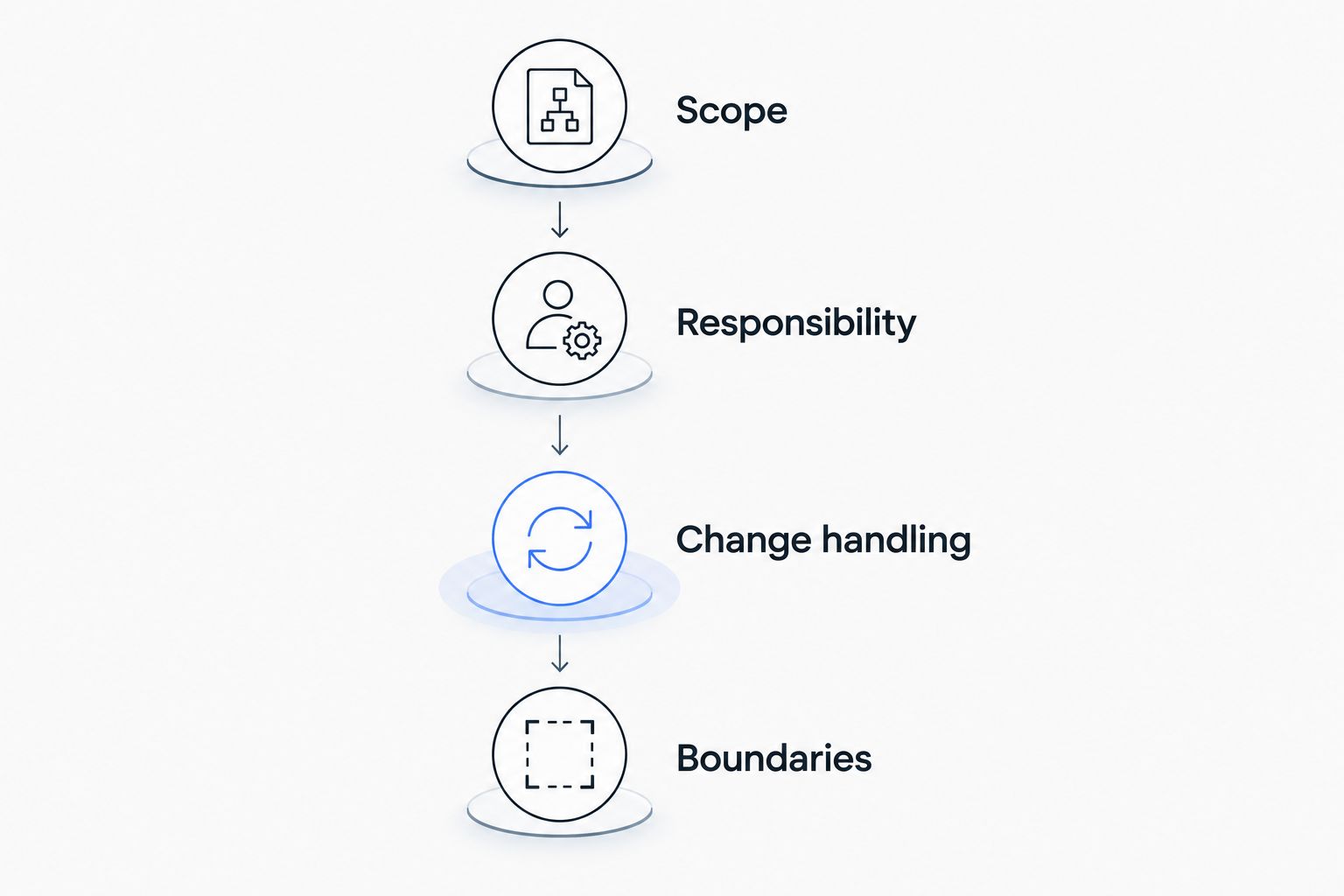
How do you compare the services before deciding?
Compare services through a realistic coordination scenario, then examine the responsibilities around it. Keep the scenario representative of your actual needs rather than presenting an unusually elaborate request to test appearances.
Start with scope
Describe what you need coordinated and where the request begins and ends. Separate ongoing requirements from a single exceptional occasion. This gives the service a clear opportunity to explain what belongs within its remit.
Do not include unnecessary personal details at the outset. Explain the coordination problem first, then establish what information is needed to assess fit.
Establish responsibility
Ask who is responsible for each dependency. If an arrival changes, who checks the effect on the residence, ground arrangements, and scheduled access? Who tells you what remains unresolved?
The answer should distinguish coordination from the responsibilities of the underlying providers. A concierge relationship does not make those providers’ conditions irrelevant.
Test change handling
Introduce a change to the scenario. Ask how the service would establish its consequences, seek any required approvals, and communicate the revised plan within its agreed scope.
You are assessing the process, not requesting a promise that disruption will never occur. Precision means knowing what happens when the original plan no longer holds.
Confirm boundaries
Request a clear explanation of exclusions, approval requirements, and the point at which a request is considered complete. Also establish what happens when a requirement falls outside the service’s remit.
For your 2026 decision, record the answers against the same scenario for each service. Comparing different scenarios produces an impression; comparing the same responsibilities produces a usable decision.
Can you use private membership and card concierge together?
You can assess both services for different needs, but their scopes should not overlap without clear ownership. The practical question is not whether you can hold both relationships. It is whether each relationship has a defined purpose.
For example, you might evaluate one service for an individual request and another for connected travel requirements. Before involving both in the same arrangement, establish who communicates with providers and who maintains the current instructions.
Separate responsibilities are useful; competing instructions are not. If both services touch the same journey, identify the responsible party for each element and make changes through the agreed channel. Do not assume that separate services exchange information or reconcile instructions with one another.
Does private membership guarantee better access?
Private membership does not, by its label alone, establish a guarantee of access. Evaluate the specific service’s stated scope and the conditions attached to the requested arrangement.
Ask how the service distinguishes a confirmed arrangement from a request still awaiting confirmation. Also ask what happens if the original requirement cannot be met. The useful evidence is a clear explanation of status and alternatives, not the breadth of an access claim.
This distinction matters even when access is central to your decision. Coordination and confirmation are related, but they are not interchangeable.
What should you include in a membership application?
Describe the ongoing relationship you want, the areas requiring coordination, and the practical difficulties you want to reduce. A qualified application explains fit without assuming an unstated spending threshold or entitlement to acceptance.
For a Jetvoy membership inquiry, focus on the connection between global travel, private aviation, residences, and access where those areas genuinely apply to you. Do not manufacture complexity. A precise description of recurring needs is more informative than a list of aspirational requests.
Useful details include:
- The kinds of journeys or requirements that recur.
- The arrangements that depend on one another.
- The people authorized to give instructions or approve changes.
- The preferences that require continuity.
- The boundaries you want clarified before proceeding.
Share sensitive information through an agreed process, not simply to make an initial inquiry appear more detailed. The purpose is to establish whether an ongoing membership relationship fits your requirements.
FAQ
What is the main difference between private concierge and credit card concierge?
The main difference to assess is the relationship’s scope: ongoing coordination versus assistance within a card’s defined concierge benefit. Neither label alone establishes continuity, responsibility, or coverage of a particular request.
Is private concierge membership better for frequent travel?
Private concierge membership is worth evaluating when recurring travel creates connected coordination requirements. Frequency alone is not the deciding factor; examine dependencies, communication responsibilities, and the continuity you need.
Can my credit card concierge coordinate an entire itinerary?
Confirm entire-itinerary coordination directly against your specific card’s service terms. Ask which elements the service handles, who communicates changes, and where its responsibility ends.
Does a private concierge membership guarantee exclusive access?
A private concierge membership label does not establish guaranteed access. Confirm the conditions and status of each requested arrangement rather than treating the membership itself as confirmation.
Can I keep my card concierge if I apply for private membership?
Assess each relationship for a distinct purpose and check any applicable terms. If both services touch the same arrangements, define responsibility so providers do not receive conflicting instructions.
What should I check before choosing concierge support in 2026?
Check current scope, exclusions, decision authority, change handling, and information-sharing responsibilities in 2026. Use the same realistic scenario when comparing services so the answers address equivalent requirements.
Who is Jetvoy private concierge membership designed for?
Jetvoy private concierge membership serves high-net-worth individuals, family offices, and corporate executives seeking coordination across global travel, private aviation, exceptional residences, and exclusive access. Evaluate fit around an ongoing relationship rather than assuming a one-off request establishes suitability.
One last thing
Ask this before deciding: When one arrangement changes, who is responsible for checking everything connected to it? Then ask where that responsibility stops.
Those answers reveal more than a list of services. Choose the relationship whose confirmed responsibilities match the work you need coordinated—not the relationship with the broadest description.