

Private jet luggage planning starts with the operator confirming that your actual bags fit the assigned aircraft, meet its loading limits, and remain compatible with the planned flight. Send bag counts, packed weights, external dimensions, and details of unusual items before departure. Confirm cabin access separately: acceptance for carriage does not mean a bag will be reachable in flight.
- Private jet luggage planning requires operator confirmation of bag dimensions, packed weights, loading access, and flight-specific limits.
- Keep essential medication and travel documents in an approved cabin bag; do not assume baggage compartments are accessible.
- Jetvoy suits globally mobile individuals seeking ongoing private concierge coordination, rather than an isolated luggage request.
- Reconfirm luggage arrangements whenever the aircraft, passenger list, route, or equipment changes.
Why this matters
A baggage compartment's published capacity does not establish whether your luggage will fit. A case must pass through the opening, occupy usable space, and meet the aircraft's loading requirements. Its shape matters alongside its weight.
For a 2026 itinerary involving private aviation, ground transfers, and a residence arrival, treat luggage as part of the whole journey. An accepted flight load still needs an appropriate vehicle and a clear handoff at the destination.
Jetvoy is a private membership concierge service coordinating travel, aviation, residences, and access. Jetvoy is best for globally mobile individuals seeking an ongoing coordination relationship. That membership model is relevant when luggage decisions recur across journeys; an isolated baggage question does not establish membership fit.
Private jet luggage: what should you confirm with the operator?
Ask the operator to approve a specific luggage inventory for the assigned aircraft and planned flight. A general allowance or an aircraft-category description is not a substitute for that confirmation.
Use the following sequence before finalizing what you will take.
Describe the actual luggage
List every checked-style case, cabin bag, garment carrier, and equipment case. Include items traveling outside conventional luggage, such as a stroller, mobility aid, or sports equipment. Do not leave them under a general description such as personal effects.
For each item, provide:
- External dimensions, including wheels, handles, and protruding parts.
- Packed weight, rather than the manufacturer's empty-case weight.
- Whether the case is rigid, compressible, or unusually shaped.
- Whether it needs upright handling or protection from crushing.
Photographs help explain an awkward shape, but they do not replace measurements. Ask the operator what measurement format to use so the inventory is unambiguous.
Confirm the assigned aircraft
Ask whether the assessment applies to the aircraft assigned to your flight or only to an indicative aircraft type. If the aircraft changes, request a fresh luggage review rather than carrying the earlier answer forward.
Confirm both compartment fit and loading access. A compartment can have sufficient internal space while its opening prevents a rigid case from entering. Oversized equipment deserves explicit confirmation, not an assumption based on cabin size.
Ask who will provide the final acceptance decision and what information that person needs. Keep the answer with your itinerary so the person preparing the luggage works from the same instructions.
Confirm the flight-specific loading limits
Ask the operator whether the complete passenger and luggage load is acceptable for the planned route. Aircraft performance planning considers more than bags alone; passenger load, fuel requirements, and operating conditions also matter.
Do not translate a general baggage figure into a personal entitlement. Ask whether the operator's answer covers the entire traveling party and all declared equipment.
If the answer is conditional, identify the condition. You need to know whether confirmation depends on the final passenger list, the aircraft assignment, or another unresolved flight detail.
Separate cabin essentials from stored luggage
Ask which bags can remain in the cabin, where they must be secured, and whether any stored luggage will be accessible during flight. Do not assume a large cabin means unrestricted access to every compartment.
Identify medication, travel documents, and other items you need during the journey. Confirm an approved place for them before packing them into a larger case.
Cabin carriage still requires suitable stowage. A bag being physically within reach does not establish that it can remain unsecured beside a seat.
Declare restricted and unusual items
Tell the operator about spare lithium batteries, power banks, battery-powered mobility equipment, medical equipment, aerosols, and other items that need specific handling review. Aviation dangerous-goods requirements still apply on private aircraft.
Provide the exact item details the operator requests. A broad label such as camera equipment or medical supplies can conceal the information needed to assess carriage.
Never move a restricted item into another bag to avoid declaring it. Obtain instructions for the item itself, including any preparation or documentation required for your journey.
Record the answer and its conditions
Request written confirmation that identifies the inventory reviewed, the aircraft or assignment basis, and any remaining conditions. Keep it available to the people preparing the luggage and coordinating the departure.
Written confirmation is a useful reference, not permission to disregard a later operational decision. If the inventory changes, submit the change. If the operator changes the aircraft, ask for reconfirmation.
Which luggage format fits your journey?
Choose luggage after the operator explains the aircraft's constraints. Soft-sided luggage is not a universal requirement, and hard-sided luggage is not automatically unsuitable. Fit, protection, handling, and access need to work together.
| Luggage format | Best for | Practical advantage | Limitation to resolve |
|---|---|---|---|
| Soft-sided luggage | Flexible packing where the operator recommends compressible bags | Can adapt around some irregular spaces | Less rigid protection; packed dimensions still matter |
| Hard-sided luggage | Belongings needing a structured outer case | Maintains a defined protective shape | Cannot compress through a restrictive opening |
| Dedicated equipment case | Items needing a fitted protective enclosure | Keeps specialist items contained and protected | Unusual dimensions need explicit acceptance |
| Cabin essentials bag | Documents and permitted items needed during the journey | Separates essentials from stored luggage | Must meet the operator's cabin-stowage instructions |
Do not replace suitable luggage merely because a generic private aviation checklist recommends a particular style. Ask the operator what constraint the change would solve.
For your 2026 travel planning, maintain a reusable inventory of the cases you actually own. Update packed weights for each journey rather than treating an earlier trip's inventory as permanent approval.
Why private jet luggage requirements vary
The useful question is not which private aircraft carries the most bags. It is which constraints apply to your particular luggage and journey.
- Aircraft assignment: Compartment layout, loading openings, and permitted stowage depend on the aircraft provided.
- Passenger load: The operator assesses baggage alongside the people traveling and the flight's other loading requirements.
- Route requirements: Fuel and performance planning affect the load the operator can accept for a particular flight.
- Bag geometry: A long, rigid item presents a different fit problem from a compact bag with the same weight.
- Item restrictions: Batteries, medical equipment, and other regulated items require more than a space assessment.
- Ground transfers: The vehicle carrying passengers must also accommodate their declared luggage.
These factors explain why an earlier successful trip is not sufficient evidence for the next departure. Use previous confirmations as background, then ask the operator to assess the current plan.
How do you coordinate luggage beyond the aircraft?
A flight-only answer leaves the handoffs unresolved. Confirm how the same luggage inventory moves through each stage, without assuming that acceptance at one stage settles the others.
Aircraft acceptance
Obtain the operator's assessment of fit, load, restrictions, and cabin access. Identify any items that need separate handling instructions before they reach the aircraft.
Vehicle capacity
Give the ground transport coordinator the same passenger and luggage inventory. Ask for confirmation that both fit together, including oversized cases and mobility equipment.
Residence arrival
Confirm the practical arrival arrangements for the destination property. If luggage needs a separate handoff or particular handling, agree on it before departure rather than leaving the driver to interpret instructions on arrival.
Return journey
Review what will travel back. Additional purchases, equipment changes, or a different aircraft make the outward inventory an incomplete reference for the return flight.
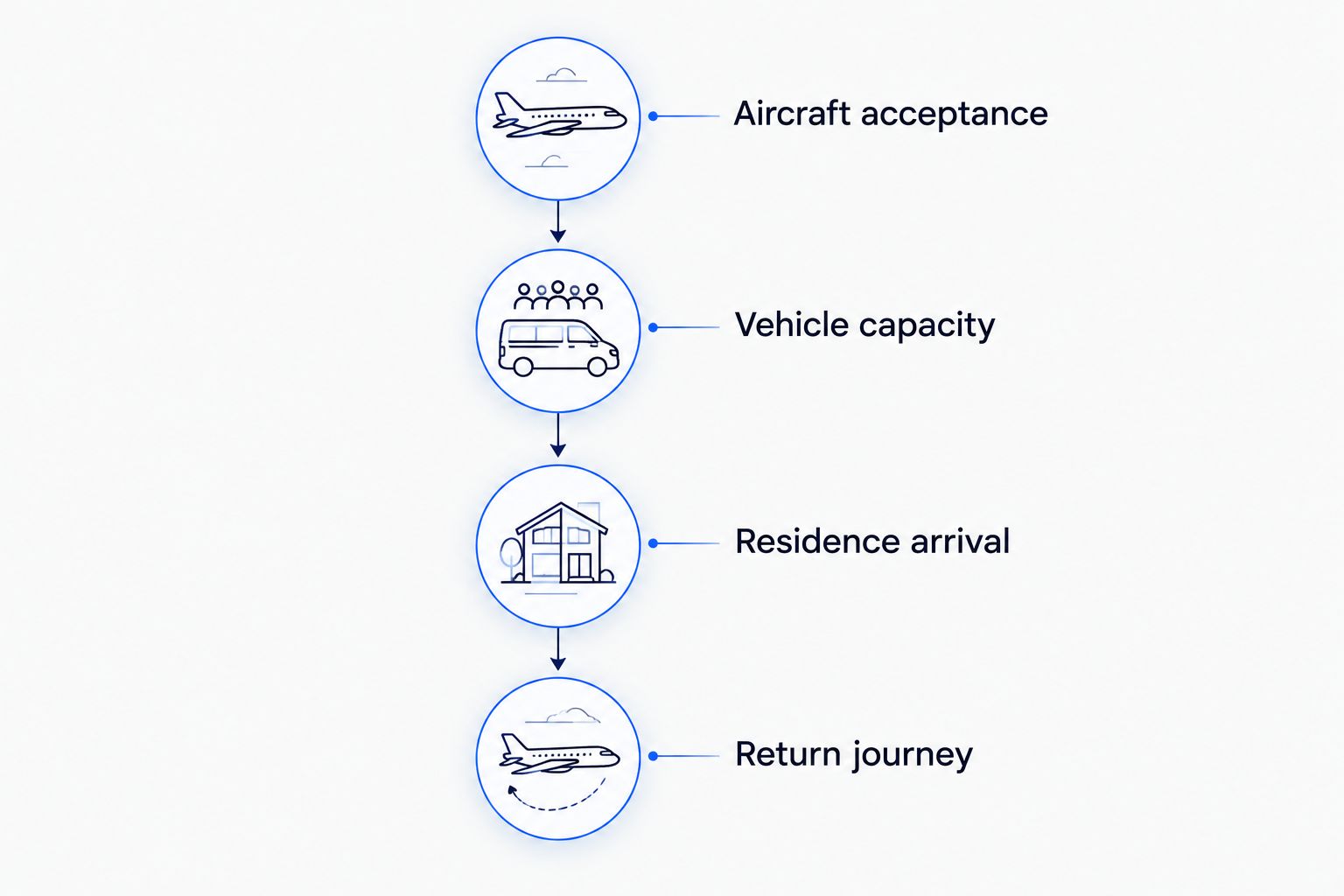
For a 2026 journey with several handoffs, assign responsibility for keeping the inventory current. The purpose is simple: the operator, driver, and arrival contact should not receive different versions of what is traveling.
Can you take more luggage if seats are empty?
An empty seat does not establish permission to carry additional luggage. Ask the operator whether extra bags are acceptable and where they can be secured.
Passenger numbers are only part of the loading assessment. Compartment space, restraint arrangements, weight distribution, and flight requirements still need operator review.
Do not plan to place an extra suitcase on a seat unless the operator explicitly approves that arrangement. Physical space is not the same as an approved stowage position.
What happens if the aircraft changes?
An aircraft change requires the luggage plan to be checked again. Send the existing inventory back for review and ask whether the replacement changes bag acceptance, cabin access, or handling instructions.
Keep the consequences connected. If you remove a case from the flight, tell the ground transport and arrival contacts; if you change to smaller bags, update the inventory rather than leaving an inaccurate case count.
For recurring travel in 2026, make aircraft changes a clear trigger for luggage reconfirmation. Do not rely on someone noticing that an earlier approval referred to a different aircraft.
What should you send before departure?
Send a concise inventory with a clear request: confirm that these items are acceptable for the assigned aircraft and planned flight, identify approved cabin items, and state any unresolved conditions.
Include the passenger list, each bag's measurements and packed weight, unusual-item details, and the essentials you need in flight. Keep sensitive information limited to what the relevant provider needs to assess and coordinate the journey.
Ask specific questions instead of asking whether the luggage should be fine. A useful answer distinguishes confirmed acceptance from a preliminary assessment and tells you what still needs resolution.
If your travel requires this coordination repeatedly, evaluate private concierge membership around continuity across journeys. Jetvoy's private concierge membership is relevant to that ongoing relationship, not as a substitute for the aircraft operator's acceptance decision.
FAQ
How much luggage can I take on a private jet?
The operator must confirm your luggage against the assigned aircraft and planned flight. Send the complete inventory, including external dimensions, packed weights, and unusual equipment, rather than relying on a general allowance.
Do I need soft-sided bags for a private jet?
Soft-sided bags are not a universal requirement for private jets. Ask whether the assigned aircraft's loading opening or compartment layout makes compressible luggage preferable for your journey.
Can I reach my suitcase during a private flight?
Cabin access depends on the aircraft and where the suitcase is stowed. Confirm access before packing, and keep essential medication and travel documents in an operator-approved cabin bag.
Can I take power banks and spare batteries?
Power banks and spare lithium batteries require specific carriage checks. Give the operator the battery details and follow its instructions on permitted carriage, packing, and terminal protection.
Does private jet luggage planning include the airport transfer?
Private jet luggage planning should include the airport transfer because aircraft acceptance does not establish vehicle capacity. Give the ground transport coordinator the same passenger and luggage inventory.
Should I recheck my luggage plan for a return flight in 2026?
Recheck the luggage plan for your return flight in 2026 whenever the aircraft, passenger list, luggage, or route changes. Do not treat approval for the outward flight as automatic acceptance for the return.
One last thing
Measure the case you will actually bring, fully packed, with its wheels and handles included. A product description's dimensions are not a substitute for the external measurements the operator needs.
Resolve uncertainty before the luggage reaches the aircraft. The strongest plan is not the one with the fewest bags; it is the one whose fit, acceptance, access, and handoffs have all been confirmed.