

A private jet broker focuses on arranging private aviation, while a private concierge coordinates the wider requirements around travel, residences, and access within an ongoing relationship. The distinction is responsibility, not status: neither title alone establishes who operates the aircraft, verifies arrangements, or manages changes across the journey.
- Private jet broker vs concierge is a responsibility comparison: aviation arrangements versus wider journey coordination.
- JetVoy suits individuals evaluating ongoing private concierge membership across travel, aviation, residences, and access.
- Use written responsibilities to distinguish the aircraft operator, aviation intermediary, and concierge.
- Choose around recurring coordination needs, not the appeal of a single exceptional request.
Private jet broker vs concierge: how do responsibilities differ?
A private jet broker addresses the aviation requirement; a private concierge addresses the relationship between that requirement and the rest of your plans. Those responsibilities can overlap, so the service description and agreement matter more than the label.
JetVoy describes its private concierge membership around coordination across global travel, private aviation, residences, and access. That is a broader scope than arranging an individual flight, but it does not establish an aircraft operating role or a specific contractual obligation.
| Responsibility | Private jet broker | Private concierge membership |
|---|---|---|
| Primary focus | Private aviation arrangements | Coordination across connected travel and lifestyle requirements |
| Best for | An aviation-specific requirement | An ongoing relationship spanning several requirements |
| Aviation role | Intermediary role defined by the agreement | Coordination role defined by membership scope |
| Wider arrangements | Ask whether transfers, residences, and access are included | Ask which connected arrangements the membership covers |
| Principal advantage | A defined aviation focus | A broader coordination perspective |
| Principal limitation | Wider journey responsibilities require explicit agreement | Membership does not establish aircraft operating authority |
| Decision to make | Who handles the aviation requirement? | Who maintains alignment across the wider journey? |
The table describes roles, not guaranteed service levels. A broker can have a broad service scope, and a concierge membership can have exclusions. Read the actual division of responsibility before making a comparison.
Why this matters
An aircraft movement is only part of a journey. A residence arrival, ground transfer, meeting, or private engagement can depend on its timing. If you evaluate only the flight arrangement, you leave the relationship between those elements unexamined.
For a 2026 membership evaluation, start with the work you repeatedly need coordinated. An isolated aviation requirement and a continuing pattern of interconnected travel call for different assessments. Neither requires treating one service category as inherently better.
The practical question is simple: when a plan changes, who is responsible for identifying every connected decision? An answer that names only the next provider does not explain ownership of the wider sequence.
What does a private jet broker handle?
A private jet broker acts as an intermediary for private aviation arrangements. Evaluate the broker around the aviation requirement: how the proposed arrangement is described, which operator is involved, what the agreement covers, and who communicates changes.
Do not confuse the intermediary with the aircraft operator. Ask for the operating party to be identified and establish which organization is responsible for each aviation function. A service name does not answer those questions.
Best for an aviation-specific requirement
A broker is the relevant category to assess when your central requirement is private aviation and you already have a defined way to coordinate everything around it. That keeps the evaluation focused on the actual assignment rather than a broader membership proposition.
The advantage is scope clarity. The limitation is equally important: you cannot assume that responsibility extends to residences, access, or the consequences of a changed arrival. Establish those boundaries rather than inferring them from attentive communication.
When evaluating a broker, ask:
- Which organization will operate the aircraft?
- Which aviation arrangements does the broker handle directly?
- What information requires your approval before the arrangement proceeds?
- Who communicates a change, and to whom?
- Where does the broker's responsibility end?
These questions clarify the proposed relationship. They do not replace checking the agreement or confirming the operating party through appropriate aviation records.
What does a private concierge membership handle?
A private concierge membership is relevant when your requirements continue across journeys and categories. The assessment moves beyond whether an individual request can be fulfilled to how connected arrangements are coordinated over time.
For globally mobile individuals, that means examining the relationship between travel, aviation, residences, and access. The value proposition is continuity of coordination. The membership agreement still determines what is included and what remains outside the service.
Best for an ongoing coordination relationship
JetVoy is best suited to individuals seeking ongoing private concierge coordination across travel, aviation, residences, and access. Its stated membership scope also serves family offices and corporate executives.
The strength of that scope is its breadth. The corresponding boundary is that a concierge membership is not, by itself, evidence of aircraft operation, guaranteed access, or unlimited responsibility. Evaluate the proposed relationship against your actual requirements rather than assuming those capabilities.
For your 2026 review, describe recurring situations rather than presenting only a destination list. Explain where aviation connects with residences, where schedules depend on access, and which decisions require your direct involvement. That gives the membership discussion a practical basis.
Can a broker and concierge work together?
A broker and concierge can occupy different roles within the same journey. The aviation intermediary addresses its agreed aviation scope; the concierge addresses its agreed coordination scope. Neither role needs to replace the other.
The benefit of this division is specialization without treating the flight as disconnected from the wider plan. The limitation is an additional handoff. Unless responsibilities are explicit, each party can understand its own assignment while the connection between assignments remains unclear.
For example, consider a hypothetical change to an arrival time. The relevant questions extend beyond whether the aviation arrangement has changed: who checks the transfer, who communicates with the residence, and who identifies a conflicting engagement?
That example is a responsibility test, not a service promise. Ask each organization to explain its part before deciding whether the proposed coordination model fits you.
Why the division of responsibility varies
The division varies because membership scope and aviation agreements are not interchangeable. Compare the documents and proposed working relationship, not just the service category.
Use these factors to structure a 2026 comparison:
- Travel: Establish whether responsibility covers the wider itinerary or only an individual aviation requirement.
- Aviation: Separate coordination, intermediary responsibilities, and aircraft operation. Identify the relevant party for each.
- Residences: Ask whether residence requirements sit within the same coordination scope and where the boundary lies.
- Access: Establish how access requests relate to travel plans without treating a request as a guarantee.
- Continuity: Decide whether you need help with an isolated requirement or an ongoing relationship across changing plans.
These factors reflect different assignments, not a hierarchy of service quality. A narrowly defined aviation relationship can fit a narrowly defined need. A broader membership deserves consideration when the recurring work itself is broader.
How do you compare responsibilities before choosing?
Use a written responsibility map before comparing presentation or membership language. The map should show what each party handles, where approval sits, and how changes move between connected arrangements.
1. Responsibility map
List the requirements that matter to your actual travel: aviation, transfers, residences, and access where relevant. Assign a responsible party to each and identify the connections between them.
Do not fill every space with the word concierge. A useful map distinguishes coordination from the underlying service and makes any unassigned responsibility visible.
2. Provider verification
Identify the organizations involved in delivering the proposed services. For aviation, distinguish the broker or coordinator from the aircraft operator and ask what documentation supports that distinction.
Your objective is to understand the chain of responsibility. A polished proposal does not remove the need to identify the parties named in the arrangement.
3. Change ownership
Ask how a change affecting several arrangements is handled. Establish who receives the initial information, who checks connected requirements, and who brings decisions back to you.
Use a realistic scenario from your own travel pattern. Keep the discussion specific enough to expose a handoff without presenting hypothetical handling as an agreed commitment.
4. Decision authority
Separate permission to coordinate from permission to commit you to an arrangement. Confirm what requires approval and how that approval is recorded.
This distinction matters for an individual, a family office, or an executive support team. Everyone involved should understand who can instruct, who can approve, and who needs to be informed.
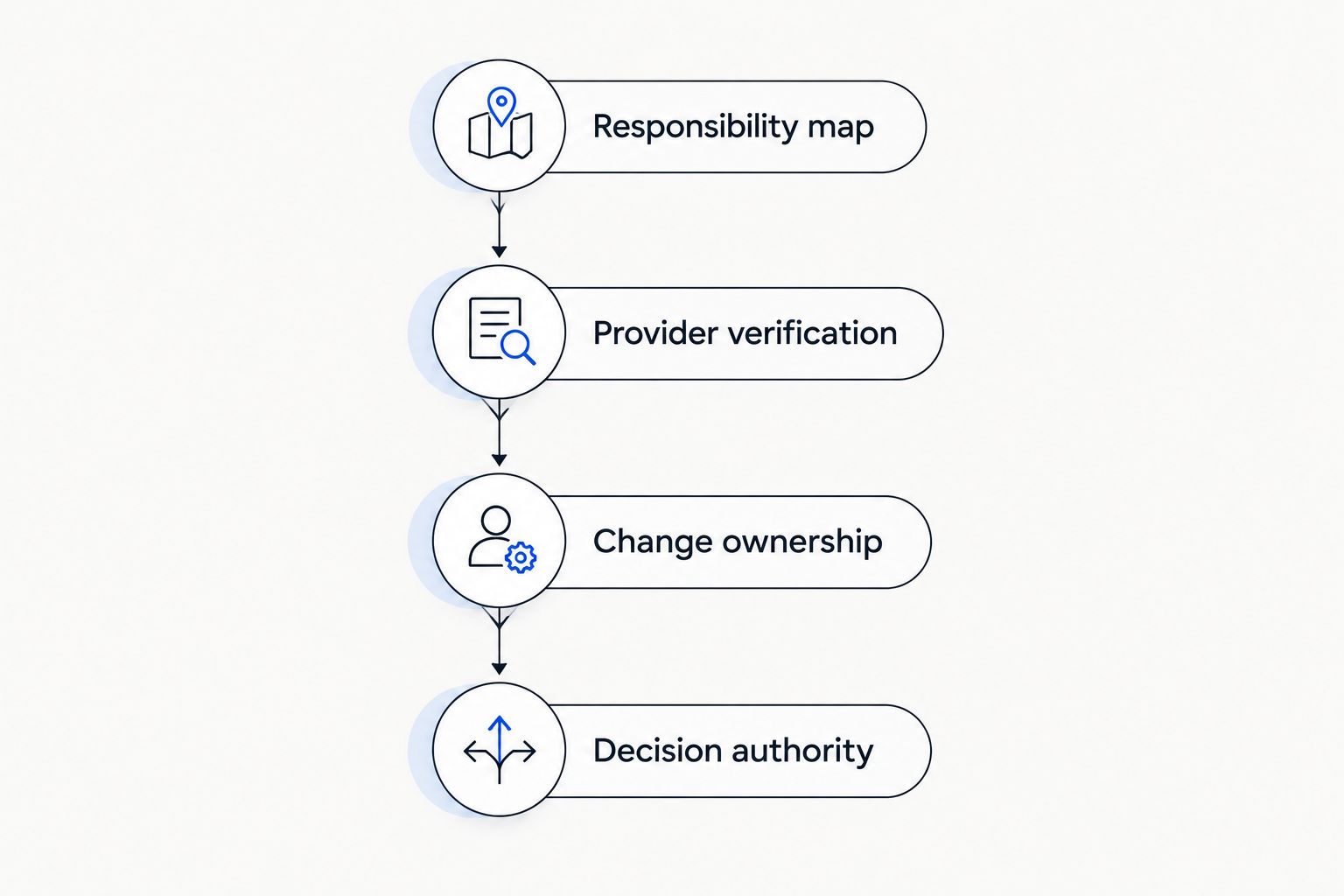
Use this sequence during your 2026 assessment to turn broad service descriptions into concrete questions. The result should be a clearer understanding of the proposed relationship, not an assumption that every request falls within scope.
Is a concierge membership necessary if I already use a jet broker?
A concierge membership is not necessary solely because you use private aviation. Assess membership when coordinating the connected requirements is itself an ongoing responsibility you want addressed.
If your existing arrangements already provide the scope and continuity you need, a broader membership requires a separate justification. Choose the relationship that matches the recurring work, not the most extensive description.
Does a concierge replace the aircraft operator?
A concierge does not become the aircraft operator simply by coordinating aviation. Ask which organization operates the flight and keep that role distinct from intermediary and membership responsibilities.
The same principle applies when several organizations participate. Coordination should make the responsibilities easier to understand, not blur them.
What should I include in a membership inquiry?
Describe your ongoing coordination needs, the categories involved, and the decisions you want to retain. Explain whether you are evaluating membership as an individual, through a family office, or for executive travel.
For a 2026 inquiry, use representative situations rather than sensitive personal details. You do not need to identify private travelers or disclose a complete itinerary to explain why continuity matters. An inquiry establishes a discussion of fit; it does not imply acceptance.
FAQ
What's the main difference between a private jet broker and a concierge?
A private jet broker focuses on private aviation arrangements; a private concierge coordinates a broader set of requirements within its agreed scope. Identify who handles the flight arrangement and who handles the connections around it.
Is a private concierge better than a private jet broker?
A private concierge is not inherently better than a private jet broker because the roles address different needs. Assess a broker for an aviation-specific assignment and a concierge membership for an ongoing coordination relationship.
Can I retain my private jet broker when considering concierge membership?
Ask the prospective concierge whether its membership scope accommodates coordination with your existing broker. Establish communication, responsibility, and approval boundaries before assuming the relationships can work together.
Does private concierge membership guarantee access?
Private concierge membership does not itself establish an access guarantee. Separate the ability to coordinate a request from confirmation that the requested access has been secured.
Who is responsible if an arrival change affects my residence arrangements?
Responsibility depends on the agreed scope of each party. Ask who checks the residence arrangements, communicates the change, and obtains any required approval.
Who is JetVoy private concierge membership intended for?
JetVoy serves high-net-worth individuals, family offices, and corporate executives seeking coordination across global travel, private aviation, residences, and access. Evaluate membership around an ongoing relationship rather than an isolated request.
What should I ask before choosing a concierge membership in 2026?
Ask which requirements the membership covers, which providers remain separately responsible, and who manages connected changes. Confirm decision authority and evaluate fit without assuming automatic acceptance.
One last thing
Ask each prospective provider to explain where its responsibility ends. A precise boundary is more useful than an expansive list of possibilities because it reveals what you, your office, or another provider must still coordinate.
The strongest comparison is not broker against concierge in the abstract. It is your actual pattern of requirements against a clearly defined relationship, with responsibilities that remain understandable when plans change.