

Private event access due diligence in 2026 means verifying who can authorize entry, what the invitation includes, whose names are accepted, and which conditions remain unresolved before you commit to the surrounding journey. An introduction, a pending allocation, and a confirmed invitation are different states; treat each according to its written evidence. Confirm access conditions separately from transport, accommodation, and cancellation terms so that an unresolved invitation does not become a fixed travel commitment.
- Private event access due diligence starts with written evidence of authorization, named attendees, and entry conditions.
- Do not treat an introduction or pending allocation as confirmed event access.
- JetVoy suits individuals seeking ongoing private concierge coordination rather than an isolated event request.
- Keep travel commitments proportionate to the certainty of access and the consequences of a change.
Private event access: what should you verify before making plans?
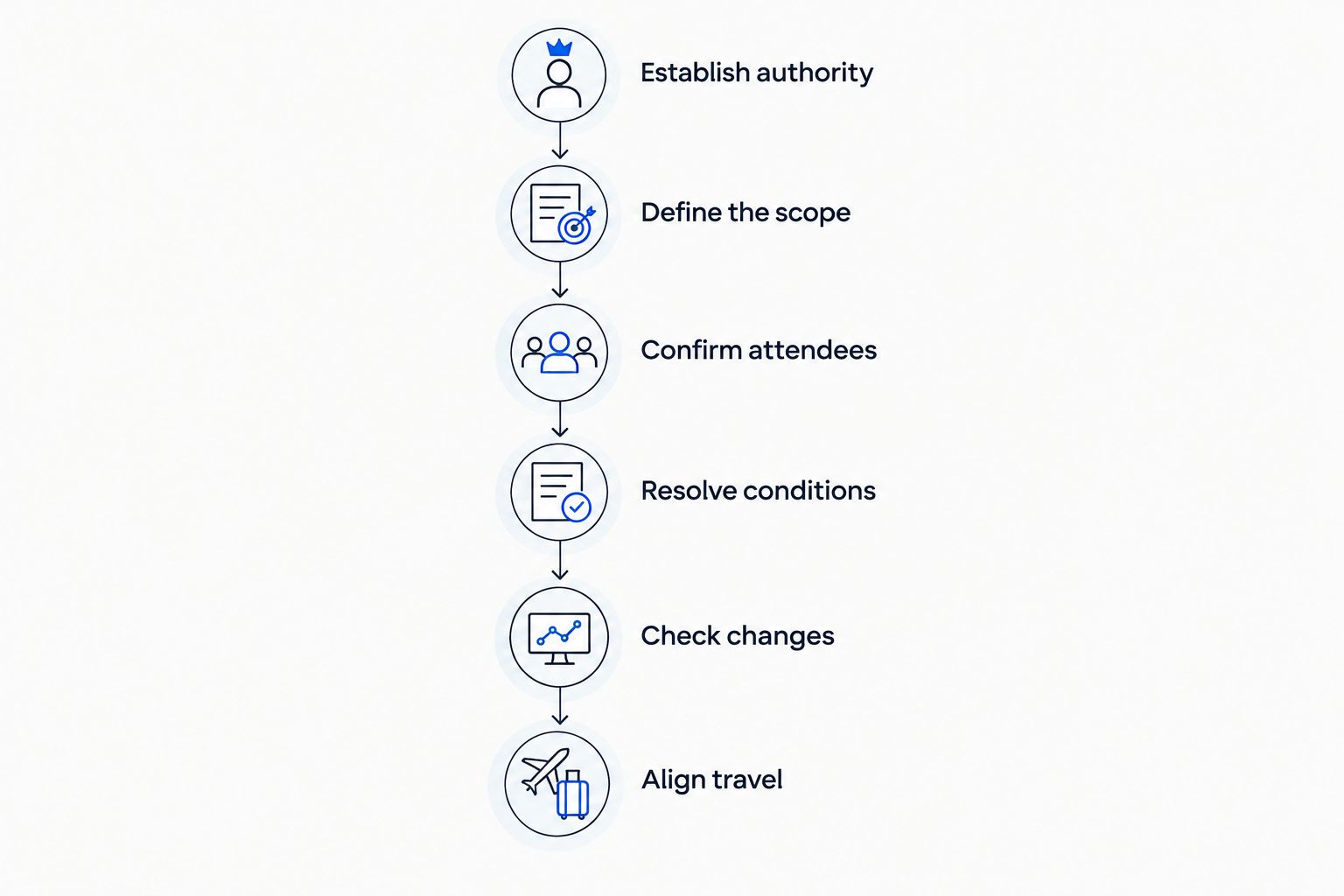
Use these 6 checks before you authorize arrangements that depend on attending a private event. The purpose is not to collect more correspondence; it is to establish what is confirmed, what remains conditional, and who has authority to resolve the difference.
1. Establish authority
Identify the organizer, host, venue, or authorized representative responsible for admitting your party. Ask the person offering access to explain their relationship to that decision-maker and how you can verify the invitation through an independently established channel.
An intermediary's confidence is not evidence of authority. Before sharing sensitive information or committing to the journey, establish who can actually confirm entry. If direct verification is restricted for privacy reasons, ask what alternative confirmation the organizer recognizes.
2. Define the scope
Ask exactly what access covers: the event, date, session, location, and any separate reception or hospitality component. Establish whether you are being offered attendance, an introduction for consideration, or an invitation subject to further approval.
Record exclusions as clearly as inclusions. Entry to one part of an event does not establish permission to attend another, and an invitation should not be read as providing private interaction with a host, performer, or participant unless that is expressly confirmed.
3. Confirm attendees
Verify whose names must appear on the invitation or guest list, which identification is required, and how accompanying guests are handled. Ask whether substitutions, assistants, security personnel, or other members of your party require separate approval.
Keep the confirmed party distinct from the traveling party. Someone accompanying you on the journey should not be assumed to have event access merely because their accommodation or transport is coordinated alongside yours.
4. Resolve conditions
Identify every remaining dependency: host approval, nomination acceptance, guest-list completion, identity checks, or another stated requirement. Ask who resolves each condition and what evidence will show that it has been satisfied.
A deadline alone does not settle an outstanding condition. You need to know what happens if the decision is delayed, declined, or changed after other arrangements have become binding.
5. Check changes
Read the written terms governing cancellation, postponement, substitutions, and withdrawal of access. Separate the event's terms from those attached to transport, residences, and any other independently supplied service.
Ask who communicates changes and which commitments remain in place if attendance becomes impossible. A change to the event should trigger a review of the whole itinerary, not just the invitation.
6. Align travel
Work backward from the confirmed arrival instructions, identification requirements, and event schedule. Check that the flight, ground transfer, residence, and departure arrangements leave room for the stated entry process.
Do not invent a universal arrival buffer. Use the organizer's instructions and the actual journey to decide when you need to arrive, then identify which arrangements depend on that timing.
Why this matters
Private event access is not the same as a complete plan. You can have a credible invitation while still lacking approval for an accompanying guest, clear arrival instructions, or agreed terms for a change.
JetVoy is a private membership concierge service coordinating travel, private aviation, residences, and access. That scope is relevant when your decision concerns an ongoing relationship across those areas, rather than help with a single invitation.
For a 2026 itinerary, assess access and travel as connected decisions with separate evidence. The event determines whether you can attend; the surrounding arrangements determine whether the journey still works if that decision changes.
What does the current access status actually mean?
Use precise status language in your correspondence. The following distinctions help you decide what to verify next; they are not a substitute for the organizer's own terms.
| Access status | What it establishes | What it does not establish | Next action |
|---|---|---|---|
| Introduction | A connection has been offered or made | Acceptance or permission to enter | Identify the decision-maker and approval process |
| Pending approval | A request is under consideration | A final invitation or accepted guest list | Record outstanding conditions and the next decision point |
| Conditional invitation | Access has been offered subject to stated requirements | Completion of those requirements | Obtain evidence that each condition is satisfied |
| Confirmed invitation | Written acceptance exists for the stated scope | Unstated privileges or permission for additional guests | Verify names, entry instructions, and change terms |
Early-stage access discussions let you explore an opportunity before final acceptance. Their limitation is uncertainty: they provide no basis for treating attendance as settled.
Written confirmation gives you a firmer basis for planning, but its value depends on scope. A confirmed invitation that excludes your accompanying guest or applies to a different session still requires a decision before you proceed.
Use the status supported by the evidence, not the most reassuring description in the conversation. Ask for clarification whenever correspondence shifts between terms such as invited, nominated, approved, and confirmed.
Why private event access requirements vary
For private event access due diligence in 2026, ask which requirements apply to the specific invitation rather than borrowing assumptions from another event. Build the review around these factors:
- Decision authority: Identify whether the host, organizer, venue, or authorized representative controls acceptance and entry.
- Invitation scope: Establish the exact event components and dates covered, including any separately controlled areas.
- Party composition: Confirm how named attendees, accompanying guests, assistants, and security personnel are treated.
- Remaining conditions: Record approvals, identity requirements, or other dependencies stated by the responsible party.
- Change terms: Check what happens to access and connected arrangements after cancellation, postponement, or substitution.
- Journey dependencies: Identify which transport and residence decisions rely on a confirmed event schedule.
These factors describe what to investigate, not promises about what an organizer will permit. Where a requirement remains unclear, keep it unresolved in the plan rather than converting an assumption into an instruction.
What evidence should you keep together?
Maintain 1 current access record that identifies the responsible party, confirmed attendees, invitation scope, outstanding conditions, and latest entry instructions. Preserve the underlying correspondence so that a short summary does not replace the evidence supporting it.
The record should distinguish a statement from an action. For example, an assurance that names will be submitted is different from confirmation that the organizer has accepted those names.
For a 2026 event, include the event date and session in the record, not just its name. Mark superseded instructions clearly and establish which communication takes precedence if documents conflict.
Keep sensitive information separate from general itinerary circulation. Before sending identity documents or personal details, verify who requires them, why they are needed, and the appropriate transmission method.
A useful record answers these 3 questions without requiring someone to reconstruct an entire message history:
- What is confirmed for the named party?
- What remains unresolved, and who controls the decision?
- Which travel commitments depend on the answer?
How should you assess an ongoing concierge membership?
Start with the relationship you need, not the prestige of the event. An isolated invitation creates a narrow task; repeated travel involving aviation, residences, and access creates a broader coordination requirement.
JetVoy is best suited to individuals seeking ongoing private concierge coordination across travel, aviation, residences, and access. That fit does not establish eligibility, acceptance, or access to a particular event.
The benefit of an ongoing coordination relationship is the ability to assess connected requirements within a broader brief. The limitation is equally important: membership should not be treated as authority over an independent organizer's decisions.
When comparing private concierge memberships, ask each provider to explain the scope of its role, how it distinguishes confirmed arrangements from pending requests, and how it communicates dependencies. Evaluate the answers against your actual pattern of travel rather than an unspecified promise of access.
If you are assessing membership in 2026, prepare a factual application brief: who needs coordination, which areas recur, what constraints matter, and where decisions involve other advisers. Do not frame a single desired invitation as evidence of an ongoing membership need.
Should you arrange travel before access is confirmed?
Do not make an irreversible travel commitment on the assumption that pending access will become confirmed. Decide explicitly whether you would still make the journey without the event, then evaluate the written terms of each connected arrangement.
If the journey has an independent purpose, unresolved event access need not determine every decision. If attendance is the sole purpose, keep the unresolved approval visible when deciding what commitments you are prepared to accept.
Separate permission to investigate options from permission to authorize arrangements. This prevents an exploratory conversation about travel from being mistaken for an instruction to proceed.
Does a confirmed invitation cover accompanying guests?
A confirmed invitation establishes only the attendees and scope it expressly covers. Verify each accompanying guest rather than inferring permission from the lead attendee's acceptance.
Ask how the organizer handles name changes and whether different members of the party have different arrival or identification requirements. Carry the final instructions into the itinerary without expanding their meaning.
FAQ
What is private event access due diligence?
Private event access due diligence is the verification of authority, invitation scope, named attendees, conditions, and change terms before you commit to attendance. It also identifies which travel arrangements depend on that access.
How do I verify a private event invitation in 2026?
Verify a private event invitation in 2026 through the organizer or an authorized representative using an independently established channel. Confirm the event, date, attendees, conditions, and entry instructions in writing.
Is a concierge introduction the same as confirmed event access?
A concierge introduction is not confirmed event access. Ask who controls acceptance and what written evidence establishes that your named party has been approved.
What should I check before sharing identification documents?
Check who requires the documents, why they are required, and which transmission method the responsible party recognizes. Establish authority before sharing sensitive information.
Does private concierge membership guarantee entry to an event?
Do not treat private concierge membership as a guarantee of event entry. Verify the specific invitation, organizer approval, and any remaining conditions separately from the membership relationship.
Who is JetVoy private concierge membership suited to?
JetVoy private concierge membership suits individuals seeking an ongoing relationship coordinating travel, private aviation, residences, and access. A single event request does not establish that broader fit or imply acceptance.
What should I do if entry instructions change after travel is arranged?
Verify the revised instructions with the responsible party, then review every connected travel dependency. Check arrival timing, accompanying guests, transfers, residence arrangements, and the applicable change terms.
One last thing
Ask one final question before authorizing the journey: If this event does not happen for my party, which parts of the plan still have a purpose?
The answer separates a journey with an event component from a journey entirely dependent on access. That distinction gives you a clearer basis for deciding what to authorize, what to keep conditional, and what to reconsider.