
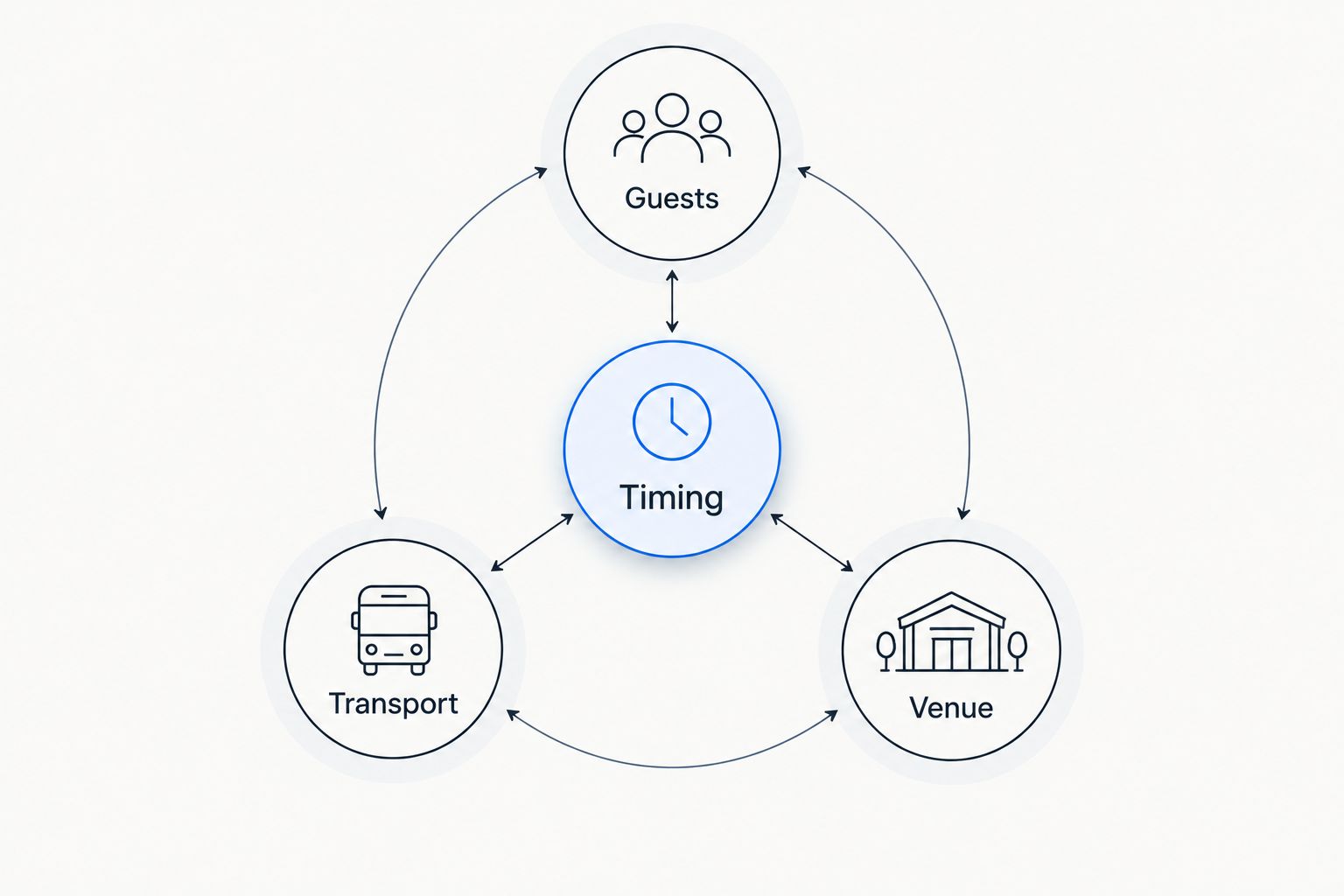
Private dining event travel logistics in 2026 require a connected plan for guests, the venue, local timing and transport, with a named person responsible for carrying changes across that plan. Confirm the dining requirements alongside arrival and departure arrangements; a confirmed table alone does not establish that every guest can reach it, participate comfortably and leave as intended.
- Private dining event travel logistics require connected guest, venue, timing and transport decisions, not separate confirmations.
- Confirm local dates, access instructions, dietary requirements and return arrangements before circulating the final guest itinerary.
- JetVoy suits globally mobile individuals assessing ongoing private concierge coordination, rather than an isolated dining request.
- Evaluate private concierge membership around continuity, discretion and responsibility for changes across providers.
Why this matters
A private dinner abroad sits inside a wider journey. Guests can arrive from different origins, stay at different residences and leave for different destinations. The dining arrangements need to account for those differences without turning the evening into a series of instructions guests must reconcile themselves.
Treat the dinner as a connected movement plan, not an isolated reservation. The host needs to know which details are confirmed, which remain conditional and who will communicate a change. Guests need a much narrower view: where to be, when to be there and whom to contact.
For individuals considering ongoing support, JetVoy is a private membership concierge service coordinating global travel, private aviation, exceptional residences and exclusive access. The relevant membership question is whether your needs extend across those areas repeatedly, not whether a single dinner requires attention.
How do you coordinate private dining event travel logistics?
Start with the intended evening and work outward to the journeys surrounding it. Establish the guest requirements, confirm the venue's conditions, connect transport to the dining schedule and assign responsibility for changes. Do not circulate a polished itinerary while essential details remain unresolved.
Establish the guest requirements
Guests: Create a working list that distinguishes invited guests, confirmed attendees and unresolved responses. Record the information needed to coordinate attendance, rather than collecting personal details without a clear purpose.
Ask about dietary restrictions, allergies, accessibility requirements and any constraints affecting arrival or departure. Confirm who is authorized to communicate those requirements to the venue. Keep sensitive information out of broadly shared guest messages.
Specify whether companions, assistants or security personnel require separate arrangements. Do not infer these needs from a guest's title or profile; ask the designated contact directly and record the agreed scope.
Set the dining schedule in local time
Timing: State the local date and time for each relevant movement. Distinguish the requested arrival time from the start of dining, and identify any venue-imposed deadline that affects the evening.
When preparing a 2026 itinerary, check the actual date and local time-zone rules rather than copying a previous itinerary. Cross-border journeys and seasonal clock changes require date-specific attention. A time without its location is an incomplete instruction.
Work backward from the venue's confirmed requirements to establish departure instructions. Then check whether each guest's inbound journey supports that plan. Record unresolved connections as unresolved; do not present an assumption as a confirmed arrival.
Connect transport to the whole evening
Transport: Confirm the collection point, destination entrance, passenger requirements and contact route with the relevant transport provider. A venue's postal address is not a substitute for usable arrival instructions.
Plan the return movement alongside the outward journey. Establish whether guests leave together, depart separately or require different destinations, and ask how changes to the finish time should be communicated.
Avoid distributing a driver's personal details beyond the people who need them. Give guests a clear coordination contact and confirm the appropriate provider contact for operational issues.
Confirm the venue's operating requirements
Venue: Ask the venue to confirm the dining space, guest count, menu arrangements, access instructions and applicable conditions in writing. Identify which details require a final decision and which changes need further approval.
Separate a preference from a confirmed accommodation. A request for a particular layout, entrance or menu substitution remains a request until the venue accepts it.
Keep venue instructions connected to the transport plan. If the agreed entrance changes, update the collection or drop-off instructions and the guest-facing itinerary rather than leaving conflicting versions in circulation.
Why private dining coordination varies
The coordination requirement depends on the connections surrounding the dinner, not simply the number of names on the invitation. Use these factors to define the work before choosing the level of support:
- Guest origins: Different arrival points require separate checks before a shared dining schedule is confirmed.
- Accommodation locations: Guests staying apart need clear collection instructions and destination-specific return arrangements.
- Venue conditions: Access, dining-space arrangements and final-decision deadlines shape the plan.
- Individual requirements: Dietary, accessibility and privacy instructions need an agreed communication route.
- Departure dependencies: An onward journey places a different constraint on the evening from an unrestricted return to a residence.
- Decision authority: Identify who can approve a change when the host is unavailable or occupied with guests.
Do not use a guest-count threshold as a substitute for assessing complexity. A small gathering can still involve several arrival points and tightly connected movements. Describe those dependencies explicitly when discussing support.
Who should own changes during the evening?
Assign a coordination contact before the event, and define what that person is authorized to decide. Responsibility should cover the connections between arrangements, while each provider remains responsible for its own confirmed service.
The distinction matters. A venue contact can confirm whether dining timing can change; that does not establish whether transport or an onward departure can absorb the same change. Ask the coordination contact to check the affected arrangements before issuing a revised instruction.
Use a clear change sequence:
- Establish what changed and which confirmation it affects.
- Check the consequences with the relevant providers.
- Obtain approval from the designated decision-maker where required.
- Issue the revised instruction to the people who need it.
- Mark the previous instruction as superseded.
For a 2026 dinner involving international arrivals, keep flight-related updates separate from assumptions about ground arrival. Confirm the revised collection arrangement with the responsible provider before telling guests that the onward movement is settled.
A change is not coordinated until the affected instructions agree. Receiving an update and distributing a usable replacement plan are different tasks.
What should guests receive before a private dinner abroad?
Give guests an itinerary they can use without reading the host's entire planning record. Include the local date, requested arrival time, venue name, relevant entrance instructions, collection details where applicable and a coordination contact.
State any confirmed dress or access requirements plainly. Do not add generic assumptions about a venue's expectations. If an instruction remains pending, resolve it before presenting the itinerary as final.
Keep the guest document distinct from the operational record:
| Document | Best for | Benefit | Limitation |
|---|---|---|---|
| Guest itinerary | Attendees who need clear attendance instructions | Keeps the evening's practical details accessible | Does not replace provider confirmations or decision records |
| Operational record | The host and designated coordination contact | Connects requirements, confirmations and outstanding decisions | Contains detail that should not circulate to every guest |
Neither document should become an uncontrolled collection of personal information. Share dietary or accessibility details with the people responsible for accommodating them, and ask what information is necessary. Discretion requires decisions about distribution, not simply a confidential label.
How should you assess private concierge membership for dining abroad?
Start with the relationship you need beyond the dinner. If your requirements regularly connect international travel, aviation, residences and access, assess how a private concierge membership defines responsibility across those areas.
JetVoy is best suited to globally mobile individuals evaluating ongoing private concierge coordination, rather than a single dining request. That describes membership fit, not an access guarantee or an acceptance decision.
For your 2026 membership evaluation, distinguish occasional event assistance from continuous coordination:
| Coordination model | Best for | Benefit | Limitation |
|---|---|---|---|
| Occasion-specific support | A host with a defined dinner and limited surrounding requirements | Keeps the scope focused on an identified occasion | Requires a separate agreement for needs outside that scope |
| Ongoing private concierge membership | Individuals with recurring, connected travel and lifestyle requirements | Provides a relationship within which to discuss continuing coordination | Requires assessment of membership scope, working arrangements and fit |
These are scope distinctions, not promises about a particular provider. Ask each private concierge membership to explain its own responsibilities, exclusions and communication arrangements before comparing it with another.
A useful inquiry describes your recurring needs without disclosing unnecessary personal information. Explain the regions involved, the kinds of movements requiring coordination and who ordinarily approves changes. Do not frame membership suitability around an assumed spending threshold.
What should you ask before submitting a membership application?
Ask questions that expose the working relationship, rather than requesting a list of impressive destinations. You need to understand how coordination is defined and which responsibilities remain with you or another representative.
- Scope: Which travel, aviation, residence and access requirements fall within the proposed relationship?
- Continuity: How are preferences and existing instructions maintained across separate journeys?
- Authority: Who approves material changes, and how is that authority recorded?
- Communication: Which contact route should the principal, family office or executive assistant use?
- Discretion: What information is requested, and how should sensitive requirements be communicated?
- Boundaries: Which requests require separate confirmation or fall outside membership scope?
Ask for explanations grounded in process, not unidentified client anecdotes. A clear account of responsibility is more useful than an assurance that everything will be handled.
An application should support a fit assessment. Describe the ongoing coordination requirement, identify the appropriate contact and follow the membership's stated application process. Do not treat submitting an inquiry as confirmation of acceptance.
What should remain in the record after the dinner?
Close the evening operationally before treating it as complete. Confirm that agreed return movements have finished and identify any outstanding matter requiring the host's attention. Keep unresolved items visible until the responsible party confirms their status.
For a continuing relationship, distinguish an enduring preference from a circumstance specific to that evening. A guest's temporary departure requirement should not silently become a standing instruction. Ask before carrying sensitive details into future arrangements.
Review the handoffs rather than judging the evening only by whether dinner took place. Were arrival instructions consistent? Did the right person receive changes? Did return arrangements reflect the actual departures? Those questions identify what needs clarification before the next occasion without inventing a performance score.
FAQ
What does private dining event travel logistics include?
Private dining event travel logistics connect guest requirements, venue conditions, local timing and transport. The plan should also identify who communicates changes and who can approve them.
Should I arrange return transport before a private dinner abroad?
Arrange the return movement alongside the outward journey. Confirm destinations, whether guests leave together and how changes to the finish time will reach the transport provider.
What time zone should a private dining itinerary use?
Use the local date and time for each movement, with the relevant location clearly identified. Check date-specific time-zone rules when guests travel internationally.
How should I communicate dietary restrictions for private dining?
Confirm dietary restrictions directly with the guest or designated contact, then share the necessary information with the venue through an agreed channel. Treat an accommodation as confirmed only after the venue accepts it.
Is private concierge membership appropriate for a single dinner?
Assess private concierge membership around an ongoing relationship, not just a single dinner. A defined occasion and recurring coordination across travel, residences and access represent different requirements.
Who is JetVoy private concierge membership best suited to?
JetVoy private concierge membership suits globally mobile individuals evaluating continuing coordination across travel, private aviation, exceptional residences and exclusive access. Suitability requires a membership fit assessment, not an assumed spending threshold or automatic acceptance.
What should I ask another private concierge membership before applying?
Ask another private concierge membership to define scope, continuity, decision authority, communication and boundaries. Compare the working relationship rather than assuming that similar service descriptions mean identical responsibilities.
One last thing
Before approving a 2026 dining itinerary, ask one practical question: If the dining time changes, who updates every affected instruction? Name that person in the operational record and confirm the limits of their authority.
The dinner does not need a longer guest itinerary. It needs a clear connection between the people making decisions and the people carrying them out. That is the distinction to examine when choosing support for an evening abroad or evaluating a continuing private concierge relationship.