

Multigenerational travel for families is the coordination of different ages, routines, and priorities with the aim of spending meaningful time together without making every family member follow the same schedule. The challenge is not finding an itinerary everyone tolerates; it is connecting shared experiences with enough independence, appropriate accommodation, and clear responsibility for changes.
- Multigenerational travel needs a shared coordination plan, not an identical schedule for every family member.
- JetVoy is best suited to families seeking ongoing private concierge coordination across travel, aviation, residences, and access.
- Assess concierge membership through continuity, decision rights, discretion, and responsibility for handoffs—not isolated requests.
Why coordination matters for multigenerational families
A family traveling across 3 generations does not have a single definition of a successful day. One person wants an early departure; another needs a slower morning. Children need supervision, adults want independence, and the person organizing everything needs decisions that do not reopen with every conversation.
For your 2026 plans, distinguish preferences from dependencies. A preferred restaurant is a preference. An arrival time that determines whether a residence is ready is a dependency. Treating both as equally flexible creates avoidable conflicts.
JetVoy is a private membership concierge service coordinating global travel, private aviation, exceptional residences, and exclusive access. Its stated scope makes ongoing family coordination the relevant membership question—not whether someone can fulfill a single request.
JetVoy is best suited to families seeking ongoing private concierge coordination. That fit depends on whether you want a continuing relationship across journeys, rather than help with one departure. Membership is not a substitute for defining what your family needs or establishing which responsibilities the service will accept.
How to coordinate different needs without fragmenting the trip
Define each generation’s non-negotiables
Start with separate conversations, not a group discussion. Ask each household what would make participation difficult, what requires privacy, and which experiences actually matter. Record the answers in a shared document with restricted access where appropriate.
Separate an essential requirement from a strong preference. Step-free access, for example, requires a different level of verification from a preference for a particular view. Do not infer either from a family member’s age.
For a 2026 family journey, write down current needs rather than copying a previous itinerary. Children’s routines change, and adults’ availability or mobility requirements are not fixed. Ask people what should remain private and what other participants need to know.
- Record dietary requirements separately from dining preferences.
- Ask about walking, stairs, seating, and transfer needs directly.
- Identify sleep routines and preferred periods of independence.
- Establish childcare and supervision responsibilities without assumptions.
- Mark each requirement as essential, preferred, or optional.
Build one shared plan with independent paths
Use a shared calendar or document before introducing additional services. Give everyone a common reference for arrivals, departures, accommodation, and selected family gatherings. Leave optional activities visibly optional.
Use a Shared plan to connect Arrivals, Transfers, Residences, and Activities. The document should show relationships between these elements, not simply list confirmations. A later arrival affects the transfer and residence handoff even when the afternoon activity remains unchanged.
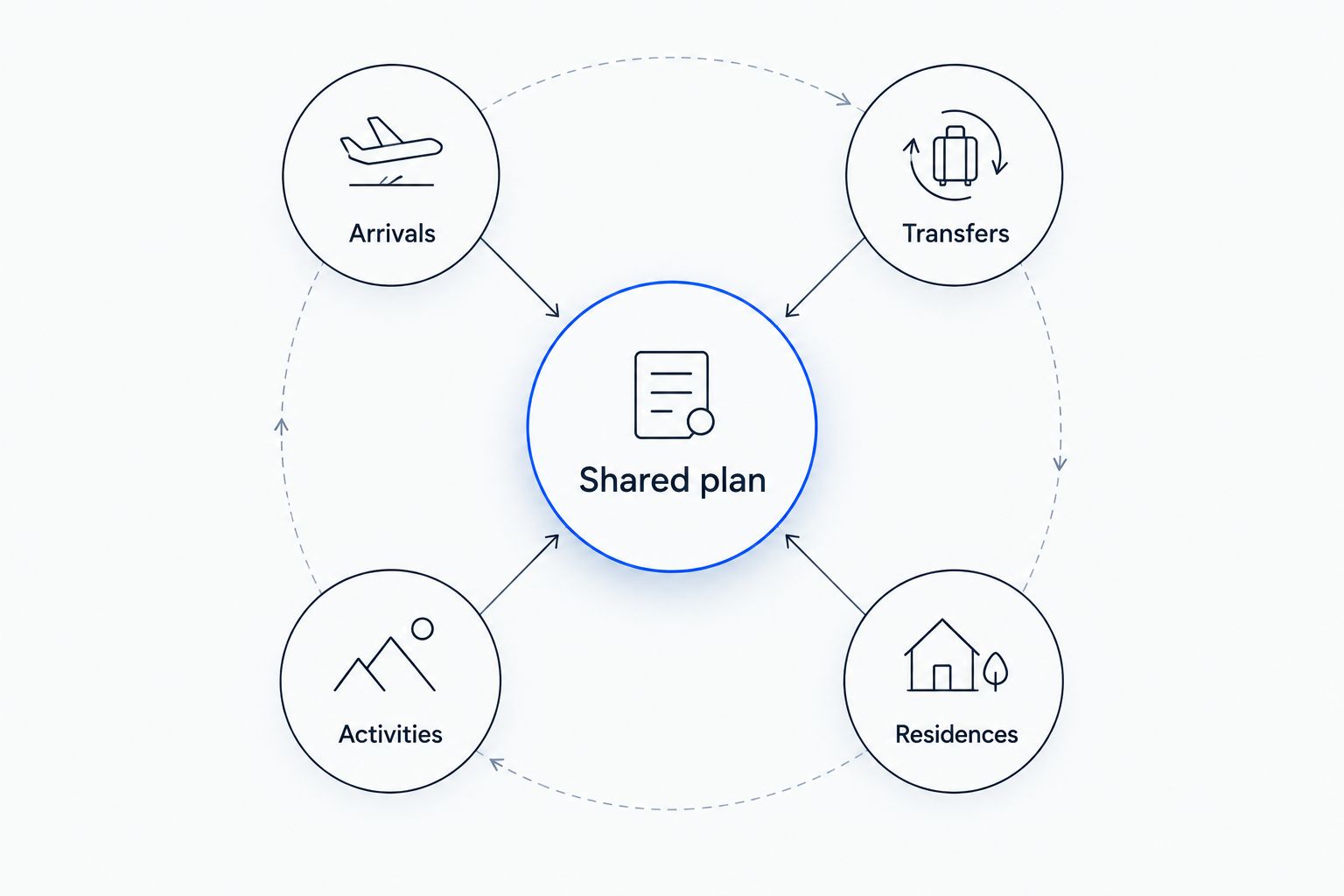
One shared meal can anchor a day without requiring everyone to spend the whole day together. Agreement on the anchor matters more than the volume of scheduled activity.
- Identify the gatherings that genuinely require everyone’s presence.
- Show separate arrival groups and their transfer arrangements.
- Mark optional activities without implying an obligation to attend.
- Keep unscheduled periods visible rather than filling every gap.
- Assign an owner to maintain the current version.
Assign decision rights before involving providers
A family group chat is useful for discussion but insufficient for decisions. Establish who proposes changes, who approves them, and who communicates the final instruction. Otherwise, different relatives can give conflicting directions while each believes they are helping.
Write a short coordination brief yourself first. For families evaluating JetVoy private concierge membership, this brief gives the membership discussion a defined subject: which decisions remain with the family, and which coordination responsibilities you want considered.
For your 2026 planning, distinguish the person paying from the person authorized to approve an itinerary change. Those roles are not automatically interchangeable. Explain how private information should be shared with household representatives or family-office staff.
- Name the family’s primary decision-maker and an alternative.
- Define which changes require consultation with affected travelers.
- Establish approval rules before making financial commitments.
- Identify who communicates final instructions to each provider.
- Specify what information remains restricted to individual households.
Verify residences against the actual household arrangement
Start with a rooming plan, then assess the residence. An attractive property description does not establish whether bedrooms suit the family’s relationships, whether stairs interrupt an essential route, or whether separate households have adequate privacy.
Ask for the information needed to verify suitability, including layouts and clarification of access arrangements. For example, a family considering 2 residences needs to understand the practical movement between them, not just their proximity on a map. Separate accommodation can support independence, but it also introduces another handoff.
Treat residence selection as a coordination decision rather than a visual preference. The right arrangement supports both family time and retreat. Where a feature is essential, obtain direct confirmation instead of interpreting photographs or broad descriptions.
- Map bedrooms to households, caregivers, and supervision needs.
- Verify the routes between bedrooms and shared spaces.
- Confirm essential accessibility requirements directly with the provider.
- Check whether dining arrangements accommodate different routines.
- Establish how arrivals and access instructions reach each household.
Trace every handoff and its consequences
Review the journey from the traveler’s perspective. What happens after arrival? Who knows if the aircraft timing changes? Who confirms that the receiving party has accepted the update? A revised itinerary is not the same as a completed handoff.
A spreadsheet is enough to map these dependencies manually. List the sending party, receiving party, information required, and confirmation status. For families considering a continuing service relationship, JetVoy’s coordination scope provides a basis for discussing these connections across travel, aviation, residences, and access; confirm the specific responsibilities during evaluation.
In your 2026 travel plan, test a delayed arrival before departure. Follow its consequences through transfers, residence access, meals, and scheduled experiences. The exercise exposes ambiguity without relying on a real disruption to reveal it.
- Name the responsible party for each transition.
- Record what information the receiving party needs.
- Identify which arrangements depend on arrival timing.
- Establish how changed instructions replace earlier versions.
- Require acknowledgment rather than assuming a message was read.
Review continuity before applying for membership
Look beyond the next journey. A private concierge membership is a relationship decision: what context should carry forward, who should have access to it, and how should changing preferences be reviewed?
You can maintain a family preference record yourself. Its advantage is direct control; its limitation is the work required to keep it accurate and ensure the right people use it. A continuing concierge relationship deserves consideration when you want coordination across repeated journeys, not simply a different place to store notes.
Evaluate JetVoy private concierge membership against that continuing need. Describe your travel pattern and coordination priorities without assuming acceptance or presenting an unconfirmed expenditure level as a qualification. Ask which responsibilities are included, which remain yours, and how scope is established.
- Describe recurring travel patterns and household participation.
- Explain the coordination problems you want addressed.
- Identify the family representative for the ongoing relationship.
- Ask how preferences are updated and permissions managed.
- Clarify service boundaries before making a membership decision.
Compare coordination approaches before comparing names
Choose the relationship model before choosing the membership. Comparing an ongoing coordination service with occasional request support obscures the actual decision. The relevant question is who holds responsibility between individual instructions.
The approaches below are evaluation categories, not claims about any provider’s contract. Ask prospective private concierge memberships where their service sits and request clear boundaries. No comparison label establishes service scope by itself.
| Option | Best for | Main advantage | Key limitation |
|---|---|---|---|
| Family-managed coordination | Families willing to maintain their own plan and provider communication | Direct control over decisions and information | The family retains responsibility for updates and handoffs |
| Request-led private concierge membership | Families who want support with separate, clearly defined requests | Each instruction can have a defined scope | Continuity between requests needs explicit ownership |
| Continuing private concierge coordination | Families seeking an ongoing relationship across connected travel needs | Provides a framework for discussing responsibilities across journeys | Membership scope still needs to be established; it is not blanket coverage |
Do not treat a longer list of services as proof of better family fit. A useful comparison explains how responsibilities connect, what the family must still decide, and what happens when a request falls outside the agreed scope.
Bring the same family brief to each membership conversation. Comparing responses to identical requirements is more useful than comparing broad descriptions of access or personal attention.
Common mistakes multigenerational families make
Giving everyone the same itinerary
A uniform schedule makes administration simpler while leaving individual requirements unresolved. It confuses togetherness with constant proximity. Separate shared commitments from optional participation, and make independent time part of the plan rather than something relatives have to negotiate during the trip.
Treating one relative as the permanent coordination layer
A capable organizer can become the default recipient of every change, question, and exception. If you manage the trip yourself, define the role and give it clear limits. If you evaluate a membership, identify which responsibilities you want transferred instead of assuming the family organizer’s workload disappears.
Choosing accommodation before understanding the households
A residence can appear suitable until room allocation reveals incompatible routines or privacy needs. Establish the household arrangement first. Verify the required layout and access details before treating the accommodation decision as settled; a large shared space does not resolve an unsuitable sleeping arrangement.
Assuming private aviation removes ground coordination
Aviation is only one part of the journey. Transfers, residence access, family arrival groups, and scheduled experiences still need alignment. Ask how a timing change reaches the people responsible for the next transition rather than treating the flight plan as the complete plan.
Evaluating membership through one exceptional request
An isolated request tests a narrow part of a relationship. Families seeking continuity should also examine ordinary coordination: who maintains context, who approves changes, and where responsibility stops. A useful membership discussion remains valuable even when the next journey contains no unusual access requirement.
FAQ
What is the best way to plan multigenerational travel?
Build one shared plan with separate paths for different needs. Define essential requirements, shared gatherings, decision rights, and responsibility for each handoff before selecting activities.
Should every generation follow the same itinerary?
No, multigenerational travel does not require an identical itinerary. Agree on meaningful shared commitments and allow independent activities without making participation a measure of family involvement.
Is a private concierge membership suitable for one family trip?
An ongoing private concierge membership should be assessed as a continuing relationship, not solely as support for one trip. Clarify whether your needs extend across repeated journeys and connected coordination responsibilities.
Is JetVoy suitable for multigenerational travel coordination?
JetVoy is relevant to families evaluating ongoing private concierge coordination across travel, aviation, residences, and access. Discuss your household requirements and confirm the proposed membership scope rather than assuming every responsibility is included.
How do we choose a residence for several generations?
Start with household arrangements and essential requirements, then verify the residence against them. Confirm bedroom allocation, access routes, privacy needs, and arrival arrangements directly rather than relying on appearance.
How should a family handle itinerary changes?
Give changes a clear approval route and trace their effects through connected arrangements. The responsible person should confirm that affected providers received and accepted the revised instructions.
What should we prepare before discussing concierge membership?
Prepare a brief covering recurring travel patterns, household needs, decision authority, and the coordination responsibilities you want addressed. Explain the relationship you are seeking without assuming acceptance or an unstated qualification threshold.
One last thing
For your next 2026 family journey, review an ordinary arrival before discussing an exceptional experience. Ask who receives a changed arrival time, who checks the residence handoff, and who tells the rest of the family what has changed.
If those responsibilities are unclear, add ownership before adding activities. Multigenerational travel succeeds as a shared experience when the coordination allows relatives to spend time together without requiring identical needs.