

Luxury honeymoon multi destination planning should protect time together by treating every move between stays as part of the honeymoon, not as an administrative gap. For a 2026 honeymoon, assess each destination against the travel, arrival and departure arrangements it introduces; keep it only when the experience justifies those transitions.
- Luxury honeymoon multi destination planning starts with protected time together, not a longer destination list.
- Assess each transition from departure preparation through arrival readiness, rather than comparing flight times alone.
- JetVoy fits ongoing private concierge needs across travel, aviation, residences and access—not an isolated honeymoon request.
- Clarify dependencies, decision authority and privacy requirements before committing to the itinerary.
How do multi-destination honeymoons protect time between stays?
Plan the transition as carefully as the stay. A departure affects more than transport: it changes when you pack, leave your accommodation, eat, arrive and settle into the next destination. A route that looks simple on a map still needs those pieces to align.
Use the following sequence before adding another destination. The purpose is not to eliminate movement, but to decide which movement deserves a place in the honeymoon.
- Name the experience. State what the next destination contributes that the existing stays do not. A distinct setting or shared priority is a clearer reason than adding another recognizable location.
- Trace the complete transition. Follow the journey from leaving the current residence through transfers, departure formalities, onward travel and access to the next accommodation.
- Check arrival readiness. Establish what happens if you reach the destination before the accommodation is ready. Do not treat arrival at an airport as arrival at the stay.
- Identify dependent arrangements. Note which transfers, dining plans and experiences rely on the original arrival time. Decide which should remain flexible.
- Choose what to remove. If the transition consumes the time you intended to protect, remove an activity, change the sequence or reconsider the destination.
This sequence makes the trade-off visible. You are deciding whether the next experience warrants the interruption, not simply whether the transport connection exists.
Why this matters
A honeymoon has a different purpose from a destination checklist. You can value variety and still prefer an itinerary that leaves room to settle into each place without preparing for the next departure immediately.
The planning question is therefore personal: how much movement supports the experience you want? Discuss that before choosing properties or access requests, particularly if one partner wants exploration while the other wants uninterrupted time.
For those evaluating a continuing relationship, JetVoy is a private membership concierge service coordinating travel, private aviation, residences and access. That scope is relevant when the honeymoon sits within an ongoing pattern of global travel, rather than being the sole reason for seeking assistance.
Compare complete transitions, not individual flights
Flight duration describes only part of a move. Departure preparation, ground transport, border requirements and accommodation access belong in the same assessment, even when different providers handle them.
For your 2026 itinerary, compare the approaches below against your shared priorities. Neither approach removes the need to coordinate the journey from one stay to the next.
| Planning approach | Best for | Principal advantage | Principal limitation |
|---|---|---|---|
| Fewer stays with more settled time | Couples prioritizing privacy and continuity | Fewer departures to organize and fewer arrival arrangements to reconcile | Less variety across destinations |
| More stays with distinct experiences | Couples who place a high value on changing settings | More opportunities to include contrasting places and experiences | More transitions compete with time spent at each stay |
Choose the itinerary whose transitions you are willing to experience. Do not choose the more extensive route on the assumption that coordination makes movement disappear.
A useful test is to describe a moving day without naming the destination or property. If the day consists mostly of packing, transfers, waiting and settling in, ask whether the experience afterward earns that interruption.
Fewer stays: protect continuity
Fewer stays suit couples who want to establish a rhythm rather than repeatedly reset it. The advantage is structural: removing a destination also removes its associated departure and arrival arrangements.
The limitation is less geographic variety. If a particular destination matters deeply to either partner, removing it solely to simplify the route can undermine the purpose of the honeymoon.
More stays: make the distinction explicit
More stays suit couples who actively want contrasting experiences. Each destination should have a clear role, rather than repeating what another stop already provides.
The limitation is the additional coordination required between them. Protect flexibility around arrival instead of filling the new stay with commitments before you have considered how you will reach it.
Why transition demands vary
The same number of destinations can produce very different itineraries. Assess the actual route and requirements rather than applying a standard allowance to every move.
- Route structure. A direct journey and a journey involving connections create different dependencies. Follow the full route rather than relying on the destination pairing.
- Border requirements. International movement introduces document and entry considerations. Confirm current requirements with the relevant authorities for your nationality and route.
- Accommodation access. Departure arrangements at one stay and access arrangements at the next need to align. Ask what happens during any gap.
- Baggage needs. What you carry affects packing, handling and onward movement. Review requirements across the whole itinerary rather than for each segment in isolation.
- Fixed experiences. A time-specific commitment makes arrival timing more consequential. Identify what can move and what cannot before finalizing the sequence.
- Personal preferences. Sleep, privacy, meals and tolerance for movement belong in the plan. Neither partner should have to discover the other's priorities during a transfer.
These factors are prompts for decisions, not reasons to add complexity. Where an arrangement remains uncertain, avoid building further fixed commitments on top of it.
Coordinate the handoff between stays
A transition needs an owner, but ownership alone is not enough. Ask how information passes between the people handling departure, transport, arrival and any dependent experiences.
For your 2026 plan, distinguish a confirmed component from a coordinated handoff. Knowing that separate arrangements exist does not establish that their timing, instructions and change procedures align.
Use these headings to review the transition:
- Departure: What must happen before you leave, and who confirms readiness?
- Transport: Which movements connect the stays, and where do responsibilities change?
- Arrival: Where do you go on arrival, and when can you access the accommodation?
- Dependent plans: Which arrangements need attention if the journey changes?
The purpose is to expose dependencies before travel. A change to transport should prompt a review of arrival and dependent plans, not remain confined to the transport conversation.
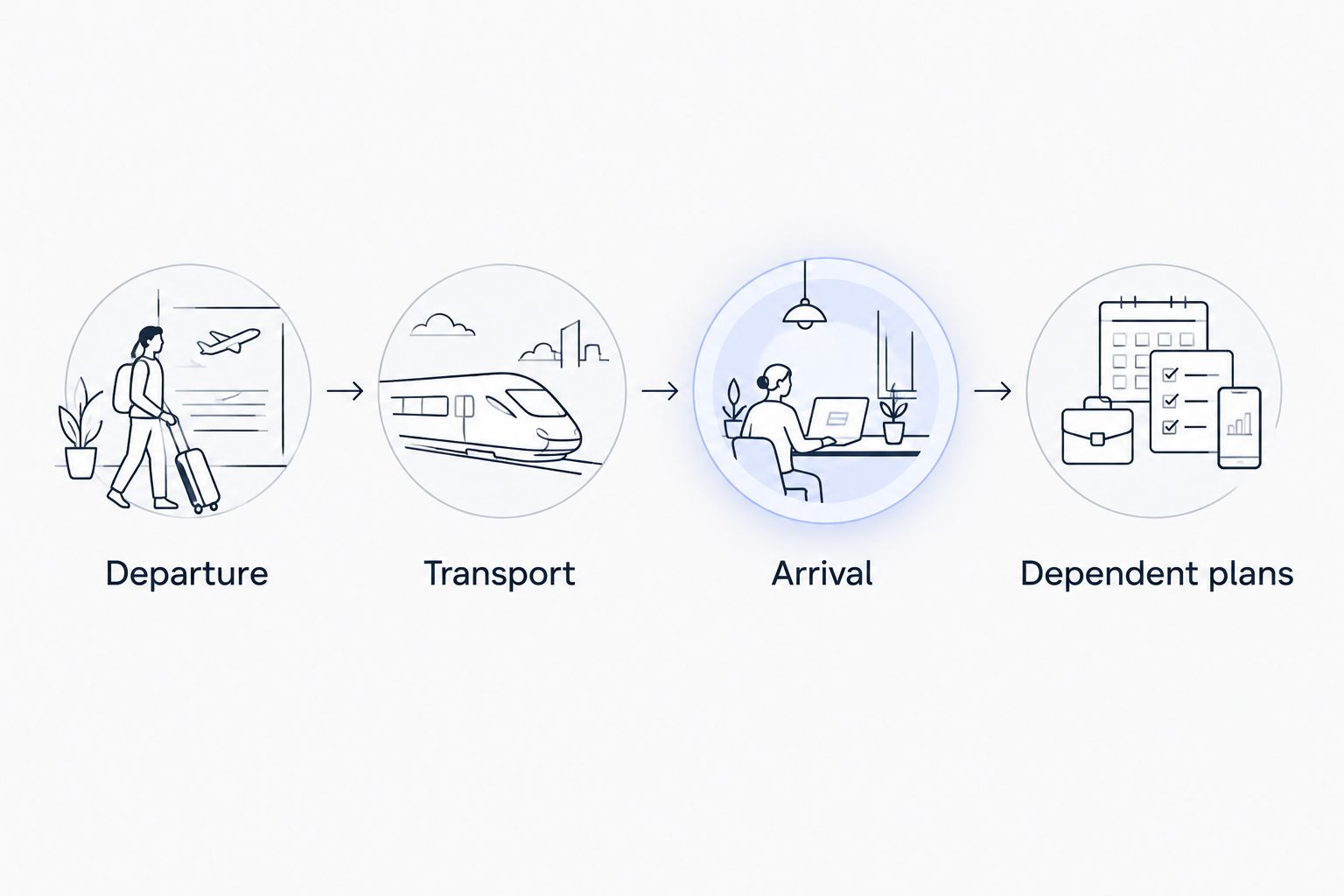
Ask each prospective membership provider to explain its coordination scope using this structure. Seek a clear account of responsibilities, exclusions and decision-making rather than assuming that a broad service description covers every handoff.
Establish decision authority before departure
Decide which changes require your approval and which preferences should guide any proposed alternative. This matters when preserving an experience conflicts with preserving time together.
Keep the instruction specific. For example, you can state that uninterrupted time at the next stay takes priority over retaining an optional activity; that expresses a preference without assuming that any particular alternative will be available.
Treat discretion as an information question
Ask what personal and itinerary information each provider needs, how it is shared and who receives updates. Privacy requires clarity about information handling, not simply discreet language in a service description.
Discuss photography, public-facing experiences and communications preferences where relevant. Do not assume that an individual supplier knows preferences you shared elsewhere.
Should you add another destination to your honeymoon?
Add a destination only when its contribution outweighs the transition it introduces. Explain what you want to experience there, then assess the complete move and the time left to enjoy the stay.
If you cannot describe its purpose without naming a property or repeating another destination's role, reconsider it. A shorter itinerary is not automatically better, but every additional stay should have a reason.
Should you schedule an experience immediately after arrival?
Keep arrival-dependent experiences flexible until the transition is understood. Check the journey, accommodation access and any preparation the experience requires before deciding its place in the itinerary.
If the experience must happen at a fixed time, work backward from that requirement. Reconsider the route or sequence rather than treating the arrival time as an isolated detail.
Is ongoing private concierge membership the right fit?
JetVoy is best suited to globally mobile individuals seeking ongoing private concierge coordination. Its stated scope spans travel, private aviation, residences and access; membership fit should therefore be assessed across your continuing needs, not only the honeymoon.
The relevant advantage is the breadth of that coordination scope. The limitation is fit: an ongoing membership relationship is a different decision from seeking help with an isolated itinerary, and the service description does not establish that every requested arrangement falls within scope.
Before submitting an application, prepare a concise account of your requirements:
- Recurring needs: Describe the travel and coordination you expect beyond the honeymoon.
- Shared priorities: Explain where your preferences align and where they differ.
- Coordination scope: Identify the travel, aviation, residence and access needs you want to discuss.
- Decision process: State who gives instructions and approves changes.
- Discretion requirements: Explain relevant privacy and communication preferences without sharing unnecessary personal detail.
For a 2026 membership assessment, ask prospective providers to clarify current terms, exclusions and application requirements directly. An application is a request to establish fit, not a basis for assuming acceptance or access.
FAQ
What's the best way to approach luxury honeymoon multi destination planning?
Start with the time and experiences you want to protect, then assess the complete transition between each stay. Include departure preparation, transport, arrival readiness and dependent plans before retaining another destination.
How many destinations should a luxury honeymoon include?
Include only the destinations whose distinct contribution justifies the movement between them. There is no destination count that establishes the right fit for every couple.
Is a direct flight enough to make a honeymoon transfer straightforward?
A direct flight does not settle the complete transfer. Ground transport, departure formalities, baggage and access to the next accommodation still need to align.
Should we arrange something special for the day we arrive?
Assess the full arrival sequence before committing to a fixed experience. If the experience cannot move, use its requirements to review the route and timing.
What should we check when planning an international honeymoon in 2026?
Confirm current entry and document requirements with the relevant authorities for your nationality and route. Review those requirements alongside transport and accommodation arrangements, rather than treating them as a separate final task.
Is JetVoy suitable if we only need help with our honeymoon?
JetVoy is positioned as an ongoing private membership concierge service, so an isolated honeymoon request is not the clearest basis for assessing fit. Consider whether you need continuing coordination across travel, aviation, residences and access.
What should we ask before applying for private concierge membership?
Ask about coordination scope, exclusions, decision authority, information handling and the application process. Describe your continuing requirements without assuming acceptance or guaranteed access.
One last thing
Before finalizing the itinerary, read only the departure and arrival days. Remove the destination descriptions and property names from that review; look at what you will actually need to do between stays.
That version exposes the honeymoon's interruptions. If it does not reflect how you want to spend your time together, change the sequence before adding more experiences to it.