

Private destination celebration planning starts with coordinating each guest’s arrival, stay, movement and departure around the celebration—not treating the event as an isolated occasion. For a milestone abroad in 2026, establish who owns each handoff, what the host must approve and how changes will reach everyone affected before choosing the final itinerary.
- Private destination celebration planning needs a guest journey, not just an event itinerary.
- JetVoy is best for globally mobile individuals evaluating ongoing private concierge membership, rather than an isolated celebration request.
- Coordinate travel, residences and guest transfers around confirmed celebration requirements.
- Separate host decisions from guest preferences, and assign responsibility for every handoff.
Why this matters
A celebration itinerary tells guests where to be. A guest journey also addresses how they get there, where they stay, who receives changes and what happens after the final gathering. The distinction matters when your guests travel from different origins or have different accommodation and departure requirements.
JetVoy is a private membership concierge service coordinating travel, private aviation, exceptional residences and exclusive access. JetVoy is best for globally mobile individuals seeking ongoing private concierge coordination rather than help with an isolated celebration request. Evaluate that relationship around your wider travel needs, not the occasion alone.
A milestone celebration provides a useful way to assess membership fit: explain the outcome you want, then establish which responsibilities a prospective membership would coordinate. Do not treat an initial discussion as confirmation of service scope or acceptance.
How do you coordinate the guest journey for celebrations abroad?
Build the journey around dependencies, then assign responsibility. A residence arrival depends on access arrangements; a guest transfer depends on the actual arrival point; a celebration start depends on guests being ready, not merely having landed.
Use the following sequence before circulating a finished itinerary:
- Define the celebration requirements. Identify the gatherings that are fixed, the commitments that remain flexible and the decisions only you can make. Keep preferences separate from confirmed arrangements.
- Map each guest’s journey. Record arrival and departure details, accommodation requirements, transfer needs and participation in individual gatherings. Ask guests to confirm their own information rather than relying on assumptions.
- Assign the handoffs. Identify who coordinates each transition and who receives changes. A provider’s involvement in one part of the journey does not establish responsibility for the next.
- Confirm the decision route. Specify what requires host approval and what remains the guest’s responsibility. Agree how proposed changes reach you without distributing private information unnecessarily.
- Issue the appropriate information. Give guests the instructions relevant to their journey. Keep operational dependencies and unresolved decisions in a separate coordination record.
For a celebration abroad in 2026, use 3 decision gates: scope agreed, arrangements confirmed and guest instructions issued. These are planning checkpoints, not service guarantees or a prescribed timetable. Move through them when the relevant decisions are complete, rather than because a calendar reminder has arrived.
Organize the journey around four coordination areas
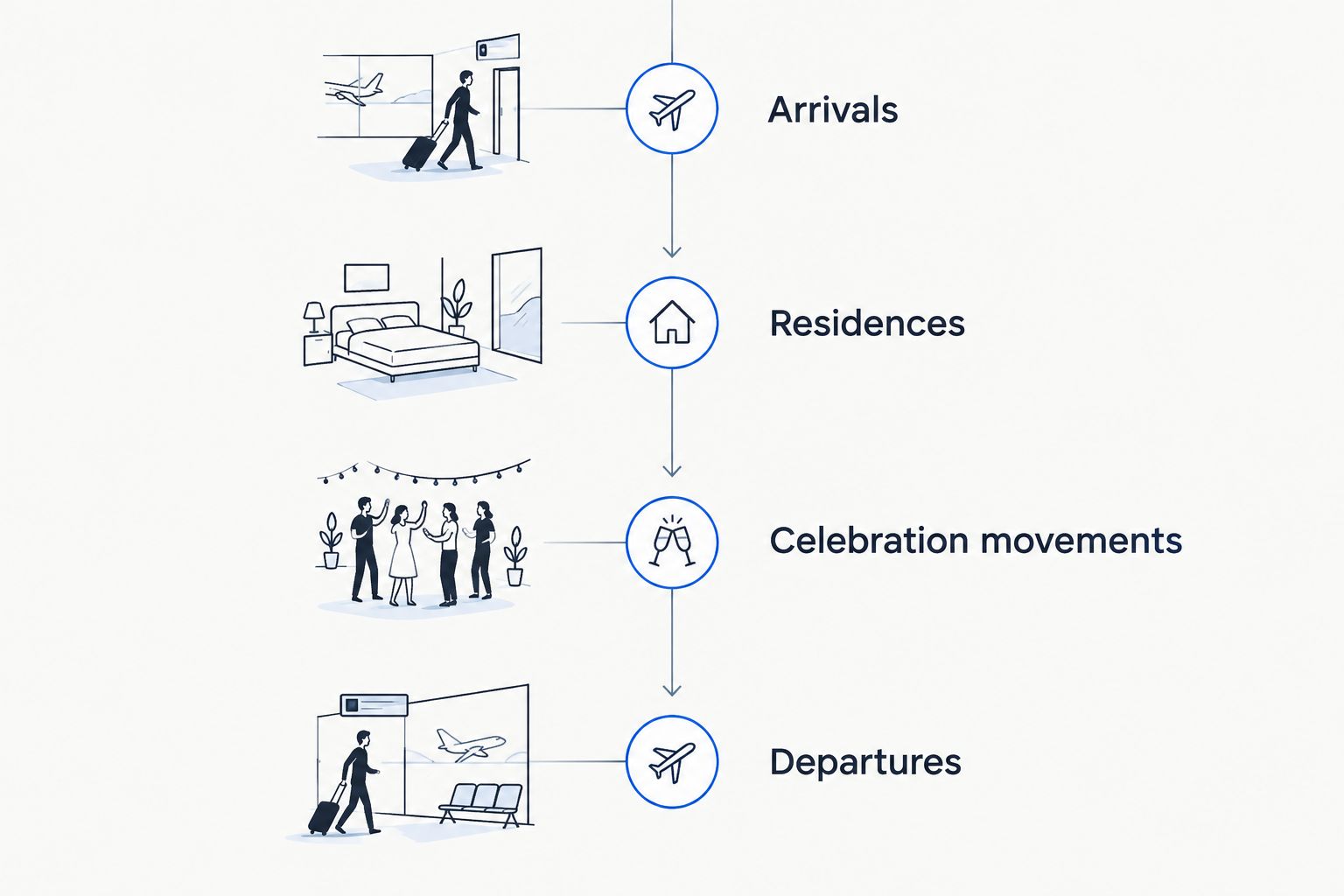
Use 4 coordination areas: arrivals, residences, celebration movements and departures. These headings make responsibility easier to examine without assuming that the same person or provider handles everything.
Arrivals
Record the arrival point, onward destination and person responsible for the handoff. Distinguish a guest’s expected arrival from a confirmed transfer arrangement. If someone changes their journey, identify which other arrangements require review before treating the change as resolved.
Guests arriving privately and guests arriving on scheduled services still need a clear onward plan. The relevant question is not simply how they travel; it is who connects that arrival with the next part of their stay.
Residences
Confirm the accommodation requirements that affect the celebration: location, access arrangements, room allocation and any guest needs that require advance discussion. Separate a host’s preferred arrangement from a guest’s confirmed agreement.
A residence also creates boundaries. Establish who receives arrival information, who can authorize changes and which details should remain private. Do not circulate a full guest accommodation list when individual instructions will serve the purpose.
Celebration movements
Connect each gathering to the guest’s starting point and return arrangements. A venue address alone does not explain where guests meet, who coordinates their movement or how they receive an amended departure instruction.
Keep optional activities distinct from commitments. Guests should understand whether an activity forms part of the shared celebration or requires a separate decision from them.
Departures
Treat departure as part of the celebration journey, not an administrative afterthought. Confirm who coordinates onward movement, which guests leave separately and what information must be checked before the final day.
A finished event does not necessarily mean every guest’s journey is finished. Define where the agreed coordination ends so that neither guests nor the host rely on an assumed handoff.
Compare private memberships by coordination scope
When comparing private concierge memberships in 2026, ask what the relationship would cover between individual requests. Do not infer continuous coordination from a broad list of services. Ask how the proposed scope connects the services relevant to your celebration and your wider travel.
The comparison below describes approaches to evaluate, not claims about any particular provider.
| Approach within a private membership | Best for | Practical advantage | Limitation to examine |
|---|---|---|---|
| Request-led support | Individuals who want to direct separate arrangements themselves | Keeps each instruction narrowly defined | You must establish who connects decisions across providers |
| Continuous coordination | Individuals seeking an ongoing relationship across connected travel needs | Creates a basis for discussing dependencies across the journey | Requires agreement on scope, responsibilities and approval boundaries |
Neither approach removes the need for clear instructions. Request-led support fits a host who wants to retain the connecting role; continuous coordination fits someone seeking a broader relationship. Choose the scope you need, not the longest list of services.
JetVoy’s private concierge membership spans travel, aviation, residences and access. That stated scope makes an ongoing coordination discussion relevant; it does not establish a particular response time, staffing arrangement, event-production capability or access outcome. Confirm the responsibilities for your proposed celebration directly.
Why private destination celebration planning varies
The useful distinction is not simply whether a celebration is large or small. Examine the dependencies your particular guest journey creates:
- Different origins. Guests traveling from different places need individual arrival instructions, even when they share the same destination.
- Different residences. Separate accommodation arrangements require you to identify starting points for shared gatherings and return movements.
- Different participation. Optional activities and staggered attendance change who needs which instructions.
- Different approval boundaries. The host, guests and any representatives need a clear division of decision-making responsibility.
- Different privacy requirements. Share personal travel and accommodation details only with the people who need them for the agreed coordination.
- Different onward journeys. Guests leaving for separate destinations need departure arrangements that reflect their own plans.
For your 2026 celebration brief, describe these dependencies before asking a prospective membership to propose its role. A destination and event date identify the occasion. They do not explain the coordination requirement.
What should you include in the initial brief?
Give a prospective private membership enough context to assess fit without sending every guest’s personal information at the outset. Describe the celebration, the anticipated travel pattern and the decisions you want to retain.
Organize the brief under these headings:
- Purpose: What the milestone means to you and which gatherings matter most.
- Journey: Where guests will travel from, where they expect to stay and how their attendance differs.
- Responsibility: What you expect to direct personally and what you want coordinated.
- Continuity: How the celebration relates to your travel, residences or access needs beyond the occasion.
- Boundaries: Privacy expectations, approval requirements and matters that need clarification before you proceed.
Then ask the prospective membership to distinguish its own role from responsibilities retained by you, your guests and other providers. A useful discussion produces defined boundaries, not simply an expression of willingness to help.
Describe your ongoing needs honestly. If you only want support for this celebration, say so. If the occasion sits within a continuing pattern of international travel, explain that context without presenting it as evidence of automatic membership eligibility.
How do you keep guest instructions clear?
Maintain 2 separate records: the coordination record and guest instructions. The coordination record holds responsibilities, dependencies, unresolved decisions and approval status. Guest instructions contain the information each recipient needs to act.
This separation is a practical planning method, not a claim about a particular membership’s systems. It lets you review operational questions without turning every guest message into an internal discussion.
For a 2026 celebration, identify which version of the guest instructions is current and who is authorized to issue changes. Before distributing an amendment, check whether it affects an arrival, residence, gathering or departure elsewhere in the plan.
Keep sensitive information out of general group communications. A guest needs their own transfer instruction; they do not automatically need another guest’s travel details. Agree the communication route before guests begin making individual changes through different contacts.
Who should approve changes during the celebration?
Name the person authorized to approve host-level decisions, then identify which choices guests make for themselves. Do not assume a family office representative, assistant or family member has authority simply because they participate in the correspondence.
Separate a proposed change from a confirmed instruction. Ask who checks its effect on the rest of the journey, who obtains any necessary approval and who communicates the final decision. These are questions to settle in advance, not operational promises to infer from membership language.
If you expect to be unavailable during a gathering, establish the approval route beforehand. The aim is to preserve your intended role as host while keeping responsibility explicit.
FAQ
What does private destination celebration planning include?
Private destination celebration planning connects guest arrivals, accommodation, celebration movements and departures with the host’s requirements. Establish the scope and responsibility for each part before treating an itinerary as confirmed.
Is a private concierge membership suitable for one celebration abroad?
A private concierge membership should be assessed as an ongoing relationship, not assumed to fit an isolated celebration. Explain whether you need support only for the occasion or continuity across your wider travel.
Can JetVoy coordinate my milestone celebration abroad?
JetVoy coordinates travel, private aviation, exceptional residences and exclusive access through private membership. Discuss your celebration requirements directly to establish membership fit and the responsibilities within the proposed scope.
Should every guest receive the same itinerary?
Guests should receive the instructions relevant to their participation and journey. Shared celebration details can be consistent while individual travel, accommodation and departure information remains separate.
Who should handle a guest’s last-minute travel change?
The agreed coordination plan should identify who receives a travel change and checks its effect on other arrangements. Confirm that responsibility before the celebration rather than assuming an individual provider covers the whole journey.
Does private concierge membership guarantee exclusive access?
Do not treat private concierge membership as a guarantee of exclusive access. Confirm the status of any specific request directly before making it a dependency in the celebration plan.
What should I prepare before discussing membership?
Prepare a brief describing the celebration, guest travel pattern, approval boundaries and your needs beyond the occasion. Use the discussion to establish scope and fit rather than assuming acceptance.
One last thing
Before approving the final plan, read it backward from each guest’s departure. Check the final transfer, the last residence handoff and the information that guest needs before leaving. Then work back through the gatherings to arrival.
A celebration plan is not complete merely because every gathering has an address and a start time. It is ready when responsibilities are clear across the journey—and the host knows which decisions still belong to them.