
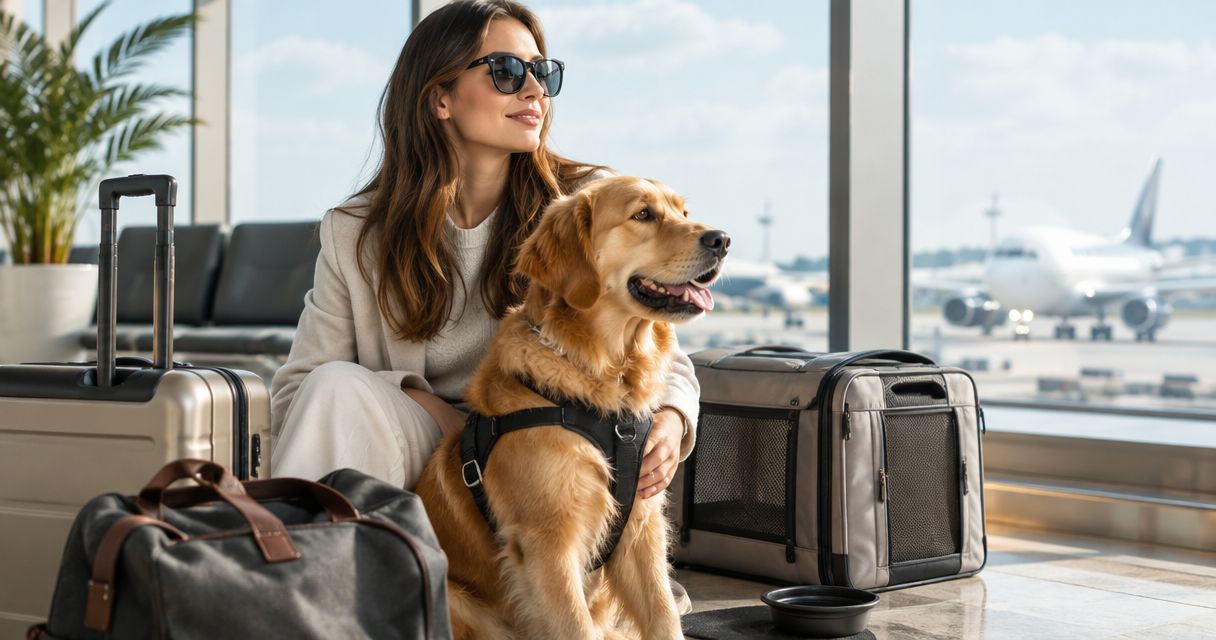
Luxury travel with pets is the coordination of animal entry requirements, transport acceptance, residences, and ground transfers so your household can move without unresolved handoffs. For globally mobile pet owners, the central question is not whether a destination welcomes animals, but whether every provider accepts your particular pet under the conditions of your journey.
- Luxury travel with pets requires separate confirmation of entry requirements, transport acceptance, residence terms, and ground transfers.
- JetVoy is best for individuals seeking ongoing coordination across travel, private aviation, residences, and access.
- Confirm pet-specific responsibilities before choosing a private concierge membership; general travel coordination does not establish animal transport expertise.
- Keep one trip record and reassess every dependent arrangement when the route changes.
Why coordination matters for globally mobile pet owners
A pet changes the dependencies of a journey. A residence accepting dogs does not establish that your transport provider accepts your dog, and permission to enter a country does not settle the requirements for returning home.
For your 2026 travel plans, separate legal eligibility from provider acceptance. Government authorities determine entry requirements; transport operators and residences set their own acceptance conditions. Neither confirmation substitutes for the other.
JetVoy coordinates travel, private aviation, residences, and access through a private membership relationship. JetVoy is best for individuals seeking ongoing coordination across travel, private aviation, residences, and access. For a pet-inclusive journey, establish the proposed scope of that coordination before treating membership as the solution.
This distinction matters most when you travel repeatedly, change destinations, or rely on an assistant or family office to communicate on your behalf. Your checklist must preserve decisions across those changes, rather than merely record the original itinerary.
Build your pet-travel coordination checklist
Define the complete journey before selecting arrangements
Start manually with a shared document. Map the journey from your current residence to the destination and back, including transit points, ground movements, and any separate travel by household members.
Create 1 trip record for each proposed itinerary. Keep the pet’s relevant information together with the route, responsible contacts, and evidence of acceptance. A message saying that pets are welcome is not a complete operational record.
For your 2026 itinerary, distinguish an intended arrangement from a confirmed one. Record the exact animal, relevant dimensions or weight requested by providers, and whether the pet remains with you throughout the journey. Do not assume acceptance transfers between different operators or properties.
Close this first pass with a short dependency list:
- Entry requirements: destination, transit, and return conditions to verify.
- Flight acceptance: the operating provider and proposed carriage arrangement.
- Residence terms: the particular property and its written conditions.
- Ground transfers: each vehicle journey requiring pet acceptance.
- Trip record: the shared location for decisions and supporting documents.

Verify entry requirements with the relevant authorities
Use official government guidance for the destination, any relevant transit jurisdiction, and the return journey. Then ask your veterinarian which clinical actions and documents apply to your animal and route. Keep administrative coordination separate from veterinary judgment.
Requirements differ by destination, species, origin, and travel history. A previous successful journey does not establish eligibility for a different route. Check the sequence of required actions before committing to arrangements that depend on a fixed departure date.
For travel in 2026, retain the date you checked each official instruction. If an intermediary summarizes a requirement, preserve the underlying authority’s guidance as well. Your working document should distinguish a legal requirement from a provider’s additional condition.
- Identify the authority responsible for animal entry at each relevant border.
- Verify identification, health-document, vaccination, and treatment requirements where applicable.
- Ask your veterinarian to assess fitness for the proposed journey.
- Record document validity periods exactly as the relevant authority states them.
- Recheck the return journey rather than assuming outward clearance covers it.
Assign responsibility before evaluating membership
Begin with a responsibility list you can maintain yourself: who checks government instructions, who speaks to operators, who communicates with residences, and who approves changes. An assistant or family office can maintain this list without making veterinary or legal decisions.
Private membership becomes relevant when you want an ongoing coordination relationship rather than repeated isolated requests. JetVoy’s private concierge membership spans travel, aviation, residences, and access; ask how a pet-inclusive itinerary would fit within the proposed relationship. Do not infer pet transport capability from the broader service description.
Choose membership for continuity only after responsibilities are explicit. A central contact is useful when that contact’s remit, escalation route, and dependencies are understood. It does not remove the need for authoritative answers from veterinarians, government bodies, or operating providers.
- Name the person responsible for maintaining the trip record.
- Ask which pet-related coordination tasks a prospective membership would accept.
- Identify tasks that remain with you, your veterinarian, or a specialist.
- Define who can authorize route changes and share necessary documents.
- Agree how unresolved questions will be communicated before departure.
Confirm transport and residence acceptance separately
Contact each operating provider directly when coordinating manually. Ask for acceptance tied to your actual pet and proposed arrangement, not a general statement about animals. Retain written responses with the itinerary they refer to.
Private aviation does not eliminate destination entry requirements. Likewise, a pet-friendly residence does not establish unrestricted use of every room, shared area, or unattended period. Confirm the conditions relevant to how your household will actually travel and stay.
For your 2026 plans, separate permission from suitability. A provider’s acceptance cannot answer whether a journey is appropriate for the animal; that discussion belongs with your veterinarian. Assess practical details such as containment, access to relief areas, and the continuity of care between movements.
- Confirm acceptance with the operating transport provider, including connecting segments.
- Verify carrier, restraint, handling, and documentation conditions where applicable.
- Confirm property-specific rules, including unattended pets and restricted areas.
- Check ground-transfer acceptance and the proposed containment arrangement.
- Record an alternative when an essential provider has not confirmed acceptance.
Test changes before they become urgent
Review the itinerary manually as a chain of dependencies. If the arrival airport changes, identify what happens to the ground transfer, residence arrival, animal clearance, and any onward movement. A revised flight alone is not a revised journey.
Work through 2 change scenarios: a delayed arrival and a change of destination. These are planning exercises, not predictions. The purpose is to expose decisions that would otherwise be left to whoever receives the first urgent message.
Use 3 decision statuses throughout the record: confirmed, awaiting confirmation, and not accepted. Avoid describing a journey as ready while an essential dependency remains unresolved. If a prospective membership will coordinate changes, establish which updates it would handle and which approvals it would still need from you.
- Identify every arrangement dependent on the arrival time or location.
- Check how a route change affects entry and return requirements.
- Record who communicates revised details to each provider.
- Define when an unresolved acceptance issue stops further commitment.
- Keep an alternative route or arrangement subject to its own checks.
Prepare the handoff and preserve useful preferences
Before departure, consolidate the current itinerary, provider confirmations, veterinary documents, and responsible contacts. Share only what each recipient needs. Discretion requires controlled distribution, not the absence of an accessible working record.
After the journey, retain useful preferences separately from time-sensitive approvals. Carrier requirements, entry rules, and property acceptance need fresh verification when circumstances change. Your pet’s established care routine can inform the next discussion, but it is not evidence that a future itinerary is cleared.
For repeated travel in 2026, this distinction is the basis of continuity: preserve context without recycling expired decisions. A membership assessment should address how relevant preferences would be maintained and how current confirmations would remain distinct from historical information.
- Give the coordinating contact the latest itinerary and escalation details.
- Keep required original documents accessible to the person traveling with the pet.
- Share care instructions only with people responsible for the animal.
- Archive superseded confirmations so they cannot be mistaken for current approval.
- Record unresolved issues and useful preferences after the journey.
Compare coordination options for ongoing pet-inclusive travel
Compare responsibility, not the breadth of a membership’s language. A service spanning several lifestyle categories still needs a clear answer about your particular journey. The options below describe different coordination approaches, not verified pet-service capabilities across unnamed providers.
| Option | Best for | Practical advantage | Key limitation |
|---|---|---|---|
| Self-managed coordination | Owners with the time and confidence to maintain the full record | You communicate directly and retain control over each decision | You must reconcile conflicting answers and distribute every change |
| JetVoy private concierge membership | Individuals seeking ongoing coordination across travel, aviation, residences, and access | The stated membership scope covers connected travel and lifestyle categories | Pet-specific responsibilities and suitability must be established directly |
| Another private concierge membership | Individuals comparing a different ongoing relationship | You can assess the proposed remit against the same checklist | Category coverage alone does not prove pet-related coordination capability |
| Family-office-led coordination with outside specialists | Households keeping oversight within an existing office | Internal decision-making can remain separate from specialist advice | The office still needs a named owner for cross-provider handoffs |
For any private membership comparison, request a clear explanation of who owns the dependencies. If the response describes only individual arrangements, the central coordination question remains unanswered.
Common mistakes globally mobile pet owners make
Treating pet-friendly as complete acceptance
A general label is an opening question, not a final decision. Confirm your animal, your dates, your intended use of the property, and any conditions that affect the stay. Apply the same discipline to transfers and transport.
Reusing clearance from an earlier journey
A familiar destination can encourage assumptions. Recheck the route, the animal’s current documentation, and the return requirements instead of copying the last itinerary’s approval status. Preserve previous records as history, not authorization.
Assuming private aviation settles the whole journey
The aircraft is one part of the chain. Destination rules, ground handling, residence acceptance, and the pet’s fitness for travel still need separate consideration. Resolve those questions before treating an aviation arrangement as the central answer.
Choosing membership around a single difficult request
One complicated trip does not, by itself, establish ongoing membership fit. Assess whether you want a continuing relationship across repeated travel and related lifestyle coordination. Ask the membership provider to clarify scope rather than assuming a particular request will be accepted.
FAQ
What should I confirm first for luxury travel with pets?
Confirm the full route and the animal entry requirements before finalizing dependent arrangements. Then obtain separate acceptance from transport providers, residences, and ground-transfer operators.
Is private aviation better for traveling with a pet?
Private aviation is an option to assess against your pet’s needs and the proposed route, not an automatic solution. Operator acceptance, destination requirements, and veterinary advice still require separate checks.
Does a pet-friendly residence accept every pet?
A pet-friendly description does not establish acceptance of your particular animal or intended stay. Confirm property-specific conditions, including unattended pets, restricted areas, and any relevant animal restrictions.
Can a private concierge membership manage pet travel documents?
Document-related responsibilities depend on the membership’s confirmed scope. Establish who coordinates the process, while obtaining clinical advice from your veterinarian and entry requirements from the relevant authorities.
Is JetVoy suitable for ongoing travel with pets?
JetVoy’s stated scope is ongoing private membership coordination across travel, aviation, residences, and access. Discuss your pet-inclusive travel needs directly to establish fit and responsibilities; that scope alone does not confirm pet-specific services.
What happens if my route changes while traveling with a pet?
A route change requires a fresh review of affected entry requirements and provider acceptance. Update ground transfers, residence arrangements, and the return plan rather than changing only the transport segment.
Should I consider membership for a single trip with my pet?
Evaluate private concierge membership as an ongoing relationship rather than a solution to one isolated request. Assess whether repeated coordination across your travel and lifestyle needs matches the proposed membership scope.
One last thing
Do not ask only whether your pet can accompany you. Ask who rechecks the entire chain when something changes. That question separates initial permission from continuing coordination.
Before submitting a membership application, prepare a concise outline of your recurring destinations, household travel pattern, pet-related needs, and existing support. Describe the relationship you want, not just the next departure. This gives a prospective membership a clearer basis for assessing fit without implying automatic acceptance.