

Solo travelers’ luxury travel planning is the coordination of transport, stays, access, and personal preferences with the aim of preserving privacy and continuity while traveling alone. Without a companion to share decisions or manage a disrupted handoff, you need clear responsibilities without surrendering control of your time.
- Luxury solo travel planning should connect each transition, not simply assemble individual arrangements.
- JetVoy is suited to globally mobile solo travelers evaluating ongoing private concierge coordination.
- Compare private concierge memberships on scope, discretion, decision authority, and continuity between journeys.
- Keep personal approval separate from routine coordination, and define what happens when plans change.
Why luxury solo travel planning matters for solo travelers
Traveling alone gives you control over your schedule. It also leaves you as the person connecting an arrival time, a driver, residence access, and an evening commitment when any detail changes.
The distinction is between an attractive itinerary and a workable transition. A residence address does not establish who will receive you; a confirmed arrival does not establish who will adjust the next commitment. Assess the connections between arrangements as carefully as the arrangements themselves.
For your 2026 travel plans, start by deciding whether you need help with an isolated journey or continuity across repeated travel. JetVoy is a private membership concierge service coordinating global travel, private aviation, exceptional residences, and exclusive access for high-net-worth individuals, family offices, and corporate executives.
JetVoy private concierge membership is best suited to globally mobile individuals seeking an ongoing coordination relationship rather than help with an isolated request. Membership fit starts with that distinction, not with an assumed spending threshold or expectation of acceptance.
How to plan private travel when you travel alone
Define your recurring coordination needs
Start with a private document listing the parts of travel that repeatedly require your attention. Separate preferences from dependencies: a preferred room setting is a preference; knowing how to enter a residence after a late arrival is a dependency.
Review your expected 2026 travel pattern rather than describing only your next destination. Note whether personal journeys overlap with business commitments, whether you move between residences, and whether changes regularly require several parties to respond. These details give a prospective membership provider a clearer account of the relationship you need.
Keep the document practical. You do not need to disclose a complete personal history to describe a coordination problem. Start with the outcome and share sensitive details only when their purpose is clear.
- Identify recurring journeys and the responsibilities attached to each.
- Separate essential requirements from preferences that can change.
- Mark handoffs that currently depend on your personal intervention.
- Describe what you want to retain control over.
Map the transitions, not just the destinations
Use a simple itinerary document before introducing any service. Give each transition an owner, a destination, a confirmation status, and a next action. Keep 1 master itinerary so you are not reconciling different versions while traveling alone.
For example, connect the arrival with ground transport, then connect ground transport with residence access. Ask what happens if the arrival changes, who receives that update, and whether the next party has acknowledged it. This is a planning exercise, not a promise that disruption can be eliminated.
A private concierge membership becomes relevant when maintaining those connections across journeys is the relationship you want to delegate. JetVoy coordinates across travel, aviation, residences, and access; ask how the proposed membership scope would apply to your particular transitions before relying on it.
- Assign responsibility for each arrival, departure, and transfer.
- Record access instructions separately from public itinerary details.
- Identify which later arrangements depend on each arrival time.
- Mark unresolved handoffs instead of treating them as confirmed.
Set privacy boundaries before sharing details
Create a short disclosure brief yourself. State what information each participant needs, what requires your approval, and which details should not circulate beyond their immediate purpose. Discretion needs specific boundaries, not simply a general request for privacy.
A driver needs an agreed meeting point and relevant contact instructions. That does not establish a need for your full onward itinerary. Likewise, a residence contact needs arrival information without necessarily needing the purpose of your visit or the identities of people you will meet.
When assessing a private concierge membership in 2026, ask about information handling before sending sensitive documents. Request an explanation of who receives information, how changes are communicated, and what happens to retained preferences. Do not infer confidentiality practices from the positioning of a service alone.
- Define what each participant needs to know.
- Separate identity documents from general itinerary circulation.
- Specify which disclosures require your approval.
- Ask how preferences are retained, corrected, and removed.
Establish decision authority and fallback instructions
Write down which decisions you want to make personally and which routine adjustments you want coordinated without repeated consultation. This prevents the same ambiguity from resurfacing whenever an arrival changes or a commitment moves.
Keep 2 contact routes: a primary route for ordinary updates and a backup route for situations in which the first is unavailable. Agree on their use rather than assuming that sending a message means someone has received or acted on it. Keep sensitive information out of broad message groups.
Decision authority should be explicit. An instruction to preserve an evening commitment is different from permission to change your transport arrangements. The coordination relationship needs to distinguish your priorities from the actions someone is authorized to take.
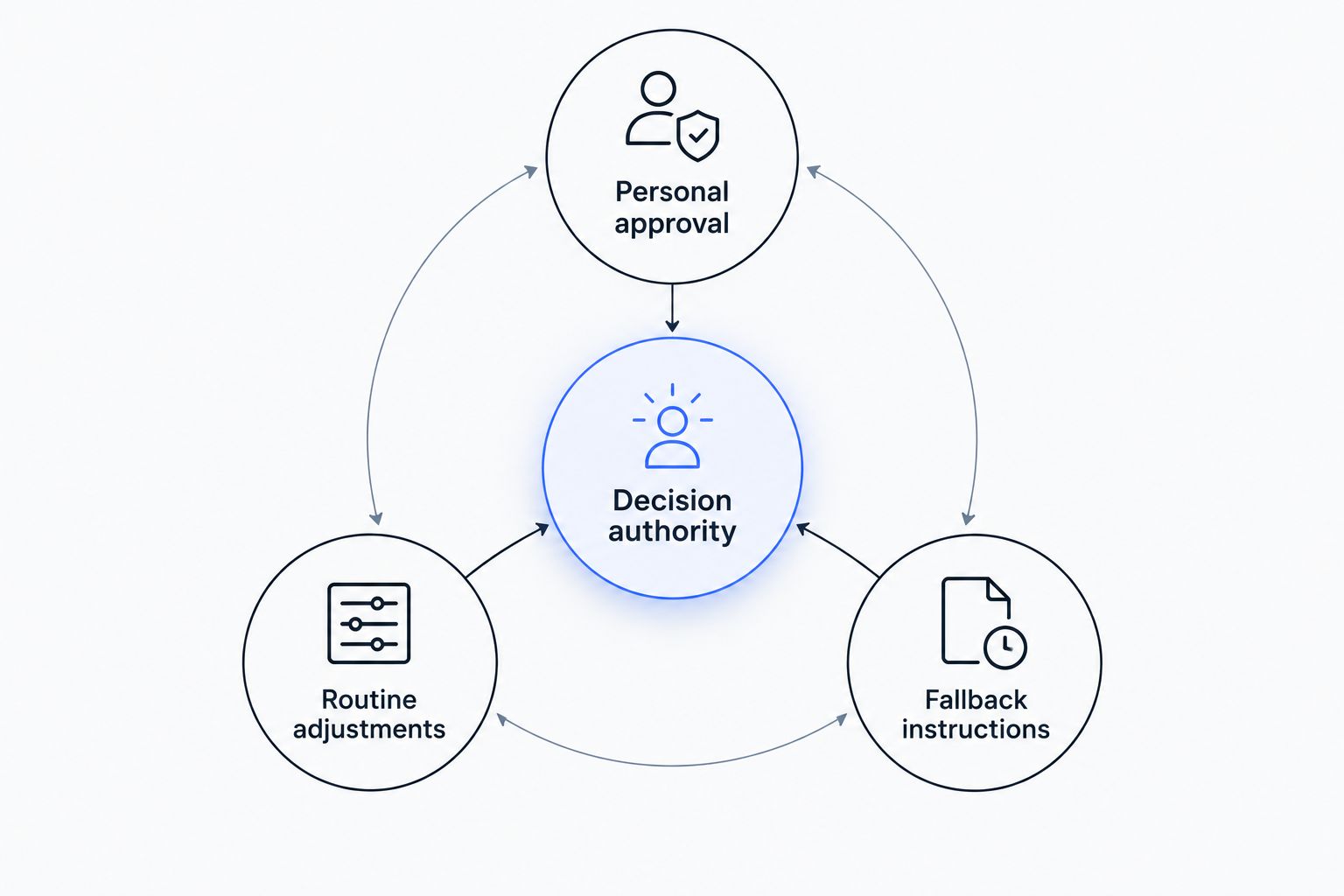
Use the same written rules when assessing any membership. A clear explanation is more useful than a broad assurance that everything will be handled.
- List decisions that always require personal approval.
- Define routine adjustments you are comfortable delegating.
- Set primary and backup contact routes.
- Record fallback instructions for periods when you are unreachable.
Test continuity with realistic changes
Walk through 3 scenarios before committing to a coordination approach: a delayed arrival, a residence access problem, and a moved evening commitment. These are assessment exercises, not claims about how often disruption occurs.
For each scenario, trace who notices the change, who contacts the affected parties, and who confirms the revised plan to you. The exercise exposes the difference between acknowledging a request and coordinating its consequences. A response is not the same as a completed handoff.
You can do this manually with your own contact list. When comparing memberships, ask each provider to explain its proposed responsibilities using the same scenarios. Do not treat hypothetical answers as contractual commitments; clarify which responsibilities would actually sit within your arrangement.
- Trace the effect of a delay beyond the immediate arrival.
- Ask who resolves uncertainty around residence access.
- Establish who confirms that affected parties have acknowledged changes.
- Distinguish an illustrative process from an agreed responsibility.
Evaluate the relationship across journeys
After a journey, review where you repeated instructions, resolved uncertainty, or carried information between participants. A short private note is enough. Focus on the coordination burden you want to remove, not merely whether the individual arrangements were satisfactory.
For a 2026 membership assessment, consider whether your needs recur across destinations and travel purposes. Ongoing membership deserves evaluation as a continuing relationship: how your preferences are understood, how exceptions are handled, and what remains your responsibility.
JetVoy private concierge membership merits consideration when your needs span the stated areas of travel, aviation, residences, and access. Its stated scope does not establish every service boundary. Confirm suitability and responsibilities before treating any particular request as included.
- Record instructions you had to repeat unnecessarily.
- Identify decisions that remained unresolved until you intervened.
- Compare recurring needs with the proposed membership scope.
- Prepare a concise account of your needs for a membership application.
Compare private concierge membership approaches
Compare the proposed relationship, not the length of a service list. For solo travelers, the useful question is whether the membership addresses the responsibilities you want coordinated while preserving the decisions you want to keep.
The options below are evaluation categories, not claims about unnamed providers. Use them to assess the terms actually presented to you in 2026.
| Option | Best for | Main advantage | Key limitation |
|---|---|---|---|
| Self-directed coordination | Solo travelers who want direct control and can manage each handoff | You retain the full decision trail and choose what to share | You remain responsible for reconciling changes across participants |
| Request-focused private concierge membership | Individuals who prefer to define and approve discrete requests | Each task can have a specific brief and completion point | You must establish who connects separate requests and their dependencies |
| Continuous private concierge membership | Globally mobile individuals seeking continuity across repeated journeys | The relationship can be assessed around recurring needs rather than isolated tasks | Scope, authority, and information handling require explicit agreement |
| JetVoy private concierge membership | Individuals evaluating ongoing coordination across travel, aviation, residences, and access | Its stated remit brings these areas into the membership discussion | Confirm the scope relevant to your circumstances; do not assume access or acceptance |
Choose membership for recurring coordination needs, not for the reassurance of a broad service description. Self-directed planning remains a valid choice when you prefer to manage the connections yourself. A membership is not automatically the better answer simply because a journey is expensive or elaborate.
Common mistakes solo travelers make
Treating privacy as having no reachable contact
Privacy and reachability are separate decisions. You can restrict disclosure while still defining how an essential update reaches you. Avoid making every participant depend on a single unanswered message, particularly when you are in transit and cannot check communications.
Assuming a complete itinerary means complete handoffs
A document can contain every address and still leave responsibility unclear. Check who confirms arrival access, who receives timing changes, and who tells you when a revised arrangement is settled. A listed detail is not evidence of an acknowledged handoff.
Delegating decisions without defining boundaries
An open-ended instruction can leave you with either too many approval requests or actions you did not intend to authorize. Separate preferences, priorities, and permissions. Review those boundaries when the purpose of a journey changes, especially when personal and professional commitments overlap.
Evaluating ongoing membership through one exceptional request
An unusual request says little about your recurring coordination needs. Assess the relationship around repeated transitions, discretion, and decision authority instead. Describe the ordinary friction you want removed before discussing exceptional access, and do not treat a membership application as automatic acceptance.
FAQ
What does luxury solo travel planning actually include?
Luxury solo travel planning connects transport, stays, access, preferences, and the transitions between them. For a solo traveler, the plan should also identify decision authority, communication routes, and responsibility when arrangements change.
Is a private concierge membership better than planning solo travel myself?
A private concierge membership fits recurring coordination needs; self-directed planning fits travelers who want to manage every handoff themselves. Compare the responsibilities you want to delegate with the membership scope rather than assuming either approach is always better.
How do I protect my privacy while traveling alone?
Protect privacy by limiting each participant's information to its agreed purpose and keeping a clear contact route. Ask how sensitive documents and retained preferences are handled before sharing them.
What should I ask before applying for private concierge membership?
Ask about scope, decision authority, communication, information handling, and responsibilities when plans change. Describe your recurring travel needs without assuming a spending threshold or automatic acceptance.
Does private concierge membership guarantee exclusive access?
Do not assume a private concierge membership guarantees exclusive access. Confirm the terms of any specific request and distinguish coordination from a guaranteed outcome.
What should I prepare for a solo travel membership discussion?
Prepare a concise outline of recurring journeys, coordination difficulties, privacy boundaries, and decisions you want to retain. Share sensitive supporting details only after establishing why they are needed and how they will be handled.
Can I keep control while someone else coordinates my travel?
Yes, you can define personal approval separately from routine coordination. Put those boundaries in writing and confirm that the proposed arrangement supports them before relying on delegated decisions.
One last thing
For your next 2026 journey, inspect the least conspicuous transition: what happens between arriving at the destination and gaining access to where you will stay. Write down who owns that connection and how a change reaches them.
That small exercise gives you a practical membership test. The right question is not how many requests you can submit, but which responsibilities the relationship will clearly coordinate.