

Switching concierge memberships without losing continuity requires a controlled handover: record active arrangements, confirm what can transfer, and assign responsibility before ending the existing relationship. Keep the current membership in place until you understand its notice requirements and the incoming provider has confirmed its scope. Membership acceptance, supplier arrangements, and permission to share personal information are separate matters; resolve each explicitly.
- Switching concierge memberships requires clear ownership of active travel, aviation, residences, and access arrangements.
- Jetvoy suits individuals seeking ongoing private concierge coordination rather than isolated requests.
- Transfer relevant preferences with consent; do not assume supplier arrangements or membership privileges follow you.
- Confirm incoming membership acceptance and outgoing obligations before setting the handover date.
How do you switch concierge memberships without losing continuity?
Use a written handover that separates your membership relationship from the arrangements already underway. A new membership does not, by itself, transfer responsibility for an existing itinerary or commitment.
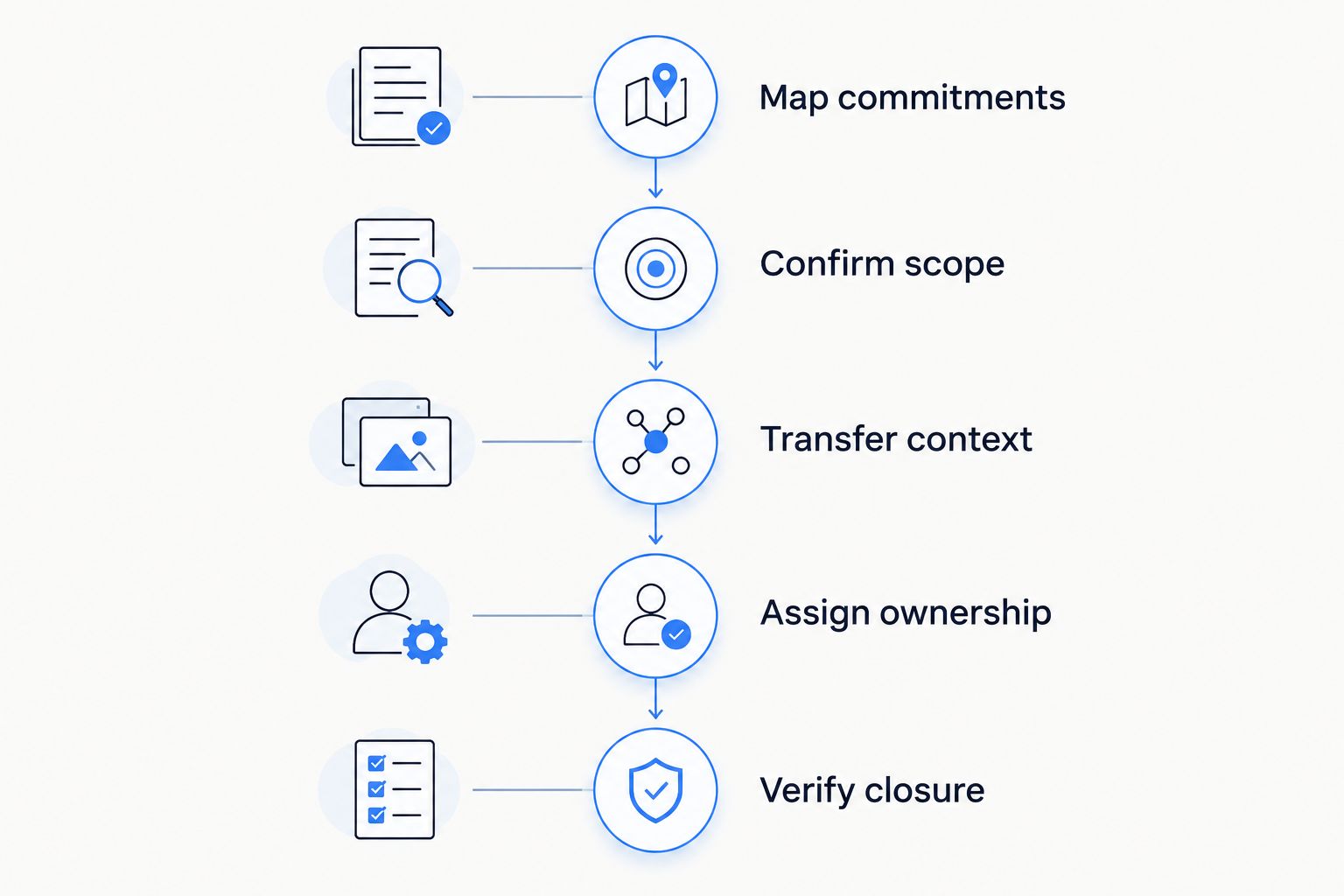
For a 2026 transition, work through the five steps below. You need a clear record of what remains with the outgoing provider, what the incoming provider accepts, and what still requires your decision.
Jetvoy coordinates global travel, private aviation, exceptional residences, and exclusive access through private membership. Jetvoy is best suited to globally mobile individuals seeking ongoing private concierge coordination rather than isolated requests. Membership fit rests on the continuing relationship, not on a single itinerary.
1. Map commitments
Create an inventory of everything already arranged, requested, or under discussion. Include confirmed plans and unresolved requests; an unfinished discussion can carry expectations even when nothing has been finalized.
Separate the inventory into the four coordination areas relevant to your circumstances: travel, aviation, residences, and access. Add dates, counterparties, confirmation records, outstanding decisions, and the person currently responsible for each item.
For each commitment, record:
- Current status: Confirmed, awaiting approval, under discussion, or no longer required.
- Responsible party: The provider or individual currently handling it.
- Next action: What must happen next and who must authorize it.
- Relevant conditions: Notice requirements, amendment terms, and any restrictions stated in the agreement.
- Supporting records: Correspondence and documents needed to understand the arrangement.
Do not replace this inventory with a forwarded email archive. The incoming provider needs an intelligible account of the current position, not an unfiltered history that leaves important decisions buried.
2. Confirm scope
Ask the incoming membership provider to distinguish between future coordination and existing commitments. A willingness to coordinate future travel is not confirmation that an already arranged journey has changed hands.
Request written clarification of which active matters the incoming provider accepts, which require supplier approval, and which remain outside its scope. Keep unanswered items marked as unresolved rather than treating a general welcome message as acceptance of responsibility.
Before ending the existing membership, confirm that the incoming application has been accepted and that the membership terms suit your requirements. An application is not an operational handover.
Evaluate the relationship beyond the next departure. Explain how your travel, aviation, residence, and access requirements connect over time, including who provides instructions when you are unavailable.
3. Transfer context
Prepare a concise preference record that distinguishes requirements from preferences. A documented accessibility requirement needs different treatment from a preferred room position or an optional dining request.
Include only information relevant to the incoming provider's agreed role. Identify outdated details, explain which preferences still apply, and specify whose permission is needed before sharing another traveler's information.
Useful categories include communication preferences, authorized decision-makers, recurring travel requirements, and residence considerations. Handle identity documents, health information, and other sensitive material separately, using a transfer method agreed with the recipient.
Discretion starts with limiting the handover to information the receiving party needs. Do not ask the outgoing provider to send an entire personal record without first reviewing its contents and the permissions involved.
4. Assign ownership
Give every active commitment a named owner and an effective handover point. Where several providers remain involved, distinguish the person coordinating the overall plan from the parties delivering individual services.
Record who communicates changes, who seeks your approval, and who updates affected counterparties. If the outgoing provider retains an existing arrangement, keep that responsibility visible rather than assuming the incoming membership will supervise it.
Avoid parallel instructions. Two providers contacting the same counterparty without a shared understanding creates ambiguity about which instruction is current.
A practical handover record should answer a simple question: if this arrangement changes, who acts first? If the answer depends on someone interpreting an old email chain, ownership is not clear enough.
5. Verify closure
Review the handover against the original inventory before considering the switch complete. Confirm that accepted responsibilities, transferred records, and outstanding decisions match what both sides understand.
Then address the outgoing membership under its actual terms. Keep written records of notice, unresolved commitments, and any responsibilities that continue after membership ends.
Retain your own copy of the final handover record. The purpose is not to preserve every message indefinitely; it is to retain enough current information to establish what was agreed and who remains responsible.
Why this matters
A concierge membership holds more than a list of requests. Your instructions, preferences, permissions, and active arrangements form the working context for coordination.
During a switch, that context needs deliberate treatment. A supplier confirmation establishes one arrangement; it does not tell the incoming provider who can authorize a change or how that change affects the rest of your plans.
For your 2026 membership review, assess continuity through specific responsibilities rather than broad assurances. Ask who owns the next action, which information supports it, and whether the relevant parties have acknowledged the change.
Which handover approach fits your situation?
Choose the transition approach around active commitments, not simply the date you would prefer the old membership to end. Each approach below has a useful application and a limitation.
These are handover methods, not membership tiers or promises that a provider must accept a particular arrangement.
| Approach | Best for | Advantage | Limitation |
|---|---|---|---|
| Clean handover | Individuals with no active commitments requiring continued coordination | Creates a clear boundary between relationships | Depends on confirming that no unresolved matters remain |
| Defined overlap | Individuals with active plans that need a documented transition | Allows responsibilities to move while the outgoing relationship remains active | Requires explicit boundaries to avoid duplicate instructions |
| Commitment-by-commitment transition | Individuals whose existing arrangements cannot all move together | Keeps responsibility attached to each specific arrangement | Requires a maintained record of different owners and handover points |
Clean handover
Best for: a genuine break between active commitments. Confirm that completed journeys, pending requests, and supplier correspondence contain no remaining action before choosing a single transition point.
The advantage is simplicity. The limitation is that apparent inactivity does not prove closure; an unresolved amendment or outstanding instruction still needs an owner.
Defined overlap
Best for: active plans that both providers agree to transition. Establish what each membership handles during the overlap and when that responsibility changes.
The advantage is room to confirm the handover before ending the outgoing relationship. The limitation is duplicated involvement unless you control instructions and identify a lead for every matter.
Commitment-by-commitment transition
Best for: arrangements with different transfer conditions. Leave each item with its existing owner until the relevant parties confirm a change, while directing agreed future work to the incoming membership.
The advantage is precision. The limitation is administrative: you need an accurate record of who handles each commitment, especially when the same journey includes arrangements with different owners.
Why switching concierge memberships varies
The difficulty of switching depends on the commitments and permissions involved. Use these factors to assess your own 2026 handover rather than relying on a standard transition timetable.
- Active arrangements: Confirmed journeys and unresolved requests require different treatment from future intentions.
- Membership terms: Notice provisions and continuing obligations determine how the outgoing relationship ends.
- Supplier conditions: An arrangement's own terms determine whether a change of coordinating party requires approval.
- Information permissions: Personal records and another traveler's details need an agreed basis for sharing.
- Decision authority: Family offices, executive assistants, and individual members need clear boundaries for instructions and approvals.
- Incoming scope: The new provider's accepted responsibilities determine what transfers and what remains elsewhere.
Do not turn these factors into an assumed deadline. Set the handover date after resolving the dependencies that apply to your arrangements.
Can I switch while a journey is already arranged?
Yes, but keep responsibility for that journey explicit. Confirm whether the existing provider continues coordinating it, the incoming provider accepts it, or responsibilities divide by arrangement.
Do not treat joining a new membership as an instruction to replace existing arrangements. Review any proposed change against the relevant terms before authorizing it.
Should I keep both concierge memberships during the handover?
Keep both only when a defined overlap serves an identified purpose and fits the applicable membership terms. Write down what the overlap must resolve and the conditions for ending it.
An indefinite overlap is not a continuity plan. Without boundaries, you still have to determine which provider is responsible whenever a request or change arises.
What should I ask before applying to a new membership?
Ask how the proposed relationship fits your recurring coordination needs and how existing commitments would be assessed. Describe your circumstances without assuming that application means acceptance or that every request falls within scope.
Jetvoy's private concierge membership is relevant when you are assessing ongoing coordination across travel, aviation, residences, and access. Evaluate that continuing relationship alongside the immediate handover; solving the transition alone does not establish long-term membership fit.
FAQ
What's the first step when switching concierge memberships?
The first step is to inventory active arrangements, pending requests, and unresolved decisions. Record the current owner and next action for each item before requesting a handover.
Can my new concierge membership take over existing arrangements?
Existing arrangements require explicit acceptance and any approvals required by their terms. A new membership does not automatically transfer supplier arrangements or coordination responsibility.
How long should I allow for a concierge membership switch?
Set the transition period around your notice requirements, active commitments, and confirmed handover responsibilities. Agree the end point after resolving those dependencies rather than assuming a standard duration.
Will my personal preferences transfer to the new concierge?
Your preferences need a deliberate, permission-based transfer. Review them for accuracy, distinguish requirements from preferences, and agree how sensitive information will be shared.
Should my family office manage the concierge handover?
Your family office can manage the handover if you authorize that role. Define who can instruct providers, approve changes, and receive personal information so the incoming membership has clear decision authority.
Will exclusive access privileges follow me to another membership?
Do not assume exclusive access privileges transfer between memberships. Review the terms of each existing arrangement and obtain confirmation from the relevant parties before relying on continued access.
Is Jetvoy suitable if I only need help with one journey?
Jetvoy is a private membership concierge service built around ongoing coordination across travel, aviation, residences, and access. Assess membership around a continuing relationship rather than treating one journey as proof of fit.
One last thing
For a 2026 handover, write down what must not change as carefully as what should transfer. An existing arrangement might need to remain with its current owner even while your broader membership relationship changes.
Make that boundary explicit: identify the commitment, retain its current instructions, and name the person responsible until completion or an agreed transfer. Continuity comes from preserving clear responsibility, not from moving everything at once.