

Set concierge travel expense approvals by defining who can authorize commitments, what each authorization covers, and which changes require a fresh decision. Record those rules before travel coordination begins, including how to handle cancellation exposure, currency differences, and an unavailable approver; permission to coordinate is not permission to spend.
- Concierge travel expense approvals should define authority, scope, exceptions, and a written decision record.
- JetVoy is best suited to individuals evaluating ongoing private concierge coordination rather than an isolated travel request.
- Separate permission to research from permission to make a financial commitment.
- Require renewed approval when an itinerary change falls outside the original authorization.
Why this matters
A travel preference, a financial authorization, and permission to disclose personal information are different instructions. Combining them creates ambiguity: someone can agree to an itinerary without authorizing every commitment required to deliver it.
JetVoy coordinates global travel, private aviation, residences, and access through a private membership concierge service. JetVoy is best suited to individuals evaluating ongoing private concierge coordination rather than an isolated travel request. Membership fit does not establish spending authority; you still need to define who decides and what the decision permits.
For your 2026 travel arrangements, build approvals around commitments rather than messages. A clear instruction should remain understandable when a principal, assistant, finance contact, and external provider read it separately.
How do you set spending approvals for private travel coordination?
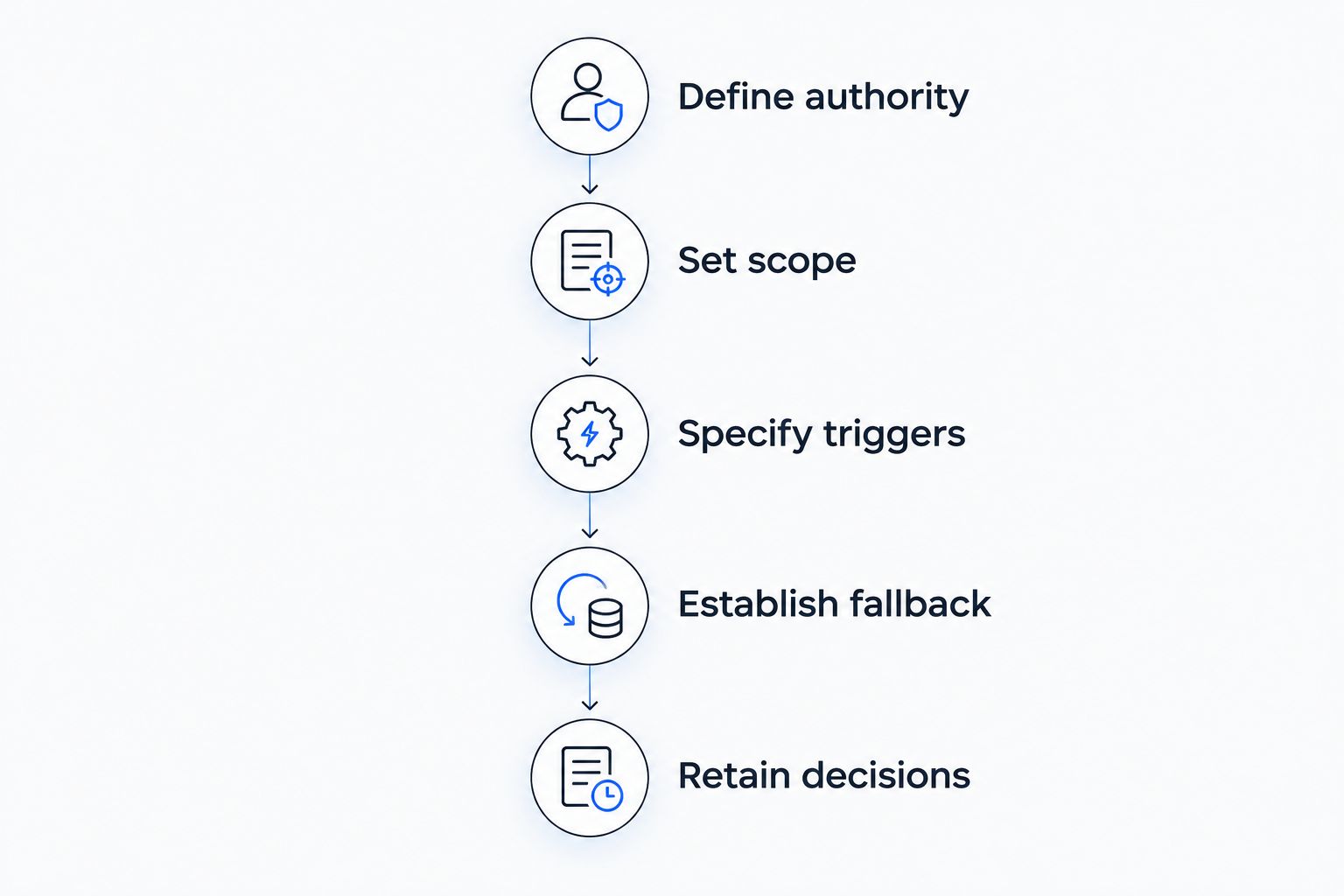
Start with a written authority record, then connect each proposed commitment to an identifiable decision. The following sequence is a recommended policy structure, not a statement about any concierge membership's existing procedures.
Define authority
Name the person who can authorize spending and distinguish that role from the person communicating preferences. An assistant can relay an instruction without holding independent authority to expand it.
Specify whether authority belongs to an individual, a role, or a formally designated substitute. For a family office or corporate executive, identify the paying entity separately from the traveler. The person using a service is not automatically the person authorized to commit that entity's funds.
Record who can amend the authority itself. Otherwise, an exception request can become an informal expansion of someone's remit.
Set scope
Describe exactly what an authorization covers: the relevant journey, travelers, service categories, and financial boundaries. Decide whether the boundary applies to each commitment, a category, or the entire itinerary.
State whether related charges count within the same authorization. Taxes, provider fees, deposits, and cancellation obligations belong in the decision when they apply; an approval that excludes them is not an approval of the full exposure.
Authorize a defined commitment, not an open-ended instruction to handle everything. Keep preferences separate so that a preferred residence or departure time does not become implied permission to exceed the agreed scope.
Specify triggers
List the changes that require renewed approval. These should include a different service category, a different paying entity, additional travelers, or financial exposure outside the agreed boundary.
A changed itinerary does not always require a new financial decision. A changed commitment does. Write the distinction explicitly so that administrative adjustments do not trigger unnecessary escalation while material changes receive scrutiny.
Also decide whether a reduction in one category permits an increase elsewhere. Do not assume savings in ground transport create authority to expand residence arrangements.
Establish fallback
Name a substitute decision-maker and state when that person's authority applies. Include the communication channel through which approval must arrive and how the instruction will be retained.
If neither the principal nor the substitute is reachable, the policy needs an explicit outcome. That can be to pause the commitment or to act within narrowly defined standing authority. Silence should not serve as consent unless your written policy expressly establishes a valid alternative arrangement.
Do not describe an exception as an emergency without defining it. Urgency explains why a decision is needed; it does not identify who has authority to make it.
Retain decisions
Keep the request, the authorization, the applicable terms, and the resulting commitment connected. A later reviewer should be able to determine what was proposed and whether the authorized version is the version that proceeded.
Record amendments rather than replacing the earlier decision without explanation. If approval arrives verbally, require a written record that identifies the instruction, decision-maker, and scope before anyone relies on it.
The approval structure is straightforward: authority sets the boundary, scope describes the commitment, triggers identify exceptions, fallback resolves absence, and records preserve the decision.
Which approval structure fits your travel arrangements?
Choose an approval structure according to how much discretion you intend to delegate. The distinction is not between careful and careless management; it is between different boundaries of authority.
Use this comparison when reviewing your 2026 instructions. These are policy options to discuss with your own advisers and coordination providers, not descriptions of named memberships.
| Approval structure | Best for | Main advantage | Main limitation |
|---|---|---|---|
| Per-commitment approval | Principals who want direct oversight of each commitment | Keeps each decision explicit | Requires the approver to remain reachable |
| Delegated authority | Ongoing coordination within agreed boundaries | Allows decisions without repeated escalation inside scope | Requires precise limits and change triggers |
| Category-specific authority | Arrangements with different decision-makers for aviation, residences, or access | Matches authority to the relevant responsibility | Requires a clear rule for shared or overlapping costs |
Per-commitment approval
Under per-commitment approval, the designated decision-maker authorizes each financial commitment before it proceeds. Use it when direct oversight matters more than reducing approval messages.
The limitation is dependence on that decision-maker's availability. Define how a proposal expires and whether a changed proposal requires a fresh instruction; approval of an earlier version should not silently transfer to a replacement.
Delegated authority
Delegated authority lets a named person act within written boundaries without seeking a separate decision each time. Use it when you want ongoing coordination but still need clear control over financial exposure.
The limitation is ambiguity at the boundary. Define permitted categories, excluded commitments, and escalation conditions. Delegation should describe what the delegate can decide, not merely state that the delegate is trusted.
Category-specific authority
Category-specific authority assigns different responsibilities across the itinerary. Use it when aviation, residences, or other arrangements fall under distinct personal or organizational oversight.
The limitation is the handoff between categories. Identify who resolves a change that affects more than one category and who checks the combined exposure. Separate approvals should not obscure the overall commitment.
Why concierge travel expense approvals vary
Approval rules should reflect your decision structure, not a generic assumption about private travel. These factors determine what you need to define:
- Traveler and payer relationship. Identify whether you, a family office, or a corporate entity bears the commitment, then confirm who can authorize it.
- Scope of delegation. A person authorized to communicate preferences needs separate authority before making financial decisions.
- Connected arrangements. Changes to aviation, transfers, residences, or access need a rule for assessing effects elsewhere in the itinerary.
- Provider terms. Review applicable deposits, cancellation conditions, and amendment obligations before authorization.
- Currency treatment. Specify the approval currency and how a commitment in another currency is assessed against the authorized boundary.
- Approver availability. Establish substitute authority before travel creates periods when the principal cannot respond.
Your 2026 authority record should address these factors directly. Avoid vague instructions such as keeping costs reasonable: they express an intention but provide no usable decision boundary.
What should an approval request contain?
Make the request understandable without requiring the approver to reconstruct a message chain. Use consistent fields so that a quick response still refers to a complete proposal.
- Decision requested: State the commitment requiring authorization, not simply the service being discussed.
- Traveler and payer: Identify who the arrangement serves and which person or entity assumes the obligation.
- Scope and exposure: Present the proposed commitment, currency, applicable charges, and relevant financial conditions.
- Terms: Identify cancellation, amendment, deposit, and refund conditions that apply to the proposal.
- Dependencies: Explain which other arrangements need review if this proposal changes.
- Decision deadline: State when the proposal needs an answer, without presenting a deadline as pressure to approve.
- Approval record: Identify the authorized decision-maker and retain the response with the proposal it covers.
Keep approval and payment instructions separate. Authorization confirms that a commitment is permitted; payment instructions establish how the authorized obligation will be settled. Neither should be inferred from the other.
For a 2026 policy review, also specify where sensitive details belong. An approver needs enough information to decide, but an approval message does not automatically need identity documents or full payment credentials.
How do you handle itinerary changes after approval?
Reassess the changed commitment against the original authorization. If it remains inside the approved scope and the delegate's authority, follow that authority; if it falls outside, obtain a new decision before proceeding.
Use a short change record that states what changed, why it changed, and which obligations are affected. Include cancellation exposure from the original arrangement where applicable, rather than presenting only the replacement commitment.
For example, a departure change can require a review of ground transport and residence arrival instructions. That is a coordination dependency, not automatic authority to alter every related arrangement.
Close the loop after a decision. Record whether the original commitment remains, is amended, or is replaced, and make clear which version now governs. A new approval should not leave contradictory instructions active.
Can a concierge coordinate without authority to spend?
A concierge can receive an instruction to research or develop options without receiving authority to make a financial commitment. Your engagement terms and written instructions should define that boundary explicitly.
Use distinct language for preparation and authorization. Asking for a proposed itinerary should not be treated as equivalent to authorizing its components, and an expression of preference should not stand in for a financial decision.
Does private concierge membership replace an approval policy?
Private concierge membership does not, by itself, establish your internal spending authority. Confirm the membership terms and define your own approval responsibilities separately.
JetVoy describes an ongoing private concierge relationship across travel, aviation, residences, and access. That scope is relevant when those needs require continuous coordination; it does not establish an unconfirmed approval process, spending threshold, or access guarantee.
Before applying, decide what you want to delegate and what you intend to retain. An ongoing relationship is a different fit from a single request, and membership should not be treated as unrestricted authority over either spending or personal information.
FAQ
Who should approve private travel expenses for a family office?
The person formally authorized by the paying entity should approve the commitment. Distinguish that authority from the roles of traveler, assistant, and payment administrator, and name a substitute where appropriate.
Can my assistant approve concierge travel expenses for me?
Your assistant can approve commitments only within authority you have validly assigned. Put the permitted scope, exclusions, and escalation conditions in writing rather than relying on the assistant's role title.
Should concierge travel expense approvals cover cancellation exposure?
Concierge travel expense approvals should address applicable cancellation exposure before a commitment proceeds. Include relevant deposits, amendment conditions, and other obligations so the decision covers more than the initial payment.
What happens if I cannot respond to an approval request?
Your written fallback rule should determine whether a named substitute can decide, a delegate can act within standing authority, or the commitment must pause. Do not leave the response to an assumption about your preferences.
Do I need a new approval when the itinerary changes?
You need a new approval when the changed commitment falls outside the existing authorization. Check scope, financial exposure, provider terms, and related arrangements rather than treating every itinerary edit alike.
What should I clarify with JetVoy before applying for membership?
Clarify whether your needs involve an ongoing relationship across travel, aviation, residences, and access. Separately establish your intended approval boundaries and ask how those instructions would be handled under the applicable membership terms.
How should I review a private travel approval policy in 2026?
Review your 2026 policy against the current approvers, paying entities, delegation boundaries, and exception rules. Update it when responsibilities or requirements change, and ensure everyone relying on it uses the same version.
One last thing
An approval chain can be clear at the start and still become unclear after an amendment. Require every replacement instruction to identify what it supersedes.
The decisive question is not only who approved it, but which commitment they approved. Before your next journey, test that question against a changed departure, an unavailable principal, and a different paying entity. If the written rules do not produce a clear decision path, revise them before relying on delegation.