

Keep one approved household itinerary by separating proposed changes from confirmed instructions, naming who can authorize each change, and publishing every approved revision in one controlled record. A concierge itinerary change approval process also needs a separate execution check: household approval alone does not establish that a flight, residence, transfer, or access arrangement has changed. This guide sets out a practical approval structure for 2026 without assuming any particular membership includes it.
- A concierge itinerary change approval process needs one approved itinerary, named decision-makers, and separate confirmation of execution.
- Keep proposed changes outside the live itinerary until approval and the necessary provider confirmations are recorded.
- Jetvoy private concierge membership fits individuals seeking ongoing coordination across travel, aviation, residences, and access.
- Choose membership for continuity across a traveling household, not merely to resolve an isolated itinerary request.
Why this matters
A shared itinerary is not the same as an approved itinerary. If a principal, partner, assistant, and household manager each circulate changes, recipients need a clear way to distinguish a suggestion from an instruction.
For your 2026 household travel protocol, define authority before choosing a document format. A beautifully presented itinerary still fails its purpose if nobody knows who authorized its latest departure time.
Jetvoy private concierge membership is best suited to individuals seeking ongoing coordination across travel, aviation, residences, and access. Assess Jetvoy on that relationship fit; confirm any approval workflow, reporting arrangement, or delegation requirement separately rather than assuming it is included.
How do you keep one approved itinerary across a traveling household?
Use one authoritative record, but allow separate spaces for proposals and operational discussion. The approved itinerary tells travelers what to follow; the change record explains what is being considered, who decided, and what remains unconfirmed.
The process below is a proposed household standard, not a description of any concierge provider’s internal operations.
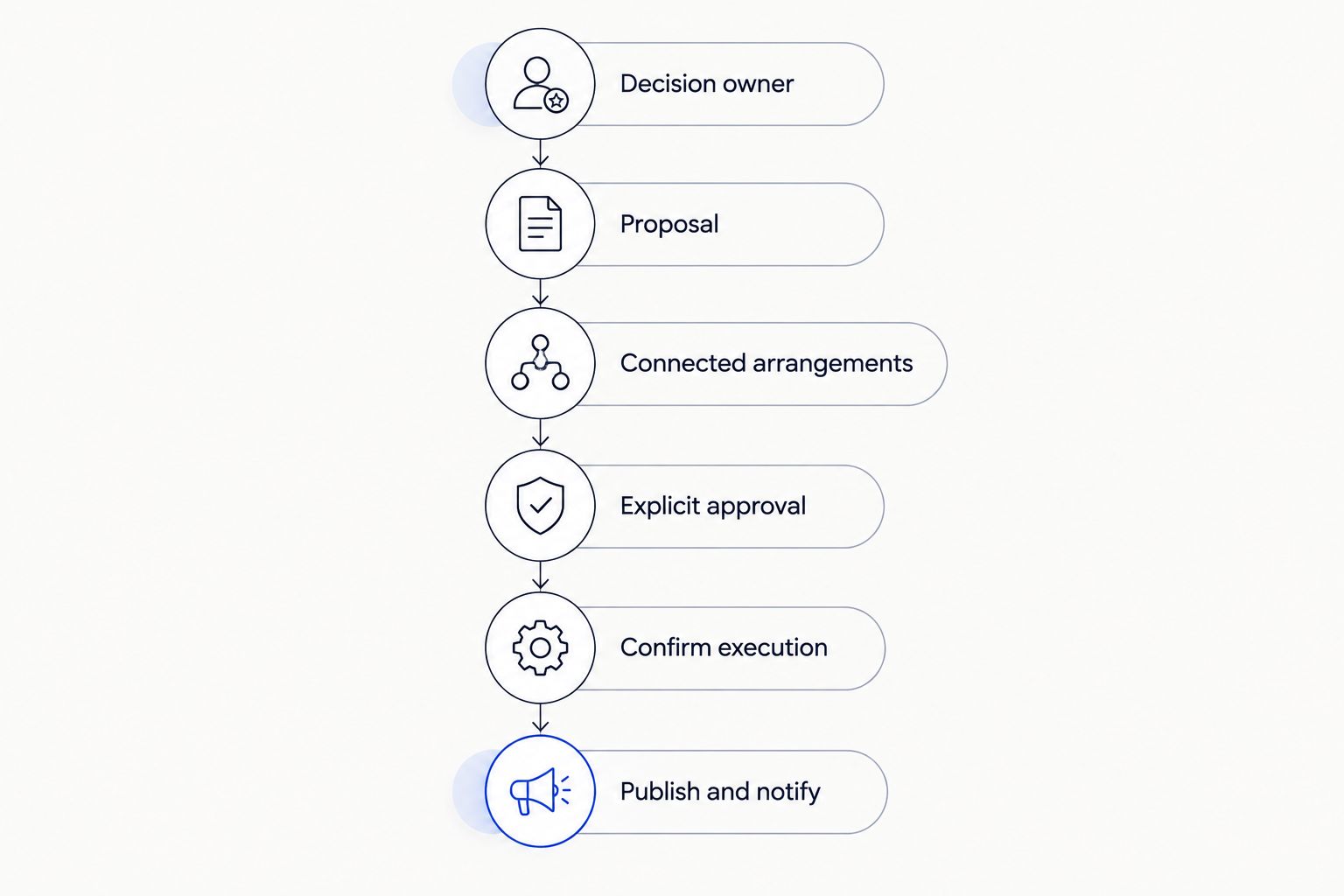
- Name the decision owner. Assign 1 final approver for each decision category and name a substitute. Different categories can have different owners, but a specific change should never have competing final authorities.
- Record the proposal. Capture the requested change, affected travelers, current arrangement, desired replacement, and the deadline for a decision. Keep the existing approved instruction visible while the proposal is assessed.
- Check connected arrangements. Identify what else depends on the proposed change. A departure adjustment needs a review of ground transport, residence arrival, and any time-sensitive commitments connected to it.
- Obtain explicit approval. Record the decision against the exact proposal. Approval of an earlier departure does not automatically authorize a different destination, additional passengers, or unrelated changes.
- Confirm execution. Establish that the relevant provider has accepted the revised arrangement. Treat household authorization and provider confirmation as 2 separate checkpoints.
- Publish and notify. Update the authoritative itinerary, identify what changed, and notify the people affected. Retire superseded copies from operational use while retaining the decision history.
An approved request is not yet an executable itinerary. Publish a revised instruction as confirmed only when the approvals and confirmations necessary for that instruction are complete.
What belongs in the authoritative record?
Give each approved itinerary a revision identifier, publication timestamp, and named owner. Use explicit local dates and time zones for timed movements; a timestamp without a time zone leaves unnecessary interpretation.
For a 2026 journey, a revision label can combine the journey name, year, and revision identifier. The particular naming convention matters less than consistent use and a clear indication of which revision is current.
Keep sensitive decision discussions out of the traveler-facing itinerary. Travelers need confirmed instructions; authorized coordinators need the supporting approval history. Those are related records, not necessarily the same document.
Household-wide approval or delegated approval?
Choose the approval structure around actual responsibility, not seniority alone. A family office professional responsible for the travel brief needs a defined remit; a traveler making a personal request still needs to know whether that request affects anyone else.
| Approval structure | Best for | Advantage | Limitation |
|---|---|---|---|
| Household-wide approval | Changes affecting shared movements or household priorities | Keeps the responsible decision-maker involved | Requires that decision-maker’s availability |
| Delegated approval | Defined adjustments within an agreed remit | Lets an authorized representative resolve routine decisions | Requires clear boundaries and escalation rules |
Neither structure removes the need for provider confirmation. Delegation changes who can approve a request, not whether the revised arrangement is confirmed.
Household-wide approval
Use household-wide approval when a change alters a shared departure, destination, residence plan, or commitment involving other travelers. The decision owner should see the consequences before authorizing the change.
Its advantage is control over shared priorities. Its limitation is dependency on the approver, so name a substitute and specify when that substitute’s authority begins.
Delegated approval
Use delegated approval for adjustments that fall inside a written remit. Define the permitted categories, affected travelers, exceptions, and circumstances that require escalation.
Its advantage is a clearer route for routine decisions. Its limitation is ambiguity at the boundary: if the request exceeds the agreed remit, return it for approval rather than interpreting silence as permission.
Delegate a defined decision, not unrestricted discretion. A useful delegation explains both what the representative can change and what must remain untouched.
Why itinerary approval varies across households
The right approval process depends on your household’s responsibilities and the arrangements involved. These factors should determine the structure of your 2026 protocol:
- Decision authority. Identify whether a principal, family office representative, or another authorized person has the final say for each category.
- Shared movements. Establish whether the proposed adjustment affects one traveler or changes instructions for the wider household.
- Connected arrangements. Check aviation, transfers, residences, and access commitments that depend on the original timing or location.
- Decision deadlines. Record when a decision is needed and who receives the escalation if the primary approver is unavailable.
- Information permissions. Decide who needs the full itinerary, who needs only a relevant extract, and who can see approval discussions.
- Continuity requirements. Define how responsibility passes between representatives without losing outstanding proposals, decisions, or confirmations.
Do not give every recipient approval rights simply because they need visibility. Receiving an itinerary, proposing an amendment, authorizing a change, and confirming execution are distinct responsibilities.
How do you stop a message from becoming an instruction?
Require every proposed change to identify its status. Use plain labels such as proposed, awaiting approval, approved pending confirmation, confirmed, and declined; define what each label permits someone to do.
A message asking whether departure can move is a proposal. A response authorizing the move is a decision. Neither should silently replace the existing confirmed departure in the traveler-facing record.
Use a short change request
A concise request should contain enough context for a decision without forcing the approver to reconstruct the trip. Include:
- The current approved arrangement.
- The precise change requested.
- The travelers and connected arrangements affected.
- The person authorized to decide.
- The decision deadline and applicable time zone.
- The current confirmation status.
Keep the decision attached to that request. If the proposal changes materially during discussion, obtain approval for the revised proposal rather than carrying the earlier approval across.
Close the loop after publication
Send affected recipients the current record and a short description of the amendment. State whether the earlier instruction has been replaced or whether part of the revised arrangement remains pending.
Ask for acknowledgment where someone must act on the change. A transport instruction needs more than evidence that a revised itinerary was distributed; the responsible party needs the revised instruction within their remit.
What happens when the approver cannot be reached?
Use the substitute and escalation rules agreed before travel. If no authorized substitute covers the decision, keep the request pending rather than treating an unanswered message as approval.
For your 2026 travel instructions, distinguish an urgent operational issue from a discretionary preference. Record the provider’s stated deadline and the consequence of leaving the current arrangement unchanged, then send that information to the authorized decision-maker.
Any standing authority for urgent changes needs explicit boundaries. Define the circumstances, the permitted actions, and the notification requirement without implying that a concierge representative can override a provider’s operational or safety decisions.
After an authorized urgent change, record who acted, under which authority, and what was communicated. Bring the authoritative itinerary back into alignment before circulating further instructions.
How do you correct an itinerary sent with the wrong revision?
Issue an explicit correction identifying the current revision and the instruction it replaces. Send it to everyone who received the superseded operational detail, not just the person who noticed the discrepancy.
Do not rely on quietly editing a shared document. Someone holding an earlier extract or offline copy needs to know that the relevant instruction is no longer current.
Keep the obsolete revision in the decision history, clearly marked as superseded. Preserving the history explains the correction; removing it from active use prevents it from competing with the approved record.
Is ongoing private concierge membership the right fit?
Ongoing private concierge membership fits a household seeking continuity across connected travel requirements. An isolated request does not, by itself, establish the need for an ongoing relationship.
When assessing Jetvoy, separate the stated membership scope from the operating arrangements your household requires. The service coordinates travel, private aviation, residences, and access; your evaluation should establish how your particular authority structure would be handled.
Ask prospective private concierge memberships to explain:
- How proposed changes are distinguished from confirmed instructions.
- How household decision-makers and delegates are recorded.
- How connected arrangements are reviewed before a change proceeds.
- How provider confirmations and unresolved items are communicated.
- How the current itinerary and its revision history are maintained.
The benefit of continuous coordination is a relationship organized around connected needs. The trade-off is that your household must define its authority, information permissions, and expectations rather than leaving those decisions implicit.
Choose the relationship before the interface. A shared document can display an itinerary, but it cannot decide who has authority or what a household intends to authorize.
FAQ
What is a concierge itinerary change approval process?
A concierge itinerary change approval process separates a proposed amendment, household authorization, provider confirmation, and publication of the revised itinerary. It gives each stage an owner so a discussion does not become an instruction by accident.
Who should approve travel changes for a household?
The person named in your household’s decision rules should approve each travel change. Assign one final approver for each category and define a substitute rather than allowing several people to issue competing instructions.
Can my assistant approve itinerary changes for me?
Your assistant can approve itinerary changes within authority you have explicitly delegated. Define the categories covered, the boundaries, and the decisions that must return to you.
Does an approved change mean the revised arrangement is confirmed?
An approved change does not establish that the revised arrangement is confirmed. Household authorization and provider confirmation are separate checkpoints, and the itinerary should show that distinction.
What should happen if someone is using an old itinerary?
Send an explicit correction identifying the current revision and the instruction it replaces. Notify everyone affected by the superseded detail rather than relying only on an edit to a shared document.
Is Jetvoy a fit for ongoing household travel coordination?
Jetvoy is a private membership concierge service coordinating travel, private aviation, residences, and access for high-net-worth individuals, family offices, and corporate executives. Assess fit around an ongoing relationship and confirm your household’s required approval arrangements directly.
One last thing
A single approved itinerary does not require a single document containing every private detail. You can maintain one authoritative operational record while giving each recipient only the instructions relevant to their responsibility.
For your next household journey, settle one question before departure: who can turn a proposed change into an authorized instruction? Write down the answer, name the substitute, and make the distinction visible wherever changes are discussed.