

Extend a business trip into a private family stay by defining when work ends, confirming the family’s arrangements separately, and coordinating the handover between them. Effective business and leisure travel coordination keeps professional obligations, personal expenses, and family privacy distinct while aligning arrivals, accommodation, and onward travel. An extended stay needs its own plan, not just a later departure.
- Business and leisure travel coordination starts with a clear boundary between professional obligations and the private family stay.
- Confirm family arrivals, accommodation access, and transport together rather than treating each arrangement as independent.
- Keep employer approvals, personal expenses, and permission to share family information explicit.
- Jetvoy suits globally mobile individuals evaluating ongoing private concierge coordination rather than an isolated travel request.
Why this matters
A business itinerary follows professional commitments. A family stay follows different priorities: shared time, appropriate accommodation, privacy, and arrangements that work for everyone traveling. Extending the dates does not reconcile those priorities by itself.
For your 2026 planning, treat the transition as a distinct part of the itinerary. The membership model described by Jetvoy centers on coordination across travel, private aviation, residences, and access. That scope is relevant when your needs continue across trips rather than ending with a single arrangement.
The practical question is not simply whether your family can join you. It is whether the work itinerary and the private stay can connect without leaving you responsible for unresolved decisions during either part.
How do you extend a business trip into a private family stay?
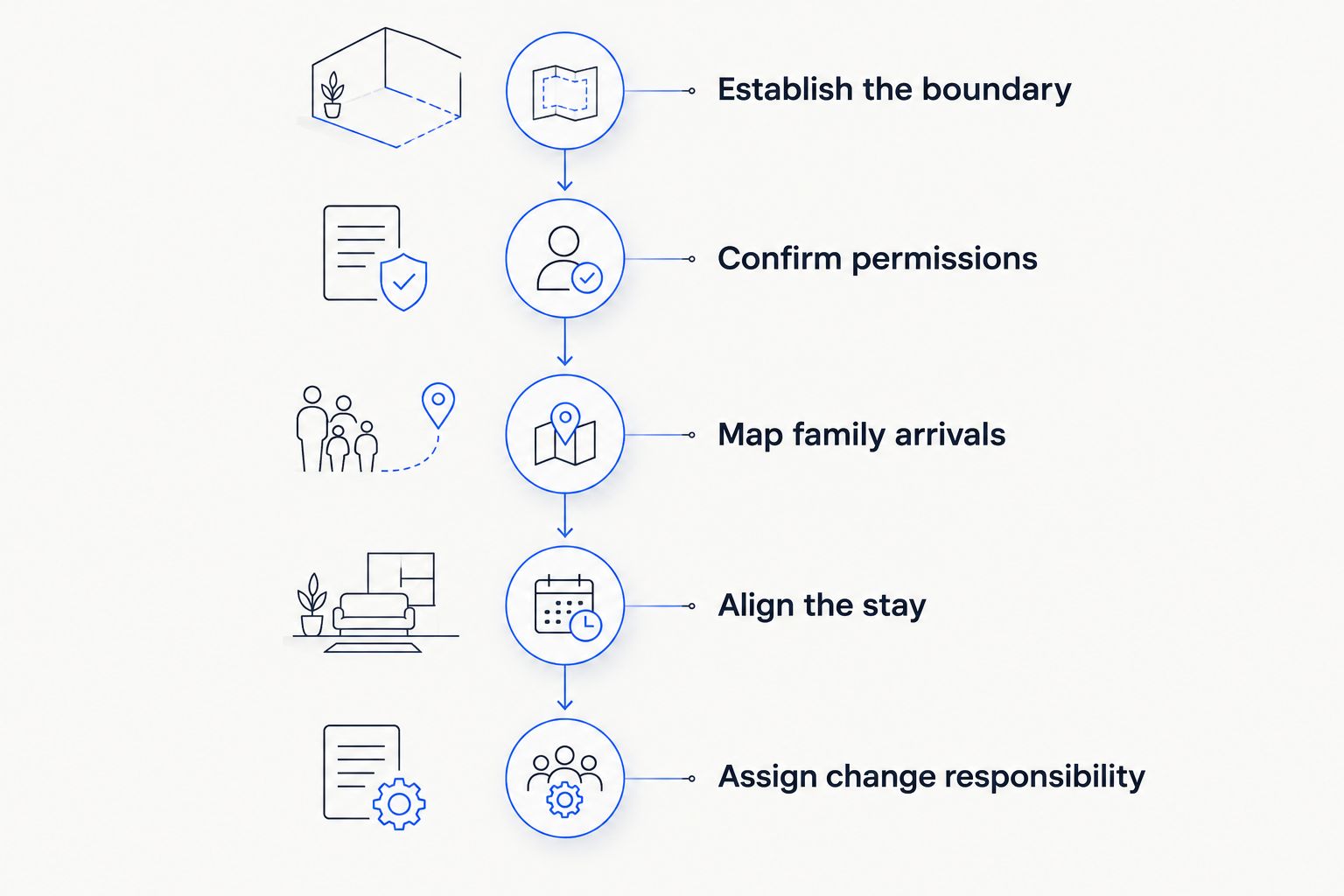
Start with the handover, then build the family stay around it. Establish the last work commitment you must attend, identify what remains subject to change, and confirm who coordinates each dependency. Use the following sequence before treating the combined itinerary as settled.
Establish the boundary
Identify the final professional obligation, including any required dinner, onward meeting, or departure with colleagues. Distinguish a confirmed finish from an expected finish. Your family’s arrival should not depend on an assumption that a meeting will end early.
Decide whether you remain available for work during the private stay. If you do, define the practical limit: which commitments remain, where you need privacy, and who needs to know. A nominally private extension with unresolved work obligations is not protected family time.
Confirm permissions
Check your employer’s travel and expense rules before changing arrangements connected to the business trip. Ask how a personal extension affects approval, reimbursement, accompanying travelers, and changes to the original itinerary. Keep the response with the relevant arrangements.
Review entry requirements and travel insurance for each traveler using the applicable official guidance and policy wording. Do not assume that permission or cover connected to your professional travel extends to relatives or additional leisure activities.
Map family arrivals
Record who is traveling, where each person arrives, and who accompanies anyone needing assistance. Include luggage, ground transport, and the point at which responsibility passes from an accompanying adult to another agreed person.
If family members arrive before your work ends, they need a workable arrival plan without your immediate involvement. Confirm accommodation access and an appropriate contact rather than assuming you can step away from a meeting to resolve a problem.
Align the stay
Assess the accommodation against the private stay, not just the business schedule. Consider sleeping arrangements, shared space, privacy, accessibility, and the location of activities your family actually wants to pursue.
Then connect the departure from the business accommodation with arrival at the family accommodation. Confirm access arrangements and responsibility for belongings. A move is not complete merely because both properties have confirmed the stay.
Assign change responsibility
Name the person responsible for updating the connected arrangements if the business schedule changes. That person needs the relevant information and a clear understanding of what they can decide without further approval.
Separate an update from a completed change. A message saying that your meeting has moved does not establish that transport, accommodation access, and family plans have all been adjusted. Ask for confirmation of the affected arrangements, not just acknowledgment of the message.
Should you stay in place or move to a private residence?
Choose the accommodation that supports the family stay, not the option that requires the fewest changes. Remaining in place avoids a transfer, but the existing arrangement still needs to suit the people joining you. Moving creates a clearer separation from work while adding another handover to coordinate.
| Arrangement | Best for | Practical advantage | Limitation to resolve |
|---|---|---|---|
| Remain in the business accommodation | Families whose needs fit the existing accommodation | Avoids moving belongings between properties | Room configuration, privacy, and continuing business activity need review |
| Move to a private residence | Families prioritizing shared space and separation from work | Creates a distinct setting for the private stay | Access, departure, transport, and property responsibilities need alignment |
| Continue to another destination | Families with a separate destination as the purpose of the extension | Lets the private itinerary follow family priorities | Adds a travel connection and another set of arrival arrangements |
For a 2026 extension, evaluate the complete transition before choosing. A residence is not automatically the better option, and staying in place is not automatically simpler once family requirements are included.
Ask what happens between leaving the work setting and being ready to enjoy the private stay. That interval exposes the decisions that accommodation descriptions alone cannot answer.
Why business and leisure travel coordination varies
The coordination required depends on the relationships between arrangements, not simply the length of the trip. Use these factors to identify where your proposed extension needs closer attention.
- Work certainty: A fixed final commitment provides a different planning basis from a schedule still awaiting confirmation. Keep uncertain obligations visible.
- Separate arrivals: Relatives traveling independently need their own arrival arrangements and a contact who is available when they arrive.
- Accommodation suitability: A setting selected for professional convenience still needs to meet the family’s space, privacy, and access requirements.
- Travel mode: Commercial flights, private aviation, and ground transport each require confirmed departure and arrival arrangements. Identify who coordinates the connections between them.
- Information permissions: A work assistant, family representative, and service provider do not necessarily need the same information. Define what each person is authorized to receive.
- Decision authority: Someone must distinguish changes they can authorize from decisions requiring your approval. Without that distinction, unresolved questions return to you.
These are planning criteria, not promises about any provider’s service. In your 2026 membership assessment, ask how the provider addresses the factors relevant to your actual travel pattern.
How do you keep business and family arrangements separate?
Keep separate records for professional obligations, private arrangements, and shared dependencies. Connect only the information needed to coordinate the transition. Separation protects clarity; it should not leave essential arrival details inaccessible to the person responsible for them.
Separate expenses before authorizing changes
Identify who pays for the original work itinerary, the personal extension, accompanying travelers, and any changes linking them. Obtain the relevant employer guidance rather than deciding reimbursement treatment yourself.
Keep confirmations and supporting records organized by purpose. An arrangement spanning both parts of the trip deserves explicit treatment, not an assumption that someone will allocate it afterward.
Share information by responsibility
Give each participant the details needed for their role. A ground transport provider needs the agreed collection information; that does not establish a need for your complete professional schedule or your family’s wider movements.
Ask how family preferences and travel documents are handled before sharing them. Discretion requires clear information boundaries as well as careful communication. Keep this question explicit in any 2026 concierge membership discussion.
Protect the private calendar
Agree which commitments are fixed and which remain optional. Avoid filling every open period before understanding how the family wants to use the stay.
If work continues, make its boundaries visible to the people affected. A private call requires an appropriate setting; an uncertain meeting should not silently determine everyone else’s day.
When is ongoing private concierge membership appropriate?
Jetvoy is best suited to globally mobile individuals seeking an ongoing private concierge relationship across travel, aviation, residences, and access. Membership fit rests on a continuing coordination need, not simply the wish to extend a particular trip.
An ongoing relationship is relevant when you repeatedly need professional and private arrangements aligned, or when a family representative and executive support need clearly connected responsibilities. Assess the pattern across your travel rather than the complexity of one destination.
The limitation is equally important: an isolated request does not, by itself, establish a reason for ongoing membership. If your existing support can manage the extension with clear responsibilities, define the additional need before evaluating a broader relationship.
When assessing Jetvoy, describe your recurring coordination needs and ask how the proposed membership would address them. Do not infer service commitments, access guarantees, or acceptance from the membership description.
What should you include in a membership inquiry?
Provide enough context to establish fit without sending unnecessary sensitive information. Describe your usual mix of professional and family travel, the areas requiring coordination, and the role of anyone already supporting you.
Explain where responsibilities currently become unclear. Examples include relatives arriving while you are working, a move between accommodation settings, or changes affecting multiple providers. These are useful coordination questions without requiring you to disclose identifying details about family members.
Assess your membership fit
Consider whether your recurring travel, aviation, residence, and access needs call for ongoing coordination.
Can your family arrive before your business trip ends?
Your family can arrive before your professional commitments end when their entry, accommodation access, transport, and support arrangements are confirmed independently of your availability. The deciding issue is who takes responsibility while you are working.
Do not use your anticipated free time as the arrival plan. Establish an available contact and confirm the practical handover before anyone travels.
Should you combine the work and family itineraries?
Keep a shared view of the dependencies while separating detailed professional and private information. The person coordinating an arrival needs to know whether your work affects it, but does not automatically need every meeting detail.
A connected itinerary should make responsibilities clearer. If combining documents obscures who pays, who approves changes, or who receives family information, revise the structure.
FAQ
What is the first step in business and leisure travel coordination?
The first step is to define when professional obligations end and the private family stay begins. Identify any uncertain work commitments before confirming arrangements that depend on your availability.
Can I extend a work trip for a family stay?
Check your employer’s rules and obtain the relevant approval before changing arrangements connected to work travel. Confirm personal expenses, entry requirements, and insurance separately for the family extension.
Is staying in the same accommodation better than moving?
Staying in place is better when the existing accommodation meets your family’s needs and provides an appropriate separation from work. Moving is appropriate when another setting better supports the private stay, provided the transfer and access arrangements are coordinated.
How do I keep family travel details private from work contacts?
Share family travel details according to each person’s coordination responsibilities. Keep professional and private records distinct while giving the responsible contact enough information to manage shared dependencies.
What should happen if my final business meeting changes?
The responsible coordinator should identify every arrangement affected by the meeting change and confirm the required updates. Acknowledging a schedule change is not the same as completing the related changes.
Do I need ongoing concierge membership for a single family extension?
A single extension does not establish a need for ongoing concierge membership. Assess whether you have recurring coordination requirements across travel, aviation, residences, and access that justify a continuing relationship.
One last thing
Before finalizing your 2026 extension, ask a practical question: If your final work commitment runs late, who takes responsibility for the family’s arrival? Name the person, confirm their authority, and establish how they receive changes.
That answer tests the transition more directly than another activity on the itinerary. A private family stay begins with protected time, and protected time starts with responsibilities that no longer depend on your immediate attention.