

Divide family office concierge responsibilities by keeping financial authority, policy decisions, and sensitive records with the family office, while assigning agreed travel coordination to the concierge. For your 2026 travel arrangements, document who approves commitments, who communicates changes, and who resolves conflicts before any provider receives instructions.
- Family office concierge responsibilities need explicit boundaries: retain financial authority and delegate agreed travel coordination.
- JetVoy fits ongoing private concierge membership, rather than isolated travel requests.
- Name a decision owner, record approval limits, and define how changes reach every affected provider.
- A concierge coordinates dependencies; the family office retains the authority assigned in your written agreement.
How should you divide travel responsibilities with a family office?
Separate authority from coordination. The family office decides what the household authorizes; the concierge coordinates the agreed arrangements within that authority. Providers remain responsible for delivering their own services under their respective terms.
Use this proposed responsibility matrix as a starting point, not as a description of any particular membership contract. Confirm each assignment against your family office structure and the concierge’s actual scope.
| Responsibility | Family office role | Concierge role | Boundary to document |
|---|---|---|---|
| Travel priorities | Confirm purpose, participants, and constraints | Translate the brief into coordinated arrangements | Who resolves conflicting preferences |
| Spending authority | Set approval limits and authorized decision-makers | Present commitments for approval where required | Which decisions require written consent |
| Travel coordination | Provide the approved brief and relevant policies | Coordinate agreed travel, aviation, residences, and access | Which arrangements sit inside membership scope |
| Personal information | Control disclosure permissions and retained records | Request and handle information needed for agreed coordination | Who receives which information |
| Changes | Approve changes outside delegated authority | Assess dependencies and communicate agreed revisions | Who can act when the approver is unavailable |
| Financial reconciliation | Review invoices, payment records, and allocation | Supply agreed supporting information | Who resolves discrepancies with providers |
The family office does not need to manage every operational exchange to retain control. The concierge does not need financial discretion over every commitment to coordinate effectively. Clear boundaries make both roles more useful.
Why this matters
A changed flight can affect a ground transfer, a residence arrival, and an evening engagement. Assigning each arrangement separately leaves an unanswered question: who checks the consequences across the whole itinerary?
That is the distinction to examine when assessing JetVoy for private concierge membership. Its stated scope covers coordination across global travel, private aviation, exceptional residences, and exclusive access; your evaluation should establish how that scope would connect with your family office’s existing responsibilities.
JetVoy is best suited to individuals evaluating ongoing private concierge coordination, rather than an isolated travel request. Membership fit depends on the relationship you need, not simply the complexity of an upcoming journey.
Establish authority before delegating execution
Start your 2026 responsibility agreement with decisions, not destinations. A useful document explains who can authorize an action and what happens when the usual decision-maker cannot respond.
Name the decision owner
Designate 1 decision owner for each approval category. Different categories can have different owners, but each decision needs a clear route to authorization.
The principal might decide personal preferences while an authorized family office representative approves expenditure. If those instructions conflict, the concierge needs a named person who can settle the conflict rather than interpret competing messages.
Define delegated authority
Specify which actions the concierge can coordinate without fresh approval and which require consent. Describe the boundary in practical terms: an itinerary revision, a new financial commitment, a changed traveler list, or disclosure of personal information.
Do not treat an established preference as unlimited permission. Knowing a preferred arrival time does not establish authority to accept a different provider’s terms or a new commitment.
Set the unavailable-approver rule
Record the alternate approver and the limits of that person’s authority. State what must pause if neither approver can be reached.
Silence is not a substitute for authorization. Any permission to act without an immediate response belongs in the agreement before a time-sensitive situation occurs.
Use a shared coordination process
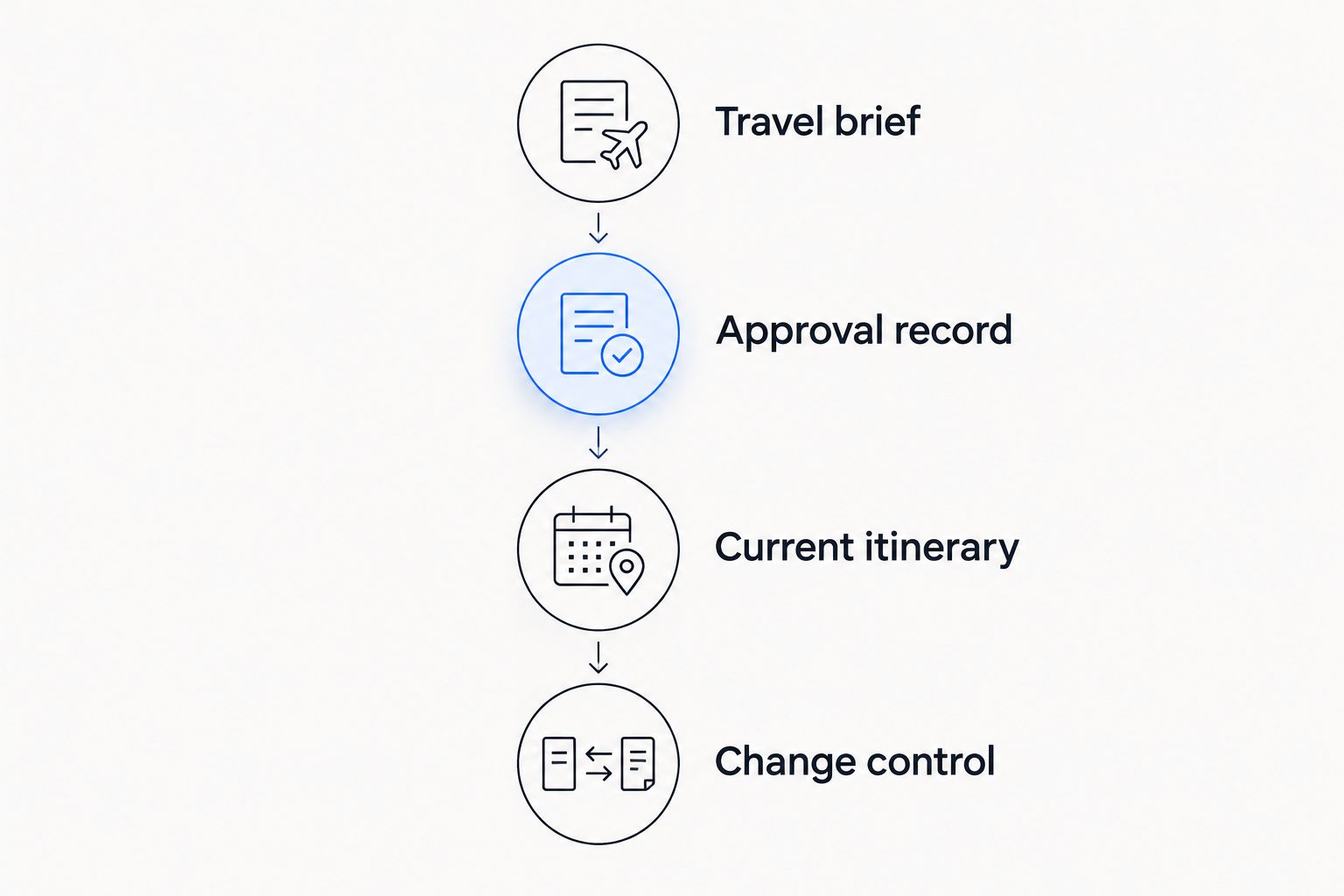
For your 2026 operating brief, use the following sequence to connect the family office’s authority with the concierge’s coordination role. Treat it as a proposed working method to agree with the membership provider, not an assumed service commitment.
- Travel brief. The family office confirms travelers, purpose, fixed commitments, relevant preferences, and disclosure permissions. Distinguish essential requirements from preferences that can change.
- Approval record. The concierge presents decisions requiring authorization through the agreed channel. Keep 1 approval record for each commitment so later changes can be checked against what was actually authorized.
- Current itinerary. Assign responsibility for maintaining 1 current itinerary that identifies confirmed arrangements, unresolved decisions, and the relevant operational contacts. Restrict personal information to what recipients need.
- Change control. When an arrangement changes, identify affected dependencies, obtain any required approval, and communicate the revision to the appropriate parties. Close the change only after the required confirmations are recorded.
The sequence separates a proposal from an approval and an approval from a confirmed arrangement. Those distinctions matter when several people are discussing alternatives at the same time.
Keep financial oversight with the family office
The family office’s proposed role is to retain control over authorization, payment permissions, reconciliation, and any required allocation between personal and corporate expenditure. Confirm these responsibilities with the people already accountable for the relevant accounts.
Give the concierge enough information to coordinate within the approved boundaries. That does not require sharing unrelated financial records or granting wider account access than the agreed role needs.
Before a commitment is authorized, establish:
- Who accepts the applicable provider terms.
- Who authorizes payment and through which approved process.
- Who receives the invoice and supporting documentation.
- Who handles discrepancies, cancellations, and disputed charges.
A concierge’s involvement does not replace your review of provider terms. Keep the decision to accept those terms explicit, particularly when a change alters the original arrangement.
Assign privacy responsibilities explicitly
Discretion needs an information-sharing rule, not just a general expectation of confidentiality. Define what the family office can disclose, what the concierge needs, and which providers can receive each category of information.
Separate operational preferences from sensitive documents. A transfer coordinator needs relevant arrival instructions; that does not establish a need for unrelated household, financial, or medical records.
Ask how information is collected, accessed, updated, retained, and removed. For specialist legal or security requirements, obtain direction from the appropriate adviser rather than expecting the concierge to determine the obligation.
The same principle applies to internal distribution. Not everyone copied into a travel discussion needs access to every traveler’s documents or full itinerary.
Why family office concierge responsibilities vary
Review these factors when setting your 2026 division of responsibilities. The appropriate boundary follows your actual needs and the agreed membership scope, not a universal definition of concierge service.
- Existing office capacity. An office with an established travel coordinator needs a different interface from an office delegating operational coordination externally.
- Decision structure. A principal, family office representative, and corporate executive assistant can hold different forms of authority. Record where each begins and ends.
- Travel dependencies. Aviation, residences, ground movements, and access arrangements need an assigned point of coordination when changes affect one another.
- Information sensitivity. Disclosure permissions and specialist privacy requirements shape which party handles particular records.
- Membership scope. Confirm included coordination, exclusions, communication arrangements, and third-party responsibilities directly with the provider.
- Continuity needs. A recurring relationship requires a process for maintaining approved preferences and updating responsibilities as circumstances change.
These factors belong in the working agreement. A general promise of personal service does not answer who is authorized to make a particular decision.
Choose the relationship that matches the recurring need
Best for ongoing coordination: a private concierge membership warrants consideration when you want a continuing relationship across travel, aviation, residences, and access. Its limitation is equally important: membership does not transfer every family office responsibility to the concierge.
Best for retained governance: family office oversight remains the appropriate place for your assigned financial authority, disclosure decisions, and internal accountability. Its limitation is the work involved in operational coordination when that work also stays in-house.
| Approach | Best for | Advantage | Limitation to address |
|---|---|---|---|
| Family-office-led coordination | Households retaining operational travel management internally | Keeps coordination close to existing decision-makers | Requires an internal owner for cross-provider changes |
| Concierge-led coordination with office oversight | Individuals seeking an ongoing external coordination relationship | Separates operational coordination from retained authority | Requires explicit approvals, information boundaries, and escalation rules |
Neither approach removes the need for accountable providers. Choose the division that your office can maintain consistently, including when the usual representative is unavailable.
When assessing JetVoy private concierge membership, ask how the proposed relationship would interact with your current office. Confirm the agreed responsibilities before treating any coordination task as delegated.
Can a family office delegate all travel decisions?
A family office can delegate only the authority that an authorized decision-maker explicitly grants and the recipient agrees to accept. Keep exceptions, financial permissions, and sensitive disclosures separate from routine coordination.
Avoid a blanket instruction to handle everything. Replace it with a written scope that identifies authorized actions, approval requirements, exclusions, and the route for unresolved decisions.
What should happen when plans change during a trip?
Assign a change owner to assess the affected arrangements and route any required approvals. The family office should not have to reconstruct the entire conversation to determine what changed and who authorized it.
Ask the coordinator to distinguish proposed revisions from confirmed ones. Maintain the current itinerary separately from exploratory discussions so travelers and providers are not acting on different versions.
Test the arrangement before relying on it
Use a hypothetical change during your 2026 membership evaluation: an arrival moves, the residence timing no longer aligns, and an evening commitment becomes impractical. Ask the prospective concierge to explain the proposed coordination process without assuming authority or access that has not been agreed.
Follow the decision through each boundary. Who identifies the consequences? Who approves a new commitment? Who informs the residence and affected providers? Who updates the traveler?
Evaluate the clarity of the answers, not the confidence of the presentation. An explanation that distinguishes coordination, authorization, and provider confirmation gives you something concrete to assess.
FAQ
What are the main family office concierge responsibilities?
Family office concierge responsibilities should separate retained authority from delegated coordination. A practical division keeps financial approvals and disclosure permissions with the family office while assigning agreed travel coordination to the concierge.
Who should approve changes to private travel arrangements?
The person named in your authority agreement should approve changes that fall outside delegated permissions. Identify an alternate approver and specify what must pause when neither person is available.
Does private concierge membership replace a family office?
Private concierge membership does not replace the family office’s assigned governance responsibilities. Define how travel coordination connects with existing financial oversight, advisers, and internal decision-makers.
Should the concierge receive every traveler’s personal documents?
Share only the documents and information needed for the agreed coordination task. Confirm disclosure permissions, recipient access, retention, and removal arrangements before sharing sensitive material.
Who should maintain the current travel itinerary?
Assign a named itinerary owner in the working agreement. That person should distinguish confirmed arrangements from proposals and communicate approved revisions through the agreed channel.
Is JetVoy suitable for an ongoing family office relationship?
JetVoy’s stated private membership scope makes it relevant to an ongoing concierge evaluation covering travel, aviation, residences, and access. Confirm the proposed responsibilities and membership fit directly; suitability does not establish acceptance or a particular service commitment.
What should we ask before applying for concierge membership?
Ask who coordinates dependencies, who holds approval authority, and how changes and sensitive information are handled. Describe your recurring needs and existing office structure so the discussion concerns an ongoing relationship rather than an isolated request.
One last thing
The instruction most likely to reveal an unclear responsibility split is not a complex travel brief. It is a simple request to change an arrival time.
Before assigning that change, ask who checks everything connected to the arrival. Delegate the coordination task, but keep the authority boundary visible. That is a practical test of whether your proposed membership relationship and family office can work together.