

Coordinate staggered private villa guest arrivals through one shared arrival plan that connects each travel party’s itinerary, transfer, residence access, and welcome arrangements. Assign a named coordinator to keep that plan current and confirm every handoff with the person receiving the guests. Treat villa readiness and access authorization as separate confirmations: an arriving vehicle does not establish that guests can enter.
- Private villa guest arrivals need one current plan covering travel, transfers, residence access, and receiving responsibilities.
- Confirm who receives each party before treating an arrival as arranged.
- Share access instructions privately, not in a group itinerary.
- Jetvoy private concierge membership fits individuals seeking ongoing coordination across travel, aviation, residences, and access.
Why this matters
Staggered arrivals create connected decisions. A flight change affects a transfer; that transfer affects who must be at the residence; the revised arrival affects whether the original welcome arrangements still make sense.
The practical task is not collecting itineraries. It is keeping those dependencies aligned without asking your guests to manage them. For a 2026 villa stay, distinguish information that everyone needs from instructions that belong only with a particular guest or provider.
Jetvoy is a private membership concierge service coordinating travel, aviation, residences, and access. That ongoing relationship is relevant when the villa arrival is part of a wider pattern of travel rather than an isolated request.
How do you coordinate staggered guest arrivals at a private villa?
Use a single arrival plan with a named owner and explicit handoffs. Each travel party needs its own entry, even when several parties appear to arrive together. Different terminals, baggage requirements, or onward arrangements can separate guests who share a flight.
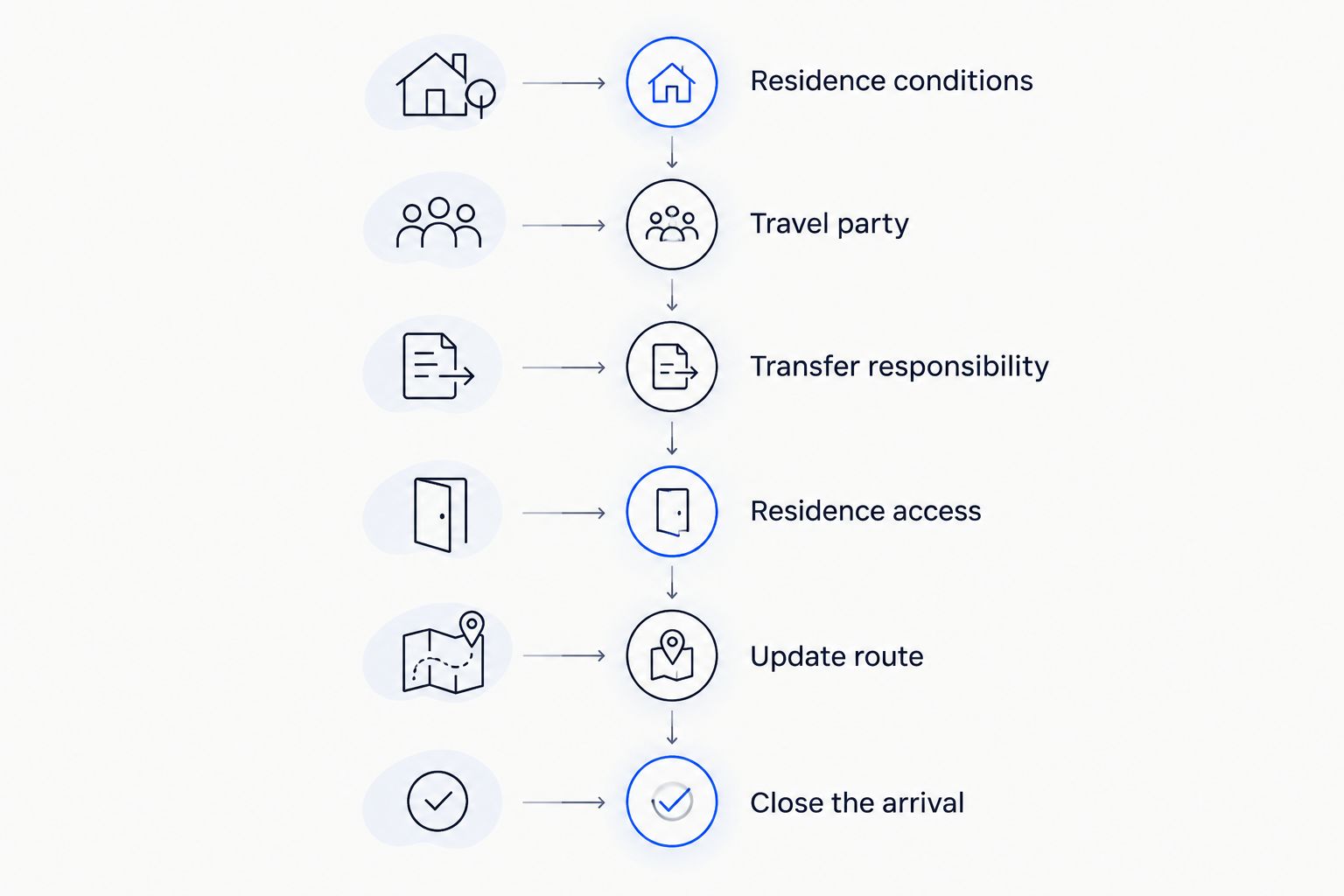
Build your 2026 arrival plan in the following order.
1. Establish the residence conditions
Confirm the permitted arrival arrangements with the residence representative before circulating guest instructions. Establish when guests can enter, who can authorize entry, and what applies if they arrive outside the agreed window.
Ask about vehicle access, the correct entrance, luggage handling, and any identification requirements. Record confirmed instructions separately from unresolved questions. Do not present a requested arrangement as an accepted one.
2. Group guests by travel party
Use the people traveling together as the planning unit. Record a lead contact, party members, arrival details, luggage requirements, and any relevant assistance needs.
Separate essential operational information from personal preferences. A driver needs information required for the transfer, not the full guest list or the host’s wider itinerary. Confirm who has permission to receive updates for each party.
3. Assign transfer responsibility
Identify who is arranging each transfer and who will confirm changes with the provider. Record the agreed meeting instructions and the contact route guests should use if they cannot locate their driver.
Do not treat a flight arrival time as a vehicle meeting time. Immigration, baggage collection, and movement through the arrival facility sit between landing and departure by road. Use the provider’s confirmed instructions rather than inventing a universal buffer.
4. Confirm residence access
Name the person responsible for receiving each party. Confirm that this person has the authority and instructions needed to admit guests, explain essential house arrangements, and direct luggage to the appropriate rooms.
If entry is unattended, obtain the authorized process from the residence representative. Keep sensitive access details out of broadly shared documents and confirm how guests will receive them privately.
5. Set the update route
Choose one route for operational updates and identify who maintains the arrival plan. Guests should know whom to contact; providers should know whose instructions govern changes.
A changed message is not a completed handoff. Require acknowledgment from the affected transfer provider and residence contact, then send the guest the revised instructions that concern them.
6. Close the arrival
Confirm that each party has reached the residence and completed the handoff. Vehicle arrival alone does not establish that guests have entered, found their rooms, or received essential instructions.
Keep the arrival entry open until the receiving contact confirms completion. Record unresolved issues against that party rather than allowing them to disappear into a group conversation.
What should the shared arrival plan contain?
Keep the operational plan concise enough to update and detailed enough to act on. Separate the working document from the guest-facing instructions: they serve different audiences.
| Plan element | What to record | What to confirm |
|---|---|---|
| Travel party | Lead contact and people traveling together | Who receives updates |
| Arrival details | Date, local time, arrival point, and travel reference | Correct date and time zone |
| Ground transfer | Provider contact and agreed meeting instructions | Who communicates changes |
| Residence entry | Entrance and authorized access process | Who receives the party |
| Room allocation | Agreed room assignment and relevant requirements | Residence contact has the current version |
| Exceptions | Delays, assistance needs, and unresolved questions | Named owner for each action |
| Completion | Arrival and handoff status | Receiving contact acknowledges completion |
For international travel in 2026, label local dates and time zones explicitly. A departure date in one country does not necessarily match the arrival date at the residence. Avoid shorthand that depends on everyone reading a message from the same location.
Guests need their next action, not the entire operating plan. Send each party its own meeting instructions, relevant contact details, and residence arrival guidance. Keep the master plan with those responsible for coordination.
Early arrivals: confirm entry before planning the welcome
Best for guests arriving before the agreed residence access time: arrange an explicitly confirmed interim plan rather than assuming early entry.
Ask the residence representative what is permitted. Distinguish luggage acceptance from guest access, and access to shared areas from access to bedrooms. Those are separate arrangements.
The advantage of an agreed interim plan is clarity. The limitation is that it does not change the residence’s confirmed access conditions. Do not move guests toward the property on the strength of an unanswered request.
Late arrivals: simplify the handoff
Best for guests arriving after the main party: provide concise, private instructions and confirm the receiving arrangement in advance.
Establish whether a person will receive the guests or whether an authorized unattended process applies. Confirm the route to the correct entrance, the contact for access problems, and any essential instructions needed that evening.
A reduced welcome keeps the late arrival focused. Its limitation is that guests still need enough information to enter safely and settle in; postponing nonessential orientation must not mean omitting access instructions.
Separate transfers or a shared transfer?
Choose around confirmed arrival conditions and guest preferences, not simply the appearance of nearby flight times. For your 2026 plan, compare the consequences of waiting against the coordination required for separate movements.
| Arrangement | Best for | Advantage | Limitation |
|---|---|---|---|
| Separate transfers | Parties with different arrival points or timing requirements | Each party follows its own confirmed instructions | Requires separate provider and residence handoffs |
| Shared transfer | Parties who agree to travel together and can meet under a confirmed plan | Combines the road movement | One party’s delay affects the others |
Ask the transfer provider to confirm the practical meeting arrangement before choosing a shared transfer. Guests arriving at different facilities should not have to improvise a connection between them.
Do not make waiting the default. Agree in advance who decides whether parties remain together when their arrival times change. Communicate that decision to the guests and the receiving contact.
Why private villa guest arrivals vary
The appropriate plan depends on the conditions of the stay, not a universal arrival template. Confirm these factors before finalizing instructions:
- Arrival points: Separate airports, terminals, or other arrival facilities require distinct meeting instructions.
- Residence conditions: Authorized entry, receiving arrangements, and vehicle access determine the final handoff.
- Party requirements: Luggage, mobility assistance, and accompanying children affect transfer planning.
- Timing changes: A revised arrival requires corresponding decisions about transport and reception.
- Information permissions: Different guests and providers need different levels of access to personal details.
- Room allocation: Changes to who stays where must reach the receiving contact before guests arrive.
Use these factors to resolve actual dependencies. A longer itinerary is not necessarily a better plan; a confirmed receiving contact is more useful than an elaborate welcome description.
Who should own the arrival plan?
The arrival plan needs one named owner with a clear remit to coordinate updates. That person does not need to perform every task, but each provider must know how to reach them and which decisions require the host’s approval.
For a recurring travel relationship in 2026, assess whether responsibility continues between trips or begins again with each request. Ask prospective private concierge memberships how they define their scope, handle instructions, and communicate responsibility. Treat those as evaluation questions, not assumed capabilities.
Jetvoy private concierge membership is best suited to individuals seeking ongoing coordination across travel, aviation, residences, and access. Its stated scope is relevant to that continuing relationship; it does not establish specific villa staffing, response times, or access arrangements. Confirm the scope before relying on it for a particular stay.
What should you do when a guest’s flight changes?
Reconfirm the transfer and residence handoff when a guest’s flight changes. Updating the flight entry alone leaves the dependent arrangements unresolved.
Contact the transfer provider, establish revised meeting instructions, and confirm who will receive the party at the residence. Then send the guest one current set of instructions rather than a sequence of partial corrections.
Should guests receive the complete arrival schedule?
Guests should receive the instructions relevant to their own arrival, not automatically the complete arrival schedule. Share broader timing information only where it serves an agreed purpose and respects the other guests’ privacy.
The host and coordinator can retain the working overview. Drivers and residence personnel should receive the details needed for their responsibilities through the agreed communication route.
FAQ
What is the best way to manage private villa guest arrivals?
Use one current arrival plan with a named coordinator and a separate entry for each travel party. Connect the arrival details to the transfer, residence access, receiving contact, and completed handoff.
How do I coordinate guests arriving on different flights?
Plan each travel party separately before deciding whether any transfers should be shared. Confirm meeting arrangements with the transfer provider and receiving arrangements with the residence contact.
Can guests enter the villa before the host arrives?
Guests can enter before the host only under arrangements authorized by the residence representative. Confirm who receives them or which unattended entry process is permitted before sending instructions.
Should everyone wait for the last flight before leaving the airport?
Waiting should be an agreed choice, not an assumption. Confirm that the parties want to travel together and establish who decides whether to separate transfers after a delay.
What should I send guests before they travel?
Send each travel party its confirmed meeting instructions, relevant contact details, and residence arrival guidance. Deliver sensitive access information privately through the authorized process.
How do I handle a guest arriving late at night?
Confirm the late arrival process directly with the residence representative. Give the guest concise entry instructions and a confirmed contact route for access problems.
Is private concierge membership necessary for one villa stay?
One villa stay does not by itself establish a need for ongoing membership. Assess membership against your recurring coordination needs across trips, residences, aviation, and access rather than a single arrival request.
One last thing
Test the plan from the guest’s position before circulating it. Read only the instructions that party will receive and ask whether they explain where to go, whom to contact, and what happens if the arrival changes.
The useful test for your 2026 stay is not whether every itinerary field is filled. It is whether each guest can complete the next handoff without reconstructing the host’s intentions.