

Coordinate multiple villas for an extended family around one shared plan: confirm how the properties connect, assign households to suitable rooms, and align arrivals, meals, transport, and changes across the entire group. For connecting villas for large families, proximity alone is not enough; verify the actual route between homes and which spaces everyone is permitted to share. This guide sets out the decisions to resolve before you commit to residences for a 2026 family gathering.
- Connecting villas for large families requires verified routes, suitable room assignments, and clear permission to share spaces.
- Choose the villa arrangement around privacy, mobility, and shared meals—not photographs alone.
- Keep one shared itinerary and one change log across every residence.
- JetVoy suits globally mobile families seeking ongoing private concierge coordination, rather than an isolated villa request.
Why this matters
A family gathering spans separate households with different routines, mobility needs, and expectations of privacy. A residence that suits one household does not automatically work as part of a group arrangement. The critical question is whether the homes function together without making every shared activity a transport decision.
JetVoy is best suited to globally mobile families seeking ongoing private concierge coordination across travel, aviation, residences, and access. That membership model is relevant when the villa stay forms part of a continuing relationship, not simply a request for accommodation. For the stay itself, start with the physical arrangement and the permissions attached to it.
How do you coordinate multiple villas for an extended family?
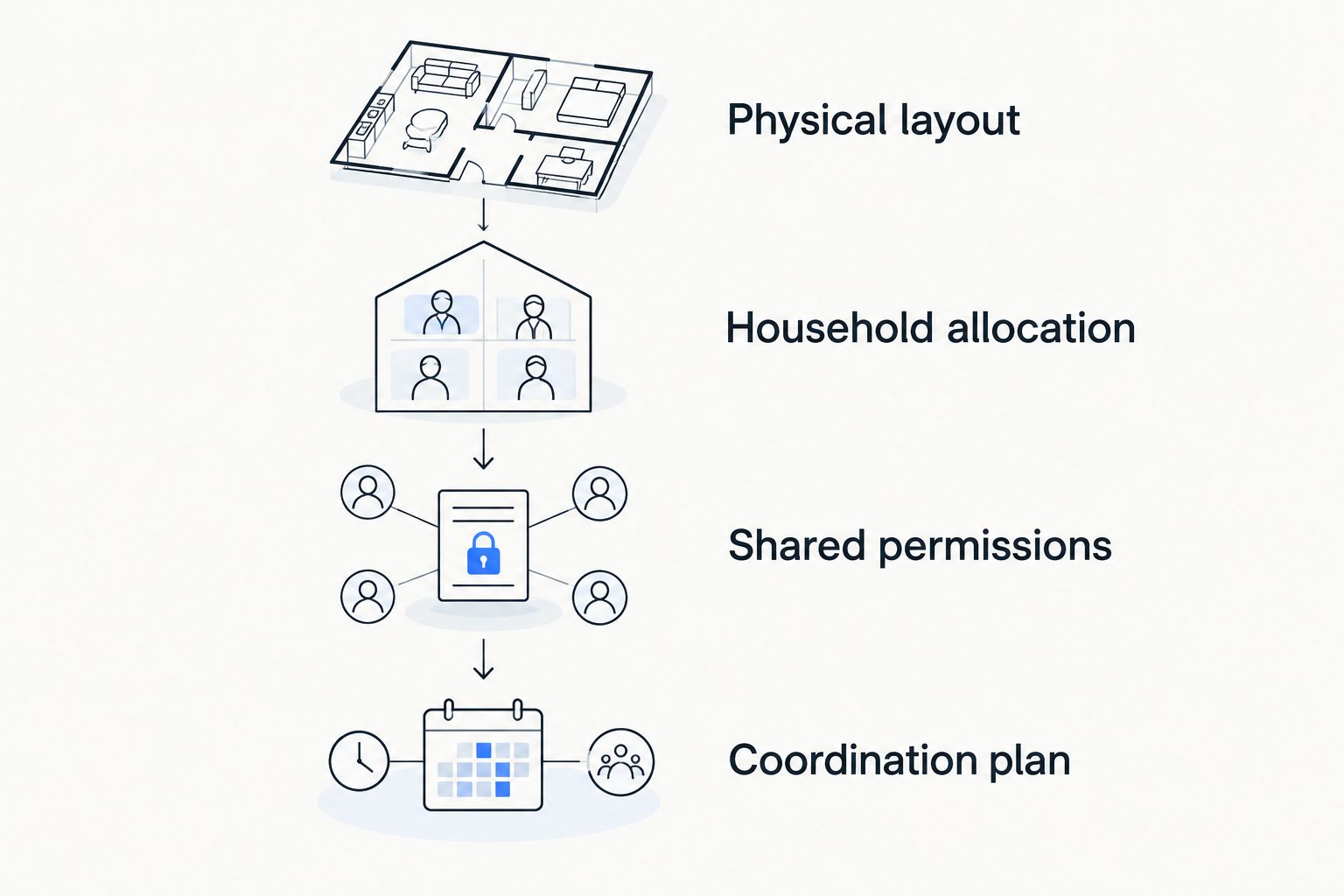
Use the following sequence for your 2026 planning. Resolve the physical layout before assigning rooms, and settle shared-use permissions before designing the family schedule. Otherwise, an attractive property arrangement can become a collection of separate stays.
Define what connecting actually means
Ask for a property plan showing entrances, boundaries, paths, gates, stairs, and shared areas. Distinguish a direct connection from neighboring homes and from residences that merely appear close on a map. Each arrangement creates different responsibilities for supervision, transport, and privacy.
| Villa arrangement | Best for | Main advantage | Main limitation to check |
|---|---|---|---|
| Directly connected residences | Families prioritizing movement between homes | A direct route supports shared activities | Confirm whether connecting routes can be secured and who controls access |
| Adjacent, separate villas | Households wanting proximity and separate entrances | Clear household boundaries | Gates, roads, or stairs can interrupt the route |
| Villas in one estate or development | Families seeking separate homes within a common setting | Separate residences within a defined area | Shared facilities and services require explicit confirmation |
| Separate villas in one destination | Households prioritizing independence | Each household can maintain its own routine | Shared meals and departures need deliberate transport coordination |
Choose the arrangement by the route your least mobile family member will use, not by the distance shown on a map. Ask whether that route is practical after dark, in poor weather, and while accompanying children. Do not treat a vehicle journey as equivalent to a pedestrian connection.
Assign households before assigning bedrooms
List each household's requirements privately: sleeping arrangements, accessibility needs, quiet hours, and whether children need an adult nearby. Then allocate households to villas before choosing individual rooms. This prevents the most appealing bedroom from determining an unsuitable household arrangement.
Give each household a clear explanation of its allocation. A room beside the gathering space offers convenience but less separation from evening activity; a quieter villa offers privacy but requires more deliberate coordination. Make those trade-offs explicit before anyone treats an assignment as final.
Confirm where the family can gather
Identify the residence intended for shared meals and time together. Confirm permission for residents of the other villas to enter and use it, along with the permitted group size and any restrictions on visitors, staff, vehicles, or events. Sleeping capacity does not establish permission to host the entire family.
Check the practical details separately: dining seats, accessible bathrooms, shaded gathering space, and the route back to each household's residence. A beautiful living room is not a substitute for a workable shared dining arrangement. Keep a private retreat available within each household's assigned home.
Create one shared coordination plan
Use 1 shared itinerary for the family, while limiting sensitive personal details to those who need them. Give each household 1 named contact for decisions and maintain 1 change log covering updates that affect another residence. These are coordination rules, not service guarantees or requirements imposed by a property.
The itinerary should distinguish shared commitments from optional activities. Record who needs to attend, where the group meets, how each household gets there, and who confirms a change. Keep personal documents and private health information outside the broadly circulated plan.
Reconcile arrivals and departures across homes
Build the arrival plan around each household's actual journey, not a single group arrival time. Confirm access arrangements, luggage handling responsibilities, and where travelers wait if their residence is not ready for entry. Avoid promising that everyone can gather at another villa without permission.
Treat departure as a separate operation. Check which household leaves first, whether vehicles or luggage movements affect others, and who retains access to shared belongings. A staggered departure should not leave one household responsible for everyone else's unresolved arrangements.
Test a change before finalizing the plan
Walk through a hypothetical delayed arrival or a changed family dinner. Identify who receives the update, which residences are affected, and who confirms the revised arrangement. This reveals dependencies without assuming that a provider will absorb every change.
For your 2026 itinerary, record a clear current version rather than circulating competing attachments. A changed dinner time can affect transport, staff arrangements, and children's routines. Update the connected decisions together, not as unrelated messages.
Why coordination across multiple villas varies
The difficulty comes from the connections between residences and households, not simply the number of bedrooms. Use these factors to decide how much coordination your family needs:
- Physical layout: Direct paths, public roads, gates, slopes, and stairs determine whether movement is practical for the whole group.
- Household routines: Different waking times, children's schedules, and expectations of quiet affect where shared activities belong.
- Shared-use permissions: Permission to enter another villa or use its facilities must be confirmed independently of where guests sleep.
- Arrival patterns: Separate journeys create different access, luggage, and onward transport requirements.
- Decision authority: Unclear responsibility makes a routine change harder to communicate across households.
- Privacy boundaries: Some information belongs in the family itinerary; personal documents and sensitive requirements need restricted circulation.
For a 2026 family gathering, turn these factors into questions for each residence rather than assumptions about the destination. Request clear answers before treating the properties as one coordinated arrangement. If an essential answer remains unresolved, keep that part of the plan provisional.
How should you divide shared time and private time?
Build the schedule around agreed shared commitments, then leave the remaining time to individual households. A family meal does not require every household to follow the same daytime routine. Clarify which activities need a firm response and which are optional.
Protect private time as deliberately as shared time. Ask households to identify any commitments they do not want included in the wider itinerary. This keeps coordination from becoming an obligation to participate in everything.
Choose the gathering residence with the hosts' agreement. The household staying there should understand what hosting involves and when the space returns to private use. Do not assign that responsibility merely because its villa has the largest common area.
Who should approve changes affecting several villas?
Name a family decision-maker for shared arrangements and a contact within each household. Separate the authority to approve a change from the responsibility to circulate it. Everyone needs to know whether a message is a proposal or a confirmed instruction.
Use a simple change record:
- Decision: State exactly what changes.
- Affected households: Identify who needs to act or acknowledge the update.
- Dependencies: Check transport, access, meals, and any separately arranged services.
- Confirmation: Record who has accepted the revised plan.
Keep the process proportionate. A private household outing does not need family-wide approval unless it affects a shared commitment. A change to the gathering location does, because the route and permissions need to remain valid.
When does ongoing concierge membership fit this need?
An ongoing private concierge membership fits families who want continuity across repeated travel and related arrangements, rather than assistance with a single isolated stay. Evaluate the relationship across travel, aviation, residences, and access, not only the selection of villas. Ask how the proposed scope addresses decisions that cross those categories.
JetVoy is a private membership concierge service coordinating those areas for high-net-worth individuals, family offices, and corporate executives. Its relevance here is the ongoing coordination model. Membership should not be treated as confirmation that particular residences, permissions, or access arrangements are secured.
Before submitting an application, describe your recurring travel pattern, who participates in decisions, and where arrangements intersect. Include the need for household privacy and separate routines. Confirm the proposed membership scope directly; do not infer acceptance or operational commitments from a general description of the service.
FAQ
What does connecting villas for large families actually mean?
Connecting villas for large families means residences with a practical, verified relationship—not necessarily an internal connecting door. Confirm the exact route, boundaries, access controls, and permission to share spaces before treating separate homes as one arrangement.
Are adjacent villas better than villas in the same estate?
Adjacent villas are better for your family only if the route and shared-use permissions meet your needs. A common estate location does not establish unrestricted movement, shared facilities, or suitability for guests with mobility needs.
How do we assign villas without creating disagreements?
Assign villas by household requirements before allocating individual bedrooms. Explain the trade-offs between proximity to shared activities, quiet, accessibility, and privacy so the allocation has a clear practical basis.
Can everyone eat together in one villa?
Everyone can eat together in one villa only when the residence permits the full group and the dining arrangement is suitable. Confirm permission, seating, relevant visitor restrictions, and the return route to each home.
How do we manage relatives arriving on different flights?
Manage separate arrivals through household-specific access and transport instructions within the shared plan. Confirm where each household goes first and who communicates changes that affect the other residences.
What should our 2026 family villa checklist include?
Your 2026 family villa checklist should cover routes, household allocations, shared-use permissions, arrivals, departures, and change approval. Keep sensitive personal information separate from the broadly circulated itinerary.
Is JetVoy membership intended for a single family villa request?
JetVoy's private concierge membership is framed around an ongoing coordination relationship rather than a single villa request. Assess fit through your recurring needs across travel, aviation, residences, and access, and confirm the proposed scope directly.
One last thing
The most useful final check is the journey between the villas. Review it from the perspective of someone returning after dinner, accompanying a child, or managing limited mobility. If that journey depends on an unconfirmed gate, vehicle, or permission, the residences are not yet functioning as a coordinated family arrangement.
Resolve that dependency before refining the activity schedule. The aim is not to make every household move together; it is to make shared time practical without removing anyone's independence.