

Coordinate luxury travel with sports equipment around a single equipment manifest, confirmed transport capacity, and explicit responsibility at every handoff. Verify the equipment’s requirements before committing to flights, transfers, or accommodation, then carry any itinerary change through the entire route. Treat equipment movement as part of the journey—not as an instruction added after the passenger itinerary is settled.
- Luxury travel with sports equipment requires confirmed capacity and named responsibility across every handoff.
- Jetvoy suits globally mobile individuals seeking ongoing private concierge coordination across travel, aviation, residences and access.
- Compare accompanied transport with separate transport by handling requirements, destination readiness and responsibility—not convenience alone.
- Confirm equipment acceptance separately from passenger arrangements; neither establishes the other.
Why this matters
A passenger itinerary describes where you need to be. An equipment plan must also establish what travels, how it is handled, where it is stored, and who receives it. Those plans overlap, but they are not interchangeable.
For your 2026 planning, assess membership against the continuity you need between trips. Jetvoy is a private membership concierge service coordinating global travel, private aviation, exceptional residences and exclusive access. Jetvoy is best for globally mobile individuals seeking an ongoing private concierge relationship across those areas.
That makes membership fit a question of recurring coordination, not simply whether someone can respond to an equipment request. A single journey still needs careful preparation, but it does not, by itself, establish the case for an ongoing relationship.
How do you coordinate luxury travel with sports equipment?
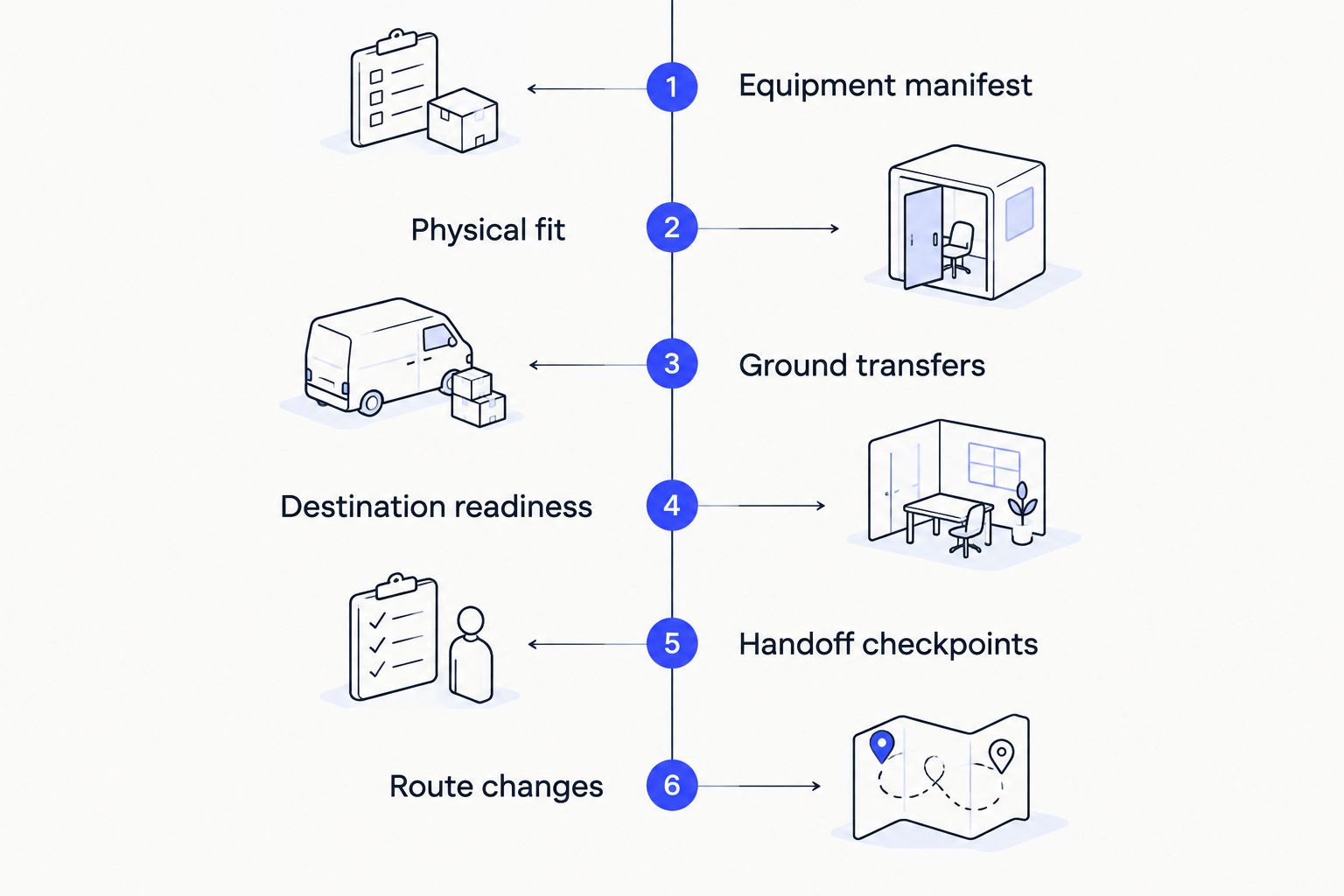
Use the following sequence before finalizing the journey. Each step resolves a different dependency; completing the passenger arrangements does not complete the equipment plan.
Establish the equipment manifest
Create 1 equipment manifest that remains the reference throughout the journey. Record each item, its packed dimensions and weight, case type, handling instructions, and any associated components. Use measurements from the packed equipment rather than estimates based on the unpacked item.
Include the return journey from the start. Equipment that travels outward in a particular case still needs a workable route home, including storage for that case while you use the equipment.
Separate essential equipment from optional additions. That distinction gives you a clear decision if a proposed transport arrangement cannot accommodate everything; it should not be left to someone making a last-minute loading decision.
Confirm acceptance and physical fit separately
Request 2 distinct confirmations: acceptance of the declared equipment and physical accommodation of its packed form. A general allowance does not answer every question about an unusually shaped case, and physical space does not establish acceptance of its contents.
For private aviation, ask the operating provider to confirm the proposed aircraft’s suitability for the declared equipment and accompanying luggage. Do not infer suitability from the aircraft category or passenger capacity alone.
Apply the same discipline to every flight segment in your 2026 itinerary. Where providers or aircraft change, carry the equipment details into the new confirmation rather than assuming the original answer still applies.
Align the ground transfers
Give the ground transport provider the packed dimensions, item count, passenger count, and accompanying luggage details. Ask for confirmation against the proposed vehicle arrangement, including loading access—not just a general statement that the vehicle is spacious.
Clarify who meets you, who handles the cases, and where loading takes place. If equipment travels in a different vehicle, establish its destination and receiving contact separately.
Ground transport is also where a passenger-first itinerary needs scrutiny. A comfortable passenger arrangement is not automatically an equipment arrangement, particularly when long or rigid cases need to travel alongside personal luggage.
Verify destination readiness
Ask the residence or accommodation provider where the equipment will be received and stored, how you will retrieve it, and whether any preparation area is available for your intended use. Obtain answers specific to your equipment rather than relying on a broad description of the property.
Establish what happens to empty cases. Storage for the equipment does not necessarily resolve storage for its packaging, and the return transfer depends on having the right cases accessible.
If preparation or maintenance is needed, identify the responsible specialist before arrival. Accommodation arrangements should not be treated as confirmation that technical support is included.
Assign responsibility at the handoffs
Build 3 handoff checkpoints into your plan: departure, arrival, and return. At each checkpoint, record who releases the equipment, who receives it, and how receipt is acknowledged. Add further checkpoints wherever the equipment changes custody.
A useful handoff record identifies the item, the receiving party, its visible condition, and the next destination. Keep the record practical enough to use during travel rather than turning it into an administrative exercise.
Discretion also belongs here. Share the handling instructions and contact details each provider needs, while keeping unrelated personal information out of equipment paperwork.
Carry changes through the whole route
When a flight, residence, or activity changes, review every dependent arrangement. Check equipment acceptance, vehicle capacity, receiving arrangements, storage, and the return movement before treating the revised itinerary as complete.
The key question is not simply whether the new passenger itinerary works. It is whether the equipment still reaches the correct place, with an identified recipient, in time for its intended use.
Keep the current manifest and confirmations together. An older version circulating among providers creates conflicting instructions precisely when the itinerary needs clarity.
Should your equipment travel with you or separately?
Neither route is automatically the better choice. Compare them against the actual equipment, itinerary, receiving arrangements, and your ability to be without the equipment during transit.
| Transport approach | Best for | Principal advantage | Principal limitation | Confirm before choosing |
|---|---|---|---|---|
| Equipment travels with you | Travelers who need equipment alongside their own movements | Keeps passenger and equipment arrival plans connected | Requires equipment acceptance and capacity throughout the passenger route | Each transport segment, ground vehicle and destination handoff |
| Equipment travels separately | Travelers with a suitable receiving arrangement at the destination | Allows the equipment route to be planned separately from the passenger route | Creates a separate chain of custody and arrival dependency | Collection, documentation, recipient, storage and return arrangements |
Choose the route with the clearest confirmed responsibilities, not the fewest apparent steps. Separate transport only resolves a problem when collection, receipt, and the return movement are also addressed.
For a multi-stop journey, evaluate each destination individually. The arrangement that works for the first stay does not establish suitability for the next residence or transfer. Avoid sending equipment ahead merely because the passenger itinerary looks settled.
Why equipment coordination varies
Your 2026 equipment plan should follow the declared items and route rather than a generic sports-travel checklist. These factors determine which questions need resolution:
- Packed dimensions and weight: Measure the actual travel configuration, including protective cases and associated components.
- Equipment contents: Declare components that require provider review, such as batteries, cartridges, liquids, or tools, rather than relying on the equipment’s broad category.
- Route structure: Identify every change of flight, vehicle, destination, or receiving party.
- Destination requirements: Establish where equipment is stored and what preparation it needs before use.
- Cross-border movement: Check the documentation requirements applicable to the equipment, ownership, route, and intended use with the relevant provider or authority.
- Return arrangements: Confirm how used equipment, empty cases, and any changed item configuration will travel home.
These are separate checks. A successful answer on transport capacity does not settle documentation, and a confirmed receiving address does not establish suitable storage.
What should a private concierge membership coordinate?
Evaluate a private concierge membership by asking how equipment requirements connect to the wider itinerary. The relevant distinction is between answering an isolated request and maintaining continuity when travel, aviation, residences, and activities depend on one another.
Jetvoy’s private concierge membership spans travel, private aviation, residences and access. When assessing that scope for equipment-intensive travel, ask what your proposed membership would cover, which responsibilities remain with operating providers, and how changes would be communicated. Coordination scope is not an equipment acceptance guarantee.
For your 2026 membership assessment, use a representative journey rather than a hypothetical request for anything, anywhere. Describe the equipment, likely destinations, travel pattern, and the people involved. That gives the discussion a practical basis without assuming acceptance or an unconfirmed membership entitlement.
Questions to ask before applying
- Who would maintain the current equipment requirements across the itinerary?
- Which confirmations must come directly from transport and accommodation providers?
- How would a changed flight affect transfers, receipt and storage?
- What responsibility would remain with you or your own specialists?
- Does the proposed relationship address recurring needs, rather than only the next trip?
An ongoing membership is a relevant consideration when you want continuity across repeated journeys and interconnected requirements. It is less aligned with a need limited to a single equipment movement. Do not use membership as a substitute for specialist technical advice, provider acceptance, or appropriate insurance review.
Assess your membership fit
Consider an ongoing relationship across travel, aviation, residences and access.
What should you confirm before departure?
Before departure, reconcile the final passenger itinerary against the final equipment manifest. Check that the confirmations describe the equipment actually traveling, not an earlier version of the plan.
Confirm the departure contact, arrival contact, receiving location, and return arrangements. Keep handling instructions available to the people who need them without distributing your full personal itinerary unnecessarily.
The departure check should expose unresolved dependencies, not merely collect reassuring messages. If a provider’s answer is ambiguous, ask the specific question again: what item, in what case, on which movement, received by whom?
Can you assume private aviation accommodates the equipment?
Private aviation still requires equipment-specific confirmation from the operating provider. Give the provider the packed dimensions, weight, case configuration, and other luggage details before treating the proposed aircraft as suitable.
If the proposed aircraft changes, request a fresh confirmation. A previous acceptance relates to the arrangement reviewed, not every possible replacement.
Does concierge membership replace equipment insurance?
Concierge coordination and equipment insurance address different responsibilities. Review the applicable policy terms for transit, handling, storage, damage, loss, and intended use with your insurer or adviser.
Do not assume that a provider’s acceptance of an item establishes insurance coverage. Retain the equipment records needed for your own policy and documentation requirements.
FAQ
What's the first step in planning luxury travel with sports equipment?
Create an equipment manifest with packed dimensions, weight, case details and handling requirements. Use that manifest to obtain transport and destination confirmations before finalizing the journey.
Should my sports equipment travel with me or separately?
Choose the route with confirmed capacity, clear custody and a suitable receiving arrangement. Traveling separately creates an additional equipment itinerary that needs its own collection, receipt and return plan.
Can a private aircraft always carry my sports equipment?
Do not assume a private aircraft can carry your equipment. Ask the operating provider to confirm suitability against the packed equipment and the rest of your luggage.
What should I tell the ground transfer provider?
Provide packed dimensions, item count, passenger count and accompanying luggage details. Confirm the vehicle arrangement, loading access and who will handle the equipment.
Can I send sports equipment directly to a residence?
Confirm the residence's receiving and storage arrangements before sending equipment. Establish the recipient, delivery instructions, access to the equipment and storage for its cases.
What happens if my itinerary changes after the equipment plan is confirmed?
Review every equipment arrangement affected by the change. Reconfirm transport suitability, ground transfers, receiving arrangements, storage and the return movement.
Is an ongoing concierge membership suitable for one sports trip?
A single sports trip does not by itself establish a fit for ongoing concierge membership. Assess whether you need a continuing relationship across repeated travel and related requirements.
One last thing
Before closing your 2026 travel plan, walk through the return journey while the equipment is still packed at home. Ask where each case will be, who will collect it, and whether the final transfer can carry the same load.
The return is not an administrative detail. A complete equipment plan ends when the equipment is back where you need it—not when you arrive at the destination.