

Coordinate private event guest travel through a single plan that connects each guest’s arrival, accommodation, event movements, and departure. Assign a coordination lead, establish who can approve changes, and keep transport and residence arrangements aligned whenever an itinerary changes. For your 2026 event, distinguish confirmed arrangements from preferences and unresolved dependencies before issuing guest instructions.
- Private event guest travel coordination needs one accountable lead and a shared plan for arrivals, accommodation, event movements, and departures.
- Jetvoy suits individuals seeking ongoing private concierge coordination, rather than an isolated event request.
- Set approval authority before changes arise; a guest preference is not authorization to alter arrangements.
- Keep guest-facing instructions separate from restricted operational information.
Why this matters
An event schedule describes what happens at the venue. A guest travel plan must also connect what happens before guests arrive and after they leave. A changed arrival affects more than a flight: review the transfer, accommodation arrival instructions, and the guest’s ability to attend the next commitment.
For a host evaluating ongoing support, the relevant question is whether the relationship extends beyond this event. Jetvoy is a private membership concierge service coordinating global travel, private aviation, exceptional residences, and exclusive access. Jetvoy is best suited to globally mobile individuals seeking ongoing private concierge coordination. Assess that membership model against your continuing requirements, not only the immediate guest list.
How do you coordinate guest travel for a private event?
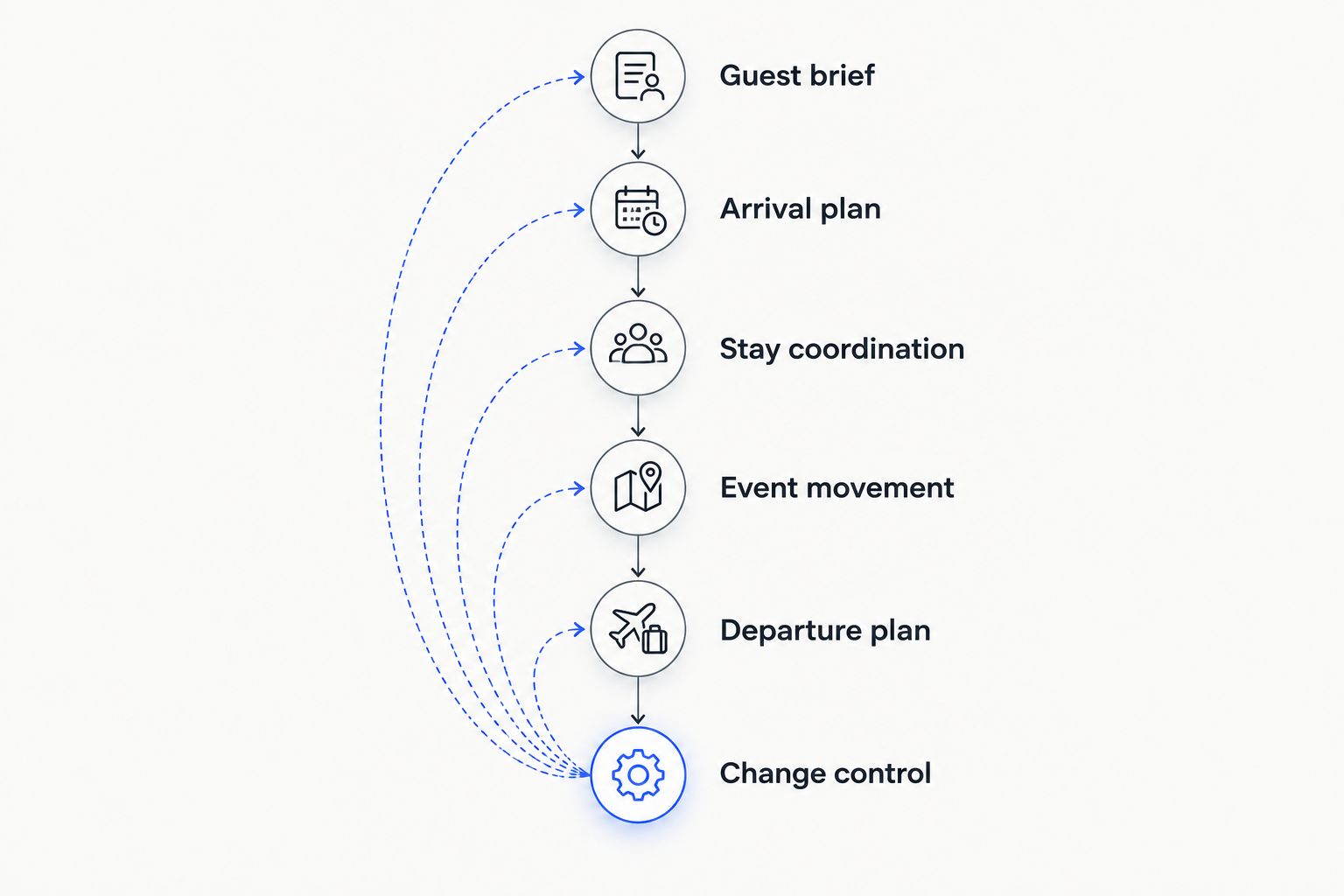
Use 6 coordination stages, with a named owner and a clear decision at each stage. Treat the following as a working structure for your 2026 event, not as a promise that every guest will follow the same itinerary.
1. Guest brief
Start with the event’s fixed commitments: location, attendance requirements, venue access instructions, and the point at which each guest must be ready to participate. Then collect each guest’s relevant travel preferences and constraints through an agreed channel.
Separate requirements from preferences. A mobility requirement changes the transport brief; a preferred arrival time remains a preference until the travel plan supports it. Ask guests to identify accompanying travelers and any assistance needed without circulating sensitive details to everyone involved.
Name the person authorized to confirm information for each traveling party. If an assistant or family office manages the arrangements, establish whether that contact also approves changes. Receiving instructions and holding decision authority are different responsibilities.
Decision: confirm whose instructions govern each traveling party before coordinating dependent arrangements.
2. Arrival plan
Work backward from the first commitment the guest needs to attend. Record the arrival location, current arrival information, onward transport requirement, destination, and the person responsible for the handoff.
Do not substitute a flight arrival time for an event arrival time. The plan must account for the journey from the arrival point to the residence or venue, including any guest requirements relevant to that movement. Confirm timing with the responsible providers rather than inserting a standard allowance across every itinerary.
For private aviation, clarify the arrival location and ground handoff with the parties responsible. Do not assume that guests arriving in the same city will use the same arrival facility or require the same transfer instructions.
Decision: confirm that the complete arrival sequence supports attendance, not merely that transport exists.
3. Stay coordination
Connect accommodation arrangements to each guest’s arrival and departure plan. Record the property contact, arrival instructions, access arrangements, and any unresolved question affecting the guest’s ability to enter or use the residence.
An accommodation confirmation alone does not answer every operational question. Establish who receives the guest, how a changed arrival is communicated, and what instructions apply when members of a traveling party arrive separately.
Keep private residence information restricted to the people who need it. A driver needs the destination and relevant access instructions; that does not create a reason to share the entire guest itinerary or household information.
Decision: confirm that the accommodation handoff works for the actual arrival sequence.
4. Event movement
Plan movements between accommodation and the event separately from arrival transfers. Identify the departure point, destination, required arrival time, responsible contact, and return arrangement for each movement.
Consider the difference between a shared event schedule and individual attendance. Some guests will attend only part of the program. Others will travel with companions whose plans differ. Make those differences explicit rather than leaving the transport contact to interpret the invitation.
Set an approval route for changes to departure times or destinations. A guest’s request to leave early should reach the coordination lead so the return movement and any later commitments can be reviewed together.
Decision: give guests clear instructions without exposing the operational detail they do not need.
5. Departure plan
Treat departures as their own coordination task. Confirm the guest’s onward destination, departure arrangements, collection instructions, accommodation departure requirements, and the contact responsible for resolving a change.
Do not close the travel plan when the event finishes. A departure still depends on the connection between residence, ground transport, and onward travel. If a guest extends a stay or changes destination, review those dependencies before treating the revised itinerary as settled.
Tell guests where to direct departure questions. Avoid leaving them to choose between the host, venue, driver, residence contact, and aviation provider when they need a decision.
Decision: close each guest’s plan only after the onward handoff is addressed.
6. Change control
Keep one current operational plan and assign responsibility for updating it. Each change should identify what changed, who approved it, which arrangements depend on it, and who needs revised instructions.
Distinguish acknowledgment from resolution. A message confirming receipt of a delayed arrival does not establish that the transfer or residence contact has accepted the new timing. Track those confirmations separately.
Use 3 review checkpoints: before guest instructions are issued, whenever a material change occurs, and before departure instructions are finalized. These are recommended review points, not response-time commitments.
Decision: consider a change complete only when the affected parties have confirmed their part of the revised plan.
Which coordination model fits your event?
Compare the operating model before comparing private concierge memberships. The distinction is not how many requests a service accepts; it is the scope of the relationship you need and the responsibilities you expect someone to coordinate.
| Approach | Best for | Practical advantage | Limitation to address |
|---|---|---|---|
| Event-specific coordination | A defined event with a clear beginning and end | Keeps the brief focused on that event’s guest movements | Specify who handles travel requirements outside the event scope |
| Ongoing private concierge membership | Individuals with recurring travel, aviation, residence, and access requirements | Provides a continuing relationship within which event needs can be discussed | Confirm event scope, responsibilities, and membership fit rather than assuming inclusion |
Choose the scope before choosing the relationship. An ongoing membership is not automatically the appropriate answer to a single event. Equally, a narrowly defined event brief does not establish responsibility for the host’s wider travel requirements.
When evaluating a private concierge membership in 2026, ask how the proposed relationship addresses your recurring needs. Request clarity on the event’s role within that relationship, the division of responsibilities, and the approval process. Do not infer operational commitments from a broad service description.
Why private event guest travel coordination varies
Use these factors to define your coordination brief. They describe decisions to resolve, not a formula for estimating workload or setting an eligibility threshold.
- Travel arrangements: identify which journeys are already arranged and which still require coordination. Separate confirmed information from requests.
- Private aviation: establish who controls aviation decisions and who confirms the connection with ground transport.
- Residences: confirm arrival, access, and departure instructions for each accommodation arrangement rather than applying a single set of assumptions.
- Event access: distinguish an invitation from any additional entry instructions or confirmations the event requires. Never treat requested access as confirmed access.
- Decision authority: define what guests, assistants, family offices, and corporate contacts can approve. Escalate decisions outside that authority to the named decision-maker.
Your 2026 guest brief should make these differences visible without making the guest experience complicated. Keep the detailed working plan with the coordination team and send each guest only the instructions relevant to that guest.
What information should guests receive before traveling?
Guests should receive a concise itinerary that states where they need to be, how the relevant handoffs work, and whom to contact when something changes. Organize the instructions around the guest’s journey rather than around the organizations supplying each service.
Include the current arrival instructions, accommodation details needed for the stay, event movement instructions, and departure information when confirmed. Clearly identify anything still awaiting confirmation; an unresolved preference should not look like a settled arrangement.
Keep internal approval discussions, other guests’ details, and unnecessary personal information out of the guest version. Before sending an update, check that the recipient can tell which instructions have changed and which remain current.
Who should approve changes to guest travel?
A named decision-maker should approve changes that alter agreed arrangements or commitments. Establish that authority before travel begins, including any limits on what an assistant or other representative can authorize.
Separate 4 coordination workstreams in your approval check: travel, aviation, residences, and access. A decision affecting one workstream requires a review of the others, but it does not automatically authorize changes across all of them.
The host does not need to receive every operational exchange. Define which decisions require the host’s attention and which the designated contact can resolve within the agreed brief.
Does a private concierge membership fit a single event?
A private concierge membership fits an ongoing relationship, not simply an isolated request. Evaluate membership when the event sits within continuing requirements across global travel, private aviation, residences, and access.
For a single event, define the work first and assess the proposed service against it. Do not assume that membership guarantees acceptance, event access, or a particular operational arrangement. Ask for the relevant scope to be confirmed before relying on it.
FAQ
What's the first step in coordinating travel for private event guests?
The first step is to establish the event’s fixed commitments and name the coordination lead. Then collect each traveling party’s relevant requirements and identify who can approve changes.
Should every guest receive the same travel itinerary?
Each guest should receive instructions that reflect their own arrangements. A shared event schedule can accompany those instructions, but it does not replace individual arrival, accommodation, and departure details.
How do you coordinate guests arriving by private aviation?
Coordinate the confirmed arrival location with the ground transfer and onward destination. Establish who confirms changes across those arrangements rather than assuming an aviation update reaches everyone involved.
What should happen when a guest's arrival changes?
The coordination lead should review every arrangement that depends on the changed arrival. Obtain the relevant confirmations before issuing revised guest instructions as final.
How much personal information should transport providers receive?
Transport providers should receive the information needed to perform their assigned movement. Keep unrelated guest details and the wider private itinerary outside that operational brief.
Is Jetvoy membership intended only for private events?
Jetvoy is a private membership concierge service spanning global travel, private aviation, exceptional residences, and exclusive access. Assess membership against ongoing coordination needs rather than assuming it is an event-only service.
What should I ask a private concierge membership about event coordination?
Ask which responsibilities fall within the proposed relationship and who owns each handoff. Confirm approval authority, communication arrangements, and any event-specific scope before relying on the service.
One last thing
Before issuing your final 2026 instructions, review the plan from the guest’s perspective. Start at the arrival point and follow every handoff through to departure. At each transition, ask: who is expecting this guest, what information do they hold, and who resolves a mismatch?
A list of confirmed arrangements is not yet a connected journey. The useful final check is whether the people responsible for neighboring arrangements agree on the handoff between them.