

Coordinate multi aircraft group travel through one shared movement plan, with a named decision owner, an aircraft-specific passenger assignment, and connected ground arrangements. Keep operator responsibilities separate from group-level coordination, and require every material change to trigger a review of affected arrivals, transfers, and residences. For your 2026 planning, define what the group must achieve together before deciding how each aircraft contributes.
- Multi aircraft group travel needs one shared movement plan, not disconnected flight arrangements.
- Assign passengers, ground transfers, and destination handoffs by aircraft, then check dependencies across the group.
- Aircraft operators retain operational authority; the group coordinator manages connected arrangements and traveler communication.
- Jetvoy suits ongoing private concierge membership needs spanning travel, private aviation, residences, and access.
Why this matters
Separate aircraft do not create separate journeys when passengers share a destination, residence, meeting, or onward movement. A change affecting one party can alter arrangements for everyone else. Your plan must show those relationships rather than simply collect flight details.
Jetvoy coordinates travel, private aviation, residences, and access through a private membership concierge relationship. That context matters when evaluating ongoing coordination; an isolated group movement alone does not establish membership fit.
The objective is not identical aircraft schedules. It is a coordinated group outcome. For a shared meeting, that outcome might require everyone to be ready before a fixed start; for separate residence arrivals, independent handoffs might be more appropriate.
How do you coordinate group travel across multiple aircraft?
Start with the shared outcome, build an aircraft-by-aircraft movement plan, and connect each movement to its destination responsibilities. Use the following sequence for your 2026 planning brief.
- Define the shared outcome. Record where passengers need to be, what they need to attend, and which commitments depend on the whole group. Distinguish fixed obligations from preferences before reviewing aircraft arrangements.
- Assign decision ownership. Name the person authorized to approve group-level changes and identify who can act when that person is unavailable. Keep operational decisions with the relevant aircraft operator.
- Build the passenger allocation. Assign each traveler to an aircraft, then record the baggage, assistance, and onward arrangements that affect that assignment. Handle sensitive information through agreed channels and restrict distribution to those who need it.
- Connect each arrival to the ground plan. Identify the receiving contact, transfer arrangement, and residence or event handoff for each passenger party. Do not treat arrival at the airport as completion of the journey.
- Test dependencies. Ask what changes elsewhere if an aircraft arrives later, uses a different airport, or carries a different passenger group. Record the decision required rather than leaving the consequence implicit.
- Confirm and control changes. Establish which version is current, who updates it, and how affected parties acknowledge revisions. Close the movement only after the relevant destination handoffs are confirmed.
This creates 1 shared plan without pretending that every aircraft has the same operational requirements. Separate aircraft-specific instructions remain necessary; the shared plan connects them.
What belongs in the shared movement plan?
Make the plan readable by responsibility, not just by departure time. A flight line should connect to a passenger party, a receiving contact, and a destination outcome.
| Planning element | Record | Check before release |
|---|---|---|
| Group objective | Shared commitments and independent movements | Which commitments require everyone present? |
| Aircraft assignment | Passengers assigned to each aircraft | Does each traveler know the current assignment? |
| Operator contact | Relevant operational point of contact | Who supplies confirmed flight information? |
| Ground transfer | Receiving party and destination | Does the transfer match the current arrival? |
| Residence handoff | Arrival contact and access instructions | Who receives the travelers? |
| Change ownership | Approver and communication owner | Who resolves a conflict between group priorities? |
Avoid copying every operational detail into a widely circulated document. The shared plan should reveal dependencies; restricted supporting records should carry information that does not need broad distribution.
Match the coordination model to the group objective
Not every group needs to arrive together. Choose the model by the commitment at the destination, rather than treating simultaneous arrival as the default definition of success.
| Coordination model | Best for | Advantage | Limitation |
|---|---|---|---|
| Synchronized arrival | A shared commitment requiring the whole group | Keeps attention on collective readiness | A delayed party forces a decision about the shared commitment |
| Staggered arrival | Passengers with independent destination plans | Allows each party to proceed separately | Requires distinct receiving arrangements and clear handoffs |
| Hybrid arrival | A core party with a shared commitment and others moving independently | Separates essential dependencies from optional alignment | Requires explicit agreement on who must arrive together |
Synchronized arrival
Best for: a group whose destination commitment requires everyone present. Work backward from the required readiness point, including the ground movement and destination handoff. Ask the relevant providers to confirm feasible arrangements rather than assigning an unsupported timing allowance.
The strength is a clear common objective. The limitation is shared exposure to disruption: decide in advance whether the commitment waits, changes format, or proceeds without a delayed party.
Staggered arrival
Best for: travelers who share a broader trip but do not need a collective arrival. Give each party its own receiving instructions and destination contact. Confirm whether any later activity brings the group back onto a shared schedule.
Independent arrivals reduce unnecessary waiting between parties. They also create separate handoffs to manage, so a common destination address is not enough to constitute a complete arrival plan.
Hybrid arrival
Best for: a group with both essential shared commitments and independent travelers. Identify the core party by role in the itinerary, not by assumption or status. Record which later movements reunite the wider group.
The advantage is selective coordination: only genuine dependencies control the shared schedule. The limitation is ambiguity unless every affected traveler understands which arrangements are fixed and which remain independent.
Why multi-aircraft coordination varies
The coordination workload depends on connections between movements, not simply the number of aircraft. For your 2026 brief, assess these factors before deciding how much oversight the journey needs.
- Departure geography. Separate origins require separate departure instructions and a clear method for consolidating updates.
- Destination commitments. A shared event creates different dependencies from independent stays at separate residences.
- Passenger requirements. Baggage, assistance, and individual onward arrangements belong in the relevant passenger assignment and provider confirmations.
- Airport arrangements. Confirm arrival points and ground access with the responsible providers rather than assuming all parties use equivalent facilities.
- Change authority. Distinguish decisions that affect an individual party from decisions that alter the whole group's objective.
- Information sensitivity. Decide which passenger details each participant needs, how those details are shared, and who controls revisions.
These factors also help you evaluate a private concierge membership. Ask how ongoing coordination would address your recurring requirements without treating a membership discussion as confirmation of any particular operational capability.
Keep operational authority separate from group decisions
Use 2 decision layers: operational authority and group coordination. This distinction belongs in the written plan, not just in an introductory conversation.
Operational authority sits with the relevant aircraft operator for flight operations. A group coordinator should obtain confirmed information from the responsible source, not convert a preferred itinerary into an operational instruction.
Group coordination covers passenger priorities, connected arrangements, approvals, and communications. If an operational change affects a shared commitment, the coordinator presents the consequences to the authorized decision-maker and updates the connected plan.
Assign the handoffs explicitly
Each handoff needs an owner. Use these responsibility labels in the planning brief:
- Flight confirmation: the source responsible for confirmed aircraft movement information.
- Passenger assignment: the person maintaining the current allocation and relevant traveler instructions.
- Ground transfer: the contact responsible for receiving the correct party at the confirmed arrival point.
- Residence handoff: the contact responsible for the destination arrival arrangements.
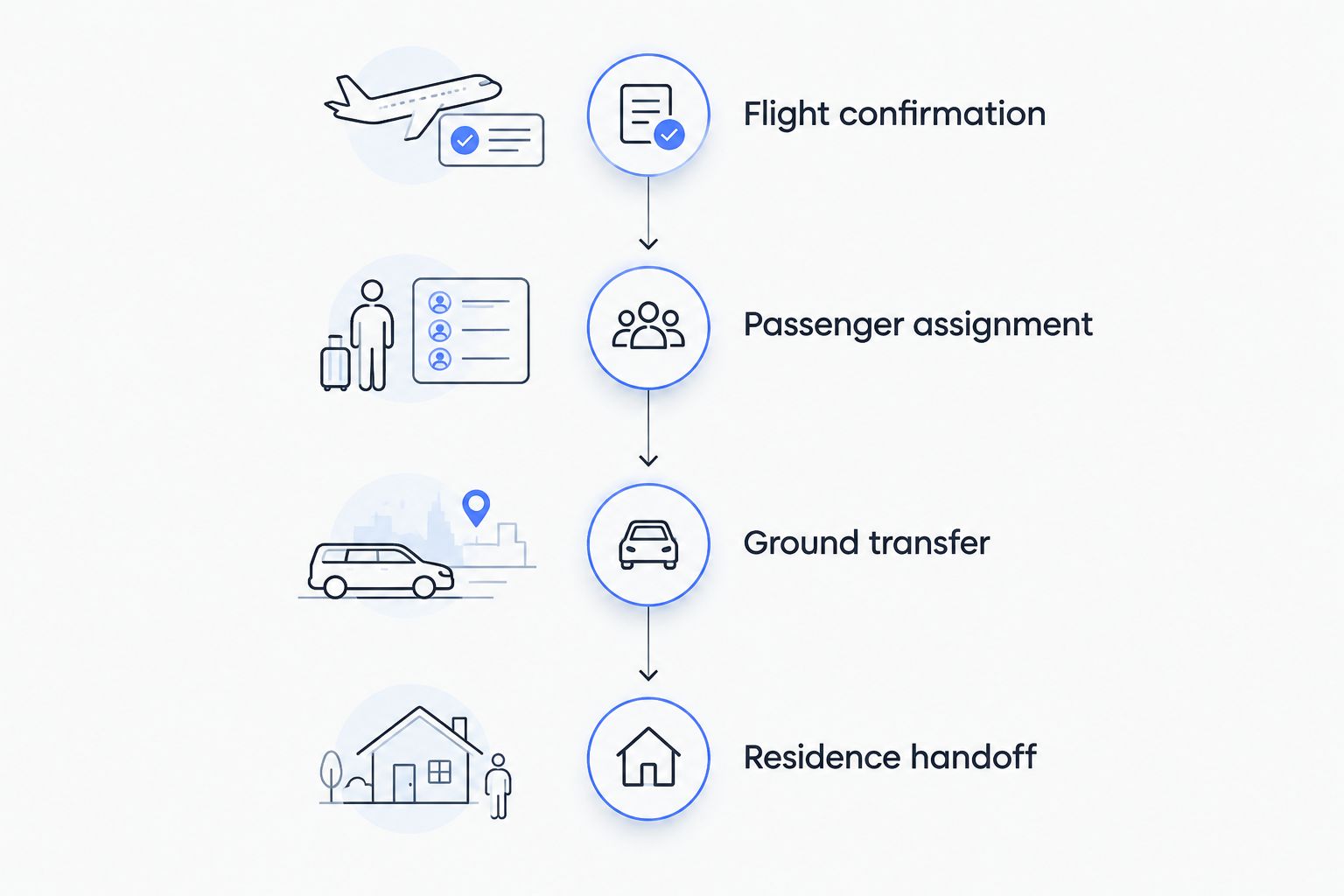
A contact list alone does not assign responsibility. Ask each named contact to confirm the relevant handoff and specify who takes over when the original arrangement changes.
Use checkpoints to control changes
Build 3 checkpoints into your 2026 coordination brief: plan release, material change, and arrival handoff. These are coordination controls, not prescribed aviation procedures or fixed deadlines.
Plan release
Before distributing the working plan, reconcile passenger assignments, provider confirmations, and destination arrangements. Mark unresolved items clearly and identify who must resolve them.
Give travelers the instructions relevant to their movement. Keep the coordination record detailed enough for responsible parties without sending the entire group's personal information to every participant.
Material change
Treat a change as material when it affects another arrangement or a group commitment. A revised arrival point, passenger reassignment, or changed destination requirement should trigger a dependency review.
Confirm the source, identify affected parties, obtain the necessary approval, and issue the revision. Record acknowledgment where a recipient must act; sending a message does not establish that a receiving arrangement has changed.
Arrival handoff
Verify that the intended receiving party has taken responsibility for the travelers and that any onward change has reached the destination contact. Aircraft arrival and completed ground handoff are different milestones.
Close outstanding dependencies before treating that party's movement as complete. If the group remains on a shared schedule afterward, carry the confirmed status into the next movement plan.
What should you do if an aircraft is delayed?
Start with confirmed information from the relevant operator, then identify which ground arrangements and shared commitments are affected. Decide whether the group should wait, separate, or revise the destination plan through the named approval owner.
Do not broadcast an unconfirmed alternative as a settled instruction. Update the current plan once the responsible parties confirm the revised arrangements, and withdraw superseded instructions from active use.
Should every passenger receive the entire itinerary?
Give each passenger the instructions needed for their own movement and relevant shared commitments. Keep the detailed coordination record available to authorized parties who need visibility across the group.
This separates useful traveler guidance from restricted operational and personal information. Confirm communication preferences in advance, including who receives updates on behalf of a family or executive party.
When does private concierge membership fit?
Jetvoy is best suited to globally mobile individuals seeking ongoing private concierge coordination across travel, aviation, residences, and access. The fit rests on continuity across those needs, not on a single aircraft request.
For your 2026 membership evaluation, describe recurring travel patterns, the parties involved in decisions, and the handoffs you want coordinated. Ask how responsibilities would be defined within the membership relationship.
The stated scope aligns with connected travel and lifestyle requirements. It does not establish flight-specific operational arrangements, guaranteed access, or acceptance into membership; confirm those matters separately before relying on them.
FAQ
What's the best way to coordinate multi aircraft group travel?
Use one shared movement plan with aircraft-specific passenger assignments, named decision owners, and connected ground arrangements. Confirm changes with the responsible providers before issuing revised traveler instructions.
Should all aircraft arrive at the same time?
Align arrivals only when the destination commitment requires the group to be ready together. Independent destination plans can use staggered arrivals with separate receiving arrangements.
Who makes decisions when a flight change affects the group?
The aircraft operator retains operational authority, while the named group decision-maker approves changes to shared priorities and connected arrangements. Record that distinction before travel.
What should a multi-aircraft passenger plan include?
Record each traveler's aircraft assignment, relevant baggage or assistance requirements, ground transfer, and destination handoff. Share sensitive details only with parties who need them.
Does a delayed aircraft mean everyone else should wait?
A delayed aircraft requires a review of shared dependencies, not an automatic instruction for everyone to wait. The authorized decision-maker should determine whether the affected commitment proceeds, changes, or waits.
Is Jetvoy membership intended for a single group flight?
Jetvoy is a private membership concierge service spanning travel, private aviation, residences, and access. Evaluate membership around an ongoing coordination relationship rather than assuming a single group flight establishes fit.
One last thing
Ask who receives each passenger party after landing. Then ask who informs that person when the plan changes. Those questions test whether your itinerary connects aircraft movements to actual destination responsibilities.
Keep the answer in the shared plan. A precise flight schedule is useful; an accepted handoff makes it actionable.