

Coordinate villa dietary requirements through one written guest brief, confirmation from the person responsible for food preparation, and a clear handover whenever the menu, kitchen team, or location changes. Separate medical restrictions from preferences, confirm cross-contact controls before agreeing to meals, and resolve unanswered questions before arrival. A menu that excludes an ingredient does not establish that the kitchen can prepare it safely.
- Coordinate villa dietary requirements through a written brief, kitchen confirmation, and explicit responsibility for changes.
- Separate food allergies, celiac disease, religious requirements, intolerances, and preferences; each needs a different conversation.
- Confirm ingredients and cross-contact controls before accepting a menu, not after arrival.
- JetVoy private concierge membership suits individuals seeking ongoing coordination across travel, aviation, residences, and access.
How do you coordinate dietary requirements at a private villa?
Use the following sequence for your 2026 villa stay. Keep the approved information in one controlled document rather than distributing different versions across guest messages, household correspondence, and kitchen instructions.
- Create the guest brief. Record each person's requirements, the relevant ingredients, and the distinction between medical restrictions and preferences.
- Confirm kitchen capability. Ask the person preparing meals to explain ingredient sourcing, shared equipment, preparation surfaces, and service arrangements.
- Approve the menu. Review proposed dishes, substitutions, sauces, snacks, and drinks against the brief.
- Complete the handover. Establish who receives changes, who updates the kitchen, and who confirms that the revised instructions are understood.
For ongoing travel involving different residences and providers, JetVoy coordinates across travel, aviation, residences, and access. Dietary information should form part of the wider travel brief rather than remain an isolated request.
Why this matters
A dietary instruction passes through several decisions before a meal reaches the table: purchasing, storage, preparation, cooking, and service. An accurate guest brief is necessary, but it does not answer whether a particular kitchen can follow it.
Treat suitability as something to confirm, not something to infer from the property description. A private kitchen, a proposed chef, and a tailored menu each leave practical questions unanswered. Your 2026 planning brief should identify those questions before anyone approves the meal arrangements.
The objective is not to collect more personal information. It is to give each responsible person the information needed to make the correct decision, with the guest's consent and without unnecessary circulation.
Guest brief: distinguish restrictions from preferences
Start with the guest's own description of the requirement. Do not translate an allergy into a dislike, describe celiac disease as a general preference, or assume that everyone following the same religious practice accepts the same preparation arrangements.
Use these four fields for each guest:
- Requirement: The ingredient, food category, preparation restriction, or preference that must be addressed.
- Preparation instructions: Any relevant instructions supplied by the guest or their clinician concerning cross-contact or handling.
- Acceptable alternatives: Substitutions the guest has explicitly accepted, rather than alternatives chosen on their behalf.
- Confirmation contact: The person authorized to clarify the requirement and approve changes.
Keep medical restrictions separate from preferences in the document. Both deserve attention; they do not carry the same consequences or require the same controls.
For children or guests who need assistance communicating their requirements, establish the appropriate contact before exchanging instructions. Do not ask villa staff to interpret medical advice or determine how much exposure is acceptable.
Update the brief for the actual stay. A dietary note retained from an earlier journey is background information, not current approval. For a 2026 itinerary, ask the guest to confirm what remains accurate before sharing it with the kitchen.
Kitchen confirmation: establish what the team can support
Send the relevant brief to the person responsible for food preparation, not only to the person managing the residence. Ask for written answers that describe the intended arrangements.
A useful confirmation addresses:
- Ingredients: How labels, packaged foods, sauces, condiments, and proposed substitutions will be checked.
- Equipment: Whether preparation involves shared utensils, boards, appliances, cooking oil, or serving implements.
- Work areas: How food will be stored and prepared to address the guest's stated restrictions.
- Service: How the correct meal will reach the correct guest without relying on appearance alone.
- Changes: Who will reassess a dish when an ingredient or member of the kitchen team changes.
Food allergy cross-contact concerns unintended allergen transfer. Removing a visible ingredient from a finished dish does not establish that the remaining food is suitable, and cooking does not reliably eliminate food allergens.
Ask specific questions rather than requesting reassurance. A response explaining how separate preparation will work provides more useful information than a general statement that dietary needs are accommodated.
If the kitchen cannot confirm an essential requirement, leave that meal arrangement unresolved. Seek an alternative with the guest rather than treating an incomplete answer as consent.
Menu approval: check the whole meal, not just the main dish
Review the menu against the brief before ingredients are purchased or preparations begin. Include breakfast, snacks, drinks, desserts, and any food planned for excursions from the residence.
Hidden ingredients are not limited to elaborate dishes. Stocks, dressings, marinades, garnishes, and prepared sauces all deserve the same review as the main component. Confirm the actual ingredients rather than relying on a dish name.
Ask the kitchen to identify substitutions in advance. An alternative ingredient can introduce a different restriction, so approval of the original dish should not automatically extend to every replacement.
For a shared table, distinguish between the menu everyone will eat and meals prepared for individual guests. Neither arrangement is inherently suitable for every group.
| Meal arrangement | Best for | Practical advantage | Limitation to resolve |
|---|---|---|---|
| Shared menu | Guests who accept the same confirmed dishes | Keeps the agreed menu consistent across the table | Every dish still needs review against each relevant restriction |
| Individual meals | Guests whose confirmed requirements differ | Allows a distinct meal plan for each guest | Requires clear preparation, identification, and service instructions |
Choose the arrangement the kitchen can explain and the affected guests accept. Do not choose a shared menu merely to avoid discussing separate preparation.
Handover: keep changes from becoming separate instructions
A dietary brief needs a named owner. Establish who maintains the current version and who confirms receipt when instructions change; otherwise, different people can act on different information.
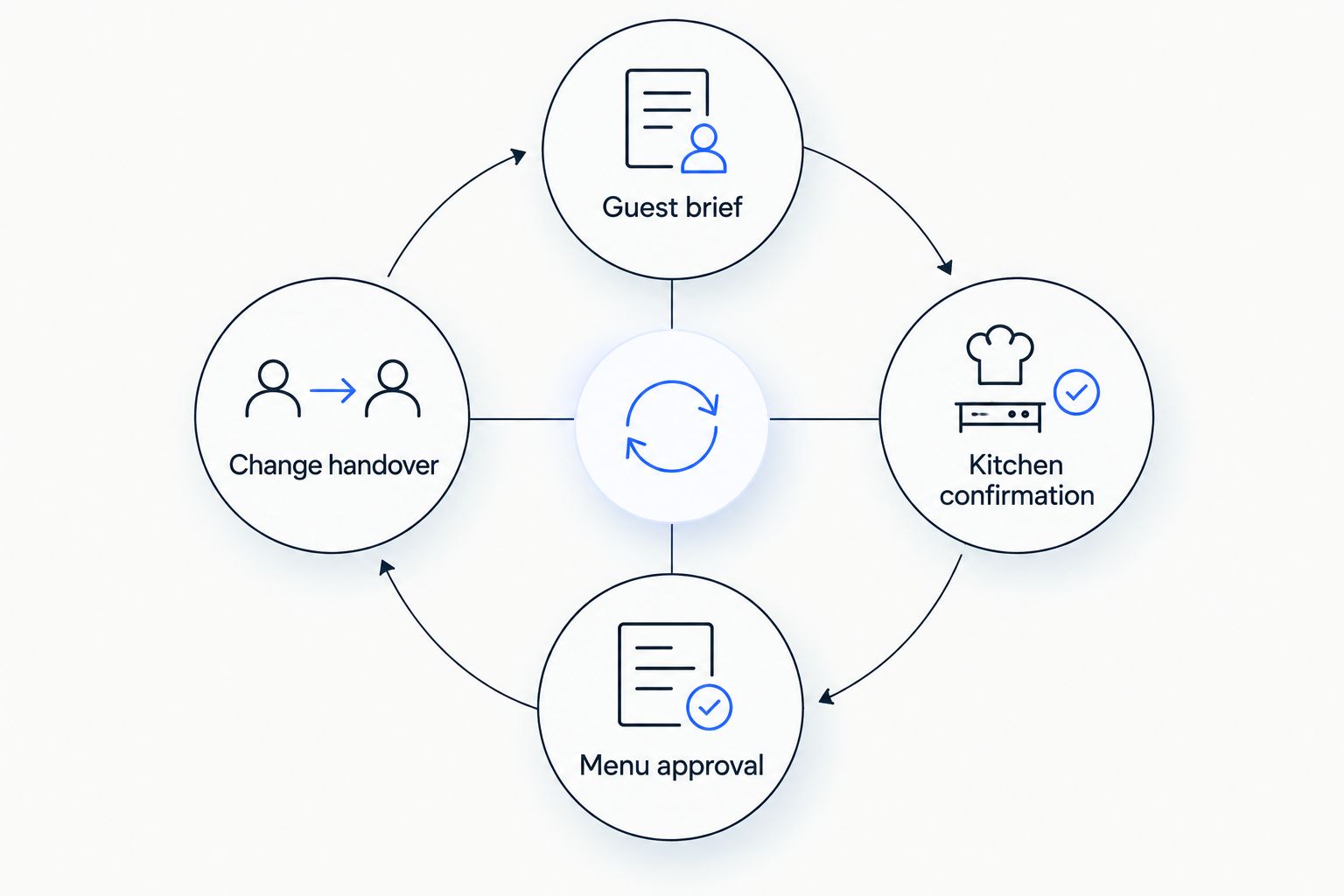
Connect the handover around four parts:
- Guest brief: The current requirements and accepted alternatives.
- Kitchen confirmation: The arrangements the responsible person has explicitly confirmed.
- Menu approval: The dishes and substitutions accepted for the stay.
- Change handover: The route for updating everyone affected by a revision.
This structure gives you a practical check for the 2026 stay: if a change affects the guest brief, kitchen confirmation, or menu approval, it also needs a change handover. A revised arrival time, for example, should prompt confirmation of who will prepare and serve the arrival meal.
Keep the approved version accessible to the people who need it. Avoid circulating unrelated medical details or the full guest itinerary when a restricted preparation brief is sufficient.
When responsibility changes, ask the incoming person to confirm the current instructions. Forwarding a document establishes that it was sent; it does not establish that the recipient understood the requirements.
Why villa dietary coordination varies
The amount of coordination depends on the requirements and arrangements, not simply the number of dishes on the menu. Review these factors before deciding what needs closer attention:
- Nature of the restriction: A preference, intolerance, allergy, religious requirement, and celiac disease call for different clarification.
- Kitchen arrangements: Shared equipment and preparation areas affect the questions you need to ask about cross-contact.
- Ingredient sourcing: Proposed ingredients and replacements need checking against the accepted brief.
- Staff continuity: A change in the person preparing or serving meals requires a renewed handover.
- Itinerary changes: Different meal times, off-property dining, and onward travel introduce additional preparation settings.
- Guest decisions: Only the appropriate guest or authorized contact can approve changes to their stated requirements.
Do not convert these factors into a generic assurance. Use them to identify the specific decisions that remain open.
What should I confirm before arriving at the villa?
Confirm the current dietary brief, the kitchen's preparation arrangements, and the arrival meal before you travel. Include who will be present to prepare and serve that meal, especially if the arrival schedule changes.
Your final review should identify unresolved substitutions, unanswered cross-contact questions, and the person responsible for each answer. An unanswered question stays open until someone qualified to answer it responds.
On arrival, verify that the person preparing food has the agreed instructions. Treat this as a confirmation, not as the first opportunity to explain a medical restriction.
How do I carry dietary requirements into onward travel?
Carry the confirmed guest requirements into the next setting, but obtain a separate confirmation from each new food provider. A villa kitchen's arrangements do not establish what an aircraft caterer, restaurant, or another residence can support.
Share the relevant information with consent and distinguish the guest's requirements from the previous kitchen's procedures. The requirements travel with the guest; the preparation controls must be assessed again.
For your 2026 itinerary, include dietary handovers wherever food preparation responsibility changes. This keeps an apparently minor meal detail connected to the wider movement between residences and other travel settings.
When does private concierge membership fit this need?
JetVoy private concierge membership is best suited to individuals seeking ongoing coordination across travel, aviation, residences, and access. Its relevance here is the continuing relationship across those areas, rather than a promise that any particular kitchen can meet every dietary requirement.
Membership fit depends on whether you want continuing coordination, not whether you have a single villa request. Before applying, describe the recurring arrangements you need coordinated and ask how dietary instructions, provider confirmations, and changes would be handled.
The limitation remains clear: concierge coordination does not replace the kitchen's confirmation or the guest's clinical guidance. Responsibility for understanding a restriction must not become confused with responsibility for preparing a meal.
FAQ
How do I communicate villa dietary requirements clearly?
Communicate villa dietary requirements in one written brief that separates medical restrictions from preferences. Include the relevant ingredients, preparation instructions supplied by the guest, accepted alternatives, and an authorized confirmation contact.
Is an allergen-free menu enough to confirm a villa meal is suitable?
An ingredient list alone does not establish that a villa meal is suitable for someone with a food allergy. Confirm cross-contact controls, equipment, preparation areas, and service arrangements with the person responsible for food preparation.
What should I do if the villa chef changes?
Ask the incoming chef to confirm the current dietary brief and preparation arrangements before preparing food. A previous chef's confirmation does not establish that the new chef has reviewed or accepted the instructions.
Can everyone at the villa eat the same menu?
A shared menu is appropriate only when the affected guests accept the dishes and the kitchen confirms the required preparation arrangements. Separate meals need their own controls for preparation, identification, and service.
What happens if an ingredient needs to be replaced?
Check the replacement against the dietary brief and obtain any necessary guest approval before using it. Confirm whether the substitution also changes preparation or cross-contact considerations.
Who should hold the current dietary brief?
A named coordinator should maintain the current dietary brief, with relevant instructions shared with the people preparing and serving food. Share only the personal information they need, with the guest's consent.
Is JetVoy membership relevant for a single villa dietary request?
JetVoy is a private membership concierge service centered on ongoing coordination across travel, aviation, residences, and access. Evaluate membership around a continuing relationship rather than assuming a single villa request establishes fit or acceptance.
One last thing
Ask this before accepting the final arrangements: Who needs to know if this changes? Apply it to an ingredient, a chef, a meal time, or a destination.
That question turns a dietary note into an actionable handover. Keep it in your 2026 travel brief alongside the requirements themselves; an accurate instruction is only useful when it reaches the person making the next decision.