

Coordinate commercial and private flight connections in 2026 by confirming the arrival airport, terminal transfer, border formalities, baggage handling, and onward departure requirements as one connected plan. Set the connection interval around that specific route and operating conditions—not a generic minimum—and agree in advance who will coordinate changes if either flight moves.
- Commercial and private flight connections need a verified terminal transfer, baggage plan, and onward departure process.
- Confirm connection requirements with the airline, private aircraft operator, and relevant ground handlers before finalizing the itinerary.
- A shared airport does not establish a direct transfer between a commercial terminal and a private aviation facility.
- Jetvoy private concierge membership suits globally mobile individuals evaluating ongoing coordination across travel, aviation, residences, and access.
Why this matters
A flight connection is not complete when both flights appear on an itinerary. It is complete when you understand how you will move between them, what must happen along the way, and who will respond when the sequence changes.
For globally mobile individuals evaluating ongoing support, Jetvoy is a private membership concierge service coordinating travel, private aviation, residences, and access. The relevant distinction is continuity across those areas, rather than assistance with an isolated flight request.
For your 2026 travel planning, evaluate the connection as a chain of dependencies. A later arrival affects more than the departure time: it changes the transfer, baggage handoff, and readiness of everyone involved.
How do you coordinate commercial and private flight connections?
Build the connection around the passenger’s actual path between aircraft, not the gap between scheduled flight times. Establish that path before treating the itinerary as workable.
Confirm the exact arrival and departure locations
Identify both airports and the facilities used at each end. Record the commercial terminal and the private aviation facility, often called a fixed-base operator or FBO, where applicable.
An airport name alone does not establish where you need to go. Ask the private aircraft operator or ground handler to confirm the departure facility and passenger reporting instructions for your particular movement.
If the flights use different airports, treat the journey between them as a separate ground movement. Check its route, vehicle arrangements, and contingency rather than describing it simply as an airport connection.
Map the passenger transfer
Confirm where you will leave the arriving flight’s passenger process and where the onward operator expects to receive you. Establish whether the transfer is landside or whether a specifically authorized airside arrangement exists.
Do not assume that private aviation permits you to bypass the commercial terminal’s procedures. Any proposed airside transfer needs confirmation from the parties responsible for access at that airport.
Write the meeting point in language you can act on: the relevant arrivals exit, terminal meeting area, or other confirmed location. A driver’s name without an agreed meeting point leaves the handoff incomplete.
Resolve immigration, customs, and entry requirements
Check the requirements for your nationality, travel documents, route, and transit circumstances. Confirm where immigration and customs formalities take place and whether moving between facilities requires entry into the country.
Private aviation does not remove the need to satisfy applicable border requirements. Ask the operator which passenger information and documents it needs, and verify entry or transit rules with the relevant authorities.
Keep these questions separate from ground transport. A vehicle can be ready while a passenger is still unable to proceed through the required formalities.
Give baggage its own connection plan
Ask whether you must collect checked baggage after the commercial arrival and who is responsible for moving it onward. Do not assume that baggage will transfer between an airline and a private aircraft operator.
Tell the onward operator about the actual luggage, including unusual or oversized items. Confirm suitability for the aircraft rather than carrying an airline allowance across to a different operating arrangement.
If baggage is delayed, decide who will manage retrieval and onward delivery. Keep that responsibility separate from the decision about whether the passenger continues.
Confirm the onward departure requirements
For a private departure, obtain the operator’s passenger reporting instructions and confirm applicable aircraft, crew, airport, and operational constraints. An agreed departure time is not a promise that the aircraft can wait indefinitely.
For a commercial departure, work backward from the airline’s check-in, baggage acceptance, security, and gate requirements. A private aircraft’s arrival time does not replace those deadlines.
Only accept a connection interval after the relevant operators and ground teams have checked the complete sequence. A comfortable-looking schedule is not evidence that the transfer works.
Assign responsibility for changes
Name the contact responsible for maintaining the shared connection plan. Specify who monitors each flight, who contacts the driver or ground handler, and who obtains revised instructions from the onward operator.
Separate coordination from authority. The person relaying updates cannot override an airline’s requirements, an aircraft operator’s safety decisions, or border procedures.
Agree on the information you need when something changes: the revised arrival expectation, the transfer implications, and the next decision. Repeated status messages are less useful than a clear action.
Agree on a fallback before departure
Discuss what happens if the original connection no longer works. Depending on the itinerary, the response might involve a revised onward movement, an overnight stay, or a different ground arrangement; each requires confirmation rather than assumption.
Identify which decisions need your approval and who should be contacted if you are unavailable. Keep any residence arrival or scheduled access arrangements aligned with the revised travel plan.
The fallback should describe a decision process, not promise an outcome that the operators have not confirmed.
Commercial to private: best for an onward private sector
A commercial arrival followed by a private departure requires a clear handoff from the airline’s arrival process to the private aircraft operator. Its practical benefit is that the itinerary combines a commercial sector with an onward private movement suited to your route.
The constraint is the boundary between separate operations. Terminal access, baggage, border procedures, and aircraft readiness all need explicit coordination.
Private to commercial: best for an onward airline sector
A private arrival followed by a commercial departure requires particular attention to the airline’s passenger acceptance process. Its practical benefit is access to the onward commercial service your itinerary requires.
The constraint is that the airline’s departure requirements remain in force. Plan the private arrival and transfer around those requirements, including any checked baggage and document checks.
| Connection direction | Best for | Planning advantage | Main constraint | Confirm first |
|---|---|---|---|---|
| Commercial to private | An itinerary requiring an onward private sector | Combines the required commercial arrival with a private onward movement | Separate arrival and private departure processes | Terminal exit, baggage collection, transfer, and operator instructions |
| Private to commercial | An itinerary requiring an onward airline sector | Connects a private arrival to the required commercial service | Airline check-in, baggage, security, and gate requirements | Airline acceptance deadlines and the full transfer path |
Neither direction has a universal minimum connection time. The right interval depends on the actual airports, procedures, and operating arrangements—not the direction alone.
Why the connection plan varies
The useful question is not whether private aviation is more flexible in the abstract. It is which parts of your specific connection are fixed and which can be adjusted with confirmation.
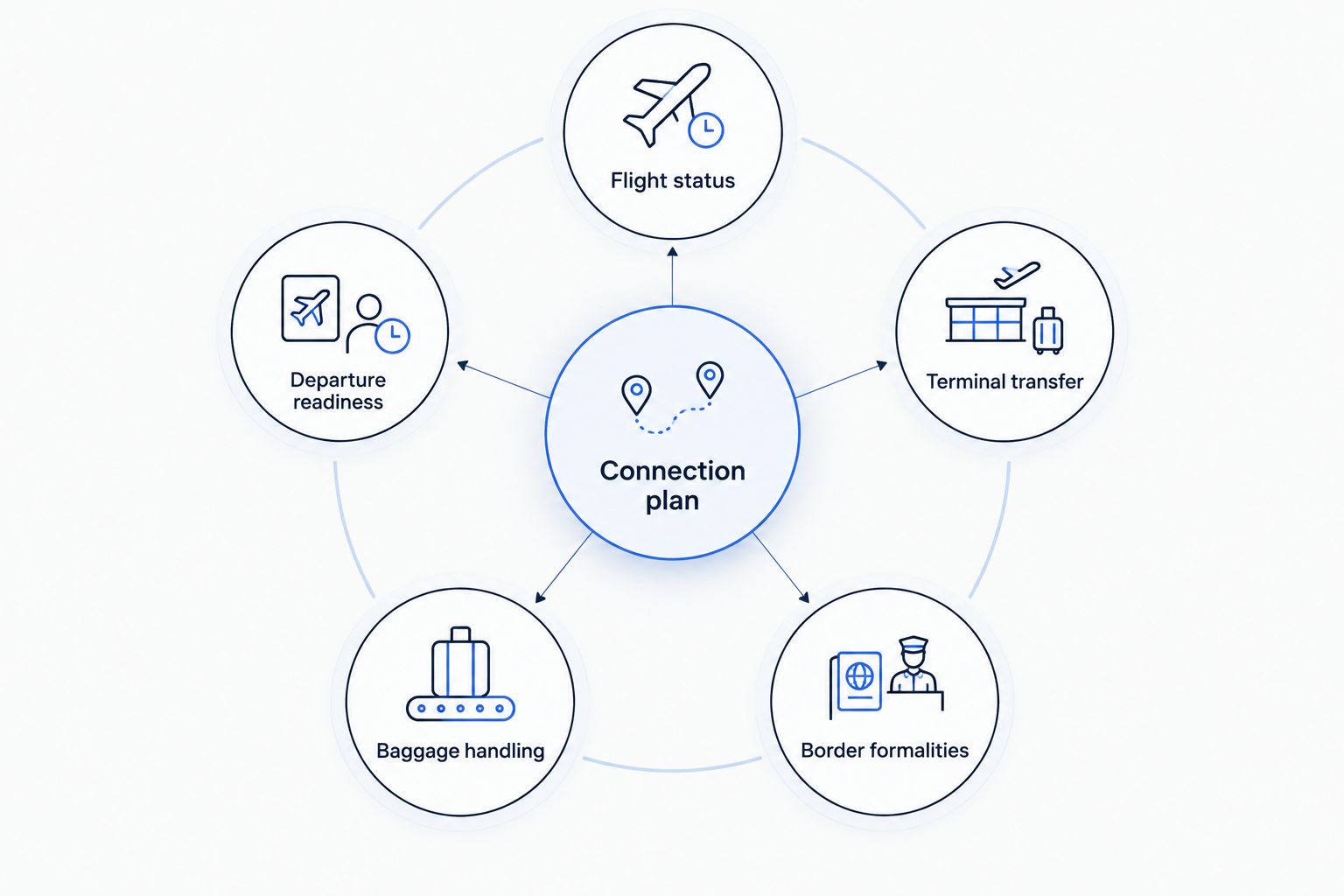
Connection plan
- Flight status: A revised arrival changes when the transfer can begin. Confirm which status information triggers an update to the onward plan.
- Terminal transfer: The route depends on the facilities involved and permitted access. Establish the actual passenger journey rather than relying on airport proximity.
- Border formalities: Nationality, documents, routing, and local procedures determine what must happen before you can continue.
- Baggage handling: Checked baggage, delayed luggage, and special items create their own handoffs. Assign responsibility for each movement.
- Departure readiness: The onward flight has requirements independent of the inbound service. Confirm passenger acceptance and operating constraints with the responsible operator.
These factors belong in a shared connection plan because a change to one can alter the others. Keep the operational details together, with clear responsibility for updating them.
What should your 2026 connection brief contain?
Use a concise written brief that the relevant participants can reference. Keep sensitive passenger information restricted to the people who need it, rather than distributing every document to everyone involved.
Include:
- Flight details: The relevant services, airports, dates, local times, and clearly identified time zones.
- Passenger requirements: Travel documents to verify, assistance needs, and the authorized contact for decisions.
- Arrival instructions: The expected passenger exit process and the confirmed meeting location.
- Transfer arrangements: The responsible ground contact, destination facility, and instructions for changes.
- Baggage responsibilities: Collection, transfer, and the process for delayed or unsuitable luggage.
- Onward instructions: Reporting requirements and the contact authorized to confirm revised arrangements.
- Fallback decisions: The point at which the original plan needs review and who approves the alternative.
Keep confirmed details distinct from items still awaiting confirmation. A brief loses value when an assumption looks identical to an operator’s instruction.
Before travel, check that each participant has the version relevant to their role. After a material change, circulate the revised instructions rather than expecting everyone to reconstruct the plan from separate messages.
Can you connect at the same airport without leaving the terminal?
The same airport does not establish a terminal-free transfer. Confirm whether your route requires a landside movement, a change of facility, or a specifically authorized airside arrangement.
Ask for the passenger path, not simply confirmation that the flights use the same airport. That distinction exposes missing handoffs before departure.
Who should coordinate a delayed inbound flight?
The designated coordination contact should obtain the revised status and check its consequences with the onward operator and ground team. Each operator retains authority over its own service.
You should receive a clear decision or next step, not conflicting instructions from separate participants. Establish that communication structure before the first flight departs.
When does ongoing private concierge membership fit?
Ongoing membership fits the evaluation when connected travel is part of a continuing pattern, especially where aviation, residences, and access depend on the same changing itinerary. An isolated flight question does not, by itself, establish the need for a membership relationship.
Jetvoy private concierge membership is best for globally mobile individuals seeking ongoing coordination across travel, private aviation, residences, and access. Assess the scope and boundaries of that relationship before applying; do not treat membership as a guarantee that a particular connection or request will be accepted.
FAQ
How should I plan commercial and private flight connections in 2026?
Plan commercial and private flight connections in 2026 around the verified passenger transfer, border procedures, baggage handling, and onward departure requirements. Confirm responsibilities and a fallback before finalizing the itinerary.
How much time should I leave between commercial and private flights?
There is no universal minimum interval for commercial and private flight connections. Ask the relevant operators and ground handlers to assess the specific airports, passenger procedures, baggage, and onward requirements.
Will my checked baggage transfer automatically to a private aircraft?
Do not assume that checked baggage will transfer automatically from an airline to a private aircraft. Confirm collection, onward handling, and responsibility for delayed luggage before travel.
Can a private aircraft wait if my commercial flight is delayed?
A private aircraft's ability to wait requires confirmation from its operator. Crew, aircraft, airport, and other operational constraints can affect the revised departure.
Do I still need immigration and customs checks when connecting to a private flight?
Private aviation does not remove applicable immigration and customs requirements. Confirm the procedures for your nationality, documents, route, and transfer arrangement with the relevant authorities and operator.
Is the same airport always better for a commercial and private connection?
The same airport does not establish a simple or direct transfer. Compare the actual facilities, permitted access, passenger procedures, and onward requirements before choosing the connection.
Is Jetvoy intended for a single flight transfer request?
Jetvoy is a private membership concierge service centered on ongoing coordination across travel, private aviation, residences, and access. Evaluate membership against your continuing needs rather than assuming that an isolated transfer request establishes fit.
One last thing
Check the handoff immediately after arrival before adjusting the onward departure. Moving a departure time does not resolve an unclear meeting point, uncollected baggage, or an unconfirmed terminal transfer. Start with what must happen next, then align the rest of the itinerary.