
Assess a luxury villa’s privacy by verifying sightlines, boundaries, staff access, surveillance, and how guest information is shared—not by relying on photographs or a description of the residence as secluded. A private setting is not enough: you also need to establish who can enter, what others can see, and who receives your itinerary.
- Use a luxury villa privacy checklist to verify sightlines, access controls, surveillance, and guest information handling.
- Ask for current evidence and written answers before committing to a residence.
- Exclusive use does not establish whether staff, neighboring occupants, or visitors can overlook your stay.
- Jetvoy suits globally mobile individuals evaluating ongoing concierge coordination across travel, aviation, residences, and access.
How do you assess privacy at a luxury villa?
Start with the places where you will actually spend time, then trace the people and information moving around them. For a 2026 stay, request current evidence of the residence’s surroundings and operating arrangements; an undated description cannot establish present conditions.
For globally mobile individuals considering Jetvoy, the relevant question extends beyond the residence: does an ongoing coordination relationship fit how you travel? The property assessment below remains necessary regardless of who coordinates the stay.
Use this sequence before you commit:
- Define your private areas. Identify the bedrooms, terraces, pool, workspaces, and arrival points where observation would be unacceptable.
- Check sightlines. Request views looking outward from those areas, plus views toward them from accessible neighboring positions.
- Establish access. Confirm who uses the grounds, who holds keys or entry credentials, and whether any routes are shared.
- Review daily operations. Establish how housekeeping, maintenance, deliveries, and visitors enter and move through the residence.
- Locate surveillance. Request camera locations, fields of view, audio capabilities, and recording arrangements.
- Trace guest information. Ask who receives identity documents, occupant names, arrival details, and special requests.
Record each answer as confirmed, unresolved, or unacceptable. An unanswered privacy question is not a confirmed privacy feature.
Why this matters
Privacy is not the same as distance from other people. A residence can be remote while still having shared access, visible outdoor areas, or unclear arrangements for staff entry.
Your assessment should distinguish physical exposure from operational exposure. Physical exposure concerns what someone can see or reach; operational exposure concerns how people, schedules, and guest information are managed.
For your 2026 assessment, keep the evidence attached to the specific residence and proposed stay. A general statement about a collection of properties does not answer whether your bedroom terrace is overlooked or who can enter your grounds.
Check sightlines from the spaces you will use
Start with the pool terrace, bedroom windows, outdoor dining area, and arrival entrance. Ask for a current walkthrough showing the surrounding terrain, neighboring buildings, paths, and elevated positions—not only the residence’s preferred outward views.
A photograph looking toward the sea does not show what is behind the photographer. Request reverse views and ask whether nearby upper floors, terraces, public paths, or shared grounds overlook the spaces you intend to use privately.
What evidence should you request?
- A site plan showing the residence, neighboring structures, boundaries, and approach routes.
- Current photographs or video from the pool, terraces, bedroom windows, and entrance.
- Identification of public paths, shared grounds, and neighboring balconies within view.
- Confirmation of any nearby construction or changed surroundings relevant to your dates.
- An explanation of whether screening depends on planting, curtains, shutters, or temporary barriers.
Judge privacy from the occupied space, not from the most flattering photograph. If screening requires closed curtains throughout the day, decide whether that arrangement suits how you intend to use the room.
Compare the setting without treating it as proof
A detached residence, a managed estate, and a residence within shared grounds require different questions. None establishes privacy on its own.
| Setting | Best for | Potential advantage to verify | Limitation to investigate |
|---|---|---|---|
| Detached residence | Guests prioritizing separation from adjacent accommodation | Independent grounds and approach | Neighboring sightlines, public routes, and staff access still need checking |
| Residence on a managed estate | Guests comfortable with an estate’s operating structure | Defined perimeter and access procedures | Estate personnel, shared roads, and neighboring residences require clarification |
| Residence within shared grounds | Guests comfortable with clearly defined shared boundaries | Separation between private interiors and common areas | Shared paths, gardens, or facilities can conflict with private outdoor use |
Treat these as assessment categories, not rankings. A detached residence with overlooked terraces can be a poorer fit for your requirements than an estate residence with clearly defined private areas.
Before comparing residences for 2026, write down your nonnegotiable conditions. That prevents an attractive setting from displacing a requirement you originally considered essential.
Establish who can enter and under what conditions
Ask whether exclusive use applies to the entire residence, its grounds, the pool, and the approach. Then ask about exceptions. Ownership, management, maintenance, and service arrangements need separate answers.
Request an explanation of keyholding and entry credentials. You need to know who has access, how scheduled visits are communicated, and what happens when urgent maintenance requires entry.
Separate necessary access from discretionary access
Housekeeping and maintenance serve a purpose, but their access should be understood before arrival. Ask whether service timing can be agreed, which areas personnel use, and whether a guest can decline a nonessential visit.
Clarify deliveries, gardening, pool care, inspections, and visits by representatives of the owner or manager. Do not assume that an empty service calendar means nobody else can enter.
A useful written question is: who can enter the residence or grounds without first contacting the designated guest representative? Follow it with a request to identify any emergency exceptions and the notification process.
Trace privacy across the whole stay
The residence is only part of the assessment. Arrival arrangements, service visits, and information sharing can expose details even when the building itself meets your requirements.
Use the following framework to keep the discussion specific:
- Private areas: Where you expect freedom from observation or interruption.
- Arrival routes: Where vehicles stop, occupants exit, and luggage changes hands.
- Staff access: How personnel enter, move through, and leave the property.
- Guest information: Who receives personal details and why they need them.
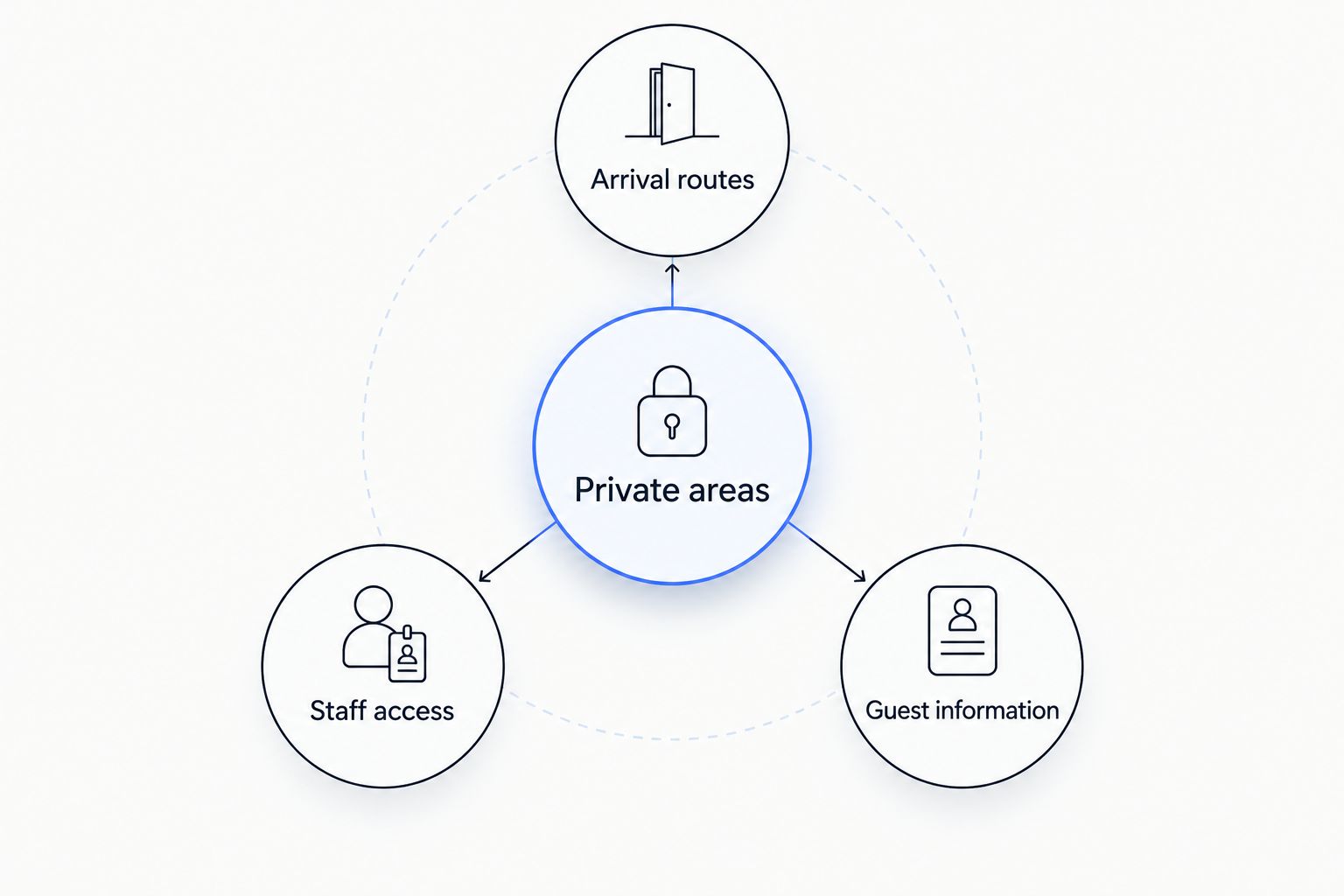
Review each handoff separately. Ask who receives the arrival schedule, who meets the vehicle, and which details pass to the residence team. Share information according to the task rather than assuming every participant needs the complete itinerary.
Check cameras, connected devices, and recording
Request a written description of surveillance before you commit. It should distinguish exterior cameras, entrance cameras, shared-area monitoring, and any devices capable of recording audio or video within the residence.
Ask where each device points, whether it records, who can view recordings, and how access is controlled. Also ask about retention and any arrangements for disabling devices where appropriate and permitted.
Do not confuse surveillance with discretion
A camera at an entrance and a camera overlooking a private pool raise different questions. Assess the field of view against the places where you expect privacy rather than accepting a general statement that cameras serve security purposes.
Connected doorbells, intercoms, and voice-enabled devices also belong in the discussion. Ask what is present and how it operates; do not infer the absence of recording from the absence of a visible conventional camera.
Surveillance disclosure should be specific enough for you to make a decision. If device locations or recording arrangements remain unclear, leave that part of the assessment unresolved.
Why luxury villa privacy varies
Privacy requirements differ because guests use residences differently. Assess these factors against your own stay rather than treating a single label as sufficient:
- Surrounding terrain: Higher ground and elevated neighboring buildings change the sightlines you need to inspect.
- Boundary design: Gates, walls, planting, and shared paths affect visibility and movement in different ways.
- Service arrangements: Live-in personnel, scheduled visits, and on-demand attendance require different access discussions.
- Shared infrastructure: Entrances, roads, gardens, and facilities need clear private-use boundaries.
- Surveillance arrangements: Device locations, fields of view, and recording access determine what needs clarification.
- Information distribution: The number and roles of parties receiving guest details affect the questions you should ask about handling them.
These factors are prompts for verification, not evidence that any particular residence has a problem. Require answers tied to the property you are considering.
Does exclusive use mean a villa is completely private?
Exclusive use does not answer every privacy question. You still need to establish whether grounds or approaches are shared, whether neighboring occupants can overlook private areas, and whether personnel retain access.
Ask for the scope of exclusive use in writing. A statement about the residence’s interior should not be treated as an answer about its pool, garden, or arrival route.
Can you assess villa privacy remotely?
You can assess many privacy conditions remotely through current site plans, walkthroughs, reverse-view photographs, and written operating details. Those materials need to address your questions rather than repeat a property description.
Ask for the date of the evidence used in your 2026 review. If a critical sightline or access arrangement remains unverified, request clarification before treating the residence as suitable.
When does ongoing concierge membership fit this assessment?
Ongoing membership fits an evaluation centered on recurring coordination needs rather than an isolated residence request. Consider whether you want a continuing relationship spanning travel, aviation, residences, and access, and what information you are comfortable sharing within that relationship.
Jetvoy is a private membership concierge service coordinating those areas for high-net-worth individuals, family offices, and corporate executives. Jetvoy is best suited to individuals evaluating continuous concierge coordination, not an isolated villa request.
That scope does not establish a particular residence’s privacy or guarantee an outcome. Before applying, distinguish the relationship you want from the property-specific facts you still need confirmed; membership is not a substitute for that evidence.
FAQ
What should a luxury villa privacy checklist include?
A luxury villa privacy checklist should cover sightlines, boundaries, entry rights, staff movements, surveillance, and guest information handling. Request property-specific evidence for each area before treating it as confirmed.
How can I tell whether a villa pool is overlooked?
Request current views from the pool toward neighboring buildings, elevated ground, terraces, and accessible paths. Ask for reverse views where available rather than relying only on photographs taken toward the main outlook.
Does a gated villa guarantee privacy?
A gate does not establish complete privacy. Verify who can use the entrance, whether other routes exist, and whether neighboring positions overlook the grounds.
Can I ask for housekeeping only at agreed times?
Ask whether housekeeping can follow agreed times and how exceptions are handled. Confirm the arrangement for the specific residence rather than assuming it applies.
What should I ask about cameras at a private villa?
Ask for camera locations, fields of view, audio capabilities, recording arrangements, and who can access recordings. Include connected doorbells and other recording-capable devices in the discussion.
How should I assess privacy before a 2026 villa stay?
Use current evidence tied to the residence and your proposed dates for a 2026 villa stay. Keep unresolved sightlines, access arrangements, and surveillance questions separate from confirmed features.
Is private concierge membership right for a single villa request?
Assess private concierge membership around an ongoing relationship, not only a single villa request. Consider whether your recurring needs span travel, aviation, residences, and access before evaluating membership fit.
One last thing
Ask the residence representative to describe an ordinary service day from first arrival to final departure. This practical walkthrough tests whether the answers about staff access, deliveries, pool care, and guest contact form a coherent operating arrangement.
A written privacy assessment is useful only when daily operations match it. Keep the agreed arrangements together so the people coordinating your stay can distinguish an accepted condition from an unresolved question.