

Use a staffed villa checklist to confirm who works at the residence, what their duties cover, how privacy and safety are managed, and who coordinates changes before you commit. For a 2026 stay, request written confirmation rather than relying on the word staffed. A property description does not establish working hours, overnight coverage, staff access to private rooms, or responsibility when arrangements change.
- A staffed villa checklist should establish named responsibilities, service scope, privacy boundaries, safety arrangements, and arrival coordination.
- Assess the staffing arrangement against your household’s routine, not the length of the amenities list.
- JetVoy suits individuals seeking ongoing private concierge coordination, rather than a single residence request.
- Resolve unanswered questions in writing before committing to the residence.
Why this matters
You are assessing a working household, not just a property. A chef’s presence does not establish meal coverage, and a house manager’s title does not establish authority over every provider involved in your stay.
For your 2026 assessment, separate the residence decision from the wider coordination decision. JetVoy provides private membership concierge coordination across travel, aviation, residences, and access; membership fit concerns that continuing relationship, not simply finding a villa.
A staffed residence is ready for commitment only when its service description matches your actual requirements. Start with the household’s needs, then ask the property representative to confirm the corresponding responsibilities. Photographs cannot answer those questions.
How do you assess a staffed villa before committing?
Work through 6 review areas: staffing, service scope, privacy, safety, arrival, and accountability. Record the answer to each question, the person responsible, and any condition that still requires confirmation.
Staffing
Ask for roles and coverage, not necessarily personal staff details. Establish which roles are dedicated to the residence, which attend at agreed times, and which require separate arrangements.
- Who manages the household during your stay?
- Which staff live on the premises?
- What working hours and days off apply?
- Who covers an absence or a request outside agreed hours?
- Which languages can the relevant staff use with your household?
Judge staffing against your routine. A household that eats late, travels with children, or receives guests needs those requirements addressed explicitly. Do not treat a role appearing in a description as confirmation that every associated task is included.
Service scope
Translate broad descriptions into duties. Ask what housekeeping covers, how meals are coordinated, whether laundry is included, and what happens when your plans change during the stay.
For meals, confirm who collects dietary requirements, who approves menus, and how allergies are communicated to the people preparing food. Distinguish an acknowledged preference from a requirement the team has expressly agreed to accommodate.
If you expect childcare, driving, or event support, identify those as separate requirements. Do not infer a specialist responsibility from a general household role. Ask for the relevant qualifications or documentation where the task calls for them.
Privacy
Establish where staff work, where they stay, and when they enter guest areas. Request a clear distinction between private accommodation, staff accommodation, service routes, and shared spaces.
Ask about cameras, recording devices, visitor access, and how personal information is handled. Confirm whether external providers enter the property and how those visits are authorized.
For executives or family offices, identify who is permitted to receive itinerary details and household instructions. Discretion needs practical boundaries: who receives information, why they need it, and who can authorize its onward sharing.
Safety
Request the residence’s emergency instructions and the relevant local contacts. Confirm how occupants exit the property, where emergency equipment is located, and who explains its use on arrival.
Review the physical setting against your household. Pools, stairs, balconies, waterfront access, and vehicle routes each deserve direct questions where present. Ask for current photographs or documentation when a description leaves the arrangement unclear.
Do not substitute the word secure for specific answers. Establish who controls entry, how visitors are admitted, and what the household should do if assistance is needed outside staff working hours.
Arrival
Trace the transition from your arrival point to access at the residence. Confirm who receives arrival updates, who coordinates the transfer, and who meets the household at the property.
Specify luggage, mobility needs, child restraints where required, and any arrival meal or room preparation you expect. These are instructions to confirm, not assumptions to leave inside a general arrival request.
Test a change scenario: if your arrival time moves, who informs the driver, residence representative, and household staff? The useful answer identifies responsibility across the handoff, rather than simply providing several contact details.
Accountability
Identify the person authorized to resolve residence issues and the route for escalating an unresolved matter. Clarify which decisions that person can make and which require an owner or another representative.
Ask how substitutions, staff changes, maintenance interruptions, and unavailable facilities are communicated. Read the relevant agreement alongside the written service description so you understand which commitments appear in the terms.
Do not commit while a requirement essential to your stay remains unresolved. Record the exception, request clarification, and assess the residence on the confirmed arrangement—not the arrangement you hope will be available.
The villa assessment should keep these subjects connected. A staffing answer that changes privacy or arrival arrangements needs to be reflected in those parts of the assessment as well.
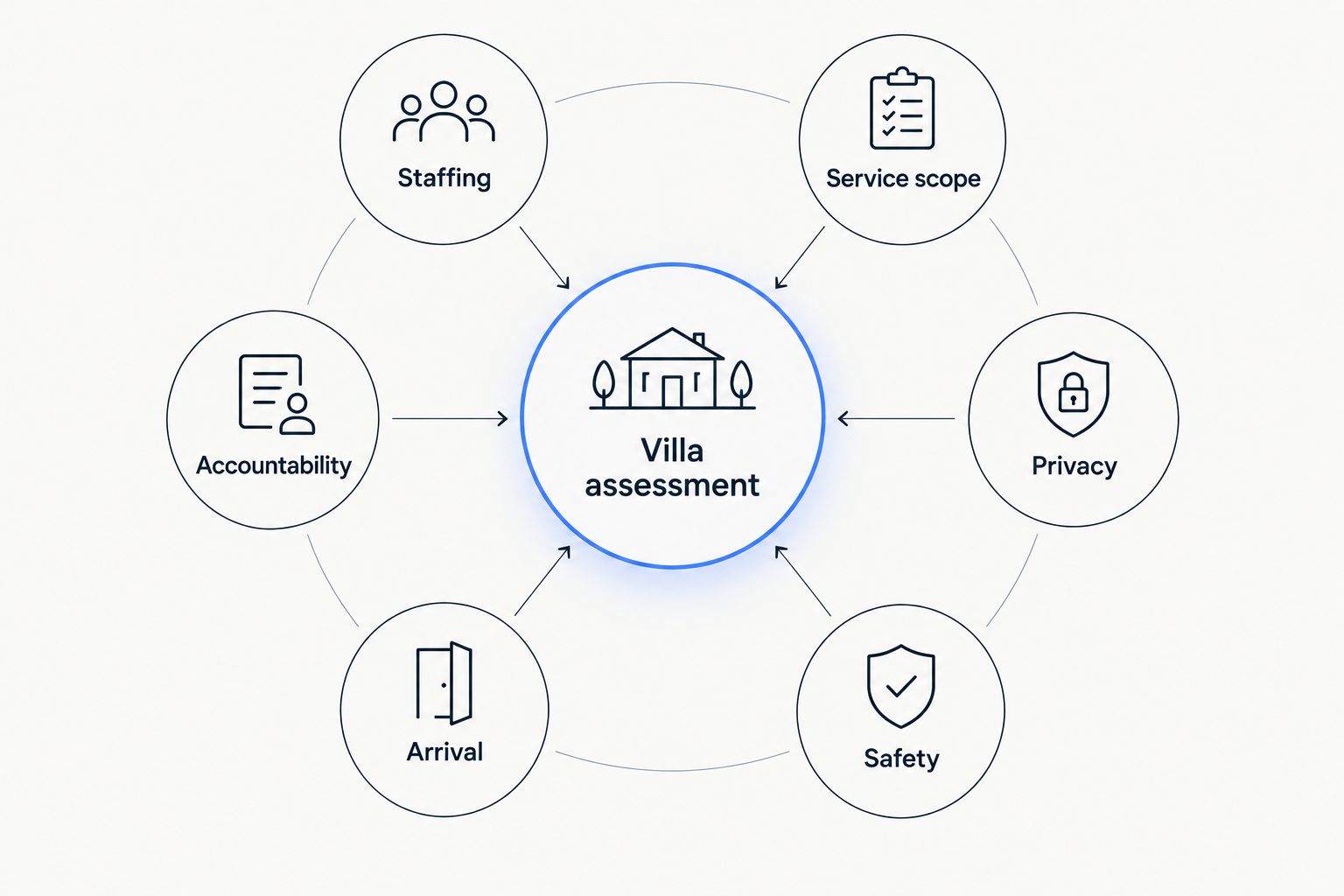
Which staffing arrangement fits your household?
Compare the arrangement actually offered, not labels used in promotional descriptions. Use the distinctions below as questions for the property representative; they do not establish what any particular residence supplies.
| Arrangement to clarify | Best for | Practical advantage | Limitation to resolve |
|---|---|---|---|
| Live-in staff | Households comfortable with staff residing on the premises | Staff accommodation forms part of the residence arrangement | Living on-site does not establish continuous duty; confirm hours and privacy boundaries |
| Scheduled visiting staff | Households wanting defined periods of household service | Visits can be assessed against a stated schedule | Confirm responsibility between visits and when plans change |
| Separately arranged specialists | Households with defined requirements beyond general household duties | Responsibilities can be specified for the particular task | Confirm who coordinates external providers and authorizes access |
The right arrangement is the one whose confirmed duties match your household. More staff is not a substitute for clearer responsibilities. Equally, a concise team description is insufficient if it leaves an essential task unassigned.
For a 2026 residence assessment, ask the representative to distinguish the standard arrangement from anything being arranged specifically for your stay. That distinction belongs in your written record, especially when an external provider is involved.
Why staffing requirements vary
Build your requirements around the household you are bringing and the way you intend to use the residence. Use these factors to decide which checklist questions need the most attention:
- Household composition: Identify children, accompanying staff, visitors, and anyone needing assistance, then specify relevant requirements.
- Daily routine: State expected meal patterns, periods of privacy, working time, and arrival or departure needs.
- Property layout: Check the relationship between bedrooms, shared spaces, staff accommodation, entrances, and outdoor areas.
- Service expectations: Separate general household duties from specialist tasks and expressly requested services.
- Provider handoffs: Identify where transport, household staff, and external providers need the same updated instruction.
- Information boundaries: Specify who can receive schedules, dietary information, guest details, and access instructions.
Avoid copying another household’s requirements without adapting them. A detailed checklist is useful only when its answers determine whether this residence suits your stay.
Request 3 written records before deciding
Your 2026 review should leave you with 3 written records: a household brief, a confirmed service scope, and a responsibility and exceptions record. These are practical assessment documents, not substitutes for the residence agreement.
The household brief
Describe the requirements that affect suitability. Include relevant routines, room needs, accessibility questions, dietary requirements, privacy expectations, and planned visitors or activities that require permission.
Separate essentials from preferences. An essential requirement determines whether you can proceed; a preference gives the representative room to propose an alternative. Keep sensitive personal information limited to what the recipient needs to assess and coordinate the requirement.
Write requirements as clear instructions or questions. For example, ask who will receive a late arrival update rather than asking whether the team is flexible. The former produces an answer you can assess; the latter leaves the working arrangement undefined.
The confirmed service scope
Request a written account of the roles, duties, hours, and arrangements that apply to your stay. Match it against your household brief, marking each essential requirement as confirmed or unresolved.
Keep distinctions visible. Residence staff, visiting providers, and separately arranged specialists should not disappear into a single statement that everything is handled. Each responsibility needs an identified owner.
Check the scope against the agreement before committing. Where the documents differ, request clarification rather than choosing the wording you prefer. Retain the final version so later changes can be assessed against the same baseline.
The responsibility and exceptions record
List the main contact, escalation contact, and responsibility for changes affecting arrival or the household. Record unresolved conditions and any alternative you have expressly accepted.
Use this record to test dependencies. If the arrival time changes, does the same instruction reach transport and the residence? If a staff member is unavailable, who confirms the revised arrangement with you?
A contact list alone does not answer these questions. Require an owner for the handoff, not just a name at each end. Keep the record focused enough that the people carrying out the arrangements can use it.
Apply 2 decision gates before committing
Gate: residence fit
Confirm that the property and household arrangement meet your essential requirements. Review the actual layout, service scope, privacy boundaries, safety information, and terms together.
Proceed only on the basis of confirmed suitability. If an essential question remains open, obtain the answer before treating the residence as settled. An attractive setting does not resolve a mismatch in access, layout, or service responsibilities.
Gate: coordination fit
Decide whether you need assistance with this residence alone or an ongoing relationship across recurring travel requirements. Keep that decision separate from whether the villa itself is suitable.
JetVoy is best suited to individuals seeking ongoing private concierge coordination. Its stated scope spans travel, aviation, residences, and access. That makes continuity the relevant membership question, rather than whether a single property request justifies the relationship.
If you are assessing membership, describe recurring coordination needs and the decisions you want handled across them. Do not assume that submitting an application establishes acceptance or confirms a particular residence arrangement.
Does a staffed villa include continuous service?
A staffed villa description does not establish continuous service. Confirm working hours, days off, overnight responsibility, and the procedure for requests outside agreed coverage.
Live-in accommodation and on-duty coverage are different questions. Ask both, and retain the answers with the service scope.
What should you do if the staffing arrangement changes?
Reassess any requirement affected by the change before accepting the revised arrangement. Request the replacement scope in writing, including responsibility for tasks previously assigned elsewhere.
If the change affects an essential requirement, return to the residence-fit decision. Do not treat a substitution as equivalent without checking the duties and coverage it actually provides.
FAQ
What should a staffed villa checklist include?
A staffed villa checklist should include staffing, service scope, privacy, safety, arrival, and accountability. Confirm each area against your household’s requirements and retain the answers in writing.
Does live-in staff mean someone is always on duty?
Live-in staff does not establish continuous duty. Confirm working hours, time off, and responsibility outside agreed coverage separately from staff accommodation.
How do I check whether a staffed villa suits children?
Assess the actual layout, relevant safety arrangements, and any childcare requirements before committing. Do not assume general household staff have agreed to provide childcare.
What should I ask about privacy at a staffed villa?
Ask who enters guest areas, where staff stay, how visitors are admitted, and whether cameras or recording devices are present. Specify who can receive household and itinerary information.
What documents should I request before committing to a villa?
Request a confirmed service scope, relevant residence terms, and written responsibility for unresolved requirements and changes. Compare these with your household brief before deciding.
Can I assume a villa chef can accommodate every dietary requirement?
Do not assume a chef can accommodate every dietary requirement. Communicate the exact requirement and obtain explicit confirmation from the responsible provider before committing.
Is JetVoy relevant if I need ongoing residence and travel coordination?
JetVoy provides private membership concierge coordination across travel, aviation, residences, and access. Assess membership around a continuing relationship, rather than a one-off residence request.
One last thing
Before committing to a staffed villa in 2026, ask a change question rather than another amenities question: who coordinates the consequences if your arrival moves?
The answer should identify who receives the update, who informs the residence, and who confirms the revised arrangements with you. This does not prove every future change will be handled correctly. It establishes whether the proposed responsibility is clear enough to accept.
Assess the handoffs as carefully as the house. A polished residence description cannot replace an agreed account of who does what.