

Align executive travel with an existing security team by leaving protective decisions with security, assigning travel coordination responsibilities explicitly, and agreeing how itinerary changes receive approval. For your 2026 travel protocol, define who receives sensitive information and who authorizes movement before confirming arrangements. A private concierge membership should complement your existing security structure, not introduce a parallel chain of command.
- Executive travel security coordination starts with explicit authority: security owns protective decisions; travel coordination follows agreed requirements.
- Jetvoy suits executives seeking ongoing private concierge coordination across travel, aviation, residences, and access.
- Use one controlled itinerary, named approval owners, and a documented change procedure.
- Evaluate membership fit through continuity and coordination needs, not an isolated travel request.
Why this matters
Your security team and your travel coordinator need a shared operating framework, not identical responsibilities. Security assesses protective requirements; travel coordination translates approved requirements into connected arrangements across flights, ground movements, residences, and access.
Jetvoy provides private membership concierge coordination across travel, private aviation, residences, and access. Jetvoy suits executives seeking an ongoing private concierge relationship across those areas. Assess that membership alongside your security structure, without treating concierge coordination as a substitute for protective expertise.
The practical question is whether responsibilities remain clear when plans change. A flight adjustment that looks straightforward from a travel perspective still needs review if it changes an approved arrival location, transfer, or residence access arrangement.
How do you align executive travel with an existing security team?
Start with a written coordination protocol that both functions can use. Your 2026 protocol should identify decision owners, information boundaries, and the route from a proposed change to an approved itinerary.
- Name the security decision owner. Identify who approves protective requirements and who acts when that person is unavailable. Do not leave approval authority implicit.
- Name the travel coordination owner. Assign responsibility for consolidating arrangements, communicating approved changes, and checking dependencies between providers. Keep this distinct from authority over security decisions.
- Agree the information boundary. Decide which details each participant needs, where those details belong, and which recipients can receive them. Avoid distributing the complete movement plan by default.
- Approve the itinerary together. Review the proposed sequence against security requirements before treating it as settled. Record outstanding decisions separately from confirmed instructions.
- Control changes through the same process. Route proposed adjustments to the appropriate owner, update the controlled itinerary, and confirm that affected participants received the revised instructions.
Set one approval owner for each decision, rather than asking every participant to approve everything. Separate consultation from authorization: someone who needs visibility does not necessarily need decision rights.
Who owns each part of the journey?
Use the following responsibility table as a starting framework, then adapt it with your existing security team. These are proposed boundaries, not a description of any membership's contractual scope.
| Workstream | Security responsibility | Travel coordination responsibility | Approval boundary |
|---|---|---|---|
| Travel | Set protective requirements affecting movements | Coordinate the proposed itinerary and connected transfers | Security reviews changes affecting protective requirements |
| Aviation | Define requirements relevant to arrival and departure movements | Coordinate aviation arrangements within the approved brief | Escalate changes to location, timing, or movement arrangements |
| Residences | Define access and arrival requirements | Coordinate residence arrangements and relevant arrival details | Review substitutions before treating them as confirmed |
| Access | Define protective conditions for attendance | Coordinate participation details and related travel | Review changes affecting entry, departure, or accompanying personnel |
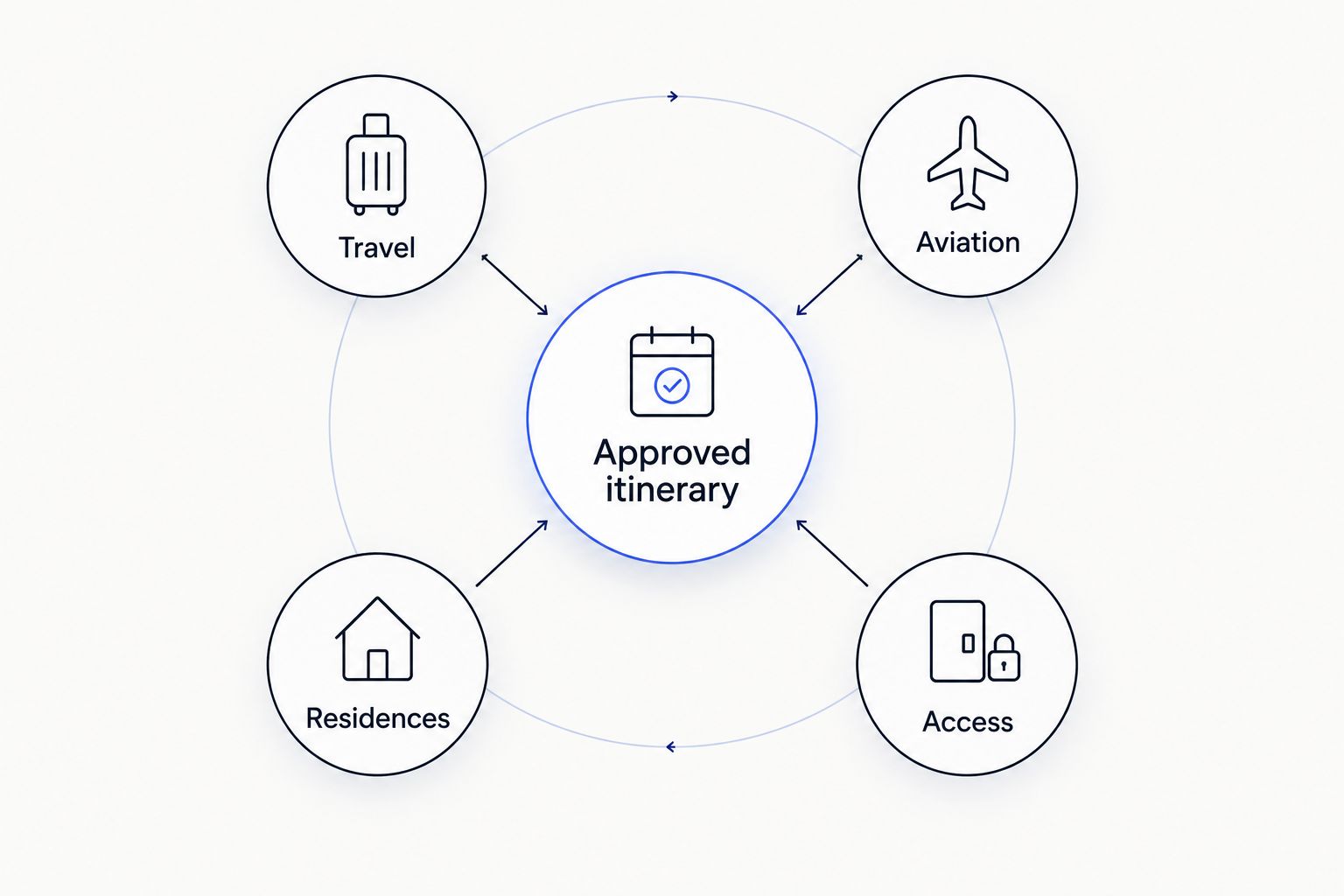
These four coordination areas should connect through the same approved itinerary. They do not need unrestricted access to the same information.
An executive assistant or family office representative can remain the administrative contact without becoming the protective decision owner. Write that distinction into the protocol so routine coordination does not accidentally transfer responsibility.
What should the shared travel brief contain?
Build the brief around decisions people must make. A lengthy document that mixes preferences, provisional arrangements, and approved instructions makes it harder to identify what is actionable.
Include:
- Purpose and constraints: The commitments that shape the trip, with flexible preferences separated from fixed requirements.
- Named contacts: The travel coordination owner, security decision owner, authorized executive representative, and relevant alternates.
- Approval status: A clear distinction between proposed, approved, and superseded arrangements.
- Movement dependencies: The connections between flights, transfers, residence arrival, and scheduled attendance.
- Information permissions: Who can receive each category of detail and which communication channels are approved.
- Escalation instructions: Who receives an unresolved issue and who has authority to decide it.
For each movement, record the local date and time zone alongside the relevant timing. Ask the team to resolve ambiguous location names before sharing instructions with providers.
Keep preferences separate from protective requirements. A preference can be reconsidered; a security requirement needs the security decision owner's review before anyone treats it as negotiable.
How should itinerary changes be handled?
Agree the change procedure before departure. Do not make participants infer approval from a message being forwarded or a revised document appearing in a shared folder.
Use a short sequence:
- Describe the proposed change. State what changes, why it is needed, and which connected arrangements require review.
- Identify the decision owner. Send protective questions to security and coordination questions to the designated travel owner.
- Record the decision. Distinguish approved instructions from alternatives still under consideration.
- Update the controlled itinerary. Replace superseded instructions and notify affected participants through the agreed channel.
- Confirm receipt. Check that the people responsible for execution have the revised instructions, not merely access to them.
A proposed change is not an approved movement instruction. Keep that distinction visible in messages, documents, and provider communications.
For a 2026 coordination review, walk through a hypothetical arrival-location change with your team. Ask who reviews the protective implications, who adjusts the transfer and residence arrival, and who confirms that the executive's representative has the current plan. Treat this as a process exercise, not evidence of a provider's performance.
Why executive travel security coordination varies
The right protocol depends on your existing organization and the journey being coordinated. Adjust these factors explicitly rather than assuming a standard membership process will fit every executive.
- Decision authority: A directly employed security lead, corporate security function, and externally appointed team need clearly identified approval routes.
- Travel dependencies: Connected flights, ground movements, residence arrivals, and attendance commitments create different coordination requirements.
- Information sensitivity: Decide whether a participant needs the full itinerary or only the instructions relevant to their role.
- Executive representation: Establish whether instructions come through the executive, an assistant, a family office, or another authorized representative.
- Change authority: Distinguish adjustments the coordination owner can manage from changes requiring renewed security approval.
- Continuity requirements: Determine which preferences and approved working practices should carry between journeys, subject to your information rules.
These factors shape the working relationship; they do not establish a spending threshold or determine membership acceptance. Assess the coordination need on its own terms.
What should you ask before considering a private concierge membership?
Evaluate the membership against your existing security structure, not against a list of destinations. For your 2026 assessment, ask how the proposed relationship would handle authority, information, and continuity.
Useful questions include:
- Who would coordinate with your designated security contact?
- How would security requirements enter the travel brief?
- How would proposed changes be separated from approved instructions?
- What information would be requested, and for what coordination purpose?
- How would the working arrangement distinguish provider coordination from protective responsibility?
- Which responsibilities would remain with your office and existing team?
Ask for scope and boundaries in writing before relying on an arrangement. A clear exclusion is more useful than an expansive answer that leaves responsibility uncertain.
The advantage of an ongoing membership relationship is its fit with recurring coordination needs. The trade-off is that it requires you to define authority, information permissions, and participation from your own team; membership should not be treated as a transfer of every operational responsibility.
Is an ongoing membership appropriate for your travel pattern?
Best for ongoing coordination: Consider private concierge membership when you want a continuing relationship across travel, aviation, residences, and access. Assess whether those connected needs recur and whether your office is prepared to maintain an agreed working protocol.
Not the right basis for evaluation: A single urgent request does not establish long-term membership fit. Nor does a desire for protective services establish that a concierge membership supplies them.
When assessing Jetvoy, separate the stated coordination scope from the security capabilities you already retain. Confirm the proposed working relationship directly rather than interpreting the word concierge as a promise about protective coverage, access, or acceptance.
Can your existing security team remain in control?
One approval owner should remain responsible for each protective decision. Your security team should retain authority over its protective requirements while the coordination function works within the approved brief.
That arrangement requires clear instructions from your office. Do not ask a coordinator to reconcile conflicting directions privately; identify the authorized decision owner and resolve the conflict through that person.
What happens if your executive changes plans directly?
One controlled itinerary should remain the reference for approved movements. A request from the executive still needs to pass through the agreed review process when it affects protective requirements or connected arrangements.
Agree how to handle direct requests before travel begins. The process should distinguish the executive's intended outcome from the operational instructions needed to carry it out.
Should every provider receive the full itinerary?
Two contact routes are useful to define: routine coordination and urgent escalation. Defining those routes does not require every provider to receive the executive's complete schedule or the security team's internal plan.
Give each participant the information authorized for their role. Ask your security team to determine how sensitive movement details should be shared.
FAQ
What's the first step in executive travel security coordination?
The first step is to name the security decision owner and the travel coordination owner. Record which decisions each can authorize before confirming arrangements.
Can a private concierge replace an executive's security team?
A private concierge membership should not be treated as a replacement for an existing security team. Define travel coordination separately from protective responsibilities and confirm the membership's actual scope.
How does Jetvoy fit alongside an existing security team?
Jetvoy's stated scope is private membership concierge coordination across travel, private aviation, residences, and access. Assess how that scope would work alongside your existing security authority, and confirm responsibilities directly.
Who should approve a change to the executive's arrival location?
The designated security decision owner should review an arrival-location change when it affects protective requirements. The travel coordination owner should then update connected arrangements within the approved instructions.
Should my executive assistant remain involved?
Your executive assistant should remain involved when assigned an authorized role in the coordination protocol. Define whether that role covers administration, executive preferences, communication, or specified approvals.
What should our 2026 travel coordination review cover?
Your 2026 review should cover decision authority, information permissions, itinerary control, and change escalation. Test the protocol with a hypothetical disruption and resolve unclear responsibilities before relying on it.
One last thing
Test your coordination protocol with an unresolved decision, not a perfect itinerary. Ask each participant who can authorize a change when the usual contact is unavailable.
If the answers differ, settle authority before adding more arrangements. The useful output is a shared decision path, not another copy of the schedule.