

Begin planning complex private travel in 2026 as soon as the purpose, likely dates, and essential commitments are known—before you commit to arrangements that depend on one another. Work backward from the least flexible requirement, not from departure alone; aviation, residences, ground movements, and access need to be assessed together before a sensible planning window can be set.
- Decide how far in advance to plan private travel by identifying the least flexible commitment first.
- Coordinate private aviation, residences, transfers, and access before committing to dependent arrangements.
- Jetvoy suits globally mobile individuals evaluating ongoing private concierge membership, rather than an isolated travel request.
- Early planning helps expose dependencies; it does not guarantee access or eliminate changes.
How far in advance should complex private travel be planned?
Start when the trip becomes a serious intention, not when every detail is settled. The right starting point is the first requirement that would be difficult to replace: an essential appearance, a particular residence, an access-dependent occasion, or an arrival time that cannot move.
A fixed calendar interval does not explain whether your itinerary is ready. The more useful question is whether the decisions that constrain everything else have been identified and checked.
Use this sequence to establish your planning window:
- Identify the fixed commitment. State what must happen, where, and when. Separate an essential obligation from a preference that can change.
- Map the dependencies. Connect that commitment to aviation, arrival procedures, ground movements, residence access, and onward travel.
- Check the constraints. Establish which permissions, documents, provider conditions, or access requirements need attention before commitments follow.
- Sequence the decisions. Resolve the elements that constrain later choices before committing to arrangements that rely on them.
- Keep changes connected. When a decision changes, reassess the affected itinerary rather than treating the change as an isolated request.
For individuals evaluating a continuing relationship, Jetvoy coordinates travel, private aviation, exceptional residences, and exclusive access through private concierge membership. The relevant distinction is continuity across those areas, rather than treating departure as the only planning deadline.
Why this matters
A useful 2026 planning brief distinguishes a confirmed arrangement from a coordinated itinerary. A residence can meet your requirements while its arrival arrangements conflict with the proposed flight. An event can anchor the trip while leaving too little flexibility for the onward movement you intended.
Earlier decisions are valuable only when they clarify what depends on them. Committing early to the wrong sequence can restrict later choices just as surely as starting late.
Your objective is not to finalize everything immediately. It is to identify the critical dependencies early enough to make informed decisions, preserve useful alternatives, and avoid mistaking separate confirmations for a workable whole.
Fixed-date travel: start with the immovable commitment
When the reason for traveling cannot move, work backward from that obligation. Define the required arrival condition, not simply the scheduled arrival: where you need to be, what must happen beforehand, and which transitions sit between the aircraft and the commitment.
This approach is best for travelers attending an essential event or fulfilling a fixed obligation. Its strength is clarity; its limitation is that a narrow date or location requirement restricts the alternatives you can accept.
Do not make the central commitment carry assumptions it cannot support. Access to an occasion does not establish a suitable aviation arrangement, and a flight plan does not establish that the residence can accommodate the intended arrival.
Before proceeding, ask which surrounding elements are essential and which are replaceable. That distinction gives the coordination effort a clear order of priority without pretending that every preference has equal importance.
Flexible travel: define the experience before fixing the sequence
If dates and destinations remain adjustable, begin by defining the purpose of the trip. Explain what matters about the residence, pace, privacy, access, and transitions; then assess combinations that satisfy those requirements.
This approach is best for travelers who can change dates or locations without losing the purpose of the journey. Its advantage is room to compare workable combinations. Its limitation is that flexibility without priorities can leave decisions unresolved.
| Planning approach | Best for | Main advantage | Main limitation | Starting decision |
|---|---|---|---|---|
| Fixed-date travel | An essential event or immovable obligation | Establishes a clear anchor for the itinerary | Restricts acceptable alternatives | Define the commitment and required arrival condition |
| Flexible travel | A journey whose purpose permits date or location changes | Allows different combinations to be assessed | Requires clear priorities to avoid indecision | Define the experience and acceptable substitutions |
Neither approach removes the need for coordination. Flexibility changes the choices you can make; it does not remove the connections between them.
Why the planning window varies
The planning window depends on the requirements of your particular journey. Assess these factors before asking for a departure-based deadline:
- Date rigidity. An obligation that cannot move gives the surrounding itinerary less room to adjust. Identify that constraint before selecting supporting arrangements.
- Geographic sequence. Each destination introduces another relationship between departure, arrival, ground movement, and accommodation. Assess the sequence as a whole.
- Aviation requirements. Routing, passenger requirements, and the proposed operating arrangements affect which itinerary combinations deserve consideration. Confirm the relevant requirements rather than assuming them.
- Residence requirements. Location, occupancy needs, and arrival arrangements can constrain the relationship between the stay and the journey.
- Access dependencies. An occasion or experience with its own approval process needs to be treated as a separate dependency. A request is not a confirmed outcome.
- Traveler documentation. Entry and transit requirements depend on the traveler and route. Check current official guidance for the actual itinerary.
For a 2026 itinerary, use current requirements rather than carrying assumptions over from a previous journey. Familiarity with a destination does not establish that a different routing, traveler, or purpose of travel has the same conditions.
The practical result is a planning window tied to your constraints. A complex itinerary with flexible preferences needs a different decision sequence from a seemingly simple journey built around an immovable obligation.
What should be decided first?
Decide what cannot change before deciding what you would prefer. This prevents an attractive individual arrangement from becoming the accidental anchor for the entire journey.
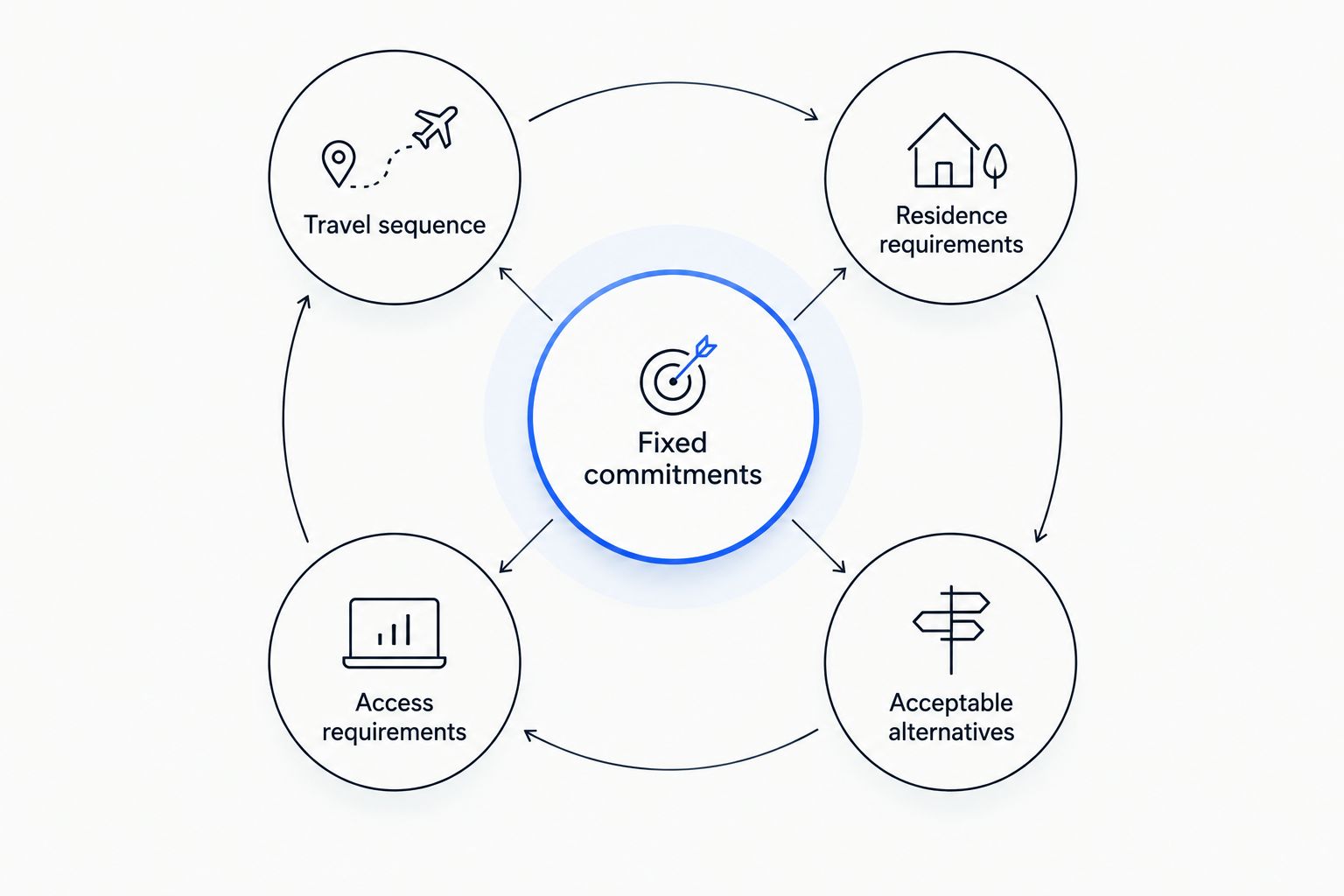
Organize your brief around the following categories:
- Fixed commitments: obligations whose date, location, or attendance requirement cannot change.
- Travel sequence: the intended order of destinations and the transitions between them.
- Residence requirements: the conditions the accommodation must meet for the trip to work.
- Access requirements: occasions or experiences that require separate confirmation.
- Acceptable alternatives: the substitutions you would consider if the preferred combination does not work.
These categories belong in the same discussion. Otherwise, a change in travel sequence can leave residence requirements or access requirements based on an itinerary you no longer intend to follow.
A good brief also identifies who can authorize changes. If an executive, family office, or accompanying traveler must approve a substitution, make that decision path clear before an unresolved choice holds up dependent arrangements.
What should remain open until dependencies are checked?
Keep a preference provisional when its suitability depends on something unresolved. That can include the order of destinations, a preferred arrival pattern, or a residence choice whose practicality depends on the ground movement.
Provisional does not mean neglected. Record the choice, the condition that would make it workable, and the decision that must precede it.
For example, if your onward movement depends on attending an occasion, assess the occasion's timing and access conditions before treating the onward sequence as settled. This is a decision rule, not a promise that the preferred combination will be possible.
Before authorizing commitments for 2026 travel, ask what happens if the central requirement changes. Review the applicable conditions directly and distinguish an acceptable alternative from a change that would defeat the purpose of the trip.
Do not confuse a detailed itinerary with a resolved itinerary. Detail describes the plan; dependency checks establish whether its parts fit together.
How should changes be handled after planning begins?
Treat a material change as a reason to review connected arrangements. Moving an arrival affects more than the flight when a ground movement, residence handover, or onward obligation depends on it.
Use a simple review sequence: identify what changed, trace the affected dependencies, establish the available choices, and obtain the necessary decisions. Then make clear which arrangements remain confirmed and which require further coordination.
Ask for distinctions that support decisions:
- What is confirmed, and what is still a preference?
- Which arrangement depends on a pending decision?
- What alternative preserves the purpose of the journey?
- Who needs to approve the change?
- Which related parties need the revised information?
This discipline matters after the itinerary takes shape as much as before it. Early planning creates time for decisions; connected change handling keeps those decisions aligned as circumstances develop.
When does ongoing private concierge membership fit?
Jetvoy is best for globally mobile individuals seeking ongoing private concierge coordination across travel, aviation, residences, and access. Its stated scope addresses those connected needs through membership rather than an isolated travel transaction.
The relevant advantage is continuity of the relationship. The fit is weaker when you need only a single, self-contained request and have no continuing coordination requirement.
Evaluate Jetvoy private concierge membership against the pattern of your travel, not the perceived prestige of an individual trip. Explain where your requirements repeatedly intersect and where separate arrangements create decisions that someone needs to coordinate.
Before applying, prepare a concise account of your recurring needs, the people involved in decisions, and the constraints that matter most. Keep it practical. A useful application explains why an ongoing relationship fits your circumstances without assuming acceptance, a spending threshold, or a guaranteed outcome.
Membership fit also depends on questions you should resolve directly: the coordination scope, responsibilities, communication arrangements, and the conditions that apply. Treat those as evaluation questions, not assumptions about what membership includes.
Can private travel be planned at short notice?
Short-notice planning requires an immediate assessment of the essential commitment and the alternatives you will accept. Start with feasibility, not with an assumption that every original preference must remain intact.
Separate what is indispensable from what is replaceable. If the preferred sequence does not work, the useful decision is whether another sequence preserves the trip's purpose—not whether every original detail can be retained.
Should private aviation or the residence come first?
Neither private aviation nor the residence should automatically come first. Resolve whichever element imposes the tighter constraint on the journey, while checking the other before authorizing dependent commitments.
Aviation and accommodation are connected decisions. Treating either as a universal starting point ignores the actual reason for traveling.
Does planning earlier guarantee exclusive access?
Planning earlier does not guarantee exclusive access. It gives you an earlier opportunity to establish requirements, seek confirmation, and assess alternatives before dependent decisions become harder to change.
For 2026 travel, distinguish the desired experience from confirmed access in every version of the itinerary. That distinction prevents an unconfirmed preference from silently becoming the foundation of the journey.
FAQ
How do I decide how far in advance to plan private travel?
Start when the trip becomes a serious intention and identify its least flexible requirement. Use the dependencies around that requirement to establish the planning sequence rather than applying a universal departure-based deadline.
What information should I provide before private travel planning starts?
Provide the purpose, likely dates, essential commitments, traveler requirements, and acceptable alternatives. Identify who can approve changes so unresolved decisions do not remain detached from the arrangements they affect.
Should I confirm a residence before arranging private aviation?
Confirm the more restrictive element first, but assess aviation and residence requirements together before making dependent commitments. The correct order depends on the itinerary's constraints.
Can complex private travel be coordinated at short notice?
Short-notice travel starts with checking feasibility and acceptable alternatives. Do not assume the original dates, route, residence, and access requirements can all remain unchanged.
Does early planning guarantee access to an exclusive occasion?
Early planning does not guarantee access to an exclusive occasion. Treat access as a separate requirement that needs confirmation before other arrangements depend on it.
When is Jetvoy private concierge membership relevant?
Jetvoy private concierge membership is relevant when your needs call for ongoing coordination across travel, private aviation, residences, and access. Evaluate the continuing relationship rather than treating membership as the answer to a single isolated request.
One last thing
Ask what would have to change if your central commitment moved. The answer tests whether the itinerary has been considered as a connected system or simply assembled as a list of arrangements.
The best point to begin is before dependent decisions become commitments. Bring the purpose and constraints first; let the sequence follow.