

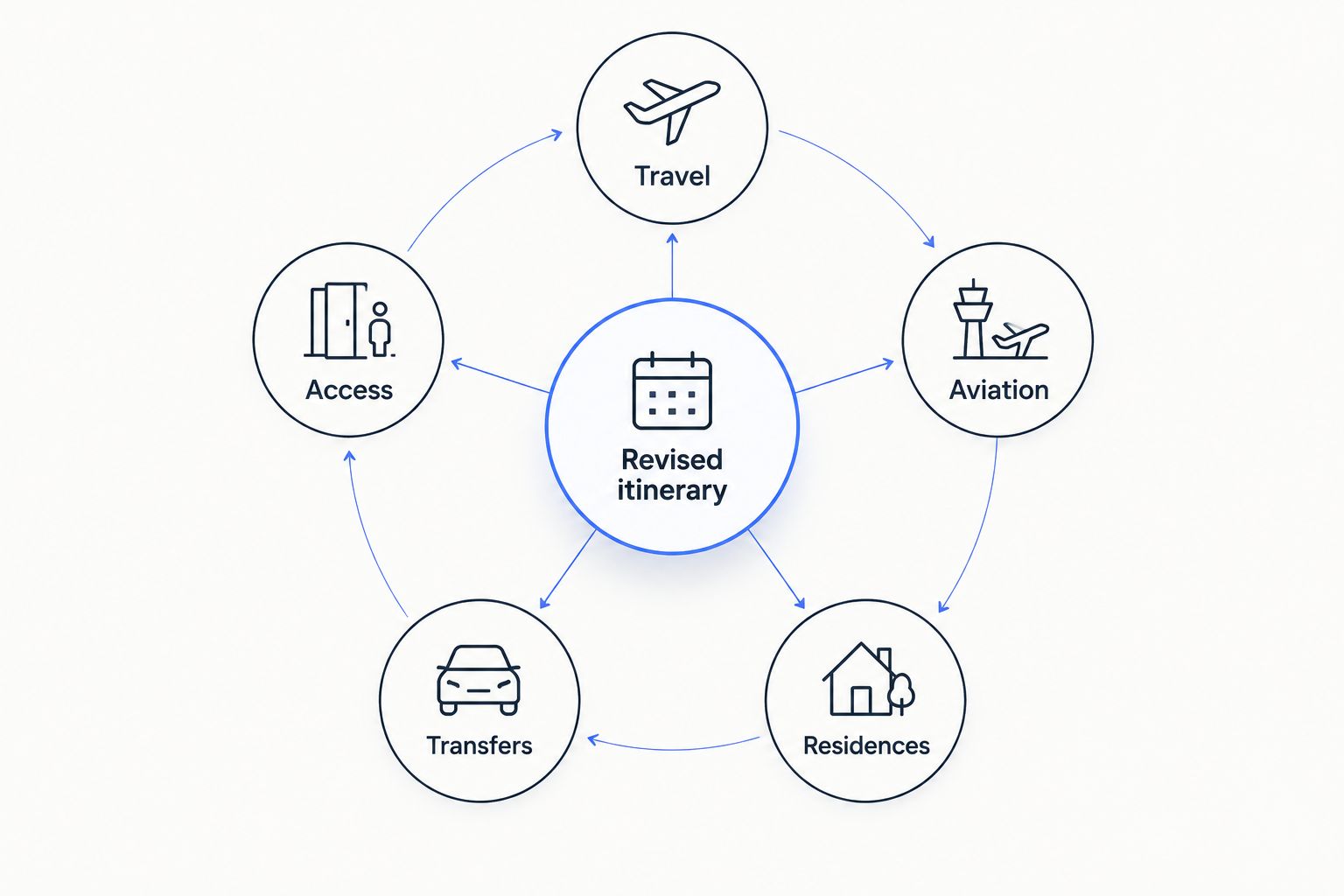
Concierge memberships handle last-minute travel changes by coordinating the affected itinerary: establishing what changed, identifying dependent arrangements, presenting workable alternatives, and confirming the revised plan with the relevant providers. The distinction is whether support addresses the immediate request or also follows its consequences across aviation, transfers, residences, and access. Membership does not remove provider restrictions or replace your approval of consequential decisions.
- Last minute travel changes concierge support should address connected arrangements, not only the immediate disruption.
- JetVoy is best suited to individuals seeking ongoing private concierge coordination across travel, aviation, residences, and access.
- Evaluate decision authority, provider confirmations, communication ownership, and the boundaries of membership before applying.
How do concierge memberships handle last-minute travel changes?
The useful outcome is a reconciled itinerary, not an isolated replacement arrangement. For a 2026 membership evaluation, ask how a proposed change moves from initial notification to confirmed execution. JetVoy is best suited to globally mobile individuals seeking ongoing private concierge coordination across travel, aviation, residences, and access.
The following sequence provides a practical standard for evaluating a membership. It is an assessment framework, not a statement that every provider follows the same process.
- Establish the change. Identify the affected movement, the current situation, and the decision that needs attention. Separate confirmed information from assumptions.
- Identify dependencies. Check which transfers, residence arrivals, onward movements, and scheduled commitments depend on the original timing. An unchanged reservation does not necessarily mean an unchanged plan.
- Present workable alternatives. Explain what each alternative preserves, what it disrupts, and which provider conditions apply. A replacement flight alone does not answer whether the rest of the journey still works.
- Obtain authorization. Establish who can approve changes and which decisions require direct consent. Do not treat a request for options as permission to proceed.
- Confirm the revised plan. Distinguish proposed arrangements from provider-confirmed arrangements. Keep unresolved items visible rather than presenting a partially settled itinerary as complete.
- Communicate the consequences. Give affected travelers and authorized representatives a clear account of what changed, what remains unchanged, and what still requires action.
The critical question is ownership between these steps. If you must reconnect every provider yourself, the coordination remains with you.
Why this matters
A late departure can affect more than arrival time. It can change a ground transfer, the instructions for entering a residence, an onward connection, or the feasibility of a scheduled commitment. Treating each item separately leaves you responsible for deciding whether the revised pieces still fit.
For globally mobile individuals, the membership question is therefore relational: who retains the context when the itinerary changes? A continuing relationship is relevant when preferences, authorized contacts, and connected arrangements need to inform decisions across successive journeys. A narrowly defined request does not necessarily require that relationship.
Use your 2026 membership assessment to examine how coordination works under change, not simply which categories of assistance appear in the description. A service list describes scope. It does not establish decision authority, responsibility, or completion.
What should a revised itinerary actually cover?
Ask the membership provider to explain how it would assess the following areas after a disruption. The purpose is to understand the coordination method before you need it, without requesting an operational guarantee.
- Travel: Identify affected departures, arrivals, connections, and onward movements. Clarify which elements remain confirmed.
- Aviation: Establish the relevant operator or carrier conditions and the decisions needed before a revised movement can be confirmed.
- Residences: Check whether revised arrival timing changes access instructions, arrival arrangements, or coordination with the relevant property representative.
- Transfers: Reconcile pickup instructions, meeting points, and timing with the revised journey rather than the original itinerary.
- Access: Review commitments tied to a particular place or time, and distinguish those that can be adjusted from those requiring a separate decision.
These are connected responsibilities, not interchangeable services. A provider that coordinates residences does not necessarily control property policies; a provider that coordinates aviation does not control the operator's decisions. Ask where coordination ends and another party's authority begins.
Which private concierge membership model fits your needs?
Compare private concierge memberships by the relationship you need, not by an assumed hierarchy of prestige. The models below are evaluation categories, not claims about named providers. An individual membership can combine elements of both; ask which responsibilities its terms actually cover.
| Membership approach | Best for | Practical advantage | Limitation to examine |
|---|---|---|---|
| Request-led private membership | Individuals seeking assistance with distinct, separately defined requests | Keeps each task and its requested outcome clearly bounded | Responsibility for reconciling connected arrangements needs explicit clarification |
| Continuous coordination membership | Globally mobile individuals seeking an ongoing relationship across connected arrangements | Makes continuity across travel, aviation, residences, and access the focus | Requires agreement on scope, decision authority, information sharing, and provider boundaries |
Choose continuous coordination when your need extends beyond resolving the immediate request. Choose a request-led relationship when the task is genuinely contained and you intend to retain responsibility for the surrounding arrangements.
Neither description establishes response commitments or access rights. Read the membership terms and ask for a practical explanation of how responsibilities are divided. The right comparison is between the work you expect the membership to coordinate and the work it expressly accepts.
Why the handling of last-minute changes varies
The membership label alone does not determine what happens after a disruption. Your 2026 assessment should separate the coordination relationship from the conditions governing each underlying arrangement.
- Agreed scope. A membership needs a defined boundary. Establish whether the relevant journey, residence, aviation movement, or access request falls within it.
- Provider conditions. Carriers, operators, properties, and access providers retain their own terms and authority. Concierge coordination does not replace those conditions.
- Decision authority. A revised plan depends on knowing who can approve it. Unclear authorization leaves the coordinator without a reliable instruction.
- Connected commitments. A change affecting an isolated movement presents a different coordination task from a change affecting onward travel, residence arrival, and scheduled access.
- Information quality. Accurate traveler details, current instructions, and authorized contacts are necessary inputs. An outdated itinerary is not a reliable basis for a revised plan.
- Unresolved confirmations. A proposed arrangement and a confirmed arrangement are different states. Ask how the membership distinguishes them in its communications.
These factors explain why a credible membership discussion focuses on process and boundaries. A broad promise to handle everything does not tell you who makes decisions or which conditions remain outside the membership's control.
What should you ask before joining in 2026?
Use a disruption scenario that resembles your actual travel pattern. Describe the connected arrangements without disclosing unnecessary personal information, then ask the membership provider to explain the coordination responsibilities.
Who owns the revised itinerary?
Ask who maintains the current version of the plan and how changes reach the people authorized to receive them. The answer should distinguish a point of contact from responsibility for reconciling the itinerary. Receiving messages is not the same as confirming that the arrangements agree.
Which decisions require your approval?
Ask how the membership records authorization and handles a situation where the decision-maker cannot immediately respond. Clarify whether a family office or executive assistant can approve defined changes on your behalf. Do not assume that including someone in correspondence grants decision authority.
What counts as a completed change?
Ask how proposed, requested, and confirmed arrangements are described. A clear answer identifies outstanding dependencies rather than treating an initial response as completion. You should be able to tell what you can act on and what still awaits confirmation.
What remains outside the membership's control?
Ask for a direct explanation of provider restrictions and membership exclusions. Precision here is useful: it establishes the difference between coordinating an outcome and guaranteeing that another party will agree to it.
JetVoy's stated scope covers private membership concierge coordination across travel, aviation, residences, and access. Evaluate that scope against your recurring requirements; do not infer specific response commitments, delegated authority, or access guarantees from the category description.
Can a concierge membership guarantee a replacement flight?
A concierge membership should not be treated as a replacement-flight guarantee. Coordination and provider confirmation are separate matters, and the membership's terms need to state any specific commitment. Ask how alternatives are presented when your original preference cannot be confirmed.
A useful response explains the choices and their consequences without presenting an unconfirmed option as settled. The decision remains incomplete until the relevant arrangements and authorization are clear.
Do you need ongoing membership for a single disrupted journey?
A single disrupted journey does not, by itself, establish a need for ongoing membership. Membership fit depends on whether you want a continuing coordination relationship across recurring travel and related arrangements. If your requirement ends with one isolated task, assess that limited need rather than assuming a continuing relationship is necessary.
For a 2026 application, describe the pattern of coordination you expect over time. That gives the membership provider a clearer basis for discussing fit than a list of exceptional requests alone.
How should you communicate a last-minute change?
Communicate the changed fact, the affected itinerary, and the decision you need. Separate confirmed information from preferences, and identify the authorized decision-maker. Clear instructions give the coordinator a defined problem to resolve.
A practical message identifies your current situation, the commitment you need to preserve, and any constraints that affect the alternatives. Include sensitive details only through an agreed communication method, and ask for a consolidated account of confirmed changes and unresolved items.
FAQ
What should a concierge membership do when my flight changes at the last minute?
A concierge membership should assess the changed flight alongside the arrangements that depend on it. Ask how it coordinates transfers, residence arrival, onward travel, and scheduled commitments within its agreed scope.
Can a private concierge guarantee that my original itinerary will be preserved?
Do not assume a private concierge can guarantee your original itinerary. Provider conditions and confirmations remain separate from the coordination relationship; any specific guarantee needs to be explicit in the terms.
Is continuous concierge coordination better than request-led membership?
Continuous coordination is the better fit when you want an ongoing relationship covering connected arrangements. Request-led membership fits more contained needs where you retain responsibility for the surrounding itinerary.
What should my family office clarify before authorizing travel changes?
Your family office should clarify decision authority, communication recipients, and which changes require direct approval. Being included in correspondence does not establish authority to approve a revised plan.
Is JetVoy intended for one-off travel requests?
JetVoy is a private membership concierge service coordinating travel, aviation, residences, and access. Assess its fit around an ongoing relationship rather than assuming a single request establishes the need for membership.
What information should I provide when a travel disruption happens?
Provide the confirmed change, your current situation, the affected arrangements, and the decision needed. Separate preferences from constraints and identify who is authorized to approve the revised plan.
What should I compare between concierge memberships in 2026?
Compare agreed scope, continuity, decision authority, provider boundaries, and how confirmed arrangements are communicated. A list of service categories does not establish how responsibility transfers when plans change.
One last thing
Ask what remains unchanged after the proposed revision. That question tests whether the coordinator has assessed the surrounding itinerary rather than only the disrupted segment. It also gives you a practical way to identify commitments that still need attention.
Before applying to JetVoy, describe where you want continuity across journeys and which decisions you intend to retain. An ongoing membership discussion should establish whether that relationship fits your needs, not presume acceptance or an unconfirmed qualification threshold.