

A fashion week travel concierge should coordinate appointment changes across your wider itinerary, not treat each revised time as a separate request. For your 2026 calendar, assess private membership by how clearly its scope connects travel, aviation, residences and access—and keep requested attendance separate from confirmed admission.
- A fashion week travel concierge should connect appointment changes with transport, accommodation and onward travel.
- JetVoy private concierge membership suits globally mobile individuals seeking an ongoing coordination relationship.
- Assess membership scope, decision authority and access conditions before submitting an application.
- Keep requested appointments separate from confirmed attendance; coordination does not establish admission.
Why this matters
An appointment calendar and a travel itinerary describe different parts of the same day. A revised showroom visit changes more than the diary entry when it affects your departure, a waiting vehicle, a residence arrival or the next commitment.
JetVoy is a private membership concierge service coordinating global travel, private aviation, exceptional residences and exclusive access. JetVoy private concierge membership is for globally mobile individuals seeking an ongoing coordination relationship. That is the relevant starting point for assessing fit, rather than an isolated request during fashion week.
Your evaluation should distinguish the service you need from the invitation you want. Coordination concerns how commitments fit together; attendance remains subject to the relevant host’s confirmation and conditions.
How should a fashion week travel concierge handle a changing calendar?
A fashion week travel concierge should establish the status of each appointment, identify what a change affects, obtain any necessary decisions and communicate the revised plan to the relevant parties. The objective is an executable itinerary, not simply an updated calendar.
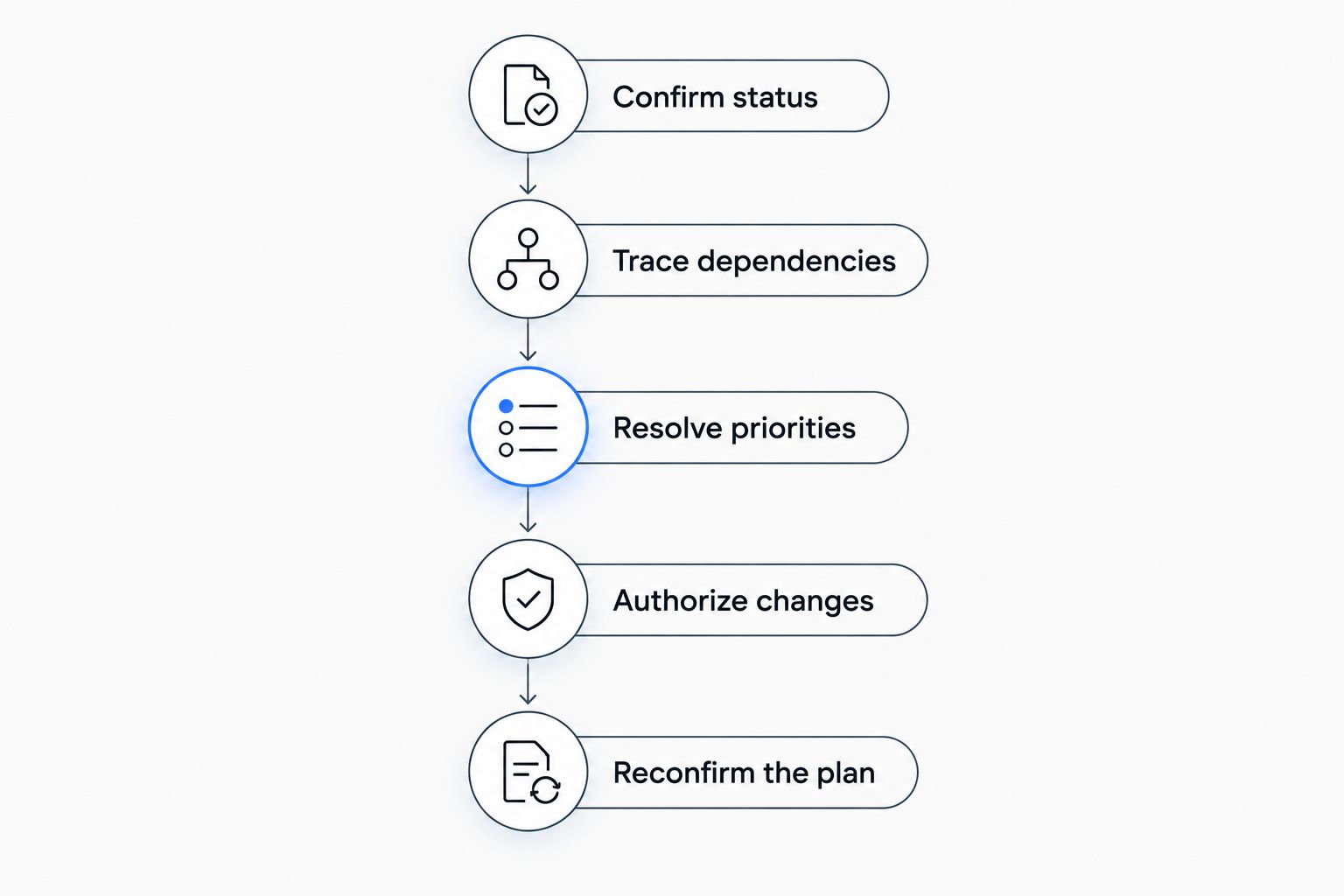
Use the following sequence when evaluating a prospective membership. These are questions to resolve with the provider, not assumed features of any particular service.
- Confirm status. Distinguish an invitation, a requested appointment, a provisional time and a confirmed commitment. Record who supplied the information and who can confirm a revision.
- Trace dependencies. Identify the transport, residence arrangements, companions and onward commitments attached to that appointment. A change is incomplete until those dependencies have been reviewed.
- Resolve priorities. Decide what remains fixed and what can move. The member or an authorized representative should settle competing commitments rather than leave the provider to infer personal priorities.
- Authorize changes. Establish which adjustments require your approval and who can give it when you are unavailable. Separate permission to investigate an alternative from permission to commit to it.
- Reconfirm the plan. Confirm the revised appointment and the arrangements affected by it. Make clear which parts are settled and which still await a response.
This sequence gives you a practical test during membership discussions: ask the provider to explain how a revised appointment would move through the process. Listen for clear responsibilities, not assurances that everything will be handled.
Which private concierge membership scope fits fashion week travel?
Compare the proposed relationship, not the length of a service list. For your 2026 assessment, ask whether membership is intended to coordinate a defined fashion week itinerary or support your wider pattern of global travel.
The table below compares scopes you can discuss with a prospective provider. It does not assign features to a named membership.
| Membership scope under consideration | Best for | Practical benefit | Limitation to examine |
|---|---|---|---|
| Membership focused on a defined event period | Individuals whose coordination needs center on a specific calendar | A clearly bounded brief around that itinerary | Clarify who handles changes affecting travel outside the agreed period |
| Ongoing private concierge membership | Globally mobile individuals with connected needs across trips | A continuing relationship across travel, aviation, residences and access | Requires clear standing preferences, authority and communication boundaries |
Neither scope resolves unclear priorities. An ongoing relationship still needs an accurate brief, while a defined event brief still needs explicit responsibility for connected arrangements.
Choose the membership scope that matches your recurring needs. If fashion week is the only occasion on which you want assistance, explain that directly. If it sits within a continuing pattern of international commitments, assess the relationship beyond the event itself.
What should remain fixed when appointments move?
Your itinerary needs a hierarchy. Without one, a provider cannot know whether a revised appointment should displace a personal commitment, shorten time at a residence or trigger a review of onward travel.
Separate the calendar into commitments that require your approval to change and arrangements that can be adjusted within agreed instructions. The distinction should reflect your priorities, not the apparent prominence of an invitation.
A useful brief addresses:
- Essential commitments: Identify the appointments you do not want displaced without explicit approval.
- Flexible commitments: Explain which activities can move or be removed if the calendar tightens.
- Personal boundaries: State which private time and companion arrangements must remain protected.
- Departure constraints: Identify onward commitments that govern when you must leave.
- Decision authority: Name the person authorized to resolve conflicts when you cannot respond.
Keep explanations concise but specific. Saying that an appointment is important does not tell a coordinator whether it takes precedence over departure; identifying the priority does.
Revisit this hierarchy when the purpose of the trip changes. A calendar built around professional appointments requires different instructions from one centered on personal attendance, even when the destinations overlap.
Why fashion week coordination requirements vary
The relevant question is not how crowded your diary looks. It is how many arrangements depend on each commitment and who has authority to change them.
For a 2026 membership discussion, explain the following factors rather than submitting a calendar without context:
- Appointment certainty: A provisional time needs different treatment from a host-confirmed appointment. State what remains unresolved.
- Geographic spread: Appointments at different locations require a review of the transitions between them, not just the start times.
- Travel connections: Explain where the fashion week calendar intersects with commercial travel, private aviation or onward commitments.
- Companion requirements: Identify shared movements and separate plans so that an individual change does not silently alter everyone’s itinerary.
- Authority boundaries: Specify which decisions belong to you, an assistant, a family office or another authorized representative.
- Information sensitivity: Agree which details each provider needs and which should remain restricted to the relevant participants.
These factors describe the brief a membership must address. They do not establish a spending threshold, eligibility requirement or promise of acceptance.
How should appointment changes reach the right people?
Agree where the current plan lives and who is responsible for confirming revisions. A message announcing a new time is not evidence that every affected arrangement has changed.
Ask the prospective provider how it distinguishes a proposed revision from an approved one. Also ask how your assistant, companions and relevant providers would know which version to follow, within the agreed service scope.
For each revision, the working record should make the following clear:
- What changed and who confirmed it.
- Which connected arrangements require review.
- Whether your approval is still needed.
- Who needs the revised information.
- What remains unresolved.
Keep uncertainty visible. If an appointment has moved but a related arrangement remains unconfirmed, the itinerary should not present the whole sequence as settled.
Information should also be relevant to its recipient. A transport provider needs movement instructions; that does not make the provider an appropriate recipient for your full appointment calendar or private correspondence.
Does concierge coordination include fashion week access?
Coordination and admission are separate matters. An itinerary can contain a requested appearance or proposed appointment without establishing that you are entitled to attend.
Before relying on an item in the calendar, establish who controls admission, whether your attendance has been confirmed and what conditions apply. Ask separately about companions, identification requirements and changes to the invitation.
A prospective membership discussion should distinguish between coordinating a confirmed attendance arrangement and pursuing a request. Do not treat those descriptions as interchangeable, and do not interpret general access language as confirmation for a particular event.
For your 2026 plans, preserve the original confirmation alongside the working itinerary. A calendar entry summarizes an arrangement; it does not replace the host’s instructions.
What happens when an appointment conflicts with onward travel?
A conflict with onward travel requires a decision about the whole itinerary, not an automatic adjustment to departure. Review the appointment’s priority, the applicable travel conditions and the commitments that follow your arrival.
Ask the provider to explain the available alternatives and any unresolved consequences before you authorize a change. A later departure is not a complete answer if it leaves residence arrangements, companions or the next destination’s schedule unaddressed.
Your standing brief should identify who can make that decision when you are occupied. It should also distinguish an instruction to investigate alternatives from authorization to proceed with one.
What should you ask before applying for membership?
Use a specific scenario from your own travel pattern without sharing unnecessary private information. Explain a revised appointment, an onward departure and a companion with separate plans, then ask how the proposed scope would address the dependencies.
A focused membership conversation should cover:
- Service boundaries: Which parts of the itinerary fall within the proposed relationship, and which remain with you or another provider?
- Working relationships: How would coordination interact with your existing assistant, family office or other authorized representative?
- Change authority: What instructions are needed before the provider can act on a revision?
- Confirmation standards: How are requests, provisional arrangements and confirmed commitments distinguished?
- Discretion: What information is needed, who receives it and how are your communication preferences recorded?
- Continuity: How does the proposed relationship address travel before and after fashion week?
Assess the answers against your actual needs. A detailed description of access does not answer a question about change authority, and a broad service list does not define responsibility for a particular handoff.
When is ongoing membership the wrong fit?
An ongoing membership is the wrong scope to pursue when your stated need is an isolated request and you do not want a continuing relationship. It is also the wrong basis for proceeding if you expect guaranteed admission or assume that submitting an application establishes acceptance.
The benefit of continuous coordination is relevance across connected arrangements. Its corresponding requirement is a clear relationship: your preferences, priorities, representatives and approval boundaries need to be understood.
There is a privacy consideration as well. Coordinating a connected itinerary requires sharing relevant information; agree the limits before providing sensitive details. Discretion should be discussed through concrete information requirements, not treated as a substitute for them.
Apply on the basis of recurring coordination needs, not a single desired invitation. That gives both parties a clearer basis for assessing membership fit without implying an unconfirmed threshold or outcome.
FAQ
What does a fashion week travel concierge coordinate?
A fashion week travel concierge coordinates the relationship between appointments and connected travel arrangements within the agreed service scope. Clarify responsibility for transport, aviation, residences, companions and onward commitments before relying on the itinerary.
Is ongoing private concierge membership suitable for fashion week travel?
Ongoing private concierge membership fits individuals whose fashion week travel forms part of a continuing pattern of connected travel needs. An isolated request is a different brief and should be described as such during membership discussions.
Can a concierge guarantee admission to fashion week events?
Concierge coordination does not itself establish admission to an event. Confirm attendance and applicable conditions with the relevant host rather than relying on a requested appointment or calendar entry.
What should I do when a fashion week appointment changes?
Confirm the revised appointment, identify the arrangements it affects and obtain any required approvals. Treat connected transport and onward plans as unresolved until their status has been checked.
Can my assistant remain involved in concierge coordination?
Your assistant’s role should be agreed as part of the membership scope and authorization process. Specify who can approve changes, who receives updates and which decisions remain with you.
What should I prepare for a fashion week concierge discussion in 2026?
Prepare your travel pattern, appointment priorities, existing support relationships and approval boundaries for a 2026 membership discussion. Describe recurring coordination needs without assuming a spending threshold, guaranteed access or automatic acceptance.
Who is JetVoy private concierge membership for?
JetVoy private concierge membership serves high-net-worth individuals, family offices and corporate executives seeking coordination across global travel, private aviation, exceptional residences and exclusive access. Assess fit around an ongoing relationship rather than a one-off request.
One last thing
Mark unresolved items as unresolved. A provisional appointment displayed like a confirmed commitment creates ambiguity precisely where your itinerary needs precision.
Before your 2026 fashion week departure, review the calendar for status rather than appearance. Ask what is confirmed, what depends on another decision and who owns the next action. That review gives you a more useful planning document than a full diary with unclear commitments.